The new digital era has shown remarkable advancements in every domain, like AI and machine learning, analytics, or data science. Cloud computing and DevOps are also among the fastest-growing domains, driven by rapid growth in cloud developer roles. Organizations are relying more on cloud infrastructure and automated software delivery today to build scalable, secure, and reliable applications. This increase in demand has created one very important question for students trying to enter the cloud computing domain: cloud vs DevOps- which domain should they opt for to have a fruitful, long career in the cloud computing domain? Many learners struggle to understand the difference between Cloud and DevOps. As both domains work together in today’s software development lifecycle, many students mistake them for the same career path. In reality, both of them are quite different and fulfil different purposes within an organization’s technology ecosystem. In this comprehensive Cloud vs DevOps guide, we will explain every key difference, required skills and tools, career opportunities, and future scope so you, as a student, will know exactly which path to take. Having a good understanding of cloud computing vs DevOps will be enough for you to stay prepared and choose the career path that aligns with your interests and long-term goals.
Understanding Cloud Computing
Cloud Computing has revolutionized the way businesses create, deploy and manage applications through computing power available via the Internet. Cloud Computing helps businesses scale up, reducing infrastructure costs and availing robust services. Cloud Computing is one of the most desirable skills in the current technology sector.
What is Cloud Computing?
Cloud Computing, in simple terms, is basically the delivery of on-demand computing services through the internet instead of relying on physical infrastructure. Scalable resources like servers, storage, database, networking, and security are made available, which enables companies to develop applications in an efficient manner by only paying for what they need. Understanding Cloud Computing is the first step for anyone comparing Cloud vs DevOps or planning a career as a Cloud Engineer vs DevOps Engineer.
Why Cloud Computing Matters
Cloud Computing has emerged as the foundation of digital transformation as it allows businesses to create scalable, safe, and economical applications. All companies from different sectors are using cloud computing to increase their productivity, save on infrastructure costs, and innovate fast. The increasing job prospects for cloud computing specialists have provided them with great career options and lucrative cloud salaries.
Major Cloud Platforms
There are many organizations are shifting to leading cloud platforms to build and manage modern applications. Some of them include:
- Amazon Web Services (AWS): It is the world’s most used cloud platform offering compute, storage, networking, databases, and security services.
- Microsoft Azure: Popular enterprise-level cloud platform known for hybrid cloud and analytics.
- Google Cloud Platform (GCP): Mainly adopted for AI, machine learning, Kubernetes, and big data analytics.
Also read: Certifications required for cloud careers
Understanding DevOps
After having a good understanding of Cloud Computing, the next step towards comparing Cloud and DevOps is to understand what DevOps entails. While Cloud is all about infrastructure and computing resources, DevOps is centred on software delivery and automation. Understanding both domains helps students clearly identify the difference between Cloud and DevOps and choose the right DevOps career or Cloud career.
What is DevOps?
DevOps refers to a number of practices aimed at automating processes between software developers and IT departments in order to collaborate and deliver software in a fast and reliable manner. Automation, CI, CD, monitoring, and collaboration form the basis of DevOps. In contrast to Cloud Computing vs DevOps, DevOps is mainly about optimizing the software development process rather than running a cloud environment.
Why DevOps Matters
The concept of DevOps allows businesses to quickly develop software without sacrificing its quality and reliability. Due to automation and constant monitoring, firms will not make many errors while deploying software, cooperate well, experience less downtime, and serve customers faster. Given that more companies begin implementing innovative approaches in their software development process, there is a great need for specialists having good DevOps skills, and therefore careers in DevOps are rapidly growing in the IT industry.
Core DevOps Workflow
A typical DevOps workflow is a continuous cycle to ensure fast and more reliable software delivery.
- Code: Developers write and manage application code using version control systems like Git.
- Build: The application is automatically compiled and packaged using CI tools such as Jenkins.
- Test: Automated testing identifies bugs and verifies code quality before deployment.
- Deploy: The application is released to cloud or production environments using automated deployment pipelines.
- Monitor: Teams continuously monitor application performance, security, and system health to ensure smooth operation and quickly resolve issues.
Automated workflow is one of the most important distinctions when we talk about Cloud vs DevOps. The cloud provides the infrastructure, while DevOps takes care of building, testing, deploying, and maintaining software in that infrastructure.
Cloud vs DevOps: Key Differences
Understanding the Cloud vs DevOps debate is essential for students planning a career in modern IT. Although Cloud Computing and DevOps often work together, they solve different business problems. Cloud Computing provides scalable infrastructure, storage, networking, and computing resources over the internet, while DevOps focuses on automating software development, testing, deployment, and monitoring. Knowing the difference between Cloud and DevOps helps students choose the right learning path, understand employer expectations, and build a successful cloud career or DevOps career. The following comparison explains Cloud Computing vs DevOps across objectives, skills, tools, responsibilities, and career opportunities.
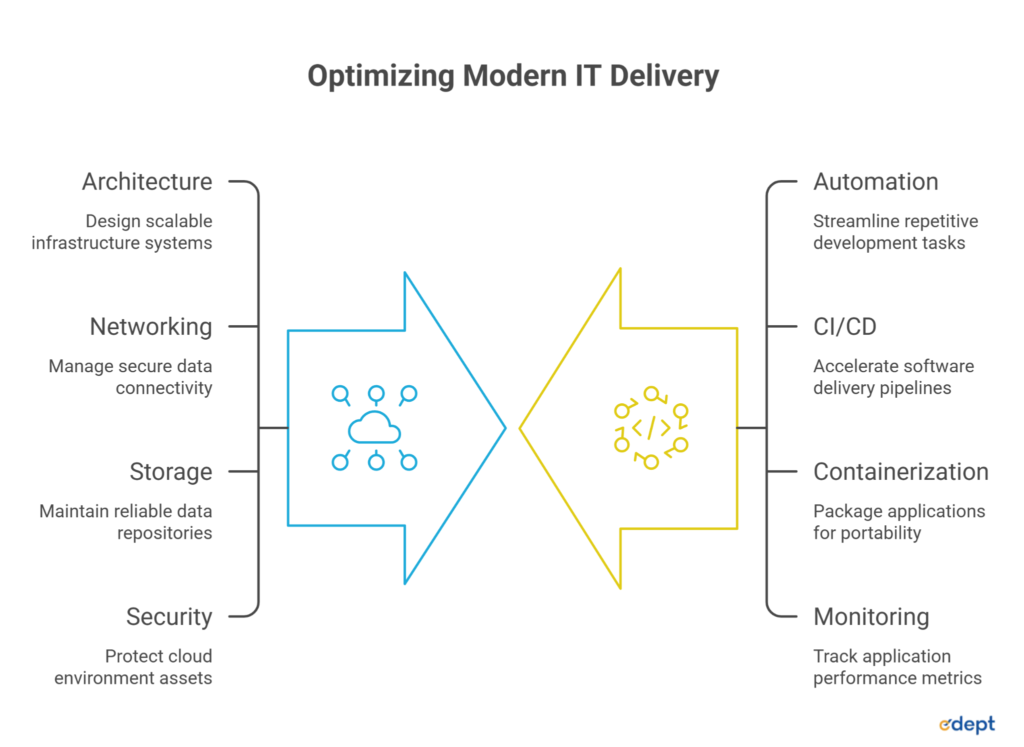
Cloud vs DevOps Comparison Table
| Factor | Cloud Computing | DevOps |
| Primary Focus | Infrastructure and cloud services | Software delivery and automation |
| Goal | Provide scalable computing resources | Deliver software faster and more reliably |
| Core Area | Cloud platforms and infrastructure | CI/CD, automation, and collaboration |
| Major Skills | Cloud architecture, networking, security, infrastructure management | CI/CD, automation, containers, monitoring |
| Popular Tools | AWS, Microsoft Azure, Google Cloud | Jenkins, Docker, Kubernetes, Terraform |
| Career Roles | Cloud Engineer → Cloud Architect → Cloud Consultant | DevOps Engineer → Senior DevOps Engineer → Platform Engineer |
Difference in Core Objective
The biggest difference between Cloud and DevOps lies in their primary objective. Cloud Computing aims at providing infrastructure reliably and securely through the internet. Cloud engineers make sure that the servers, virtual machines, databases, storage, networking, and security services remain up all the time as and when needed by the organizations. Their main focus lies on infrastructure availability, scalability, and performance. The DevOps team, however, concentrates on the process of delivering software applications. Rather than dealing with the infrastructure alone, they automate the whole process of software delivery via CI, CD, testing, monitoring, and collaboration between development and operations departments. When we compare Cloud vs DevOps answers, Cloud says “Where will the application run?” while DevOps answers “How will the application be built, tested, deployed, and maintained?”
Difference in Skills
Infrastructure is a key aspect of success for Cloud jobs. Cloud architects must know cloud architecture, virtualization, networking, identity management, security, storage, backup mechanisms, and costs. Knowledge about Infrastructure as Code (IaC) and native cloud technologies will give an advantage. Strong DevOps skills enable organizations to automate repetitive tasks and deliver software more efficiently. Cloud Skills:
- Cloud Architecture
- Virtual Machines
- Networking
- Cloud Security
- Identity & Access Management (IAM)
- Infrastructure Management
- Storage and Backup
DevOps Skills:
- Automation
- CI/CD Pipelines
- Docker
- Kubernetes
- Terraform
- Linux Administration
- Shell & Python Scripting
Difference in Tools
Another important aspect of Cloud vs DevOps is the tech stack used in each domain. Cloud practitioners work mainly with cloud service providers who provide infrastructure, networking, storage, databases, artificial intelligence services, and security services. The commonest cloud technologies include Amazon Web Services (AWS), Microsoft Azure, and Google Cloud Platform (GCP). DevOps engineers work with automation and deployment tools that automate software delivery. Some of the common automation and deployment tools include Jenkins, Docker, Kubernetes, and Terraform. Common monitoring tools include Prometheus and Grafana. Popular Cloud Tools include:
- Amazon Web Services (AWS)
- Microsoft Azure
- Google Cloud Platform (GCP)
Popular DevOps Tools include:
- Jenkins
- Docker
- Kubernetes
- Terraform
- Git
- Ansible
- Proemtheus
- Grafana
One common misconception in the Cloud vs DevOps discussion is that these tools compete with each other. In reality, they complement one another.
Differences in Daily Responsibilities
Cloud experts spend most of their time designing cloud architecture, creating VMs, setting up networks, working on storage solutions, cloud cost optimization, securing cloud environments according to best practices, and scaling applications. Success for cloud professionals is determined by reliable, secure, and efficient infrastructure. DevOps experts are dedicated to efficient software delivery and operation. They create CI/CD pipelines, automate the deployment process of applications, test their applications, monitor them, and address issues that occur during deployment. Their main goal is speeding up the software release process. For students who are going to choose between Cloud vs DevOps, the entire decision boils down to your interests. If you enjoy working on networking and infrastructure, a Cloud career might be the best for you, while if you prefer working on automation, scripting, and software delivery, a DevOps career might be more rewarding for you.
Career Opportunities in Cloud Computing
There is an increased demand for cloud experts due to the rising adoption of cloud technology and AI by businesses and the implementation of digital transformation. There are various types of cloud computing career paths, including managing cloud infrastructure, cloud security, and enterprise consulting, among others, offering high-paying jobs with good prospects in the future. As per reports from Gartner, global public cloud services spending will cross $1 trillion by 2027.
Cloud Engineer
The Cloud Engineer is involved in developing, deploying, and managing cloud infrastructure on such platforms as Amazon Web Services (AWS), Microsoft Azure, Google Cloud, etc. He manages virtual machines, networking, storage, monitoring, cloud security, and guarantees that applications stay scalable, reliable, and cost-effective. It is considered to be one of the most popular career tracks for students choosing cloud computing jobs.
Cloud Architect
The Cloud Architect creates enterprise cloud solutions in accordance with the company’s goals. He chooses appropriate cloud services, provides secure and scalable architecture, implements cloud migrations, and makes sure there is high availability of complex systems. A Cloud specialist should have great skills in cloud platforms, networking, security, and solution design.
Cloud Security Engineer
The Cloud Security Engineer is responsible for providing cloud environments with adequate levels of protection through the implementation of IAM, encryption, threat detection, compliance rules, and security monitoring. With the increasing number of companies shifting their workloads to the cloud, the need for specialists in cloud security grows higher and higher.
Cloud Consultant
The Cloud Consultant is responsible for consulting companies on how to use their cloud infrastructure effectively. He analyzes business needs and offers the necessary cloud strategy for clients, implements migration projects, optimizes cloud expenditures, etc. Industry Insight (2026 & Beyond): Gartner forecasts that public cloud services spending will continue its rapid growth, exceeding $1 trillion by 2027, while AI-driven cloud adoption is expected to further increase demand for Cloud Engineers, Cloud Architects, Cloud Security Engineers, and Cloud Consultants in the coming years.
Career Opportunities in DevOps
In today’s world, organizations are becoming more and more dependent on automation, cloud-native applications, and the continuous delivery of software. There is a very high demand for professionals who can perform well in DevOps roles to enhance the quality of the software, its deployment, and efficiency. As per Gartner, by 2027, 90% of organizations will be implementing platform engineering to help with DevOps and software delivery.
DevOps Engineer
A DevOps Engineer automates software development, testing, deployment, and infrastructure management using CI/CD pipelines and cloud technologies. It is one of the most in-demand roles for professionals starting a DevOps career.
Site Reliability Engineer (SRE)
Site Reliability Engineers (SREs) keep applications highly available, scalable, and reliable by merging operations and software engineering for better performance and reduced downtime.
Platform Engineer
The Platform Engineers create and manage the platforms used internally by developers to streamline the process of building and managing infrastructure, which allows development teams to release software products more quickly.
Automation Engineer
The Automation Engineers write scripts and tools that remove redundant activities from IT operations and development, making the development process easier and faster. Industry Insight (2026 & Beyond): Gartner predicts that by 2027, more than 90% of organizations will adopt platform engineering to enhance DevOps practices, driving continued demand for DevOps Engineers, SREs, Platform Engineers, and Automation Engineers.
Skills Students Need for Cloud Careers
To have a successful cloud career, you as a student require a combination of good technical knowledge and hands-on practice. Beginners should focus more on mastering core cloud concepts before they progress to advanced services and certifications.
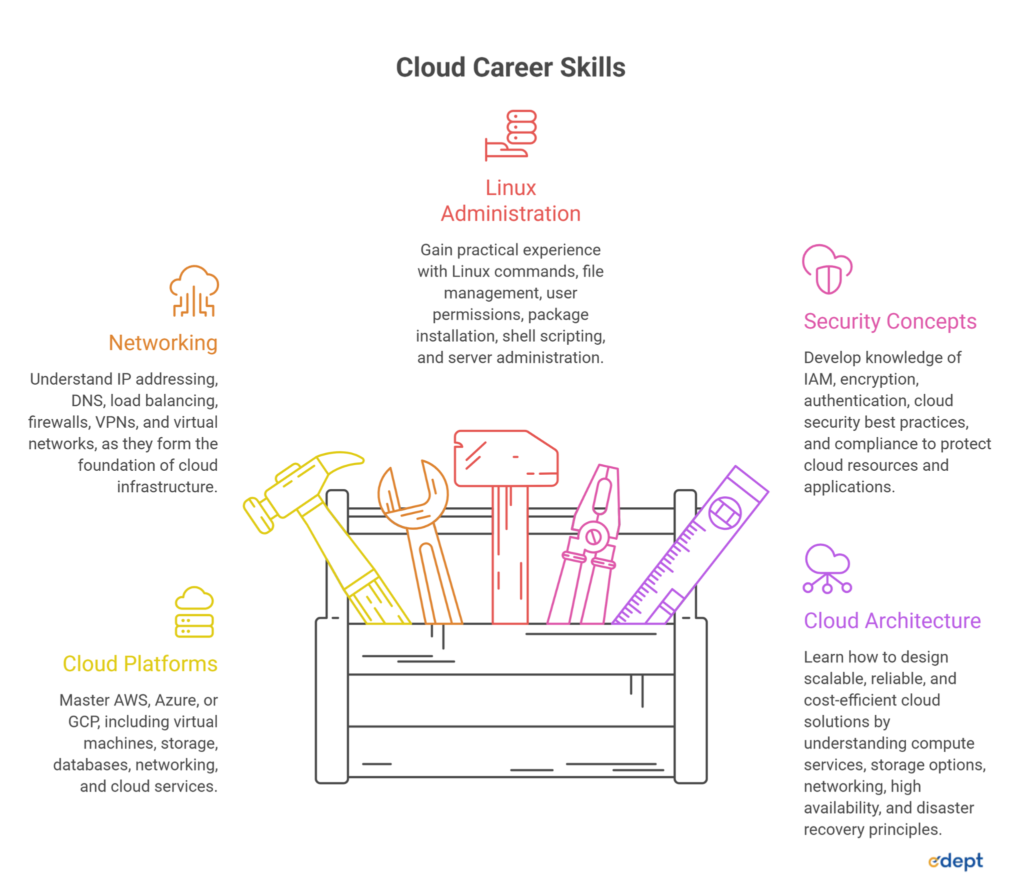
Cloud Platforms
Learn the fundamentals of AWS, Microsoft Azure, or Google Cloud Platform (GCP), including virtual machines, storage, databases, networking, and cloud services.
Networking
Understand essential networking concepts such as IP addressing, DNS, load balancing, firewalls, VPNs, and virtual networks, as they form the foundation of cloud infrastructure.
Linux Administration
Gain practical experience with Linux commands, file management, user permissions, package installation, shell scripting, and server administration, since most cloud environments run on Linux.
Security Concepts
Develop knowledge of Identity and Access Management (IAM), encryption, authentication, cloud security best practices, and compliance to protect cloud resources and applications.
Cloud Architecture
Learn how to design scalable, reliable, and cost-efficient cloud solutions by understanding compute services, storage options, networking, high availability, and disaster recovery principles. Read more: Ultimate Guide to Cloud Platforms
Skills Students Need for DevOps Careers
The DevOps profession is one that needs experience in operating systems, automation, and software deployment procedures. In order to be proficient in DevOps practice, students need to emphasize practical learning of these skills.
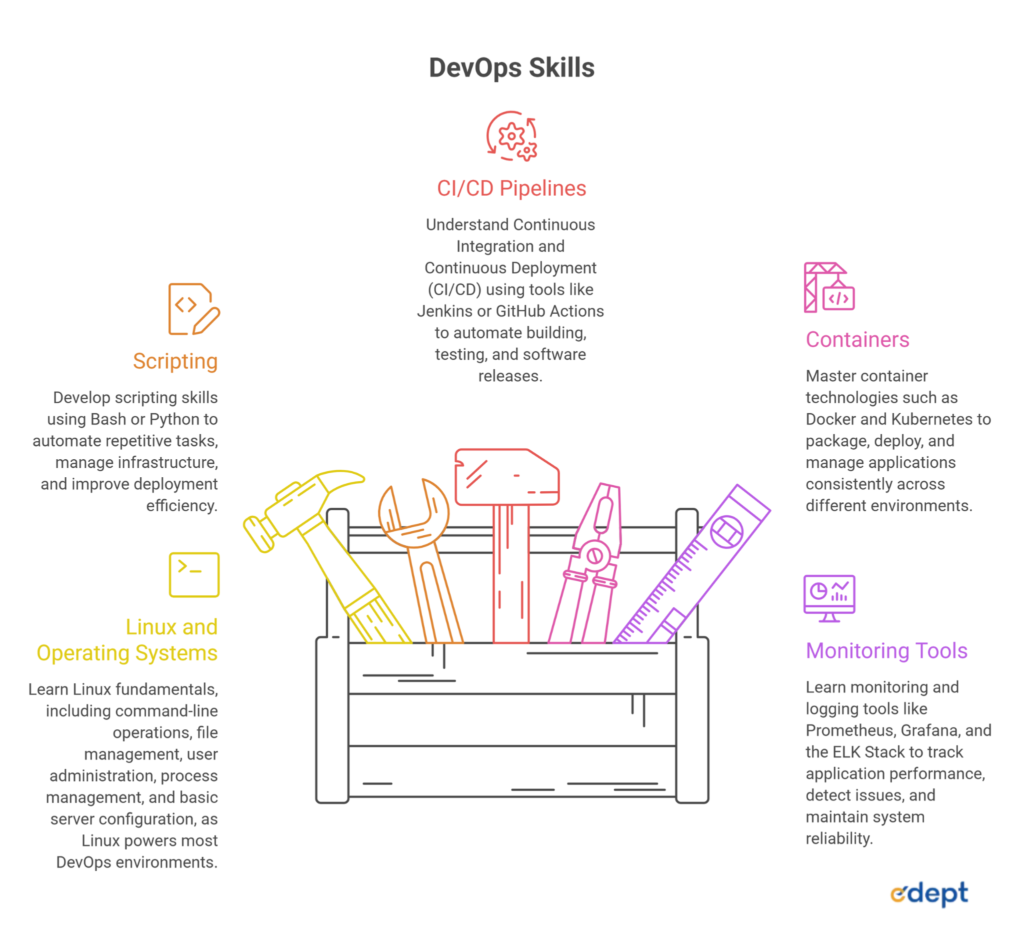
Linux and Operating Systems
Learn Linux fundamentals, including command-line operations, file management, user administration, process management, and basic server configuration, as Linux powers most DevOps environments.
Scripting
Develop scripting skills using Bash or Python to automate repetitive tasks, manage infrastructure, and improve deployment efficiency.
CI/CD Pipelines
Understand Continuous Integration and Continuous Deployment (CI/CD) using tools like Jenkins or GitHub Actions to automate building, testing, and software releases.
Containers
Master container technologies such as Docker and Kubernetes to package, deploy, and manage applications consistently across different environments.
Monitoring Tools
Learn monitoring and logging tools like Prometheus, Grafana, and the ELK Stack to track application performance, detect issues, and maintain system reliability.
Salary Comparison: Cloud vs DevOps
Both Cloud Computing and DevOps offer highly competitive salaries due to increasing demand for cloud infrastructure, automation, and digital transformation. While cloud salary and DevOps salary vary based on experience, location, certifications, and technical expertise, both domains provide excellent long-term earning potential in India and global markets.
| Experience | Cloud Salary (India) | DevOps Salary (India) | Cloud Salary (Global) | DevOps Salary (Global) |
| Entry Level (0–2 Years) | ₹5–10 LPA | ₹6–12 LPA | $80,000–110,000/year | $85,000–115,000/year |
| Mid-Level (3–6 Years) | ₹10–20 LPA | ₹12–22 LPA | $110,000–140,000/year | $120,000–150,000/year |
| Senior Level (7+ Years) | ₹20–40+ LPA | ₹25–45+ LPA | $140,000–200,000+/year | $150,000–210,000+/year |
With more companies investing in the use of cloud, AI, and automation technologies, there will be an increased need for Cloud and DevOps professionals until at least 2026. Individuals who are experienced in both of these specialties tend to have greater earning potential and occupy leadership and architect positions.
Which field is Easier for Beginners in between Cloud vs DevOps?
Both Cloud Computing and DevOps are excellent career paths, but their learning curves differ. When comparing Cloud vs DevOps, Cloud Computing is generally easier for beginners because it focuses on understanding cloud services and infrastructure, whereas DevOps requires knowledge of development, operations, and automation.
Cloud Learning Curve
Cloud Computing has an incremental way of learning. Novice learners can begin with cloud basics, virtual machines, storage, networking, and services on cloud computing platforms such as AWS, Azure, or Google Cloud before advancing into architecture and security. It is the ideal platform for kicking off a career in cloud computing.
DevOps Learning Curve
DevOps has a relatively harder learning curve since it incorporates Linux, scripting, CI/CD pipelines, containers, cloud platforms, and monitoring tools. Proficiency in DevOps is attained via practical knowledge of various technologies and skills development through continuous use.
Which is More Beginner-Friendly?
For most students, Cloud Computing is the better starting point due to its structured learning path and easier concepts. However, students interested in automation, software delivery, and infrastructure management can gradually transition into a DevOps career after gaining cloud and Linux fundamentals. Learning both domains ultimately provides the strongest career advantage.
Cloud vs DevOps: Which Has Better Future Scope?
The future of Cloud vs DevOps does not involve picking one or the other because there lies an understanding of the way the two are related. With companies embracing digital transformation at a faster pace than ever before, there will be increasing opportunities for both cloud and DevOps.
Cloud Adoption is Growing
Today, businesses in various domains are moving their applications and data into cloud platforms like AWS, Microsoft Azure, and Google Cloud. As a consequence of such trends, the job roles of Cloud Engineer, Cloud Architect, and Cloud Security Specialists have become highly popular around the world.
DevOps Demand is Rising
Companies are investing millions of dollars in DevOps technologies that help automate the process of software development and deployment. Thus, individuals with good skills in DevOps have great chances to build successful careers in the field of DevOps.
Hybrid Cloud and Automation Are Expanding
Today’s organizations adopt hybrid and multi-cloud architecture while automating their infrastructures via DevOps methodologies. As a result, there is a rising need for people who can work on cloud platforms, along with CI/CD, containers, IaC, and monitoring solutions.
Cloud + DevOps Skills Offer Maximum Career Advantage
Thus, instead of opting between Cloud Computing vs DevOps, it would be more beneficial for college students to learn both fields. It will give them a chance to land high-paying jobs.
Common Mistakes Students Make While Choosing Between Cloud vs DevOps
Students often get confused and compare Cloud vs DevOps based on trends rather than the job responsibilities and skills. It will be helpful for your future career choice to avoid these frequent mistakes.
Following Salary Trends Only
Choosing cloud careers or DevOps careers only because of the high salary rates is a mistake that will bring you dissatisfaction. Analyze your interests and long-term career aspirations first.
Ignoring Skill Requirements
The skill set of Cloud Computing consists of infrastructure, network, and cloud services, while the DevOps skill set is automation, CI/CD, scripting, and monitoring. The difference should be clear to you before choosing a specialization.
Choosing Without Practical Exposure
Many students do not test any technologies when deciding Cloud Computing vs DevOps. Create small projects and try different cloud platforms to find out what specialization is more suitable for you.
Avoiding Hands-On Learning
Just reading documentation about these technologies is not enough. Potential employers expect you to have experience working with AWS, Azure, Docker, Kubernetes, Jenkins, and Linux.
Why Learning Both Cloud and DevOps Creates Stronger Career Opportunities
In today’s technology landscape, Cloud vs DevOps is no longer about choosing one over the other. Today, companies demand that professionals possess knowledge about cloud infrastructure as well as DevOps. Having skills in both areas will enhance job prospects, increase earning capabilities, and prepare students for future careers in technology.
Employers Prefer Multi-Skilled Professionals
There is high demand for professionals capable of managing cloud infrastructure and, at the same time, automating software deployment processes. It is important to have skills in Cloud Computing and DevOps because such an ability will make one more flexible when getting hired.
Cloud Infrastructure Needs Automation
Automation of the cloud environment can be done by using tools such as Terraform, Jenkins, Docker, Kubernetes, etc. When a person knows about clouds and can work with DevOps, then he or she will be able to deploy and scale up and down much more easily and also with lower operational costs.
DevOps Relies on Cloud Platforms
Nowadays, DevOps processes are developed on cloud technologies such as AWS, Microsoft Azure, and Google Cloud. In order to develop pipelines, deploy applications, and work with the cloud-based environment, it is necessary to know the services of clouds.
Hybrid Skills Improve Employability
Students who master both Cloud Computing and DevOps are well-positioned for roles such as Cloud DevOps Engineer, Platform Engineer, Site Reliability Engineer (SRE), and Cloud Solutions Architect. These hybrid skills increase employability, open doors to higher-paying roles, and provide stronger long-term career growth in the evolving IT industry.
Why Choose edept for Cloud and DevOps Career Preparation
Success in Cloud Computing or DevOps is not just about having theoretical knowledge. Students enrolled at edept benefit from industry-relevant training, practical experience, global industry certifications, and project exposure to prepare for their careers. The company’s partnerships with top firms and its focus on learning for your career benefit make it possible for you to develop valuable skills.
Industry-Aligned Programs
The edept program features university and industry partnership-driven undergraduate and certification courses tailored to suit the needs of students in line with the demands of Cloud Computing and DevOps professionals. The course content will revolve around emerging technologies that are sought after in the industry.
Practical Labs and Projects
Students work on live industry projects, cloud deployment exercises, and hands-on labs that simulate real business scenarios. This practical learning approach helps build problem-solving skills and a portfolio that strengthens internship and placement opportunities.
Hands-On Exposure to Cloud and DevOps Tools
edept provides practical experience with industry-standard technologies, including AWS, Microsoft Azure, Google Cloud, Docker, Kubernetes, Python, SQL, cloud networking, and automation tools. Students also gain access to Deloitte Learning Academy content, IBM-guided live projects, and globally recognized certifications.
Career-Focused Learning
Employability is one of the focuses in the learning process due to various activities like mentoring, industrial interactions, soft skills development, resume writing, mock interviews, webinars, and workshops.
Placement-Oriented Approach
Through edept, students have access to internships, job placements, industrial immersions globally, and access to a recruitment network that consists of over 300 companies. This allows students to get industry exposure and start their career in Cloud Computing and DevOps confidently.
Step-by-Step Roadmap for Students
Whether you choose Cloud Computing or DevOps, following a structured roadmap will help you build the right technical skills and become job-ready. You need to begin by learning the basics and move to other levels from there.
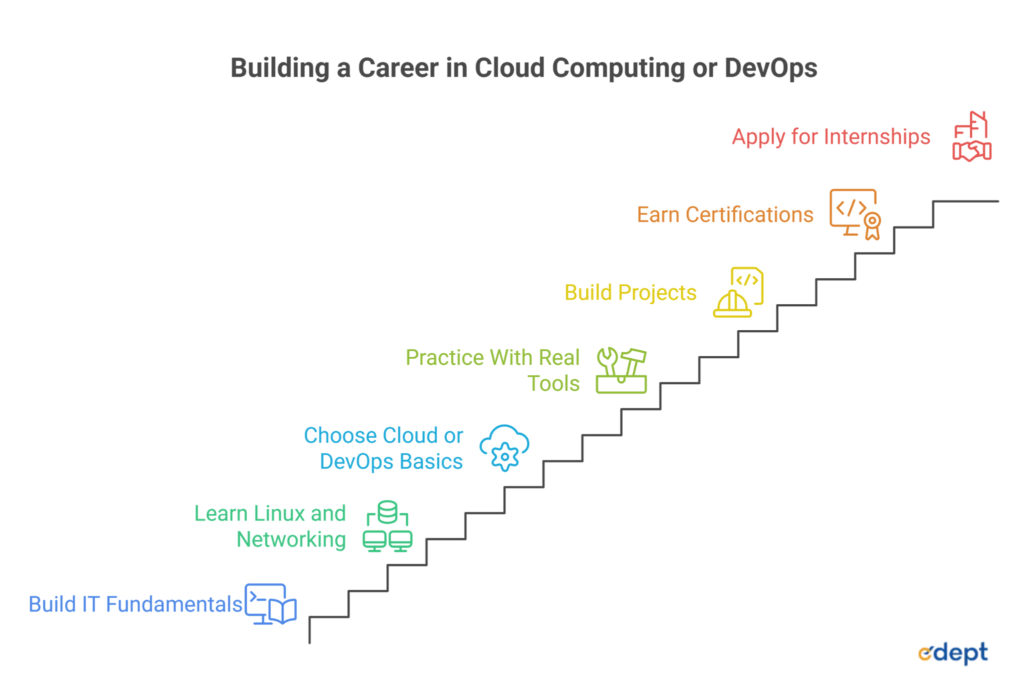
Build IT Fundamentals
Develop a strong foundation in computer science, operating systems, networking, databases, and basic programming using languages like Python or Java.
Learn Linux and Networking
Master Linux commands, networking concepts, IP addressing, DNS, firewalls, and server administration, as these are essential for both Cloud and DevOps careers.
Choose Cloud or DevOps Basics
Begin with cloud platforms such as AWS, Microsoft Azure, or Google Cloud, or learn DevOps fundamentals including CI/CD, Infrastructure as Code, and automation.
Practice With Real Tools
Gain practical experience using Docker, Kubernetes, Jenkins, Git, Terraform, Ansible, and cloud management services through hands-on labs.
Build Projects
Create cloud deployments, CI/CD pipelines, containerized applications, or infrastructure automation projects to showcase your practical skills.
Earn Certifications
Validate your expertise with certifications such as AWS Certified Cloud Practitioner, Microsoft Azure Fundamentals (AZ-900), Google Associate Cloud Engineer, or Docker and Kubernetes certifications.
Apply for Internships
Build a strong resume, contribute to GitHub projects, participate in hackathons, and apply for internships to gain industry experience and improve your employability.
Future Outlook Beyond 2026
The future of Cloud Computing and DevOps remains exceptionally strong as organizations continue investing in digital transformation, artificial intelligence, and cloud-native technologies. Students who develop expertise in both domains will be well-positioned to take advantage of emerging career opportunities across industries.
Multi-Cloud Growth
Multi-cloud deployment of cloud services that involves using AWS, Microsoft Azure, and Google Cloud is increasing among businesses, thereby leading to flexibility and business continuity. Multi-cloud is set to generate demand for cloud professionals in the coming years.
Platform Engineering Expansion
Platform Engineering is one of the key technologies that enables development teams to develop and manage applications in a better way.
Automatic-Driven Infrastructure
Cloud environment management is changing through Infrastructure as Code, CI/CD pipelines, and intelligent automation. Automation experts will continue to be in great demand in the next few years.
AI in Cloud Operations
AI is revolutionizing cloud management through predictive monitoring, incident detection, resource optimization, and security.
Strong Global Demand
Students who combine Cloud Computing, DevOps, automation, and AI knowledge will enjoy excellent global career opportunities and long-term job security well beyond 2026.
Cloud vs DevOps: Ending the debate
There is no clear winner in the Cloud vs DevOps war since both domains have crucial importance in today’s IT and present good career prospects. Cloud Computing deals with developing scalable infrastructure, cloud platforms, and computing resources, whereas DevOps deals with such aspects as automation, CI/CD, and software deployment. Combining them helps deliver reliable applications. For students, the decision about choosing one path depends on personal preferences and career aspirations. If a student likes infrastructure and cloud technologies, a career in cloud can be the best decision. In the case where automation and software development become appealing, a DevOps career can be more interesting. Nevertheless, mastering both Cloud Computing and DevOps gives a strong competitive edge and enhances employability. Related Links:
| Everything about Digital Transformation | Green Cloud Computing Careers |
| Complete Guide to Cloud Security | Cloud vs DevOps: Which is best for you! |