Cloud engineers focus on designing and managing cloud infrastructure (AWS/Azure/GCP), while DevOps engineers focus on automation, CI/CD pipelines, and streamlining software delivery. Choose Cloud for infrastructure, networking, and architecture. Choose DevOps for coding, automation, and speed. Both offer high salaries and converge, making combined skills highly valuable.
The tech industry is growing fast, and two career paths that consistently top the demand charts are cloud computing and DevOps. If you are a student exploring IT careers, you may have come across both terms, often used together, and wondered: are they the same? Which one should I learn? Which one pays more? This Cloud vs DevOps guide breaks down everything you need to know. By the end, you will have a clear picture of what each field involves, what skills they demand, and how to choose the right path based on your goals.
What Is Cloud Computing and DevOps?
The cloud computing model offers scalable IT infrastructure as a service over the internet, whereas DevOps combines development and operations processes to release applications faster. Combined, they provide a method for automating the deployment process.
What is Cloud Computing?
Cloud computing involves delivering computing services such as servers, storage, databases, networking, software, and analytics through the Internet (cloud). In other words, businesses do not have to own hardware but instead lease computational power from cloud providers such as Amazon Web Services (AWS), Microsoft Azure, and Google Cloud Platform (GCP).
From a technical perspective, cloud computing enables users to build their infrastructure with virtual machines, allowing them to create an entire data centre in minutes by allocating virtual CPUs, memory, storage, and network bandwidth. The Big Data market is forecast to reach USD 273 billion by 2026, while cloud spending in India is projected to exceed USD 17.8 billion by 2027.
What is DevOps?
DevOps is a culture and technical initiative that combines software development (Dev) with information technology operations (Ops). Its purpose is to reduce the development life cycle, increase the rate of deployments, and produce high-quality software products.
In reality, DevOps engineers construct and support pipelines responsible for testing, compiling, and releasing code into production. They use tools such as Docker, Jenkins, Kubernetes, and Terraform to achieve this task. While the cloud provides the underlying infrastructure, DevOps shows how to utilize it effectively.
Why Students Get Confused Between Cloud and DevOps?
Cloud computing and DevOps are inherently linked together, and that’s why the misunderstanding arises. All DevOps operations are carried out using cloud technology, and today’s cloud architecture uses the DevOps methodology. Nevertheless, these fields have their unique set of skills, job positions, and career paths. And this is the point to realize first.
Cloud vs DevOps: Key Differences Explained
Here is a clear comparison across the dimensions that matter most for students:
| Aspect | Cloud Computing | DevOps |
| Core Focus | Infrastructure, storage, and services via cloud platforms | Automating and integrating development and operations workflows |
| Primary Tools | AWS, Azure, Google Cloud Platform | Docker, Jenkins, Kubernetes, Git, Terraform |
| Key Skills | Cloud architecture, networking, storage, security | CI/CD pipelines, scripting, automation, monitoring |
| Learning Style | Platform-oriented (learn to deploy and manage services) | Process-oriented (learn to automate and streamline releases) |
| Typical Roles | Cloud Engineer, Cloud Architect, Solutions Architect | DevOps Engineer, Release Manager, Site Reliability Engineer |
| Entry Salary (India) | ₹5–9 LPA | ₹5–9 LPA |
| Works Best With | DevOps for faster deployments | Cloud for scalable infrastructure |
Core Function
Essentially, cloud computing revolves around infrastructure and services – creating, implementing, and controlling the environment on which applications execute. On the other hand, DevOps focuses on the process itself – from building to releasing and maintaining software.
Skill Requirements
While cloud computing experts primarily focus on the platform, studying the architecture, security, costs, and scalability of various services, DevOps professionals concentrate more on workflows – scripting, pipeline management, automation of repetitive processes, and system reliability.
Learning Approach
In terms of training, learning cloud computing is mainly about the platform. You’ll be spending quite a lot of time within the consoles of AWS, Azure, or Google Cloud Platform, understanding how their services interact with each other. In contrast, learning DevOps is about the workflow.
Skills Required for Cloud vs DevOps Careers
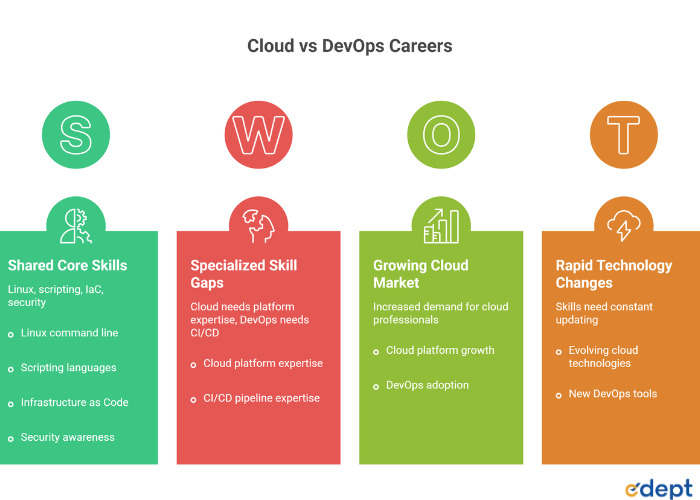
Cloud Engineers work on designing and managing cloud infrastructure such as AWS, Azure, and GCP, whereas DevOps Engineers work on automating CI/CD and making it reliable. Both Cloud Engineers and DevOps Engineers need Linux, scripting languages (Python and Bash), and knowledge about Infrastructure as Code. Below are the skills required for Cloud Computing and DevOps.
Cloud Computing Skills
- Cloud platforms: AWS, Microsoft Azure, Google Cloud Platform
- Cloud computing architecture: building scalable and fault-tolerant architectures
- Networking basics: virtual private cloud, load balancing, DNS, firewall
- Storage and databases: object storage, managed databases, data lakes
- Cloud security: IAM policy, encryption, compliance regulations
- Big data: Hadoop, Spark, and distributed processing frameworks
DevOps Skills
- Continuous integration/continuous deployment (CI/CD): Creating and sustaining CI/CD pipelines
- Containers: Docker, Kubernetes, container management
- Infrastructure as code (IaC): Terraform, Ansible, CloudFormation
- Automation scripts: Bash, Python
- Monitoring and observability tools: Prometheus, Grafana, ELK stack
Common Skills for Both
- Linux command line and system administration
- Git and version control principles
- Basic programming (Python is particularly useful)
- Security awareness: understanding compliance and best practices
Build job-ready cloud & DevOps skills with edept’s industry-focused programs.
Career Opportunities in Cloud vs DevOps
Cloud Engineers build and manage infrastructure, while DevOps Engineers automate delivery and operations. Both are high-demand, high-paying roles, with DevOps often earning more due to automation expertise and faster delivery impact. Here are some of the cloud career and DevOps roles for you to check and clarify.
Cloud Career Roles
Cloud careers span a wide range of specialisations. At the entry level, you can start as a Cloud Support Associate or Junior Cloud Engineer, progressing toward roles like:
- Cloud Engineer (₹5–9 LPA entry)
- Data Engineer (₹5–9 LPA entry)
- Big Data Developer/Engineer (₹5–8 LPA entry)
- Data Analyst (₹3–6 LPA entry)
- Junior Cloud Solutions Architect (₹7–12 LPA entry)
DevOps Career Roles
DevOps roles are equally diverse and are in high demand across product companies, startups, and enterprise IT. Common roles include:
- DevOps Engineer
- Release Manager
- Site Reliability Engineer (SRE)
- Platform Engineer
- Build and Release Engineer
Industry Demand Comparison
According to Burning Glass and LinkedIn data, demand for Cloud, DevOps, and Data roles has grown approximately 2x in recent years. With 95% of organisations expected to run most workloads in the cloud by 2026 (IDC), and AI/ML driving a significant data talent crunch (McKinsey), professionals in these fields are and will continue to be among the most sought-after in the industry.
Salary Comparison: Cloud vs DevOps
Here is a realistic look at salary ranges for cloud and data-aligned roles in India, based on AmbitionBox and Naukri.com data:
| Role | Entry-Level (LPA) | Mid-Level (LPA) | Senior/Specialist (LPA) |
| Data Analyst | ₹3–6 | ₹7–12 | ₹14–20+ |
| Cloud Engineer | ₹5–9 | ₹10–16 | ₹18–28+ |
| Big Data Developer/Engineer | ₹5–8 | ₹10–18 | ₹20–35+ |
| Data Engineer | ₹5–9 | ₹10–18 | ₹22–35+ |
| Junior Cloud Solutions Architect | ₹7–12 | ₹14–22 | ₹25–40+ |
| DevOps Engineer | ₹5–9 | ₹10–18 | ₹20–35+ |
Entry-Level Salary
Most graduates entering cloud or DevOps roles can expect to start between ₹3–9 LPA, depending on their specialisation, certifications, and the projects they have worked on.
Mid-Level Growth
With 2–4 years of experience and relevant certifications, professionals typically move to the ₹10–18 LPA range. Those with specialised skills in cloud architecture, machine learning, or distributed systems see faster progression.
High-Paying Roles
Senior cloud architects and experienced DevOps practitioners at product companies or in global roles can earn ₹25–40+ LPA, with the upper ceiling significantly higher in global markets.
Which Career Path Is Better for Students?
There is no universal answer, but there are clear signals to help you decide.
Choose Cloud If –
- You are interested in infrastructure, systems, and how applications are hosted and scaled.
- You enjoy working with large-scale platforms and cloud service configurations.
- You are drawn to data, big data, analytics, and storage, which are cloud-adjacent skills.
- You prefer working at the architecture level rather than the code level.
Choose DevOps If –
- You enjoy automation, making repetitive processes faster and more reliable.
- You are comfortable with scripting and enjoy solving workflow bottlenecks.
- You want to work closely with development teams on deployment and release engineering.
- You prefer working at the intersection of code and infrastructure.
Can You Learn Both?
Absolutely. Indeed, IT professionals who have a good understanding of cloud computing technology and DevOps skills are some of the most highly sought-after in the field today. Most current job postings call for candidates to have a combined knowledge of both areas.
Why Skill-Based Learning Is Critical for Cloud & DevOps Careers?
Skill-based training is crucial for Cloud and DevOps since employers need people skilled in automation, infrastructure, and tools. By 2026, 75% of businesses will be using cloud-first approaches, making it important to have ready-to-work specialists.
Industry Demand for Practical Skills
Employers are not hiring for theoretical knowledge. They want candidates who can configure a VPC, write a deployment pipeline, handle a production incident, or optimise cloud costs on day one. Practical, hands-on learning is the deciding factor in placement outcomes.
Importance of Hands-On Projects
Working on real projects, whether it is deploying a web application on AWS, building a CI/CD pipeline, or analysing a large dataset using cloud-native tools, gives you the portfolio evidence that separates strong candidates from average ones.
Industry immersion programmes where students work on live client briefs, receive real-time feedback, and present to professionals are particularly effective. The exposure to global project environments builds both technical depth and professional confidence.
Role of Certifications
Certifications from AWS, Azure, GCP, IBM, and bodies like NASSCOM signal to employers that your skills have been independently validated. They are not a substitute for project experience, but they do open doors, particularly at the screening stage. Top certifications to target include AWS Certified Solutions Architect, Microsoft Azure Fundamentals, and Google Associate Cloud Engineer.
Why Choose edept for Cloud vs DevOps Training
If you are looking to build a career in cloud computing or data technologies, Edept’s B.Voc. in Big Data and Cloud Computing, offered in collaboration with Shree L. R. Tiwari College of Engineering (SLRTCE), is structured specifically for students who want to enter the industry job-ready.
Industry-Aligned Curriculum
The programme covers the full spectrum of cloud and data skills across six semesters, from core computing fundamentals, Python, and database management, to advanced topics like cloud network security, machine learning, distributed computing, and IoT. The curriculum is designed to align with what hiring organisations actually look for, not just what fits an academic syllabus.
Hands-On Training & Live Projects
To prepare for future jobs, the students complete global industry immersion projects in three levels: Foundation, Applied, and Advanced, which entail up to 80–120 hours of actual project work before they graduate. With the help of Practera, the students can partner with international client organizations, thus gaining valuable cross-cultural experience and a unique portfolio.
In addition to this, the students gain access to live projects mentored by IBM, IBM’s courseware, and IBM Watson & IBM Cloud technologies. The top performers are then awarded a joint certification from IBM and NASSCOM, and a national stipend worth ₹4,000.
Placement Assistance & Career Support
SLRTCE runs a full-fledged Placement Cell with 100% placement assistance. Combined with Edept’s industry network of 300+ recruiting partners, students benefit from resume building, mock interviews, and job referrals. The practical focus of the programme means placement outcomes are grounded in real employability, not just credential collection.
Beginner-Friendly Learning Path
The programme is designed for students from any stream (10+2 or equivalent) who want to enter the tech industry. You do not need a prior engineering background. The structured semester roadmap builds from fundamentals to advanced application, ensuring that no student is left behind, regardless of starting point.
Credential Stack That Employers Notice
Students graduate with a University of Mumbai B.Voc. degree, a Deloitte Learning Academy certification (delivered through edept’s LMS), and the opportunity for IBM + NASSCOM joint certification. This combination of academic qualifications and industry-recognised credentials is particularly powerful in a competitive job market.
Cloud vs DevOps: Learning Roadmap for Students
Whether you are just starting or thinking about a career switch, here is a practical roadmap:
Step 1: Learn IT Fundamentals
Start with the basics: operating systems (Linux is essential), computer networks, data structures, and algorithms. These form the bedrock of both cloud and DevOps careers. A strong foundation here will make every advanced topic significantly easier.
Step 2: Choose Cloud or DevOps Path
Review the comparison in this guide. Reflect honestly on whether you are drawn to infrastructure and platforms or to automation and workflows. Choosing a direction early lets you focus your effort rather than dabbling in everything simultaneously.
Step 3: Learn Tools & Platforms
For cloud: start with AWS (the most in-demand platform globally) or Azure. Learn to deploy virtual machines, set up storage, configure networking, and work with managed databases. For DevOps: begin with Git, then progress to Docker, CI/CD with Jenkins or GitHub Actions, and infrastructure automation with Terraform.
Step 4: Build Projects & Portfolio
Projects are non-negotiable. Deploy a cloud-hosted application. Build an automated deployment pipeline. Analyse a large dataset using cloud-native tools. Participate in global industry immersion programmes if available. Document everything and put it on GitHub.
Step 5: Earn Certifications & Apply
Target entry-level certifications in your chosen domain. Pair them with your project portfolio and a well-structured resume. Apply strategically, starting with roles that align with your project experience.
Common Mistakes Students Should Avoid
Most students hinder their growth by adopting poor learning techniques or neglecting exposure to the real world. Cloud vs DevOps requires a consistent, in-depth approach. You need to know about these mistakes so that you can learn the proper skills and get ready for work quickly.
Learning Without Practice
Watching tutorials and reading documentation without building anything is one of the most common traps. Cloud and DevOps are hands-on disciplines. If you are not deploying, configuring, and breaking things in a real (or sandboxed) environment, your learning will not transfer to the workplace.
Switching Paths Frequently
The tech landscape is wide, and it is tempting to keep exploring. But constantly switching between cloud, DevOps, data science, and cybersecurity without depth in any one area will slow your career down. Pick a direction, go deep enough to become genuinely useful, then expand.
Ignoring Certifications
Some students undervalue certifications, viewing them as just a piece of paper. In practice, certifications serve as a screening signal for recruiters, particularly when you are early in your career and lack extensive work experience. They are not sufficient on their own, but combined with projects, they can meaningfully accelerate your job search.
Future Scope of Cloud & DevOps Careers
There is an extremely bright outlook for careers related to cloud computing and DevOps, with job growth expected to reach 24% within the next five years. With a focus on multi-cloud architectures like AWS, Azure, and Google Cloud Platform (GCP) and automation, individuals with CI/CD, IaC, and DevSecOps expertise are indispensable.
Increasing Cloud Adoption
Cloud adoption continues to accelerate. IDC projects that 95% of organisations will run most workloads in the cloud by 2026. The global cloud services market is projected to reach USD 2–3 trillion by 2030. This growth directly translates to sustained demand for cloud professionals across every sector.
Rise of Automation & DevOps Culture
More organisations are embedding DevOps practices into their engineering cultures. The shift toward platform engineering, GitOps, and infrastructure as code is expanding the scope of DevOps roles beyond traditional IT boundaries into product teams, data teams, and even AI/ML operations (MLOps).
Integration with AI & Data Technologies
AI and machine learning are creating a significant talent crunch in big data, as McKinsey data highlights. Professionals who combine cloud infrastructure skills with data engineering and ML operations are among the most sought-after in the market. The convergence of cloud, DevOps, and AI/data technologies means that career paths in this space are becoming richer and more interconnected than ever.
Conclusion
Cloud computing and DevOps are among the most powerful career tracks within the field of technology, different in emphasis yet highly complementary in nature.
- Cloud = infrastructure, platforms, scalability, and data services
- DevOps = automation, CI/CD, and workflows
Both provide generous initial pay, excellent growth opportunities, and an ongoing need
It all comes down to personal preference, method of study, and long-term vision. Are you interested in platforms and architecture? The cloud is for you. Are automation and workflows your thing? DevOps is the place. And if you’re looking to develop into a truly well-rounded technology professional, studying both is entirely possible – and becoming more necessary by the day.
Kick-start your career in the cloud or DevOps with edept now.