Yes, green cloud computing is a highly sustainable and rapidly growing career path in 2026. With global data center energy consumption skyrocketing due to artificial intelligence, decoupling operational growth from environmental impact is an immediate business necessity. Sustainability has transitioned from a secondary metric to a core corporate mandate.
The world is under pressure to go green, and the tech industry is right in the middle of it. Data centers today consume about 1 to 2% of global electricity, and that number keeps climbing as more businesses move their operations online. At the same time, governments and corporations are making serious climate commitments. Something had to change. That change is green cloud computing, and it is quietly becoming one of the most exciting career spaces in tech right now. Green Cloud Computing Careers sit at the intersection of two things the world urgently needs: digital infrastructure and environmental responsibility. Companies cannot afford to slow down their cloud adoption, but they also cannot ignore their carbon footprint. Professionals who can manage both are in very high demand.
According to LinkedIn’s 2024 Jobs on the Rise report, sustainability-related tech roles grew by over 40% in the past two years. Major cloud providers like AWS, Microsoft Azure, and Google Cloud have each committed to running on 100% renewable energy within the decade. That shift requires people. Specifically, people who understand cloud systems and sustainability together.
This blog covers the top roles, salaries, required skills, and how you can build a career in this space, whether you are just starting or looking to specialize.
What Are Green Cloud Computing Careers?
Before getting into roles and salaries, it helps to understand what this field actually covers. Green cloud computing is not a separate technology. It is a way of approaching cloud work with energy efficiency and environmental impact in mind. The career opportunities it creates are practical, technical, and growing fast.
Definition of Green Cloud Computing
Green cloud computing means designing, running, and optimizing cloud infrastructure in a way that reduces environmental impact. That includes how a data center is cooled, how much electricity a workload actually uses, and whether the energy powering the servers comes from solar or coal.
It is not about symbolic gestures. It is real engineering work, like optimizing server utilization, reducing idle compute, switching to energy-efficient hardware, and tracking emissions at the workload level.
Why Sustainability Matters in Cloud Computing
A single large data center can use as much electricity as 50,000 homes. There are thousands of data centers worldwide, and the number is growing every year.
Global climate agreements like the Paris Accord, combined with mandatory ESG reporting in markets like the EU and UK, have pushed companies to track and reduce their digital carbon footprint. Cloud computing, as the backbone of modern business, is directly in scope. Sustainability inside cloud operations is no longer optional. It is a compliance requirement and a business priority.
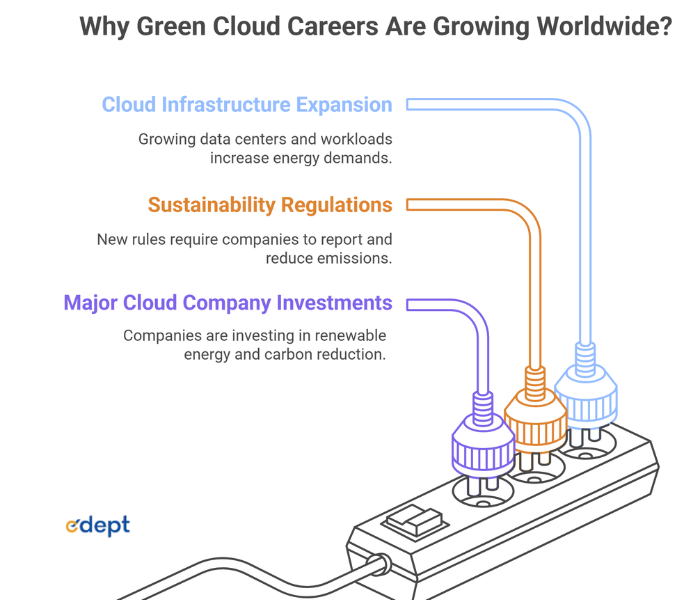
Why Green Cloud Computing Careers Are Growing Worldwide
This is not a trend that appeared overnight. Several forces are driving sustained growth in this field, and they are not going away anytime soon.
Expansion of Cloud Infrastructure
The global cloud market was valued at $676 billion in 2024 and is expected to cross $1.2 trillion by 2028. Every new data center, every new workload, every new deployment adds to the energy equation. Managing that growth sustainably requires a new category of specialists, and most organizations are only beginning to build those teams.
Sustainability Regulations and ESG Goals
The EU Corporate Sustainability Reporting Directive now requires large companies to disclose their environmental impact, including digital infrastructure. In the US, the SEC has introduced climate disclosure rules for public companies. Businesses need people who can measure, report, and reduce cloud-related emissions. That is creating a direct hiring need.
Investment by Major Cloud Companies
AWS has pledged to reach 100% renewable energy by 2025 and net-zero carbon by 2040. Microsoft is committed to being carbon negative by 2030. Google claims to have matched 100% of its electricity with renewables since 2017 and is now aiming for 24/7 carbon-free energy. These commitments require engineers, analysts, and consultants to actually implement them at every level of the cloud stack.
Top Green Cloud Computing Career Roles in 2026
This is the core of what the field looks like for job seekers right now. Each role below has real hiring activity behind it, not just theoretical demand.
Sustainable Cloud Engineer
This is a core engineering role. Sustainable cloud engineers redesign how cloud infrastructure runs. They reduce wasted compute resources, optimize workload scheduling, and select energy-efficient configurations. For example, migrating a company from always-on servers to auto-scaling cloud functions can cut energy use by 30 to 50%.
- Key responsibilities: Infrastructure optimization, workload scheduling, and energy usage monitoring.
- Skills needed: AWS, Azure, or GCP, Terraform, cloud cost and usage optimization tools. Industries hiring: Tech firms, logistics, retail, finance.
- Growth potential: High. Every enterprise cloud team will need this role going forward.
Green Data Center Specialist
This role focuses on the physical layer, specifically how the data center itself consumes energy. Specialists work on cooling systems, which account for nearly 40% of data center energy use, alongside renewable energy sourcing and PUE (Power Usage Effectiveness) optimization.
- Key responsibilities: Cooling system management, energy audits, renewable energy integration
- Skills needed: Data center operations, DCIM tools, renewable energy systems
- Industries hiring: Cloud providers, colocation companies, manufacturing
Cloud Sustainability Analyst
This is the reporting and measurement role. Analysts track a company’s cloud carbon footprint using tools like the AWS Carbon Footprint Tool or Google Cloud Carbon Sense. They translate raw data into ESG reports for leadership and regulators.
- Key responsibilities: Emissions tracking, ESG report preparation, cloud usage analysis
- Skills needed: Data analysis, GHG Protocol, ESG reporting frameworks, BI tools like Power BI or Tableau
- Industries hiring: Financial services, consulting firms, large enterprises
ESG Technology Consultant
Consultants advise businesses on how to make their digital operations more sustainable. If a retail company wants to cut its cloud emissions by 30% over three years, an ESG tech consultant builds that roadmap, covering which cloud services to use, what to retire, and how to report progress.
- Key responsibilities: Digital sustainability strategy, stakeholder reporting, and technology advisory
- Skills needed: Cloud strategy, ESG frameworks, business communication
- Industries hiring: Big 4 consulting firms, boutique sustainability consultancies, large enterprises
DevOps Engineer for Sustainable Infrastructure
DevOps engineers who specialize in sustainability focus on automation. The goal is to reduce human error, eliminate idle resources, and build pipelines that scale efficiently. Infrastructure that scales cleanly wastes less energy over time.
- Key responsibilities: CI/CD pipeline management, infrastructure automation, resource efficiency
- Skills needed: Kubernetes, Terraform, Python or Bash scripting, cloud cost management
- Industries hiring: SaaS companies, fintech, e-commerce platforms
Carbon Optimization Analyst
This is a newer but fast-growing role. Carbon optimization analysts review cloud usage data to find inefficiencies, such as underutilized instances, redundant storage, and poorly configured workloads, and then quantify the carbon and cost impact of each.
- Key responsibilities: Cloud usage audits, emissions analysis, optimization recommendations
- Skills needed: Cloud billing tools, emissions calculators, data analysis, cloud architecture basics
- Industries hiring: Enterprise IT departments, cloud managed service providers
Read more: Cloud Computing Job Roles Explained
Industries Hiring Green Cloud Computing Professionals
Green cloud is not limited to a single sector. Sustainability requirements are spreading across industries, and so is the hiring.
Cloud Service Providers
AWS, Azure, and Google Cloud are hiring sustainability engineers and analysts internally to meet their own green commitments. These roles exist at scale and tend to be well-compensated.
Banking and Finance
Banks face heavy ESG disclosure requirements from regulators. They are actively hiring cloud sustainability analysts and consultants to manage the carbon impact of their large-scale data operations.
E-Commerce and SaaS
High-traffic platforms generate enormous compute demand around the clock. Sustainability-focused DevOps and cloud engineers help optimize workloads at scale, which also reduces infrastructure costs.
Manufacturing and Smart Industry
Industry 4.0 companies run large IoT and data infrastructure. Sustainability in cloud supports their broader net-zero manufacturing targets, making green cloud professionals a natural fit.
Energy and Utilities
Energy companies are building green tech stacks and need professionals who understand both energy systems and cloud infrastructure. This sector is particularly well-aligned with the green cloud skill set.
Also read: Intersection of Cloud Computing and Cybersecurity
Countries Leading in Green Cloud Careers
Not all markets are at the same stage. Some countries are ahead in regulations, investment, and actual job demand. Here is a useful comparison for anyone thinking about international opportunities.
Germany
Germany leads in green technology regulation and industrial sustainability. EU compliance requirements have driven strong demand for cloud sustainability roles across manufacturing, finance, and enterprise tech.
Netherlands
The Netherlands has become a major hub for sustainable data centers. Companies like Equinix and Digital Realty operate large green facilities there. The local ecosystem supports both technical and consulting roles.
Canada
Canada’s hydroelectric infrastructure powers some of the cleanest cloud data centers in the world. Demand for green cloud professionals is growing steadily, particularly in Toronto and Vancouver.
Singapore
Singapore is investing in smart infrastructure and has strong ESG compliance requirements across Southeast Asia. It serves as a regional hub for green cloud operations across several multinational companies.
United States
The US remains the largest market, with the highest salaries and the most active hiring. Demand is driven by hyperscalers and Fortune 500 ESG programs, particularly in states like Virginia, California, and Washington.
| Country | Sustainability Focus | Avg. Annual Salary (Mid-Level) | Avg. Annual Salary (Mid-Level in Indian Currency) | Demand Level |
| Germany | Green tech leadership, EU compliance | EUR 65,000 to 85,000 | ₹18–32 LPA | High |
| Netherlands | Sustainable data center hub | EUR 60,000 to 80,000 | ₹16–30 LPA | High |
| Canada | Renewable-energy cloud infrastructure | CAD 80,000 to 110,000 | ₹14–28 LPA | Growing |
| Singapore | Smart sustainable city infrastructure | SGD 75,000 to 100,000 | ₹18–35 LPA | High |
| United States | Hyperscale cloud investment | USD 90,000 to 140,000 | ₹20–45 LPA | Very High |
Salary Trends in Green Cloud Careers
Salaries in this field are competitive, partly because the combination of cloud and sustainability knowledge is still relatively uncommon. Employers are willing to pay for that.
Entry-Level Salary
Entry-level roles like Cloud Sustainability Analyst or junior cloud engineer positions typically start between $55,000 and $75,000 annually in the US. In European markets, this translates to roughly EUR 45,000 to 60,000.
Mid-Level Salary
Mid-level professionals, typically those with three to five years of experience and relevant certifications, earn between $85,000 and $110,000 in the US. This is where the field starts to show real earning power.
Senior-Level Opportunities
Senior engineers, consultants, and team leads can earn between $120,000 and $160,000 or more, especially in the US. ESG Technology Consultants at large firms often exceed this range with bonuses included.
Impact of Certifications on Salary
Professionals who hold both a cloud certification and a sustainability certification typically earn 15 to 25% more than those with only technical credentials. That premium exists because the combination is still rare in the market.
| Level | Role Example | Annual Salary (USD) | Annual Salary (INR) |
| Entry-Level | Cloud Sustainability Analyst | $55,000 to $75,000 | ₹45 LPA to ₹62 LPA |
| Mid-Level | Sustainable Cloud Engineer | $85,000 to $110,000 | ₹70 LPA to ₹91 LPA |
| Senior-Level | ESG Technology Consultant | $120,000 to $160,000+ | ₹99 LPA to ₹1.32 Cr+ |
Skills Required for Green Cloud Careers
You do not need to be an expert in everything from day one. But building across these four areas will make you competitive for most green cloud roles.
Cloud Computing Fundamentals
You need hands-on experience with at least one major cloud platform, whether that is AWS, Azure, or Google Cloud. Understanding compute, storage, networking, and cost management is the baseline. Without this, the sustainability layer has nothing to sit on.
Sustainability and ESG Knowledge
This is what makes the profile different from a standard cloud engineer. Carbon accounting, lifecycle assessment, GHG Protocol standards, and energy efficiency metrics for IT are not things most cloud professionals know. Learning them puts you in a smaller, more sought-after group.
Automation and Optimization Skills
DevOps practices, scripting in Python or Bash, and infrastructure monitoring tools like Datadog, CloudWatch, or Grafana help you actually implement sustainable practices rather than just measure them.
Data Analytics Skills
You will regularly need to turn cloud usage data into sustainability reports or optimization recommendations. Experience with dashboards and BI tools like Power BI or Tableau is useful across almost every green cloud role.
Certifications That Help in Green Cloud Computing Careers
Certifications matter in this field because they signal cross-domain knowledge. A cloud cert alone is common. A sustainability cert alone is less technical. Both together is what stand out.
AWS Certifications
AWS Certified Solutions Architect and AWS Certified Cloud Practitioner are strong starting points. AWS also has a Sustainability specialty focus within its Cloud Practitioner track that is worth exploring.
Azure Cloud Certifications
Microsoft Azure Fundamentals (AZ-900) and Azure Administrator (AZ-104) are widely recognized. Microsoft also offers a Sustainability Manager certification through its Cloud for Sustainability platform, which directly applies to this field.
Sustainability Certifications
The GRI Standards certification and LEED Green Associate are respected in ESG circles and recognized by non-tech hiring managers, particularly in consulting and financial services.
ESG and Green IT Certifications
The Certified Sustainability Practitioner (CSP) and ISO 14001 Lead Auditor certifications demonstrate environmental management expertise. These pair well with any cloud certification to build a complete profile.
Why Green Cloud Computing Careers Are Ideal for Students in 2026
If you are a student exploring career options right now, this field has a few things going for it that most others do not. It is new enough that the market is not saturated. It pays well at every level. It is internationally portable, meaning you can apply the same skills in Germany, Singapore, or Canada. And it is connected to something real, which increasingly matters to employers and to people choosing their careers.
ESG reporting is becoming a legal requirement in more markets every year. Cloud adoption is not slowing down. The overlap between those two realities is where this career lives, and it is not going away. This is exactly the kind of career path edept is built to help you navigate.
Why Choose edept for Future-Ready Green Cloud Computing Careers
Edept partners with universities and industry leaders to deliver programs that go beyond classroom theory. The B.Voc. in Big Data and Cloud Computing, offered in collaboration with Mumbai University at Shree L.R. Tiwari College of Engineering, is built specifically for students who want to enter cloud and data careers with real skills.
Industry-Oriented Cloud Program
The curriculum covers cloud computing, big data analytics, machine learning, cybersecurity, and distributed computing across six structured semesters. Every subject is aligned with what the industry is hiring for right now.
Practical Project-Based Learning
Through Edept’s Global Industry Immersion Projects, students work on real briefs from global industry clients, across three stages spanning up to 120 hours of live project work. You graduate with a portfolio, not just a degree.
Learn from the Experts
Faculty with industry experience guide students through hands-on labs using tools like Python, SQL, and cloud platforms. Dedicated mentors support both technical understanding and real-world application.
Career Support for Global Opportunities
With 100% placement assistance and strong industry connections, Edept prepares you for cloud roles across global markets.
Admissions are open for 2026. Only a few seats are available. Call now: +91 97690 86795.
Step-by-Step Roadmap to Build a Green Cloud Career
This section is for anyone who wants a clear starting point. Follow these steps in order, and you will have a solid foundation within 12 to 18 months.
Step 1: Learn Cloud Computing Basics
Start with AWS Cloud Practitioner or Azure Fundamentals. Get comfortable with core services like compute, storage, and networking. This is your technical foundation, and everything else builds on top of it.
Step 2: Understand Sustainability Concepts
Learn the GHG Protocol, basic ESG reporting requirements, and how energy efficiency applies to IT systems. You do not need a degree in environmental science. You just need enough to apply these concepts to real cloud work.
Step 3: Build Projects on Cloud Optimization
Set up a small cloud environment and start optimizing it. Reduce cost, track usage, automate scaling. Document what you changed and describe the impact it had. This becomes part of your portfolio and gives you something concrete to talk about in interviews.
Step 4: Gain Certifications
Target at least one cloud certification and one sustainability-related certification within your first year. The AWS Sustainability specialty, Azure Administrator, or a GRI Standards certification are good options. That combination is still rare, which works in your favor.
Step 5: Apply for Global Cloud Roles
Start with LinkedIn, Wellfound, and career pages at companies like AWS, Microsoft, Accenture, and Deloitte. Look for titles like Cloud Sustainability Analyst, Sustainable Infrastructure Engineer, or ESG Technology Consultant. Do not wait until everything feels perfect. Apply early and learn as you go.
Future Scope of Green Cloud Computing Careers Beyond 2026
The demand you see now is early-stage. Here is where the field is heading over the next several years.
Sustainable Data Centers Becoming Standard
By 2030, most major enterprises are expected to require ESG compliance from their cloud vendors. Sustainable data center operations will shift from being a competitive advantage to a baseline requirement for doing business.
ESG Compliance Driving IT Hiring
As sustainability reporting regulations expand globally, every company’s IT function will need someone who can handle both cloud operations and carbon accounting. That is a long-term, structural hiring driver.
Green Technology Investments Increasing
The IEA projects global clean energy investment will exceed $2 trillion annually by 2030. A significant share of that flows into digital infrastructure, creating sustained demand for professionals who sit at the intersection of cloud and sustainability.
Does Green Cloud Computing Careers Provide Sustainability and Opportunities?
Green cloud computing brings together two things the world genuinely needs right now: technology and sustainability. Companies across every major market are actively hiring professionals who can work across both, and that demand is only going to grow.
For students considering their next step, the B.Voc. in Big Data and Cloud Computing at Shree L.R. Tiwari College of Engineering, powered by edept, is built exactly for this moment. The program gives you hands-on cloud skills, real industry project experience, and the kind of profile that global employers are looking for in 2026 and beyond.
The field is not oversaturated. The salaries are strong. The opportunities are international. And the hiring is happening right now. If you want to build a career that sits at the center of cloud technology and sustainability, this is a good place to start.
Related Links:
| Cloud Computing Career Roadmap | Cloud vs DevOps: Which path to choose? |
| Cloud Skills for Placements | How does Cloud Security Work? |