Our world is currently experiencing a massive technological transformation. Artificial Intelligence is no longer a future concept; it is now reshaping industries, business models, and workforce demands worldwide. From automation and predictive systems to Generative AI and intelligent decision-making, AI is driving one of the biggest technological shifts of this decade. AI careers are no longer just a future conversation; now, they are present, and they are currently reshaping how the world is hiring, learning and building.
According to the World Economic Forum’s Future of Jobs Report 2025, AI and information processing technologies are expected to be the single biggest driver of job transformation through 2030, with 170 million new jobs created and 92 million displaced, resulting in a net gain of 78 million roles. This shift is increasing the demand for AI specialists and creating a 56% wage premium for workers with AI-related skills. As AI adoption expands across industries, demand for skilled AI professionals is rising rapidly. Companies are not only hiring engineers to build AI systems but also specialists to deploy, secure, govern, and optimize AI solutions. Some of the major industries include technology, healthcare, finance, manufacturing, education, and retail. The next decade will not simply be about technological innovation; it will be about the people who build, manage, secure, and improve these technologies.
This blog breaks down the top AI careers expected to dominate the next decade, the salaries you can target, the skills employers are actively looking for, and a step-by-step roadmap for students who want to break in. Whether you are a fresher, a working professional, or someone planning a career switch, this guide gives you a clear, data-backed view of future AI jobs.
Why AI Careers Are Growing Rapidly
AI careers are growing rapidly because currently most businesses are trying to integrate AI for their massive productivity gains. This results in a global talent shortage; hence, the growth of AI careers is not just a hype word now; it is properly backed by hiring data, government policies and capital flow.
Global AI Adoption Is Accelerating
Global AI adoption is rising at a rapid pace. Global spending on AI will rise by 47% year over year in 2026, totalling $2.59 trillion, according to a Gartner report. The global average planned AI investment per organization is hitting $186 million. AI adoption is not only limited to large organization, various small and medium enterprises are also now adopting AI infrastructure. India ranks first globally in AI workplace adoption, with nearly 80% of professionals interacting with AI systems several times a week
AI Investment Is Rising
AI investment is expanding at a historic pace, with worldwide AI spending projected to reach $2.5 trillion. Major tech companies like Google and Microsoft are investing hundreds of billions in AI infrastructure and data centres. The Indian AI sector is almost crossing $7 billion, and it is backed by thousands of global capability centres and the government’s support. This investment directly influences the hiring process, because every amount spent on AI will actually need a person to build, deploy and manage.
Talent Shortage in AI Roles
The global AI talent shortage has become one of the most critical structural deficits in the modern workforce. “India’s talent shortage at 82%, significantly above the global average of 72%, signals a structural transformation in the labour market rather than just a cyclical change. The increase in demand for AI skills, particularly AI literacy and model development, reflects that AI is not replacing jobs but reshaping how work gets done. This shortage is the main reason that AI careers and salaries have risen so sharply.
AI Is Expanding Across Industries
Artificial Intelligence is expanding across various sectors, not only technology and IT. This expansion is widely spread across sectors such as healthcare, financial services, manufacturing, retail, and supply chain, as well as automotive and transport. Technology/SaaS leads AI adoption at 92%, followed by financial services at 84% and media/publishing at 78%. Manufacturing (52%) and agriculture (28%) trail significantly. Healthcare shows the fastest adoption acceleration: from 38% in 2024 to 67% in 2026.
Key Trends Shaping Future AI Careers
The future of AI careers is defined by the transformation of manual programming to human-AI collaboration and the rise of agentic AI and agents.
Growth of Generative AI
Nowadays, companies are heavily investing in Gen AI to increase employee productivity, drive personalised customer experiences and reduce operational costs significantly. Companies are using Gen AI to reduce the time spent in content creation, automate customer support, accelerate and improve software development and analyze large amounts of data. GenAI automates various routine knowledge work, such as drafting reports, writing code, and analysing data, thus freeing employees to focus on high-value tasks and strategic initiatives.
AI + Cloud Integration
Cloud AI integration connects artificial intelligence services such as natural language processing, predictive analytics, and computer vision directly to your existing cloud infrastructure, websites, and databases. It helps in automating workflows, scaling various operations and deploying AI without hosting expensive on-premises hardware.
AI Security Challenges
As digital transformation is expanding day by day, the rise of cyber threats is increasing at a rapid pace. Some of the key AI system vulnerabilities include prompt injection & leakage, data & model poisoning, and sensitive information disclosure.
Responsible AI and Governance
Artificial Intelligence (AI) governance helps in translating ethical principles into operational reality, providing the concrete policies, risk assessments, and audits required for responsible AI. While responsible AI represents the ethical philosophy, mainly focusing on fairness, transparency, and safety, governance helps in enforcing these beliefs through management frameworks and continuous monitoring.
AI Automation at Scale
Enterprises are now moving from AI experiments to AI automation across customer support, finance, HR, and operations. While traditional automation uses strict, hardcoded rules to execute tasks (e.g., RPA), scaling with AI means leveraging large language models (LLMs) and autonomous AI agents. 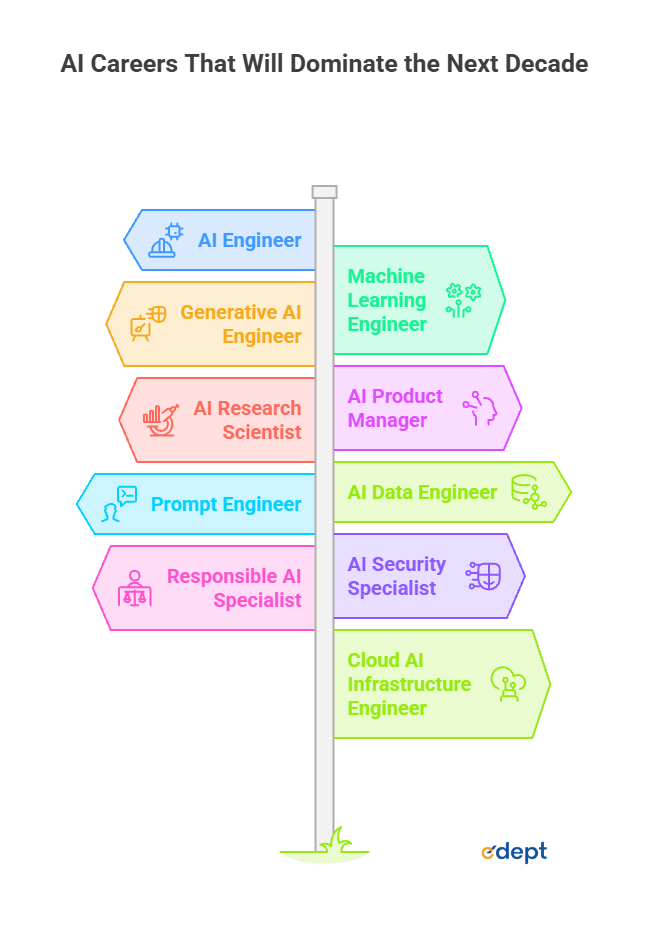
AI Careers That Will Dominate the Next Decade
Some of the AI careers that will dominate the next decade are
AI Engineer
AI engineers design, build, and deploy AI-powered systems and applications, taking models from prototype to production. They work closely with software engineering teams to make sure AI features actually function reliably inside real products, not just in a research notebook. They mainly focus on practical AI implementation, such as chatbots, semantic search, and recommendation engines.
Skills Required: Python Machine Learning Deep Learning TensorFlow PyTorch Data Science Mathematics and Statistics
Salary potential: In India, salaries typically range from ₹6 to ₹40 LPA+ depending on expertise, while global markets like the US and Europe offer total compensation packages ranging from $150,000 to over $400,000.
Future Demand: One of the highest-demand roles. AI engineering has a massive, expanding scope and is one of the highest-paying, most future-proof career paths.
Machine Learning Engineer
A machine learning engineer helps in building, training, and deploying AI models. They are also responsible for assessing, organizing, and cleaning large, complex datasets for model training. They track model performance in real time and detect any data drift to maintain high accuracy. This is one of the most technically intensive roles in AI.
Skills Required: Statistics ML algorithms Model evaluation PyTorch Docker (containerization) Kubernetes Cloud Platforms
Salary Potential: In India, the entry-level salary starts at ₹6 to ₹12 lakhs/year, and the senior level can reach ₹40 lakhs to ₹1+ crore/year. In the USA, the entry-level salary starts at $90,000 to $140,000 USD/year, and the senior level can reach $200,000 to $450,000+ USD/year.
Future Demand: The demand for Machine Learning (ML) engineers is experiencing explosive growth, projected to surge by up to 75%. Strong, long-term growth is expected as more companies move beyond experimentation into deploying ML at scale across operations.
Generative AI Engineer
A Generative AI Engineer helps in designing, fine-tuning, and deploying applications powered by Large Language Models (LLMs) and diffusion models. They help bridge the gap between foundation models such as OpenAI GPT, Gemini, and Claude and enterprise software.
Skills Required: LLMs Vector databases LangChain/LlamaIndex Prompt design Fine-tuning Evaluation Python PyTorch Docker (containerization) Kubernetes Cloud Platforms
Salary Potential: In India, salaries range from ₹6–₹12 LPA for freshers and ₹30–₹70+ LPA for senior talent. Globally, entry-level roles start around $83,000, while senior experts in the US can earn $179,000–$300,000+.
Future Demand: The future demand for Generative AI (GenAI) Engineers is booming. With an estimated 1 million AI jobs projected, and only one qualified engineer available for every ten open roles, it remains one of the most secure and lucrative tech domains.
AI Product Manager
An AI product manager is responsible for bridging the gap between engineering, data science, and non-technical stakeholders. He owns the development and delivery of AI-powered products. Unlike traditional management, this role requires an understanding of what an AI can do and what it cannot, what the limitations of current models are and how to set realistic expectations with leadership and customers.
Skills Required: AI & Machine learning fundamentals Product Strategy and Vision Development Customer and User-Centric Thinking Data-Driven Decision-Making Cross-Functional Collaboration Communication and Stakeholder Management Prioritization and Roadmap Planning Responsible AI and Ethical Judgment
Salary Potential: In India, entry-level professionals earn ₹10–₹17 LPA, while senior or lead AI PMs at top-tier tech firms command ₹50–₹100+ LPA. Globally, annual compensation ranges from $100,000 to $200,000+.
Future Demand: The future is strong and growing, as more companies launch AI-powered products and need people who can bridge the gap between engineering teams and business leadership.
AI Research Scientist
An AI Research Scientist is an advanced computer science professional who helps in developing breakthrough algorithms and pushes the boundaries of artificial intelligence. They bridge the gap between theoretical mathematics and practical engineering. This is typically the most academically demanding AI career path, often requiring a master’s degree or PhD.
Skills Required: Linear Algebra Calculas Probability & Statistics Optimization Theory Python PyTorch, NumPy Natural Language Processing (NLP), Computer Vision, Research methodology.
Salary potential: In India, the average salary typically ranges from ₹15 to ₹60 Lakhs per annum (LPA). Globally, particularly in major tech hubs like the US, base salaries range from $180,000 to $400,000+.
Future Demand: Highly complex role. Lower-volume hiring, but consistently strong demand from organizations pushing the frontier of AI capability.
AI Data Engineer
An AI Data Engineer helps in designing and building the data architecture, pipelines, and infrastructure required to feed, train, and deploy artificial intelligence and machine learning models.
Skills Required: Python SQL Data Engineering ETL Cloud Platforms Big Data technologies Apache RAG TensorFlow Docker Kubernetes
Salary potential: In India, entry-level salaries range from ₹6–10 lakhs per annum (LPA), while senior professionals scale to ₹30–60+ LPA. Globally (particularly in the US), top-tier engineers average $150,000–$400,000+ USD.
Future Demand: The future demand for AI Data Engineers is exploding globally and in India, driven by enterprise shifts toward Generative AI and LLM deployment. India alone is projected to host over 1 million active AI and Machine Learning roles, with demand growing upwards of 40% annually.
Prompt Engineer / AI Workflow Specialist
A prompt engineer mainly designs and also helps in refining instructions that are given to the AI systems to produce highly accurate, consistent, and useful output. They help in experimenting with different phrasing to identify and eliminate errors, hallucinations, or vague outputs. It helps organizations tailor AI tools for practical applications like content creation, customer service, or data analysis.
Skills Required: AI tools Language models Problem-solving Workflow design Python System Design & API Knowledge NLP Critical Thinking
Salary Potential: Prompt engineers in India earn between ₹4 LPA and ₹60 LPA, heavily depending on whether they possess coding skills. Globally, particularly in the US, median salaries range from $120,000 to $160,000, with leading AI labs offering well over $200,000.
Future Demand: Demand for prompt engineering is increasing both in India and globally, driven by rapid adoption of generative AI. The global prompt engineering market is projected to reach $3.48 billion.
AI Security Specialist
An AI Security Specialist is an expert who helps in protecting artificial intelligence and machine learning systems from unique cyber threats, such as data poisoning, prompt injections, and adversarial attacks.
Skills Required: Adversarial Machine Learning Agentic AI Threat Modelling Data & Model Protection Security Testing & Red Teaming Cloud & Pipeline Security Python TensorFlow Cybersecurity fundamentals
Salary potential: AI security specialists have a significant premium due to a severe talent shortage. In India, salaries typically range from ₹15 to ₹40+ Lakhs Per Annum (LPA). Globally, particularly in North America and Europe, specialized AI security roles average between $152,000 and $350,000+ annually.
Future Demand: The demand for AI security specialists is rising, significantly outpacing the available talent pool. As enterprises increasingly deploy machine learning models and intelligent agents, the expanding digital attack surface is driving specialised job roles across finance, healthcare, technology, and government.
Responsible AI Specialist
As AI is becoming more powerful and evolving rapidly, the main question is how to use it ethically and safely. A responsible AI Specialist (often called an AI Ethicist or governance specialist) helps bridge the gap between technical data science teams and business stakeholders. They help ensure AI systems treat all individuals and groups equitably, actively identifying and removing historical biases. They are responsible for designing models whose decisions can be easily understood by humans.
Skills Required: AI Ethics & Governance Algorithmic Fairness Knowledge of AI ethics frameworks Regulatory literacy Risk assessment methods. AI/ML Foundations & Cloud Platforms Stakeholder Communication
Salary potential: In India, salaries range from ₹5 LPA for entry-level roles to over ₹55 LPA for leadership. Globally, total compensation packages can reach $200,000 to $460,000.
Future Demand: The demand for Responsible AI Specialists is expanding. Driven by emerging regulations like India’s AI ethics guidelines and the 1.8 trillion economic impact of AI by 2030, this niche is projected to grow by 30%.
Cloud AI Infrastructure Engineer
A Cloud AI infrastructure engineer is a specialized role bridging the gap between cloud computing, DevOps, and machine learning. These engineers deploy and manage the cloud infrastructure that AI workloads run on, ensuring systems can scale reliably and cost-effectively.
Skills Required: Cloud Platforms Kubernetes & Docker Infrastructure as Code PyTorch TensorFlow Serving. Python Linux Administration CI/CD & Automation
Salary potential: In India, entry-level salaries range from ₹6 to ₹12 LPA, while senior MLOps and platform specialists typically command ₹25–₹50 LPA and can exceed ₹1 crore annually at top-tier product companies. Globally, total average compensation packages can reach $120,000 – $170,000 / year.
Future Demand: The future demand for Cloud AI infrastructure engineers is expanding. As AI is transitioning from a software revolution to an infrastructure revolution, companies are facing a massive talent shortage. This industry is experiencing a massive gap, with thousands of open roles for specialized AI Cloud Engineers in India and globally.
Highest-Paying AI Careers
The highest-paying AI jobs command salaries ranging from $200,000 to well over $500,000 annually.
AI Research Scientist
An AI Research Scientist in India earns an average base salary of ₹25–30 Lakhs per year, with experienced or Ph.D.-level professionals exceeding ₹70+ Lakhs. Globally, particularly in the US, compensation ranges from $150,000 to $500,000+ (₹1.26–₹4.2 Cr) India: Junior / Entry-Level: ₹6–12 lakhs. Mid-Level: ₹20–30 lakhs. Senior / Lead (5+ years): ₹30–70+ Lakhs Global: United States: $150,000 – $250,000+ United Kingdom: £70,000 – £120,000
AI Architect
AI Architects are among the highest-paid tech professionals. In India, salaries average ₹35 LPA to ₹46 LPA, scaling up to ₹80+ LPA for senior roles. Globally, particularly in the US, compensation ranges between $140,000 and $256,000 annually. India: Entry-Level (1–3 years): ₹20 Lakhs – ₹35 Lakhs/year Mid-Level (3–7 years): ₹35 Lakhs – ₹60 Lakhs/year Senior/Lead Roles (8+ years): ₹60 Lakhs – ₹1 Crore+/year Global: United States: $140,000 – $250,000+/year (Average: ~$188,000) United Kingdom: £85,000 and £135,000
AI Product Manager
In India, the average salary ranges from ₹25 to ₹30 LPA, with senior roles reaching ₹60 to ₹80+ LPA. Globally, salaries typically span $140,000 – $200,000+ USD depending on location India: Entry-Level (1–3 years): ₹10 – ₹15 LPA Mid-Level (4–6 years): ₹25 – ₹40 LPA Senior-Level & Leadership: ₹50 – ₹80+ LPA Global: United States: $140,000 – $200,000 USD base United Kingdom: £85,000 – £120,000
Chief AI Officer (CAIO)
Chief AI Officers (CAIOs) are among the highest-paid technology executives, commanding total compensation packages that typically range from $250,000 to over $650,000 globally, and from ₹1 crore to ₹4.5 crore in India. India: Entry-Level : ₹40 LPA to ₹60 LPA Mid-Level :₹60 LPA to ₹90 LPA Senior Level: ₹90 LPA to ₹1.5 Crore+ Global: United States: $250,000 and $400,000+ United Kingdom: £180,000 and £320,000,
Generative AI Engineer
Generative AI Engineers in India have attractive packages due to a high-demand, low-supply skill gap. Overall salaries range from ₹6 LPA to ₹70+ LPA, with a national average hovering around ₹12 to ₹15 LPA. Globally, particularly in the US, total compensation ranges from $130,000 to $400,000+ per year India: Entry-Level : ₹6 – ₹12 LPA Mid-Level: ₹18 – ₹35 LPA Senior Level: ₹35 – ₹70+ LPA Global: United States: $160,000 to $265,000+ United Kingdom: £70,000 and £170,000 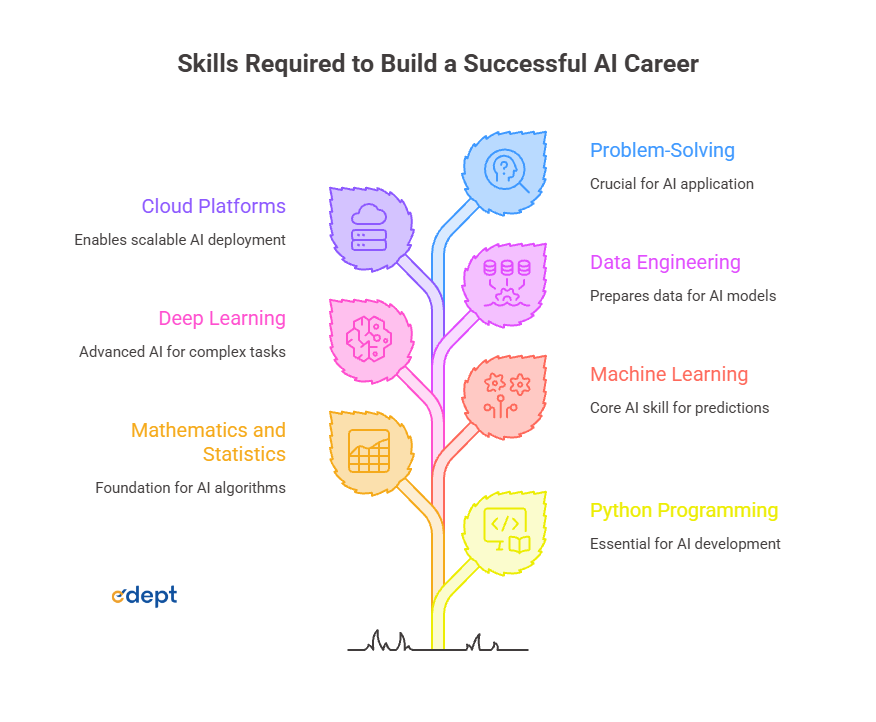
Skills Required to Build a Successful AI Career
Python Programming
Proficiency in Python is a must for a successful career in AI. Python is a very versatile, beginner-friendly programming language renowned for its clean, English-like syntax. Python programming is the foundational skill required to build a successful career in artificial intelligence (AI). Nearly all major AI frameworks, Large Language Models (LLMs), and machine learning libraries are built on Python.
Mathematics and Statistics
Mathematics and statistics are the engines of artificial intelligence, serving as the universal language used to process information, recognize patterns, and optimize algorithms. Some of the core mathematics disciplines include linear algebra, calculus, probability & statistics.
Machine Learning
Mastering Machine Learning (ML) has become the foundation of a successful career in AI. It empowers professionals to build algorithms that learn from data, seamlessly integrating predictive models and intelligent systems into real-world applications. Some of the core skills include Python, SQL, and TensorFlow. Linear algebra, calculus, probability & statistics are also important in machine learning.
Deep Learning
Deep learning acts as a core pillar of modern AI, focusing on multi-layered neural networks to solve complex problems like computer vision and natural language processing. Mastering it, alongside essential math, programming, and MLOps, creates a highly versatile and lucrative profile for professionals aspiring to enter or advance in the AI industry. Some of the foundational deep learning skills include neural network design and framework proficiency. Python, linear algebra and calculus.
Data Engineering
To build a successful AI career requires shifting from traditional data management to integrating, scaling, and monitoring intelligent, non-deterministic systems. Success demands mastery of core data infrastructure combined with AI-specific engineering skills like vector databases and RAG (Retrieval-Augmented Generation) pipeline management.
Cloud Platforms
Mastering cloud platforms is very essential for a successful AI career. Cloud infrastructure provides the necessary computing power, storage, and serverless environments required to build, train, and deploy machine learning and deep learning models at enterprise scale. Amazon Web Services (AWS), Microsoft Azure and Google Cloud Platform (GCP) are among the top three cloud platforms that dominate AI and machine learning.
Problem-Solving
Problem-solving in AI goes far beyond memorizing coding syntax. It is the core ability to break down complex, real-world challenges into manageable components, evaluate mathematical models, and design efficient, scalable solutions.
Industries Hiring AI Professionals in India
AI hiring in India is experiencing massive growth, and it is driven by rapid enterprise integration, Global Capability Centres (GCCs), and the IndiaAI Mission. Some of the industries hiring AI professionals are:
IT & Software Services: The companies hiring are Tata Consultancy Services (TCS), Infosys, Wipro, Cognizant, Accenture and Capgemini
Banking, Financial Services, and Insurance (BFSI): The companies hiring are BNP Paribas, Citi, Uptiq, Accenture, IDFC FIRST Bank, SBI, and Deutsche Bank
Healthcare & Life Sciences: The companies hiring are Novartis, IQVIA, Evernorth Health Services, Axtria, Aganitha
Manufacturing & Automotive: The companies hiring are Mercedes-Benz, Bosch, Magna International, and Stellantis
E-Commerce & Retail: The companies hiring are Flipkart, Amazon India, Myntra, and Reliance Retail
Best Countries for AI Careers
United States
The United States is one of the top countries for AI jobs and careers. It offers the highest average salaries for professionals with AI skills. It has a large number of AI labs and tech companies, such as Google, Microsoft, Meta, and Nvidia, which provides great career opportunities. Various roles such as machine learning, data scientist, AI researcher, and AI scientist are the most in-demand positions.
Canada
Canada has positioned itself as one of the most accessible destinations for AI jobs. This is mainly due to the factor that it has a very proactive immigration strategy, and the path to being a permanent resident is very clear and quick. It has famous AI institutes and research centres; the Vector Institute in Toronto & Mila in Montreal are world-class AI labs. Some of the in-demand job roles are AI researcher, AI scientist, ML engineer, and data scientist.
Germany
Germany has become a premier destination for an AI career in Europe. The market is growing rapidly at a CAGR of 38% from 2025 to 2030. It offers high-paying job roles in the automotive, automation, and manufacturing sectors. Some of the major job roles include AI engineers, machine learning developers, and data scientists. Various industrial companies such as Siemens, Bosch and SAP are building entirely new AI divisions. All these provide excellent job opportunities and career growth for the recent graduates.
United Kingdom
The United Kingdom has its own global AI superpower, which itself has pushed the government to invest more in AI infrastructure. The fintech and SaaS sectors in the UK are experiencing a massive surge in AI-related hirings. The companies are heavily investing in AI and transformation. Roughly 70% of all UK fintech roles are based in London. The combination of various global banks, fintech startups, and deep academic research creates a robust working environment. Some of the top hiring SaaS development partners include Bytes Technolab, Softwire, Miquido, Itera, Kainos & BJSS.
Switzerland
Switzerland is a premier global hub for AI in finance and research, driven by top-tier universities like ETH Zurich/EPFL and a strong financial sector aiming for high-ROI generative AI adoption. Nearly 50% of Swiss financial institutions use AI, along with 91% adopting AI for chatbots, compliance and risk management. It hosts major research labs, Google, IBM and HPE. The finance institute in Switzerland mainly focuses on deep learning, NLP and reinforcement learning.
UAE & Singapore
The UAE & Singapore have both been emerging AI hubs for professionals. Singapore has a Smart Nation initiative that pays high-paying roles in fintech, AI and engineering. It has a huge demand for AI engineers, data scientists, and quantitative analysts. On the other hand, the UAE offers the world’s first graduate-level AI university and also provides tax-free salaries. The process for obtaining an employment visa is fastest in the UAE.
Australia
Australia has a high demand for AI professionals across sectors such as healthcare, agriculture, financial services, and mining & resources. It offers huge demand for AI/ML engineers and data scientists, particularly under the Core Skills Occupation List. It provides very competitive and attractive salaries along with a very clear and smooth visa pathway.
Salary Outlook for AI Careers
The salary outlook for AI careers is significantly strong, and it is driven by high demand and a talent shortage. Salaries vary based on experience, location, and specialization, with roles like AI Engineers and Generative AI Specialists having premium salaries.
| Experience Level | India Salary (Annual) | Global Salary (US, Annual) |
| Entry-level (0–2 yrs) | ₹6–12 LPA | $70,000–$110,000 |
| Mid-level (3–6 yrs) | ₹12–30 LPA | $130,000–$200,000 |
| Senior-level (7+ yrs) | ₹35–80 LPA+ | $250,000–$400,000+ |
Top-Paying AI Specializations:
- Generative AI Engineer: ₹15 LPA to ₹40 LPA
- Machine Learning (ML) Engineer: ₹10 LPA to ₹28 LPA
- AI/ML Solutions Architect: ₹22 LPA to ₹35 LPA
- NLP (Natural Language Processing) Engineer: ₹9 LPA to ₹22 LPA
Common Mistakes Students Make While Pursuing AI Careers
The students who are pursuing AI careers often make vital mistakes by getting stuck only in theoretical math, ignoring foundational software engineering, building projects without a portfolio, and chasing every new tool coming in the market,instead of mastering core concepts
Focusing Only on AI Tools
Knowing how to use ChatGPT or other AI tools is not the same as understanding how to build, train, or deploy AI systems. AI is not just about prompt engineering or pulling APIs. Students often fail to grasp backend development. Employers look for candidates who can actually build such systems.
Weak Programming Foundations
Python is essential, but many students rush past programming basics; they have very limited knowledge about the programming foundations, and they skip the core coding skills to jump straight into “AI” courses, which often leaves students unable to handle real engineering tasks.
Ignoring Mathematics
Linear algebra, probability, calculus and statistics are not optional any more. Students who skip this struggle once they move past beginner-level work. The professionals who understand the math behind the models make better architectural decisions and debug issues faster.
Not Building Projects
Theory alone without any practice is of no value. You should build real projects, contribute to open source, and create a portfolio that demonstrates your ability to solve problems.
Avoiding Practical Experience
Internships, freelance experience, and practical lab experience are very important for every student. The gap between academic knowledge and production-ready skills is where most graduates fail. Only academic knowledge and theory won’t help you land a job in AI.
Why AI + Cloud + Cybersecurity Skills Will Dominate Hiring
AI, Cloud, and Cybersecurity are combining into a critical “hybrid tech skill set”. Employers are now shifting from capacity hiring to capability hiring, which means they are prioritizing professionals who can deploy scalable infrastructure, secure multi-cloud environments, and integrate artificial intelligence to drive business efficiency and resilience. Cloud-native environments introduce various complex vulnerabilities, such as misconfigured servers, weak access controls, and exposed data APIs. Now, organizations require experienced professionals who can help in building secure architectures, automate security checks within CI/CD pipelines, and continuously monitor cloud logs.
As organizations are adopting AI-powered applications, migrating workloads to the cloud, and defending against increasingly sophisticated cyber threats, the demand for professionals who understand all three domains is growing rapidly. Organizations need professionals who can understand these connections, solve complex challenges, and bridge the gaps between different technology domains. Some of the benefits of developing the hybrid tech skill include high earning potential, job security, greater opportunities, career flexibility and various leadership opportunities.
Why Choose Edept for AI Career Preparation
If you are serious about building a career in AI, the programme you choose matters as much as the effort you put in. There is a difference between studying AI in theory and being trained to actually work with it. edept’s Master’s in Data Science & AI is built around the second approach. The programme runs as a 1+1 dual-degree pathway; you begin your studies in India through the PGDM in Business Analytics at Shree L.R. Tiwari School of Business Management (SLRTSBM) in Mumbai, and then complete a Master’s in Data Science & AI at Steinbeis University in Berlin, Germany
Industry-Focused Curriculum
The curriculum is built for the job market, not just the examination. On the India side, you work through modules in Python programming, machine learning, data visualisation with Tableau and Power BI, cloud computing, SQL, applied econometrics, and business analytics, the practical toolkit that AI employers expect candidates to walk in with. On the German side at Steinbeis University in Berlin, the focus deepens into artificial intelligence, data strategy and governance, data-driven business models, high-performance computing, and a live innovation project with a real company.
Career Readiness Support
edept provides dedicated support for students navigating the career aspects of international migration, from resume preparation and interview coaching to job-search strategies for specific markets. The goal is not just skill development in isolation but also a clear bridge from learning to landing an international role.
Global Career Exposure
For Indian students who want to enter the AI job market globally, not just domestically, this kind of programme addresses the three things that matter most: the right skills, an internationally recognised qualification, and real exposure to the country where you intend to work. Those three together are what make the difference between a competitive application and a strong one.
Step-by-Step Roadmap to Start an AI Career
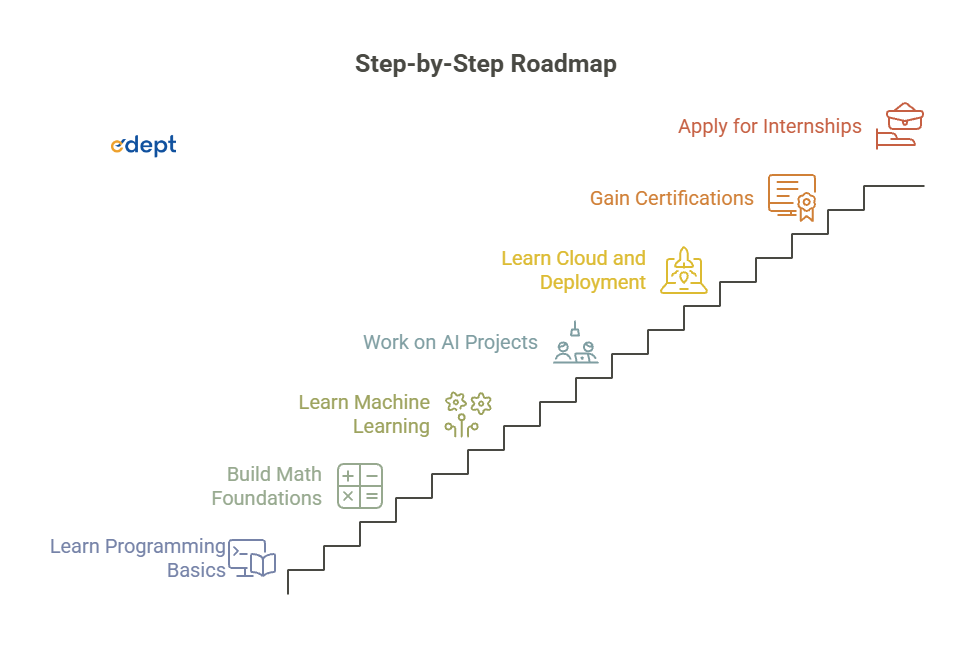
Learn Programming Basics
You should start with the basics, that is, how AI works. Start learning Python, as it is the primary language of AI development. Learn data manipulation and visualization using NumPy, Pandas, and Matplotlib. Focus on data structures, loops, functions, and object-orientated programming (OOP).
Build Math Foundations
You should start focusing on linear algebra (matrices, vectors), multivariable calculus (gradients, partial derivatives), and probability/statistics. These are not just academic requirements; they’re the language AI speaks.
Learn Machine Learning
You should start understanding supervised and unsupervised learning, model evaluation metrics, and feature engineering. Implement algorithms from scratch before using libraries. Machine learning helps in automating data-driven decision-making by enabling computers to identify patterns and make predictions without explicit programming for each scenario.
Work on AI Projects
Practical project experience helps in transforming the theoretical knowledge into demonstrable skills that employers mostly value. Building real-world applications reinforces learning, creates portfolio pieces, and develops the problem-solving abilities needed for professional AI development.
Learn Cloud and Deployment
Some of the major cloud platforms, including AWS, Google Cloud, and Azure, provide comprehensive AI deployment services. Start learning containerisation (Docker), orchestration (Kubernetes), and MLOps practices.
Gain Certifications
Certifications from Google, AWS, Microsoft, and Stanford validate your skills. They’re not substitutes for projects, but they are proof of your commitment and competence.
Apply for Internships
Start applying for internships to build practical, real-world experience before your first full-time role. They help you gain real-world experience, industry knowledge, and an opportunity for a full-time job offer.
Future Outlook Beyond 2035
By 2035, artificial intelligence, automation, and demographic shifts will have fundamentally reshaped how, where, and why people work. This isn’t just an idea or a mere speculation; it’s already happening. Research shows that 39 per cent of employees’ skill sets will transform by 2030, while 92 per cent of companies plan to significantly increase their AI investments over the next three years. By 2030, most workers won’t be replaced by machines or AI; they’ll be working alongside them, collaborating and supervising intelligent systems while focusing on what humans do best.
By 2030, digital and AI-related skills will be base requirements across virtually every sector. Data literacy, the ability to interpret and work with data even without being a data scientist, will be as essential as reading and writing. At the same time, regulation is set to increase, creating ongoing demand for governance and compliance specialists. There will be a change in the hiring world, which is also transforming. By the early 2030s, skills-based hiring will be standard practice for leading organizations. New AI job titles will likely continue emerging as the technology becomes more advanced and mature. Through all of this, demand for skilled AI talent is expected to remain strong well beyond 2035.
Conclusion
AI careers are expected to dominate the global hiring market over the next decade. AI careers are no longer just a future conversation; now, they are present, and they are currently reshaping how the world is hiring, learning and building. As AI adoption expands across industries, demand for skilled AI professionals is rising rapidly. Companies are not only hiring engineers to build AI systems but also specialists to deploy, secure, govern, and optimize AI solutions. Some of the major industries include technology, healthcare, finance, manufacturing, education, and retail. Roles in AI engineering, machine learning, generative AI, AI security, and AI governance all offer genuine, long-term growth potential.
Students and professionals who build strong technical foundations ; programming, mathematics, and hands-on project experience, will be best positioned to take advantage of these opportunities. AI professionals with hybrid skills in cloud and cybersecurity will command the highest value. If you are a student thinking about your career path, 2026 is an excellent time to start moving in this direction. The demand is real, the salaries are strong, and the long-term growth is genuinely promising. Focus on building skills, building your portfolio, and finding programmes that prepare you for the job market, not just the examination hall.