The IT industry today does not stay inside one city or one country. Software developers, cloud engineers, cybersecurity analysts, and data professionals regularly work with teams sitting in different countries, speaking different first languages, and working in different time zones. This means employers are no longer just checking for coding skills. They also want to know if a graduate can work well in a global team. This is where Global Immersion Projects come in. They are one of the biggest differentiators in the B.Sc. IT with Gen AI program. Instead of learning only inside a classroom, students get to work on real international business challenges, collaborate with global teams, and build solutions the way multinational companies actually operate. Many IT graduates today have solid technical knowledge but very little exposure to how international teams function. That gap often shows up during interviews and in the first few months of a job. This blog explains how Global Immersion Projects close that gap and help students become ready for global technology careers.
Why International Exposure Matters in Today’s IT Industry
Almost every large tech company today works across borders. A single product can be built by teams in India, tested by teams in Europe, and used by customers in the US. This makes international exposure a real, practical need, not just a nice add-on.
- Technology companies operate globally: Products and services are built and used across countries, so teams rarely work in isolation.
- Remote international teams are becoming the norm: Hybrid and remote work has made it common to have colleagues you never meet in person.
- Employers value global business understanding: Knowing how business decisions are made in different markets gives graduates an edge.
- Cross-cultural collaboration is a core workplace skill: Working smoothly with people from different backgrounds is now expected, not optional.
What Are Global Immersion Projects?
Global Immersion Projects are practical, industry-based projects that let students step outside the syllabus and work the way professionals do. They are not about memorising theory. They are about applying it to real problems set by real organizations.
- Learning beyond the classroom: Students work on projects inspired by actual international business scenarios, not textbook case studies.
- Exposure to global business practices: Students get a feel for how international workflows, client expectations, and business processes actually work.
- Experiential learning: The learning happens through solving problems, working in teams, presenting ideas, and finishing real projects, not just reading and writing exams.
How Global Immersion Projects Work
Global Immersion Projects run in three stages, each building on the last. The Foundation Immersion runs for 2 to 3 weeks (around 25 hours) and helps students start thinking like an industry professional. The Applied Immersion runs for 4 to 6 weeks (40 to 60 hours), where students build and present real solutions. The Advanced Immersion runs for 8 to 12 weeks (80 to 120 hours), where students lead a global capstone project. This staged approach means students are not thrown into complex work on day one. They build confidence step by step.
Understanding Global Business Challenges
Students start by studying real problems faced by real organizations, such as Salesforce, Infosys, Deloitte, EY, Alibaba, Western Union, and even non-profits like Greenpeace and the United Nations. This is not a fictional case study. It is a live brief from an actual client ecosystem.
Working on Industry-Oriented Projects
Students apply what they learn in class to live problems across:
- Software Development
- Cloud Computing
- Artificial Intelligence
- Data Analytics
- Cybersecurity
- Digital Transformation
Collaborating in Diverse Teams
Students learn to work with people who think differently, communicate professionally, split responsibilities fairly, and solve problems as a group rather than alone.
Presenting Solutions Like Industry Professionals
By the end of a project, students are expected to present their work clearly, write proper documentation, and communicate as they would in a real job, not just submit an assignment.
Receiving Industry Feedback
Mentors from partner organizations review the work and give feedback, which helps students improve both technically and professionally before they graduate.
Technical Skills Students Build
Working across Software Development, Cloud Computing, Artificial Intelligence, Data Analytics, Cybersecurity, and Digital Transformation projects gives students hands-on practice, not just theory. Instead of only studying these topics for an exam, students actually build something using them, which makes the learning stick.
Professional Skills Developed Through Global Immersion
Along with technical skills, these projects build the soft skills that recruiters keep asking for.
- Cross-cultural communication
- Global team collaboration
- Leadership
- Critical thinking
- Business problem-solving
- Professional presentation skills
- Adaptability
These are consistently among the top skills multinational employers look for in fresh graduates, often more than a perfect GPA.
Also read: Global Immersion Programs for Indian Students
How Global Immersion Improves Placement Readiness
Practical project experience does more than teach skills. It gives students something concrete to talk about in interviews and something real to show on a resume.
- Practical project experience: Real work, not just coursework
- Stronger resume: Project outcomes to list, not just subjects studied
- Better interview performance: Real examples to talk through
- Professional portfolio development: A body of work to show recruiters
- Increased employer confidence: Proof the student can already handle live work
This matters because the program already backs it with real numbers: 300+ recruiting partners and 100% placement assistance through the placement cell, with the highest offer in 2026 touching ₹10 LPA.
Career Opportunities After Global Immersion Experience
Global project exposure adds direct value across common IT career paths, including Software Developer, Cloud Engineer, Data Analyst, AI Engineer, Cybersecurity Analyst, IT Consultant, Business Analyst, and Digital Transformation Associate. According to current fresher salary data, roles like ML Engineer can start around 5 to 8 LPA, Cybersecurity Analyst around 4 to 6 LPA, and Software Developer around 3 to 5 LPA. Candidates who already have global project experience tend to stand out even at this entry level, because they can show they have handled real client expectations before.
Why Multinational Companies Value Global Project Experience
Global companies are not just checking for a good CGPA. They want to know a candidate can actually function in their environment from day one.
- Familiarity with international work environments
- Ability to work across time zones
- Strong communication skills
- Business-oriented problem-solving
- Adaptability to diverse teams
These qualities reduce the time and cost it takes to onboard a new hire, which is exactly why companies value candidates who already have this exposure.
Global Immersion vs Traditional Academic Projects
| Academic Projects | Global Immersion Projects |
| Classroom-focused | Industry-focused |
| Local learning environment | Global business exposure |
| Faculty evaluation | Real-world problem solving |
| Limited collaboration | Cross-functional teamwork |
| Academic outcomes | Career-ready skills |
Both types of projects have value. Academic projects build the foundation. Global Immersion Projects build on that foundation and add real industry exposure that academic projects alone cannot offer.
Common Mistakes Students Make
- Treating projects as academic assignments: Approaching it like homework instead of real work
- Not participating actively in team discussions: Staying quiet instead of contributing ideas
- Ignoring feedback: Not applying mentor suggestions to improve
- Weak documentation: Skipping proper write-ups of the work done
- Not showcasing projects on LinkedIn and resume: Doing the work but never talking about it publicly
Avoiding these mistakes is often the difference between a project that just gets completed and one that actually helps during placements.
Why Choose the edept B.Sc. IT with Gen AI Program for Global Career Preparation
The B.Sc. IT with Gen AI program at Shree L. R. Tiwari Degree College, delivered with edept, is built so that global exposure is not an afterthought but a core part of the course.
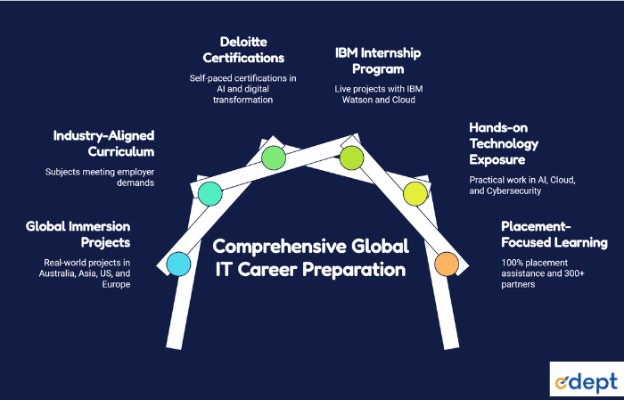
- Global Immersion Projects built into the course: Delivered through partnerships with Deloitte, IBM, HEX, and Practera, giving access to real projects across Australia, Asia, the US, and Europe
- Industry-aligned curriculum: Subjects like AI and ML, Security in Computing, and Advanced Web Programming are mapped directly to what employers need
- Deloitte Learning Academy certifications: Self-paced certifications in AI, data analytics, digital transformation, and business strategy, included in the program and delivered on the edept LMS
- IBM Internship Program: Live IBM-mentored projects using IBM Watson and IBM Cloud, with a ₹4,000 stipend for the top 2,000 performers nationally, plus an IBM and NASSCOM joint certification
- Hands-on technology exposure: Practical work across AI, Cloud, Cybersecurity, and Data Analytics rather than just theory papers
- Placement-focused learning: Backed by 300+ recruiting partners and 100% placement assistance from the college’s placement cell
This combination means students are not just studying IT. They are building a portfolio of real, global work before they even graduate.
How Students Can Maximize Their Global Immersion Experience
- Participate actively: Speak up, contribute, and take ownership of your part of the project
- Learn about global business practices: Read up on how international companies operate before jumping in
- Build strong teamwork skills: Learn to compromise, delegate, and support teammates
- Document every project: Keep records of what you built and why, not just the final output
- Build an international-ready portfolio: Collect your best work in one place recruiters can access
- Reflect project experience during placement interviews: Practice explaining what you did and what you learned, not just what the project was
Future Outlook: Why Global Exposure Will Be Essential for IT Careers
Technology careers are becoming borderless. Remote global teams are increasing, AI and cloud adoption are pushing companies to collaborate across countries even more, and employers are only going to care more about global workplace skills, not less. With India’s IT workforce projected to reach 7.5 million by 2030 and 126,000-plus new IT jobs expected by 2026, students entering the field now have a real advantage if they already know how to work in global settings.
Conclusion
Global Immersion Projects take students beyond textbook learning and put them face to face with real international business challenges, real teams, and real feedback. Along with technical knowledge, students walk away with communication skills, teamwork experience, leadership practice, and problem-solving ability, all things multinational employers actively look for. Combined with edept’s industry-focused curriculum, Deloitte Learning Academy certifications, and the IBM Internship Program, these projects help B.Sc. IT with Gen AI students graduate with the confidence and real-world experience needed for a successful, globally competitive IT career.
Related Links:
| Best Countries for Fastest Work Permits | Study abroad vs Direct Job abroad |
| Digital Transformation: A Complete Guide | Get International Internship Opportunity |