There has been rapid growth in the Cyber Security industry over the last few decades due to the development of new technologies such as Artificial Intelligence (AI) and Cloud Computing, where there has been an increase in demand for skilled Cyber Security professionals around the globe. As reported by the World Economic Forum, it is expected that the damages caused by Cybercrime will reach over $13 trillion annually by 2028. Another report by Cybersecurity Ventures suggests that millions of Cyber Security jobs are expected to remain unfilled by the end of 2026 and beyond. Given this consistent pattern of continued growth in future Cyber Security jobs, we can expect this trend to continue well into the future. In this guide, we will see how organizations today are not only looking for traditional security professionals but also experts who can work on AI and cloud security.
The future of cybersecurity is being shaped by evolving digital threats and an increase in dependency on technology. As businesses are opting for cloud infrastructure and AI systems, the attack surface will continue to grow for criminals.
Modern cyber attacks include:
- AI-powered phishing attacks
- Deepfake scams
- Ransomware-as-a-Service
- Cloud Infrastructure breaches
- Supply chain attacks
According to reports from IBM’s Cost of a Data Breach Report, the average cost of a data breach will continue to rise globally, which makes cybersecurity a top priority for organizations.
In the future, cybersecurity strategies will mainly focus on:
- Predictive threat detection
- AI-driven security monitoring
- Zero Trust architecture
- Real-time threat intelligence
Why Cybersecurity Jobs Will Continue to Grow
Cybersecurity job opportunities are likely to grow substantially in the next decade. Digital systems are increasingly essential in every industry, ranging from health care to finance to e-commerce to education to government, and thus security specialists are in growing demand globally.
Several aspects are fueling the expansion of cybersecurity careers:
- The number of cyberattacks has increased.
- Global shortage of skilled professionals
- Increasing cybersecurity regulations
- Growth of cloud and AI solutions.
According to ISC Cybersecurity Workforce Studies, the global cybersecurity workforce shortage continues to be in the millions, as organizations are finding it more difficult than ever to recruit qualified individuals. Some high-demand roles include Security Analysts, SOC Analysts, and Cloud Security Engineers. Ethical Hackers and Threat Intelligence Specialists also take huge roles in the cybersecurity sphere.
Enroll in industry-approved cybersecurity programs and secure the Digital Future. Click Here
How Artificial Intelligence is Transforming the Future of Cybersecurity Jobs
The use of machine learning is revolutionizing the way businesses recognize and react to cyber threats. Machine learning-powered systems can integrate a huge amount of information about security data and find any irregularities in the system in a very short amount of time.
AI is revolutionizing cybersecurity by using:
- Automated threat detection
- Behavioral analytics
- Predictive security monitoring
- Security automation and response systems.
AI is being exploited by threat actors as they look to improve the methods they define as cyber threats, and while AI is being utilized for its benefit to the business, the need for human intervention and experience is still very much needed. Rather than replacing Cybersecurity professionals, AI is altering their job descriptions.
Future cybersecurity jobs will increasingly require professionals who can collaborate with AI-powered security systems and can create security automation processes. These are the must-have key skills for a cybersecurity professional.
Future Trends in Cybersecurity Careers
The world of cybersecurity jobs is transforming, and technology is constantly evolving as the digital threats are getting more advanced. Those who are flexible, willing to learn and adapt to future trends, and acquire the skills that will be necessary will have a better career in the coming years. An important trend is the use of AI-powered security operations, where AI systems are leveraged to enhance the detection of threats, tracking of anomalies, and to accelerate the response to incidents. In the meantime, with the expansion of cloud computing, the need for cloud security experts to protect the cloud infrastructure and critical business information is increasing.
Identity and access management continues to be vital as organizations are shifting to Zero Trust security models that are grounded in the “never trust, always verify” principle. Moreover, cybersecurity automation is now a standard practice; companies use automated tools for quick threat management and orchestration for security. Another trend that is gathering momentum is IoT and critical infrastructure security. With the increase in the number of mobile phones and connected devices, it is becoming more important to protect them from cyberattacks.
Emerging Cybersecurity Roles in the AI Era
AI is transforming the cybersecurity landscape and opening up opportunities for new roles related to AI-driven security operations, automation, and threat forecasting. The need for experts who can safeguard AI systems and modern digital infrastructure is rising at an unprecedented pace, as more and more organizations turn to cutting-edge technology.
These new cybersecurity roles bring together traditional security skills and AI, cloud computing, automation, and threat intelligence capabilities.
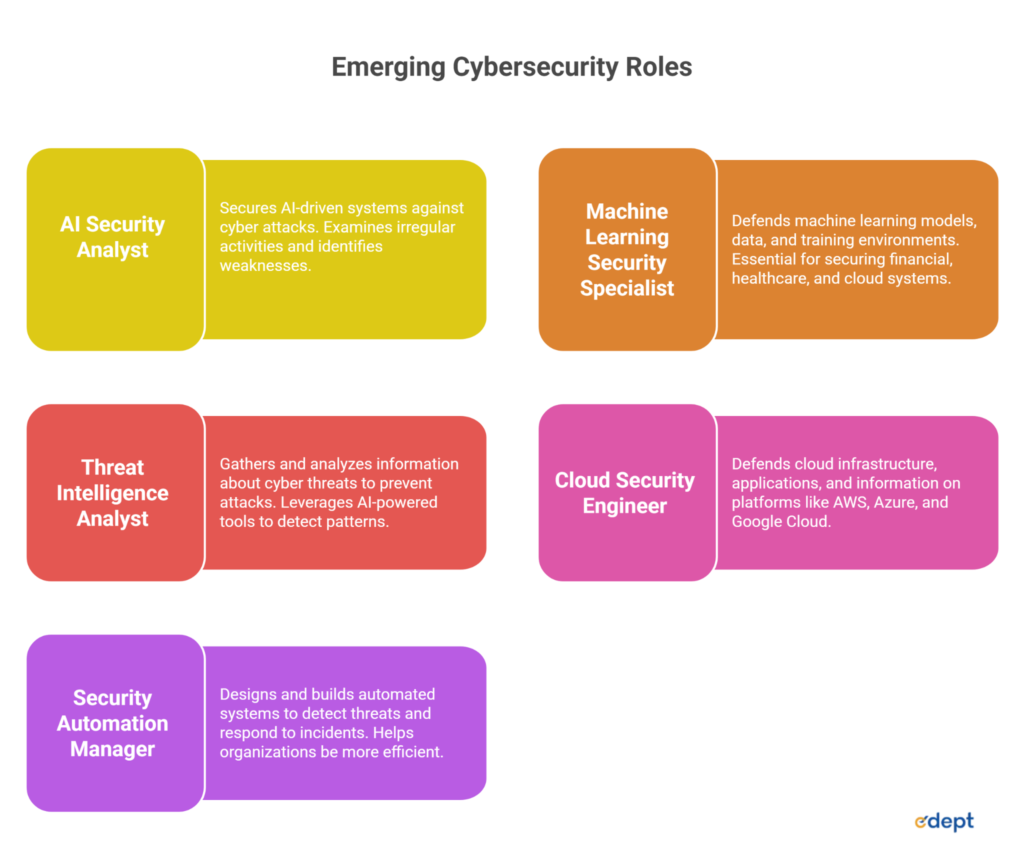
AI Security Analyst
AI Security Analysts are in charge of stopping AI-driven systems from being used in the wrong way through cyber attacks. They look at things that do not seem right, find weaknesses in AI systems, and help keep automated systems
Key Skills: AI tools, finding threats, looking at behavior
Machine Learning Security Specialist
Machine Learning Security Specialists protect machine learning models, data, and the places where they are trained from attacks like data and people trying to manipulate them.
They are very important for keeping healthcare, cloud, and other types of AI systems safe.
Key Skills: Machine learning, keeping data safe, protecting AI models
Threat Intelligence Analyst
Threat Intelligence Analysts collect information about cyber threats. Look at it to stop attacks before they happen and to see what might happen next. They use AI-powered tools and threat intelligence platforms to find new threats.
Key Skills: looking at threats using SIEM tools, doing cybersecurity research
Cloud Security Engineer
Cloud Security Engineers keep cloud infrastructure, applications, and information safe on platforms like AWS, Azure, and Google Cloud. This job is one of the needed cybersecurity jobs because more organizations are moving to the cloud.
Key Skills: keeping the cloud safe, IAM, network security, DevSecOps
Security Automation Manager
Security Automation Engineers design and build systems that can automatically find threats, respond to incidents, and watch over security. They help organizations be more efficient and faster at responding to things.
Key Skills: writing Python scripts using automation tools, working with SOAR platforms
Challenges of AI in Cybersecurity
Artificial Intelligence can process a huge amount of data in a shorter time frame and accurately as well; however, chances are it is not perfect. AI systems still require human intervention and supervision.
Potentially, cyber criminals are now using AI to develop sophisticated phishing attacks, automated deep fakes, and social engineering attack campaigns. As a result, the ability to detect and ultimately prevent cyber threats is becoming increasingly difficult.
False positives are also a major issue, where previously identified threats are misidentified or incorrect. IT intervention is essential to properly train an AI system (e.g., proper training will ensure an AI system classifies appropriate activity as either malicious or as an unclassified attack). Over-dependence on automation runs the risk of reducing the importance of humans making critical security-related decisions.
While artificial intelligence will augment traditional security controls for the network and provide organizations with a level of overall security that has not been seen before, human intelligence will continue to play a key role in risk mitigation, critical security-related decision making, and addressing complex information system security issues.
Ethical Consideration in AI-driven Cybersecurity
The number of AI cybersecurity ethical considerations that arise is increasing rapidly nowadays, specifically in terms of privacy, transparency, and responsible use of artificial intelligence. Though AI significantly increased the functionality of the system through its ability to automatically detect and react to threats, at the same time, AI generated additional ethical issues connected to data collection, analysis, and processing.
User safety is one of the primary concerns. Intelligent systems generally have capabilities of analyzing massive volumes of data, which include personal and company records, to identify anomalies. Otherwise, this may result in over-monitoring of actions and the misuse of sensitive information.
In addition, AI faces significant challenges in terms of possible bias and unfairness. If the AI product is trained using an incomplete dataset or data that contains biases, then the resulting security decisions made by AI may be flawed or unfair towards certain groups of people or activities.
To help users make an ethical choice while employing AI technologies, specific policies are implemented regarding AI governance, human oversight, ethical cybersecurity, etc. To prevent privacy violations, companies must consider individual rights when collecting data to implement proper AI products.
Also read: How to start your Cybersecurity Career
How to Prepare for the Future of Cybersecurity Careers
To prepare for the future of cybersecurity careers, it is beneficial to have a mix of technical expertise, hands-on experience, certifications, and a commitment to ongoing learning. The landscape of cybersecurity threats is constantly changing, and AI is increasingly playing a role in security operations, making it important for professionals to be aware of the latest technologies and industry trends.
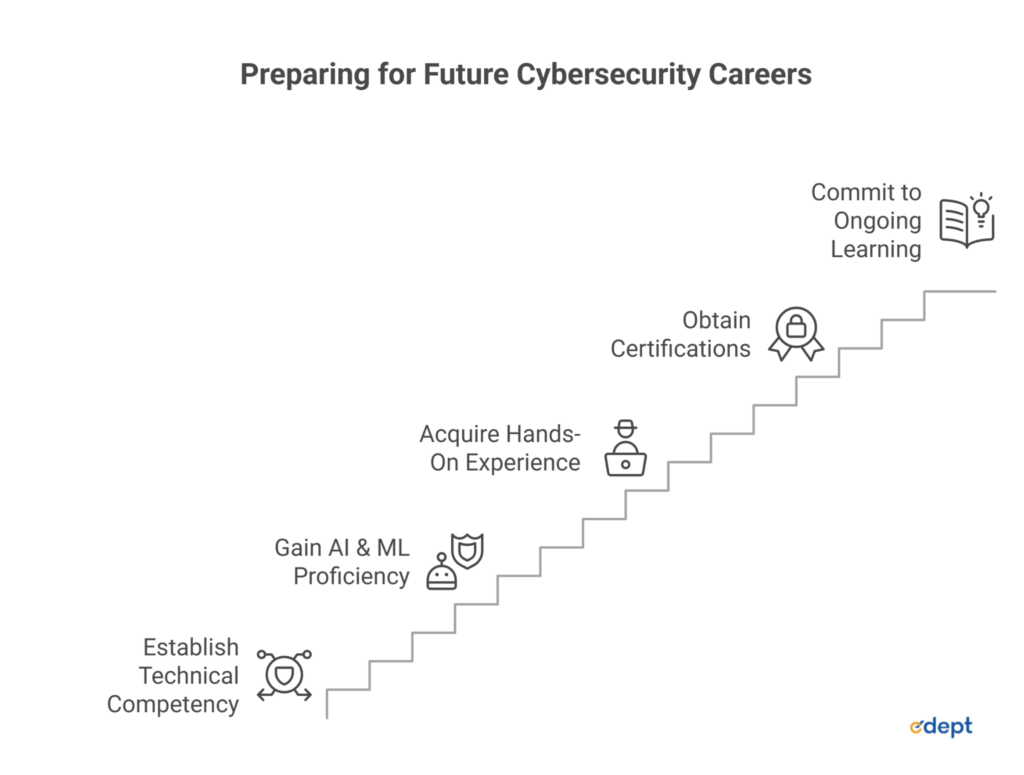
First, establish competency in:
- Networking and Operating Systems
- Cybersecurity fundamentals
- Cloud computing, cloud security
- Programming and automation basics
Additionally, aspiring cybersecurity experts need to gain proficiency in AI and machine learning, threat intelligence, and data analysis, which are becoming integral components of the evolving cybersecurity landscape.
It is also essential to get some hands-on experience. Students should work on:
- Security labs and simulations
- Capture The Flag (CTF) challenges
- Real-world security projects
- Should also be proficient in Threat hunting and incident response exercises
Certifications are used by employers to verify your knowledge and enhance employability. Some of the popular future-ready certifications are:
- CompTIA Security+
- Certified Ethical Hacker (CEH)
- CISSP
- AWS Security Specialty
- Microsoft Security Certifications
Is Cybersecurity a Good Career Choice For the Future?
There are a good number of cybersecurity job openings for professionals that can be found within a multitude of industries, including healthcare and cloud computing. A growing need exists for individuals who possess cybersecurity skill sets, and many employers continue to search for qualified individuals in the future.
Compensation in Cyber Security is also a key factor that lures professionals in this field. Entry-level professionals can earn competitive packages, while experienced specialists in cloud security, ethical hacking, AI security, and threat intelligence receive much higher salary packages globally.
Job security is also a key factor that makes students opt for cybersecurity as a career. Unlike other fields where the demand is decreasing owing to automation, there is a high demand for cybersecurity because companies will always seek professionals who can help them protect their information infrastructure against attacks that continually change. Given the prevailing situation, it is safe to say that cybersecurity is an occupation with a bright future ahead since it is highly sought after, lucrative, provides global opportunities, and ensures job security.
Conclusion
The future of cybersecurity positions will be dependent on evolving technology, including but not limited to the use of Artificial intelligence, the cloud, automation, and rapidly emerging sophisticated cyber threats. With the continued push for digital transformation, there will be a consistent need for trained cybersecurity professionals in all sectors throughout the world.
The transformation of security operations initiated by artificial intelligence has not eliminated human skillsets. Innovative opportunities are being created in many new areas of cyberspace that require highly trained cybersecurity personnel, including cloud security, threat intelligence, and security automation. As long as individuals keep current by actively reading and gaining knowledge & skills in Cloud Security, Programming, and Threat Analysis, they will have the most opportunities available in their field.
Related Links: