Today, the MBA landscape has fundamentally changed; it is not just about earning a prestigious degree. It is about choosing a domain that aligns with your interests, helps you build real-world skills, and ultimately pays well enough to support a successful career in the future. Management education in India is becoming a rapidly evolving sector. India has the second-largest pool of graduate management students globally, trailing only China, with a massive network of over 3,000 B-schools. When it comes to shaping your career in business, the most common question that comes to every aspirant’s mind is, ‘What should I pursue? MBA or a PGDM. This debate between PGDM vs MBA creates a lot of confusion among the management aspirants. Industry reports show that over 68% of PGDM graduates secure jobs within 3 months of graduation, compared with 58% of traditional MBA graduates. Both programmes help you build strong business skills, leadership qualities and achieve your career goals. In 2026, global business is evolving rapidly through digital transformation, cloud adoption, AI, and analytics. The ways companies hire, as well as the course design by institutes, have changed dramatically. Because of this reason, a candidate needs to understand the differences and strengths of both programmes before they make any final decision. The confusion is very real. People, most of the time, think both courses are the same thing with different names, but they are not. Both of the courses prepare you for the corporate world; they differ in structure, curriculum, recognition, and even the way they are taught. A good choice depends on what you want to learn, the type of college you want to join and the career path you wish to follow. In this blog, we will help you break down PGDM vs MBA, discuss the factors that affect your decision, and compare fees, value, scope, and placement opportunities. By the end, you will have a clear idea of which course actually fits your goals in 2026.
What Is an MBA?
Now, let us understand every detail about an MBA degree, which is one of the most recognized postgraduate degrees in the world.
Definition & Structure
An MBA, or Master of Business Administration, is a 2-year postgraduate degree offered by universities and colleges affiliated with a university. When a candidate usually enrols in an MBA, they follow a curriculum which is set and regulated by bodies such as the UGC. They usually operate on a university framework; hence, the programmes follow a well-structured academic calendar with fixed semesters, standard examinations and a well-built curriculum. This program is often recognised globally and mainly focuses on building a strong foundation in management and business. Here, students can choose from various specializations such as marketing, finance, HR, operations, strategy and analytics.
Curriculum Approach
MBA programmes are mainly focused on theories. The curriculum is built across foundational management subjects such as organisational behaviour, financial accounting, marketing management, HR and operations and strategic management. The syllabus is very standardised, and it is regulated by the university. It tends to be consistent across every batch and does not change rapidly. This builds academic depth and credibility about the programme.
Recognition & Accreditation
An MBA programme in India is approved by the UGC, which is the University Grants Commission and is the apex body for higher education. This makes the MBA a recognized degree both domestically and internationally. Many universities also hold accreditations from NAAC, AICTE, or global bodies like AACSB. The UGC recognized degree is especially for students who want to pursue further higher studies, go for a government job or explore opportunities abroad.
What Is a PGDM?
The PGDM, or Postgraduate Diploma in Management, is a postgraduate management programme offered by autonomous institutes approved by AICTE.
Definition & Structure
A PGDM is a 2-year full-time diploma programme. The institutes offering PGDM degrees are approved by the All India Council for Technical Education (AICTE). These institutes are not tied to any university syllabus, and hence it gives them more freedom to design and update the curriculum. This program is more practical and industry-driven and is designed to meet the current needs of the business environment. There is more flexibility in choosing your electives and specializations. It is best for candidates who want practical learning and industry exposure.
Curriculum Approach
The biggest advantage for a PGDM curriculum is its flexible nature. Since they are not bound by any specific universities, they can revise and change their course content regularly to match the growing industry needs. If you choose a PGDM, the learning is usually more industry-orientated. New subjects and domains such as analytics, AI, digital marketing, fintech and sustainable management are usually incorporated much faster in a PGDM than in an MBA programme.
Recognition & Accreditation
PGDM programmes are approved by AICTE, and reputed PGDM programmes are often equivalent to an MBA when accredited by the AIU (Association of Indian Universities). Top PGDM institutes also carry international accreditations like AACSB, AMBA, or EQUIS, which makes them well respected in private and global job markets
Key Differences Between PGDM and MBA
In order to understand the basic difference between an MBA and a PGDM, candidates should examine how the syllabus is created and updated. In 2026, as industries are evolving at a fast pace and new skills are needed every few months, many aspirants prefer PGDM for its flexible, modern approach. However, an MBA is still a good choice for those who want a strong conceptual foundation.
Degree vs Diploma
The most fundamental difference is that an MBA is a degree, whereas a PGDM is a diploma. An MBA degree is approved by the UGC, whereas PGDM programmes are approved by the AICTE. For government-orientated jobs or international opportunities, where we need a formal university degree, an MBA has a structured advantage. Whereas in the private sector, where employers mainly look for your skills, your internship experience and industry-related exposure, where more than just your degree, your practical knowledge and experience matter, this distinction does not matter.
Curriculum Flexibility
Most MBA programmes follow a fixed, structured curriculum and syllabus approved by the affiliated university. Although the curriculum is detailed and is built across foundational management subjects such as organisational behaviour, financial accounting, marketing management, HR, operations and strategic management. It is not updated frequently according to the growing needs of the industry. PGDM institutes, on the other hand, are very flexible in nature. Since they are not bound by any specific universities, they can revise and change their course content regularly to match the growing industry needs. They can introduce new subjects, redesign existing modules, and bring industry-related activities without waiting for any approval. They are more responsive to market needs.
Industry Relevance
PGDM programmes are more industry-relevant and are designed with input from industry experts. They include live projects, simulations, internships, guest lectures, industry visits and case studies as part of the regular curriculum. The MBA programmes are more detailed, comprehensive and academic in nature. Here, students gain a strong theoretical foundation, but they need to put some extra effort into bridging the gap between classroom learning and corporate market demands.
Global Recognition
An MBA degree is globally recognized especially for PhD, MS, or government roles in other countries. PGDM is also accepted globally, but its acceptance depends on the institute’s reputation and and accreditations. For instance, a PGDM from IIM Ahmedabad is globally recognized, but from a lesser-known institute, it may not carry that same weight.
PGDM vs MBA: Fees Comparison
Cost is one of the biggest factors when choosing between PGDM and MBA programmes.
MBA Fees
The MBA fees vary a lot depending on the universities. The government and state-run universities offer MBAs at a lower cost. It generally ranges between ₹50,000 and ₹600,000. The private institutes and colleges generally charge higher fees that range between ₹ 800,000 and ₹ 2,000,000, depending on their location, reputation and infrastructure.
PGDM Fees
PGDM programme fees are usually on the higher side, especially in the top institutes. Fees at leading institutes range between ₹ 10,00,000 and ₹ 25,00,000 for a full 2-year programme. Institutes such as IIMs, XLRI, and SP Jain usually charge ₹20 to ₹27 lakhs in some cases. The higher fees are usually due to updated curriculum, industry exposure, practical projects, internship opportunities and placement support.
ROI Analysis
The return of investment is where the comparison gets more complex. A top PGDM institute that charges higher fees may offer better placement support and salary packages, making the investment justifiable over the long term. ROI is just not about fees; it is about the salary you get after graduation and how fast you grow in your career. For example, a PGDM graduate from a premier institute who is placed at ₹ 15 lakhs – ₹ 18 lakhs can easily recover the tuition fees within 2 years of joining the workforce. A ₹10 lakh placement after a ₹3 lakh MBA gives a better ROI than a ₹6 lakh package after a ₹20 lakh PGDM. You should always look at the placement record of the institute before judging the value. An MBA from a sound and reputed government institute at a much lower fee offers a financially sound path.
PGDM vs MBA: Curriculum & Learning Approach
While both of them can help you advance your career, they differ fundamentally in their core structure. The way knowledge is delivered and practically applicable can help you shape your career readiness.
Theoretical vs Practical Learning
MBA programmes are usually built on strong academic foundations. Here you will study the core business concepts, frameworks, business economics, business ethics, financial accounting and organisational theory. This gives you a full understanding of how businesses operate. PGDM, on the other hand, is completely industry-orientated. The curriculum is based on real-world practical application. A bit of theoretical base is provided, but it focuses on applying various practical concepts. Classes often start with a real business problem and then move into the theory needed to solve it. They also include various case studies, internships, and industry visits.
Case Studies & Industry Exposure
Both programmes offer various case studies, but there is a difference in their depth and relevance. MBA courses use case studies that are in a more structured, exam-aligned manner. They are often drawn from well-known statistics or international business scenarios. PGDM case studies are more practical and current. They depend a lot on industry-related news, practical working experience, and internships. Here, industry exposure is more structured. Many courses include guest sessions by CXOs, industry mentors, and visits to corporate offices.
Skill Development Focus
MBA programmes mainly focus on building a strong base of business knowledge, communication, and academic research skills. They help in building strong analytical and research skills. Many MBA candidates believe that the well-structured exam pattern improves their ability to work within a proper system and process. PGDM programmes tend to emphasise skill development that matches the current hiring needs of the employer. They include data analytics, presentation skills, business storytelling, data-driven decision-making, leadership and digital tools.
PGDM vs MBA: Placements & Career Opportunities
For most of the students, the major metric while selecting for a management programme is the placement support. Let us now understand it a bit moe deeply
Placement Trends
Placements usually depend more on the institute rather than on whether the course is an MBA or PGDM. Top IIMs, ISB, XLRI, FMS, MDI, SPJIMR, and similar institutes report strong placements regardless of the qualification type. The top PGDM institutes report strong placement outcomes. The AICTE 2025 placement report showed that nearly 68% of PGDM graduates from accredited institutes secured jobs in consulting, analytics, and marketing within three months of graduation. The MBA placements vary widely depending on the institute. The top MBA colleges usually offer good placement support, whereas the smaller ones receive considerably modest salary packages.
Average Salary Comparison
Salary usually depends on the institute’s reputation and placement support. Graduates from top management schools in India usually earn between ₹15 and ₹25 LPA, while mid-tier schools fall in the ₹6–12 LPA range. Specialized PGDM programmes in business analytics, product management, and FinTech are seeing yearly salary growth of 20–25%, driven by strong demand from tech and consulting firms.
| Experience Level | MBA Salary (Average) | PGDM Salary (Average) |
| Fresher (0–2 Years) | ₹4–8 LPA | ₹5–10 LPA |
| Mid-Level (3–5 Years) | ₹8–15 LPA | ₹10–18 LPA |
| Senior Level (6+ Years) | ₹15–30 LPA+ | ₹18–35 LPA+ |
Note: Salaries may vary depending on the institute, specialization, industry, location, candidate skills, and market demand. Top-tier MBA and PGDM graduates often receive significantly higher compensation packages.
Recruiter Preferences
Most recruiters today think that both PGDM and MBA are equal as long as the institute is ok, reputable and accredited. Consulting firms, FMCG, tech, and BFSI companies usually hire from both MBA and PGDM candidates. However, in most cases, such as banking, public sector, and academic roles, MBA holders still lean slightly towards MBA holders, while startups and new-age companies often prefer PGDM graduates for their hands-on readiness
Both of these programes provide a wide range of specialization, which helps students to choose the career path aligned with their goals. 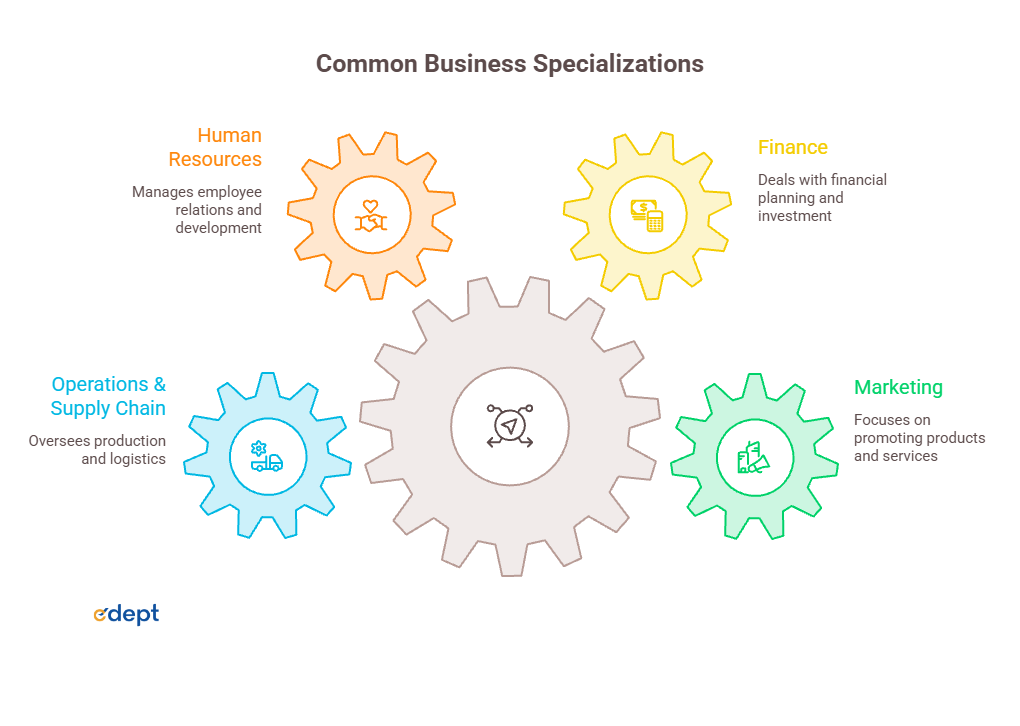
Common Specializations
Specialization |
Focus Areas |
Career Opportunities |
Marketing |
Brand Management, Digital Marketing, Consumer Behaviour, Sales Strategy |
Marketing Manager, Brand Manager, Digital Marketing Specialist, Sales Manager |
Finance |
Corporate Finance, Investment Banking, Wealth Management, Risk Analysis |
Financial Analyst, Investment Banker, Wealth Manager, Risk Consultant |
Human Resources (HR) |
Talent Acquisition, Employee Engagement, Organizational Development, Industrial Relations |
HR Manager, Talent Acquisition Specialist, Learning & Development Manager |
Operations & Supply Chain |
Logistics, Project Management, Procurement, Operational Excellence |
Operations Manager, Supply Chain Analyst, Logistics Manager, Project Manager |
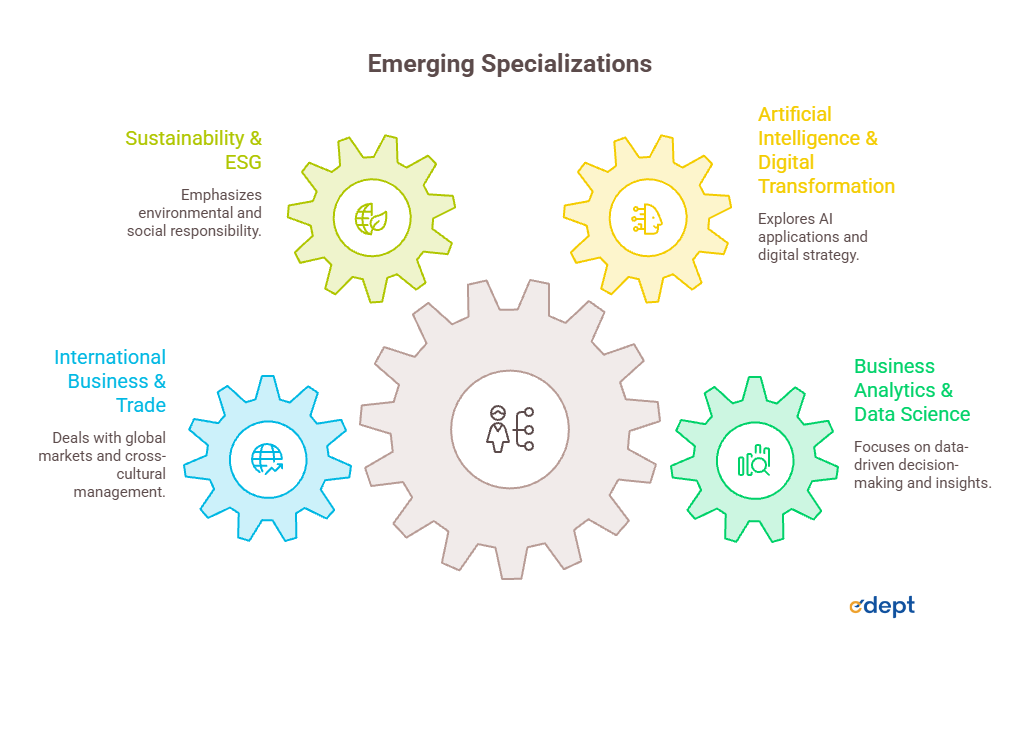
Emerging Specializations
Because PGDM institutions are autonomous and more flexible, they can rapidly introduce new, highly focused specializations to meet corporate demands:
| Specialization | Key Areas Covered | Career Opportunities |
| Business Analytics & Data Science | Predictive Analytics, Big Data, Data Visualization, Machine Learning Applications in Business | Business Analyst, Data Analyst, Analytics Consultant, Business Intelligence Manager |
| Artificial Intelligence (AI) & Digital Transformation | Generative AI, Automation, Digital Strategy, Emerging Technologies, Tech-Driven Innovation | AI Consultant, Digital Transformation Manager, Product Manager, Innovation Strategist |
| Sustainability & ESG | Environmental, Social & Governance (ESG) Practices, Corporate Social Responsibility, Renewable Energy, Sustainable Business Models | ESG Analyst, Sustainability Consultant, CSR Manager, Environmental Strategy Manager |
| International Business & Trade | Global Supply Chains, International Trade Laws, Cross-Cultural Management, Global Market Expansion | International Business Manager, Trade Analyst, Global Operations Manager, Export-Import Manager |
Flexibility in Choosing Specializations
The PGDM students often get more freedom and flexibility while choosing specializations, because PGDM institutions are autonomous and more flexible, they can rapidly introduce new, highly focused specializations to meet corporate demands. The MBA programmes usually have a well-built, structured university framework and may have rigid policies. Here it is more regulated and fixed, not flexible. If you want to design your own learning path, PGDM gives you more room to do that.
Advantages of MBA
Earning a Master of Business Administration (MBA) provides a major career advantage, some of which is:
Recognized Degree
An MBA is a universally recognized postgraduate degree. It is approved by the UGC, and it is accepted by the government and public sector organizations.It carries strong academic value and is easy to validate for higher studies, government roles, and international jobs. If the candidate wants to pursue higher education, secure a government job or look for global job opportunities, then an MBA is their best option.
Affordable Options
MBA programmes in government and public universities are far more affordable than most PGDM courses. For students with financial constraints, an MBA is a more accessible path to achieving your goal. Many government MBA programmes also have strong alumni networks and good placement support.
Suitable for Academic Careers
If your long-term goal is to pursue a PhD, MPhil, or a teaching career, then an MBA is the right choice for you. Universities across the globe recognize it as a degree, and it makes the application process for research programmes much smoother. It helps in satisfying all the academic qualification requirements. Some other advantages are:
- It provides accelerated career growth
- You have a higher earning potential
- It helps you build a vast network
- It increases your credibility and professional authority
Advantages of PGDM
A Post Graduate Diploma in Management (PGDM) provides an industry-oriented, highly practical business education
Industry-Oriented Curriculum
The PGDM programmes are regularly updated as per growing industry needs. Autonomous institutes control their own curriculum; they continuously update their course content. This means the students learn the tools, frameworks, and concepts that are already used in an organization.
Better Industry Exposure
The PGDM programmes typically offer more industry exposure. Internships, live projects, guest lectures, corporate visits, case studies, and industry mentor guides and programmes are deeply embedded in PGDM courses. By the time the students graduate, most students already have hands-on experience working with real business problems.
Strong Placement Opportunities
Top PGDM institutes have built strong corporate relationships over the years. They often have dedicated placement cells, alumni networks across Fortune 500 companies, and recruiters who come back year after year. If placement support and starting salary are your goals, then pursuing a PGDM degree from a reputed institute is what you need. Some other advantages are:
- You have a practical learning approach
- You get an option for dual specialization
- You benefit from direct mentorship by experienced faculty and seasoned industry professionals.
- Graduates often enjoy higher starting salary packages
Which One Should You Choose?
When considering an MBA vs PGDM, choosing one programme becomes easier when students think about what they want in the future and what their career path is.
Based on Career Goals
If your goal is to enter the corporate world quickly, build a private-sector career, or join a consulting/analytics/startup environment, a PGDM from a reputed AICTE-approved institute is the right choice for you. The curriculum will be more updated and advanced, along with being industry-relevant. If your goal is to secure a government job, academic career, PhD, or international higher studies, where a formal degree is very important, an MBA from a recognized university is what you need.
Based on Budget
If budget is your main concern, an MBA from a government university or a reputed private university at moderate fees provides a cost-effective career path with a reasonable outcome. The fees are low, and the degree value is high. Now, if you are in a position where you can afford a high investment and want premier industry experience, then PGDM is the right choice for you, where you can get various real-world experiences.
Based on Learning Preference
If you enjoy theory, structured learning, research, and detailed academic study, along with a conventional learning pattern with a clear syllabus and examination patterns, an MBA will be the best choice for you. If you prefer learning by doing, case studies, projects, internships, and solving real business problems, a PGDM will feel more natural. It is more industry-relevant and practical.
Explore Edept’s Management Programmes
Why Choose Edept for Your PGDM or MBA?
Once you decide between PGDM and MBA, the next decision is equally important: where you enrol matters as much as what you enrol in. If you want an MBA that goes beyond textbooks and actually prepares you for the job market, you should explore about edept . Founded by INSEAD and IIM alumni, edept partners with leading universities like SGT University and Shree L.R. Tiwari Institute of Management & Technology to deliver industry-led MBA programmes in Business Analytics and Finance. What makes edept different is its strong focus on employability. Your degree comes with certifications powered by Deloitte Learning Academy, a joint IBM + NASSCOM certification through live industry projects. The IBM Internship Program even offers stipends to top-performing students. You also get a Global Industry Immersion with exposure to business hubs across Asia/GCC, helping you build an international portfolio. With 100% placement support, access to a 300+ recruiter network, scholarships worth up to ₹1.5 crore, and a curriculum that includes Python, AI, predictive analytics, and strategic management, edept gives you everything you need to launch a high-paying career in 2026, not just a degree, but real career outcomes. Both programmes are built on the same foundation: industry-relevant curriculum, global exposure, and job-ready outcomes. Whether you are drawn to finance, data, or general management, edept has a structured path for you.
Conclusion
The PGDM vs MBA debate does not have a winner; it entirely depends on your choice and your career goals. Both are strong management programmes and have produced strong business leaders, executives and successful entrepreneurs. The right choice depends on your career goals, learning preferences, and financial situation. If you are looking for a deep academic foundation, broad global recognition and are drawn towards a structured academic experience, then an MBA is the right choice for you. If you want a flexible, industry-aligned programme with strong placements and modern specializations, a PGDM may suit you better. In 2026, as industries are evolving, both programmes will hold value, but your choice should align with your long-term career ambitions. Are you interested in the traditional route, or are you looking for a hands-on, modern approach to learning and career building? Before enrolling, you should do your research in detail. Check the institute’s accreditation, placement record, alumni network, faculty, and curriculum. The brand of the institute will always matter more than whether it is a PGDM or an MBA. The right programme at the right institute will always open the right doors for you.