For 2026, the highest-paying MBA specializations revolve around technology, data, and strategic leadership. Top choices include Business Analytics & Data Science, FinTech/Finance, Digital Marketing, AI & Product Management, and Strategic Management, with expected average salaries frequently exceeding ₹18–35 LPA in India or $100k+ globally.
Today, the MBA landscape has fundamentally changed; it is not just about earning a prestigious degree. It is about choosing a domain that aligns with your interests, helps you build real-world skills, and ultimately pays well enough to support a successful career in the future. Employers and companies are not just looking for a degree now; they want professionals who can make critical decisions, who can lead data strategy, who can solve complex problems and who can adapt to this fast-changing business environment. Many students and working professionals who start their MBA journey now have a common question in their minds: “Which MBA Specializations will give me the best return on my money as well as my precious time?” or ‘Will this degree actually help me to move forward in my career?
Now, these all are valid questions, but the answers are not the same for everyone. The salary range, the career scope and growth and, most importantly, the demand vary widely across various MBA streams. Companies nowadays need finance professionals who have fintech knowledge, marketers who are aware of AI-driven trends and analytics, and HR professionals who can understand how flexibility and remote work opportunities can increase the efficiency of the company and improve the workforce dynamics. Hence, the choice of your specialization at present will directly impact and determine which door will open in your career tomorrow.
In this blog, we will walk you through the best MBA specializations for high salary in 2026, the average salary you can expect after completing your degree, what each specialization offers, and how you will pick the one that fits your career goals and strengths. By the end of this blog, you will have a much clearer picture of where your MBA can take you.
Why Choosing the Right MBA Specialization Matters
An MBA is one of the biggest career investments that you will make in your entire career journey. Choosing the right MBA specialization will help you in shaping what you will study in your business school journey, what projects you will do, what internships you will get, and the various job opportunities that will open after you complete your programme. The right specialization can help you improve your career path and fast-track your growth; on the other hand, a wrong one can get you stuck in a position that does not match your strengths and skills.
Impact on Salary & Career Growth
Your specialization can directly impact your starting salary package as well as your earning potential in the long run. A candidate who has done an MBA in finance or business analytics will be regarded more favourably and have more earning potential than a candidate who has done a normal general MBA. The correct choice in your MBA journey will open doors for various opportunities and give you a better return on your investment.
Industry Demand Trends
The business environment and industries are evolving at a very fast pace. Artificial intelligence, data-driven decision-making, adoption of the cloud, and digital transformation are completely reshaping all sectors, including fintech, IT, banking, healthcare, and e-commerce. Now, the specializations which align with these transformations are data analytics, business analytics, finance, and the role of artificial intelligence. These domains are experiencing strong demand and high salary benchmarks. If you pick a trending stream like these, it will be relevant in a competitive job market.
Long-Term Career Opportunities
A good specialization is not just for your first job; it is important for your entire career journey. It should have the capability to support your career for the next 10-20 years. The domains or streams that help you build core skills such as decision-making, analytics and leadership tend to support you in your whole career path. They help in providing a steady career growth and stability, even if the industry shifts.
Top MBA Specializations for High Salary in 2026 (600–700 words total)
Some of the top MBA specializations for high salary in 2026 are as follows:
MBA in Finance
Finance is one of the highest-paying and most popular specialization in an MBA programme. This demand for finance professionals spans over investment banking, corporate finance, asset management, consulting and fintech. It is a great pick for students who love numbers, enjoy problem-solving and making strategic decisions. This domain mainly focuses on financial analysis, planning, taxation, and treasury management.
Some of the key job roles include portfolio manager, investment banker, corporate treasurer, financial controller and financial consultant. In India, the starting salary for an MBA in finance from a reputed institute typically starts between 6 LPA and 12 LPA. At the mid-level, the professional with 5-8 years of experience can earn between 15 LPA and 20 LPA. Finally, the senior leaders often earn more than 30 LPA. Globally, finance professionals earn much more, making this career a strong choice for professionals who want to go abroad. Some of the key recruiters include HDFC Bank, ICICI Bank, JP Morgan, Deloitte, KPMG and McKinsey.
What makes edept stand out?
edept, in partnership with the Shree LR Tiwari Institute of Management and Technology, offers an MBA in business analytics and finance. Your degree comes with certifications powered by the Deloitte Learning Academy and a joint IBM + NASSCOM certification through the IBM Internship Program, where students work on live projects. There is also a global industry immersion experience built into the curriculum, giving you exposure to international business hubs in Asia/GCC. With 100% placement support, a network of 300+ recruiters, and partners like CFA Society India and Emurgo, edept learners are placed in roles such as business analyst, market analyst, and BI analyst with strong starting salaries.
MBA in Business Analytics
Business analytics has become one of the fastest-growing MBA specialization in 2026. Today, every company, be it a start-up or a Fortune 500, depends on data. It helps them to make data-driven decisions, understand customer behaviour, predict future trends and finally make smarter decisions. The business and data analytics market is estimated to reach roughly USD 302 billion by 2030, growing at a CAGR of 28.7%. This itself provides a large scope for the MBA graduates to secure a future in business analytics. This specialization teaches you to use various tools such as Python, Power BI, Tableau, and machine learning, which help in converting raw data into actionable insights.
Some of the key job roles include business analyst, data analyst, business intelligence analyst, and market research analyst. The entry-level salaries in India usually range between 6 LPA and 10 LPA. At the mid-level, the professional with 5-8 years of experience can earn between 14 LPA and 22 LPA. Finally, the senior leaders often earn more than 40 LPA. The industries hiring are banking, e-commerce, IT, healthcare and retail.
What makes edept stand out?
edept in partnership with SGT University, Gurugram, offers a dedicated programme in MBA in Business Analytics. They have an advanced curriculum and cover topics like machine learning, predictive analysis, data visualization, and blockchain. A 5-day international immersion in Dubai, Singapore, or Malaysia is included in your fees. Global Industry projects & internships with IBM, Practera, HEX and Deloitte. Gain hands-on, project-based learning with internship opportunities from IBM, plus earn a joint certification from IBM and NASSCOM upon successful project completion. Hands-on training in Excel, Power BI, Python, financial modelling, CRM, and AI in business and direct access to 300+ hiring companies from Day 1.
MBA in Marketing (Digital & Growth)
Marketing has undergone a major transformation; it is no longer just about ads, campaigns and brand awareness. It now involves data, growth, creativity, performance and consumer psychology. This shift has made an MBA in marketing a very good option for candidates who understand people and their behaviour patterns. This domain focuses on marketing analytics, communication, sales and distribution, digital marketing, and consumer behaviour. Some of the key job roles include digital marketing manager, brand manager, growth hacker, product marketing lead, marketing lead, and content lead. Entry-level salaries typically range between 5 and 8 LPA. At the mid-level, the professional with 5-8 years of experience can earn between 12 LPA and 18 LPA. Finally, the senior leaders often earn more than 30 LPA. The professionals who combine creativity with analytical thinking, using various tools such as Google SearchConsole, Analytics, and Meta Ads Manager, are highly valued.
MBA in Operations & Supply Chain
Operations are the backbone of any business organisation. An MBA in Operations Management is a very crucial programme that teaches you how to streamline processes that are followed in an organization, including workflows, product development, and final delivery. This domain teaches you how you can manage supply chains, optimise logistics, and finally improve efficiency. It is very suitable for candidates who enjoy problem-solving, planning and process improvement. Some of the key roles include operations manager, supply chain analyst, logistics head, procurement head, and plant manager. The fresh graduates earn between 6 and 8 LPA. At the mid-level, the professional with 5-8 years of experience can earn between 12 LPA and 18 LPA. Finally, the senior leaders often earn more than 40 LPA. The industries with strong demand for operations management include automobile, e-commerce, FMCG, and manufacturing.
MBA in Information Technology
An MBA in IT merges tech expertise with strategy. It is ideal for candidates who are interested in learning about information systems and business by combining both concepts. You get to learn about IT management, cybersecurity, software systems and digital strategy. Further, you will come across trending topics like cloud computing, AI and automation, machine learning and many more. Some of the key job roles include IT manager, product manager, technology consultant, project manager and CTO. In India, the starting salary for an MBA in IT from a reputed institute typically starts between 7 LPA and 12 LPA. At the mid-level, the professional with 5-8 years of experience can earn between 15 LPA and 22 LPA. Finally, the senior leaders often earn more than 55 LPA. They have a huge demand in technology-based companies such as TCS, Infosys, Wipro, HCL, L&T, Hexaware, Google, and IBM.
MBA in Human Resource Management
HR is not just about admin and hiring tasks; it has evolved a lot. Today, the HR function involves strategic workforce planning, shaping company culture, organizational development, and building leadership pipelines. This domain focuses on analytics, training and development, talent management and employee retention. It is suitable for candidates who are people-oriented, good with planning and strategy, and are ethical. Some of the key job roles include HR manager, talent acquisition lead, chief people officer, HR consultant, and HR business partner. In India, the starting salary for an MBA in HR from a reputed institute typically starts between 4 LPA and 7 LPA. At the mid-level, the professional with 5-8 years of experience can earn between 10 LPA and 15 LPA. Finally, the senior leaders often earn more than 30 LPA.
Emerging MBA Specializations with High Salary Potential
The emerging MBA specialization mainly focuses on technology, data and sustainability. Some of the top domains include data science, artificial intelligence, international business and healthcare management.
MBA in Data Science
In 2026, India is emerging as a global hub for data science, with projections indicating demand for over 1.5 million professionals and over 2 lakh open job positions. This industry is experiencing a 28% annual growth rate.
An MBA in data science is a new and trending concept; it combines business strategy along with advanced data techniques. It focuses on applying technical insights and knowledge to face business challenges. It combines core subjects such as finance, marketing, and operations, along with technical aspects like data modelling, visualization, AI, and big data technologies. Some of the key job roles include data science manager, AI strategy consultant, business intelligence analyst, and analytics consultant. An MBA in data science offers a starting salary, typically ranging between 8 and 15 LPA, and experienced professionals can earn between 30 and 50 LPA, depending on the skill, experience level and institution.
MBA in Healthcare Management
The healthcare sector in India is expanding rapidly and is driven by the adoption of digital health, new reform policies, new insurance rules and the growth of various private hospitals. It mainly focuses on hospital operations, various health policies and pharmaceuticals. It helps in preparing professionals for various leadership positions, such as managing cost, quality and patient-orientated services. Some of the top job roles include hospital operations manager, healthcare consultant, health IT manager, and marketing executive for pharma-related services.The starting salary range is between 4.5 and 8 LPA; the mid-level professionals with 4-8 years of experience earn between 8 and 15 LPA, and the experienced professionals earn between 15 and 40 LPA.
MBA in International Business
An MBA in international business helps one specialize in global trade practices, foreign exchange programmes, cross-cultural programmes, and international finance. It is ideal for candidates seeking a managerial career in domains such as international financial management, global logistics, international marketing, export, and import. Here you will learn about cross-cultural understanding and communication, strategic and critical analysis, global business expertise, and so on. Some of the key job roles include international business consultant, global chain manager, international business strategist, and global project manager.
The freshers usually earn between 7 and 12 LPA, and senior roles can earn between 25-40 LPA.
Salary Comparison by MBA Specialization
The salary in an MBA is influenced by specialization, the institution and your year of experience. Finance, analytics, consulting and data science are leading and among the fastest to grow.
Entry-Level Salary
At the entry level, the highest paying specialization include finance, consulting and analytics. The salaries range between 15 and 25 LPA from top-tier institutes for entry-level employees or beginners. For candidates graduating from B-schools, the salaries usually range between 4.5 and 10 LPA. Currently, MBAs in business analytics, data science and product management are emerging as top-paying options.
Mid-Level Salary Growth
After 5-8 years of experience, the finance and marketing professionals, particularly in digital roles, see a significant jump. The salaries usually range between 12 and 25 LPA. Some of the specialized roles in operations or IT management show a consistent job progression, with managers often reaching 15-25 LPA in this phase.
Senior-Level Earning Potential
At the senior level, finance professionals, mainly those who are in investment banking, private equity or at the CFO level, earn the most, with salaries often exceeding 50 LPA. The senior managers and senior consultants often earn between 25 and 30 LPA. At this stage, what matters most is not just your technical expertise but also what impact you are creating on the business, stakeholder management, and your ability to lead large teams.
Salary comparison by experience:
ENTRY LEVEL – 0-2 YEARS
| SPECIALIZATION | SALARY |
| MBA in Business Analytics / Data Science | ₹7–12 LPA |
| MBA in Finance / Investment Banking | ₹25–45 LPA (Top-tier/IB) |
| MBA in Consulting (MBB) | ₹28–45 LPA (Top-tier) |
| MBA in Information Technology Management | ₹8–15 LPA. |
| MBA in Marketing (FMCG) | ₹12–20 LPA. |
MID-LEVEL – 3-7 YEARS
| ROLE | SALARY |
| Product Management | ₹10 LPA – ₹22 LPA. |
| Management Consultant | ₹12 LPA – ₹25 LPA+ |
| Business Analytics | ₹20+ LPA. |
| Marketing Manager | ₹7 LPA – ₹15 LPA. |
| Operations/Supply Chain | ₹12–20 LPA. |
SENIOR LEVEL – 8-15 YEARS
| ROLE | SALARY |
| Finance & Analytics Leaders | ₹25 LPA – ₹50 LPA+ |
| IT Management/Technology Leaders | ₹25+ LPA. |
| Strategy/General Management | ₹35–55 LPA. |
| CXO/Leadership Roles | ₹70 LPA – ₹2 Crore+ |
2026 Salary Comparison by Specialization:
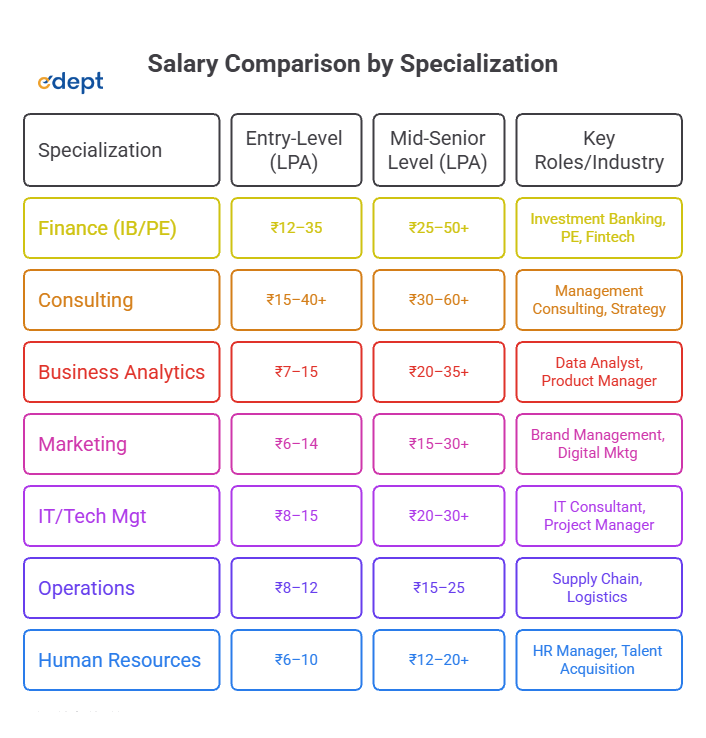
Note: Salary ranges vary based on college, location, and experience.
Factors That Influence MBA Salaries
Various factors influence the MBA salaries. Some of them are the industries where you want to work, your prior work experience, the institute from which you have obtained your degree and the geographic location.
College/Institute Reputation
The institute or college from which you have graduated plays a vital role in your first placement and your entire career path. IIMs, XLRI and other similar top-tier institutes offer high placement assistance and attractive salary packages. However, the mid-level institutes with strong connections across various industries and mainly those that work with companies such as IBM, Deloitte, and KPMG, offer competitive salaries and great outcomes for candidates.
Skills & Certifications
Skills and certifications are both significant factors that play a very important role during your MBA journey. The skills that you actually gain during the programme will help you get a reputable job and increase your earning potential. Certifications from Google, Microsoft, AWS, and CFA are easily noticed by recruiters, and they increase your chances of getting the job. The candidates who graduate with a degree and also pursue a certification receive many better and more interview letters. The programmes that can embed these certifications in their curriculum are really beneficial for the candidates.
Work Experience
The MBA graduates who have 1-3 years of work experience normally earn more than the fresh graduates who do not have any work experience. The experienced professionals have experience of the business environment and the challenges faced by businesses; this makes them productive during the hiring process. If you have any work experience before joining the MBA programme, it can increase your resume credibility, improve your career starting journey and your future long-term growth.
How to Choose the Right MBA Specialization
Choosing the right specialization completely depends on your strengths, career goals, your interests and market demand.
Align with Career Goals
Your future goals are an important factor when you want to choose a specialization.You need to take time to reflect on your future career path, as this decision is very crucial for your entire career journey. You need to ask yourself, “Where do I want to be in the next 7-10 years?” If you aspire to lead a financial institution, then finance will be your path. If you love working with numbers and technology excites you, then data analytics and business analytics are your accurate destinations. Knowing your goals will help you select a specialization that aligns with your aspirations and career path.
Evaluate Market Demand
Another important factor when choosing your specialization is its current demand in the job market. You need to do extensive research on which job roles are trending, what skills the recruiters are looking for and where the compensation is increasing day by day. Specialization with a high market demand can be very helpful for you in getting jobs with good salaries. Understanding where the market is heading will help you not only in the current scenario but also for the next 5 years.
Consider Your Strengths
The best specialization is one where your natural strength is working in your favour. If you love solving complex problems, enjoy analytics, and are detail-oriented, then finance or analytics will be your ideal domain. If you are a person with strong communication skills and love working with people, then HR or marketing is your best choice. A career that involves your interests and strengths tends to grow a lot faster.
Why Consider edept for Your MBA
If you want an MBA that goes beyond textbooks and actually prepares you for the job market, you should explore about edept . Founded by INSEAD and IIM alumni, edept partners with leading universities like SGT University and Shree L.R. Tiwari Institute of Management & Technology to deliver industry-led MBA programmes in Business Analytics and Finance.
What makes edept different is its strong focus on employability. Your degree comes with certifications powered by Deloitte Learning Academy, a joint IBM + NASSCOM certification through live industry projects. The IBM Internship Program even offers stipends to top-performing students. You also get a Global Industry Immersion with exposure to business hubs across Asia/GCC, helping you build an international portfolio.
With 100% placement support, access to a 300+ recruiter network, scholarships worth up to ₹1.5 crore, and a curriculum that includes Python, AI, predictive analytics, and strategic management, edept gives you everything you need to launch a high-paying career in 2026,not just a degree, but real career outcomes.
Conclusion
An MBA is not just a degree; it is a major turning point in your career path. The specialization which you will choose today will help you shape your salary, job role and your career path. No single specialization is best for all students; the right choice is the one that suits your natural strengths, skills, interests, long-term goals and job market trends.
In 2026, the highest-paying specialization are finance, business analytics, IT, and marketing. Emerging domains like data science, healthcare, and international business are gaining importance. One rule should be applied to everyone: that no matter what specialization you choose, do not focus on what your friends or colleagues are choosing. The job market in India always looks for genuine expertise. A candidate who is more curious and is more willing to know about a specialization will be a far better student than one who is not aware of their interests and strengths. You should choose the path where you are willing to work harder, learn more, and show your genuine interest. Take your time to evaluate your strengths, research the market and choose your specialization.
FAQs
Which MBA specialization has the highest salary in 2026?
In 2026, MBA in Business Analytics and MBA in Finance (including Fintech) offer the highest starting salaries, often exceeding ₹20–35 LPA for top-tier graduates.
Is an MBA in Business Analytics worth it?
An MBA in Business Analytics is highly worth it for professionals seeking to bridge the gap between data science and strategic management, offering strong ROI through high demand and lucrative salaries, particularly in tech-driven roles
Which MBA specialisation is best for the future?
For the future, the best MBA specializations focus on technology, data-driven decision-making, and sustainable leadership, with Business Analytics, Artificial Intelligence (AI), Finance/FinTech, and Marketing leading in demand
What is the salary after an MBA in Finance?
In 2026, the average starting salary for an MBA in Finance in India typically ranges from ₹6 LPA to ₹15 LPA, with a general average of around ₹8.5–₹10 LPA.
Does college impact MBA salary?
Yes, the college you attend for an MBA significantly impacts your salary, with top-tier institutions (such as IIMs, ISB, and leading global business schools) generally offering much higher placements,
Which MBA specialization is in demand?
The most in-demand MBA specializations for 2026 include Business Analytics, AI & Data Science, Finance, Marketing/Digital Marketing, and Supply Chain Management
Can I switch specialization later in my career?
Yes, you can absolutely switch specializations later in your career
Is MBA in HR high paying?
Yes, an MBA in HR can be a high-paying career path, particularly with experience, skill specialization, and graduation from top-tier institutions.
Which MBA is best for international jobs?
For international jobs, the best MBA specializations are International Business, Finance, Business Analytics, and Marketing, which are highly demanded in multinational corporations and across borders.
How do I choose the right MBA specialization?
Choosing the right MBA specialization involves aligning your personal interests, professional skills, and long-term career goals with industry demand and salary prospects