The UI/UX sector is taking over the frontend sector at a large scale, with students who are pursuing Computer Science and Design programs going for this domain. With the rise of the internet and social media, companies are pursuing digital product development and are hiring candidates proficient in both technology and design thinking. This trend of pushing online ads and products has expanded the UI/UX Career Scope for CSE design students. The global UI/UX industry has shown significant growth as product-based organizations and SaaS industries are turning towards using design-based marketing for better user experience. According to the industry reports, companies are prioritizing user experience to improve customer retention rates up to 200%, which makes UI/UX one of the most business-critical functions in modern product development. In this guide, we will cover everything you need to know about the UI/UX career scope as a CSE Design student globally, so you can take the right steps to have a long, fruitful career in the UI/UX domain.
What is UI/UX Design?
The process of creating digital products that are actually visually appealing and easy to interact with falls under UI/UX Design. The main focus of a UI/UX engineer is to improve the user experience with respect to websites, mobile applications, and software platforms. When we talk about UI design, its main focus is to deal with the visual appearance of a product, while UX design focuses more on improving the overall user experience and usability. Modern businesses are keen on using digital products to attract customers, considering the bloom in social media users and the internet. For this, they require professionals who can actually use their creativity and technical understanding to build an effective digital experience.
Understanding UI Design
UI stands for User Interface, and as the name suggests, its main focus is on the visual and interactive elements of a product. Key elements a UI engineer works on are designing different layouts, buttons, and other assets like icons, spacing, and the overall interface experience. Their main goal lies in creating an interface that is both visually interactive and easy to use for the users. Some key areas that UI design covers include:
- Designing systems and interfaces
- Creation of a responsive layout
- Design systems and UI consistency
- Typography and color theory
Understanding UX design
UX stands for User Experience, and its main focus is how a user interacts with their digital product, be it a website or any mobile application. UX designers work on understanding key aspects, like understanding user behavior, and making decisions on them to improve customer satisfaction for a better product experience. Key tasks that a UX designer indulges in include having proper user research for generating insights, analyzing how other competitors are working, wireframing, journey mapping, and prototyping. Instead of just focusing on the visuals, a UX designer also ensures that a product is easy to use by all kinds of customers and actually aligns with the customer’s needs.
Difference Between UI and UX
In general, we talk about UI and UX designers in the same phrase, considering both of them work on designing a digital product. But when we go in depth, we can easily recognize key differences in both of their tasks. A UI designer mainly deals with the interactive and visual appearance of the product, while a UX designer focuses more on improving the overall user experience.
| UI Design | UX Design |
| Main focus is on visual design and interface appearance | Focus on improving user experience and usability |
| Work on typography and layouts | Mainly work on user research and problem-solving |
| Ensuring an attractive and consistent interface | Ensure products are intuitive and easy to use |
| Use tools like Figma and Adobe XD | Use wireframes, prototypes, and usability testing |
Why CSE Design Students Have an Advantage in UI/UX Careers
The UI/UX industry is showing good growth in hiring professionals who are proficient in both technology aspect as well as design. That is where Computer Science and Design students have the upper hand compared to traditional design-only graduates. CSE Design programs have a good combination of both technical teaching and creative problem solving, covering both the UI and UX key elements. Today, organizations are not just looking for designers to create Figma templates, but someone who can actually create those designs and publish them through digital products, covering key aspects like better user interactivity and user retention. As businesses are moving towards AI-driven applications, SaaS platforms, and cloud-based products, demand for hybrid professionals will continue to grow rapidly.
Technical + Design Combination
The biggest advantage a CSE Design student has over a traditional design-degree holder is the combination of both coding and creative design knowledge. CSE Design programs teach students how interfaces are technically implemented inside real-world applications. Having coding knowledge, specifically frontend knowledge, is the major benefit a CSE Design student has over a traditional design degree holder. Frontend skills like HTML, CSS, and other frontend workflows, along with designing platforms like Figma and Adobe, make recruiters hire them faster for better industry-driven skills. At the same time, along with the technical knowledge, having a design background helps them think creatively about layouts, user flows, and usability improvements.
Better Product Understanding
Due to exposure of CSE Design students to software systems as well as user experience concepts, they develop strong product understanding. Having a good understanding of how users interact with digital products helps them build key skills that are industry-relevant. They can identify limitations in the early stage and suggest practical UI solutions during product development cycles. In modern systems governed by agile methodology, cross-functional understanding significantly improves the workflow efficiency of design and engineering teams.
Demand for Hybrid Professionals
In today’s market, organizations want employees who can handle multiple aspects of product development instead of working in isolated roles, causing an increase in demand for hybrid professionals globally. Professionals who can actually understand designing the systems and front-end implementation do receive better overall career opportunities in this field than someone who is just good at design creation. This trend is one of the major reasons why the UI UX career scope for CSE design students is expanding strongly in 2026 and beyond.
Read more: Computer Science Vs. Computer Science And Design: Everything You Need To Know
Skills Required for UI/UX Careers
You must possess good knowledge in both visual design skills and technical awareness, along with good problem-solving ability, to build a successful UI/UX career globally. Modern UI/UX professionals should be able to create interfaces that are easy to use, being user-friendly while being visually appealing. Organizations hiring UI/UX professionals in 2026 and beyond prioritize candidates who can actually handle designing the systems and developer collaboration together.
UI Design Skills
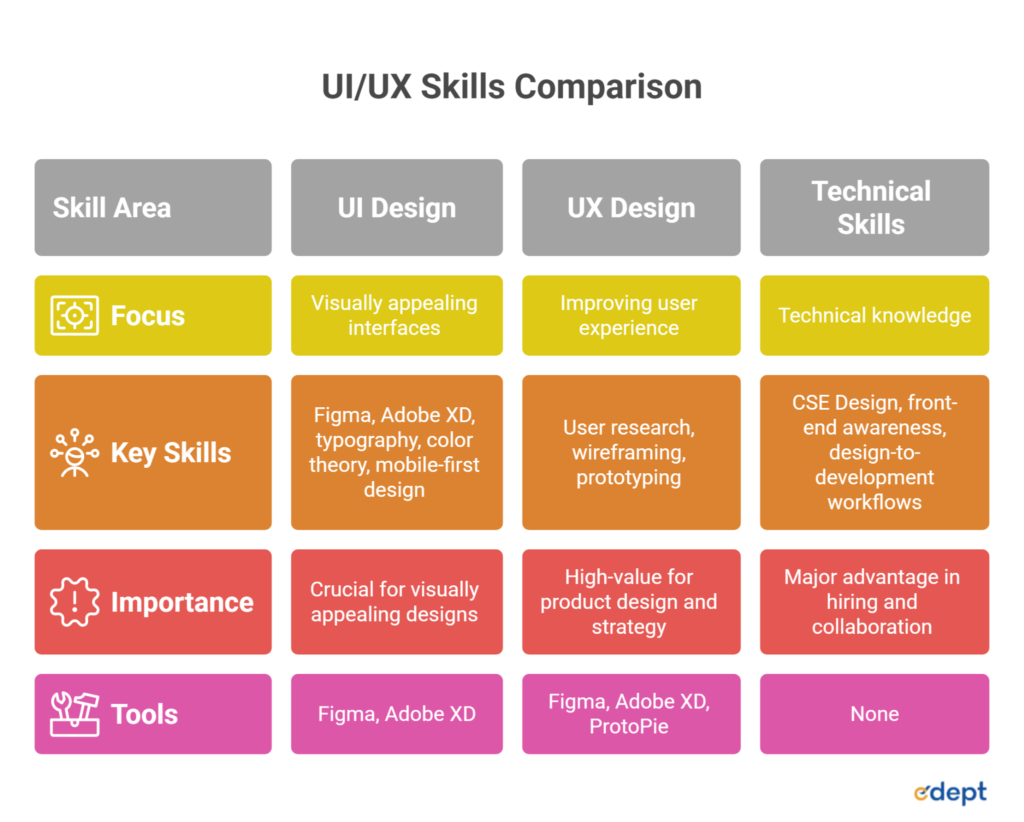
The main focus of UI Design skills is on creating visually appealing and interactive digital interfaces for different digital products like websites, mobile applications, and software products. One of the most important tools in modern UI design is Figma, which is widely used by organizations irrespective of their sizes, ranging from startups to SaaS companies. Many companies now consider Figma proficiency a mandatory skill for entry-level UI/UX roles. Some important UI design skills include key design tools like Figma and Adobe XD, having a good understanding of typography and color theory, and mobile-first and web interface design. According to industry trends, candidates who have strong UI portfolios and expertise in modern design tools have better chances of getting shortlisted than candidates with only theoretical design knowledge.
UX Skills
The main focus of UX design is improving the complete user experience of digital products. One of the core UX skills is user research, where designers analyze customer needs, pain points, and behavior patterns through interviews, surveys, competitor analysis, and usability testing. Another important UX skill is wireframing, which involves creating low-fidelity layouts to structure user flows before moving into final design stages. Prototyping is also a major UX skill where designers create interactive mockups to test user journeys before actual development begins. Tools like Figma, Adobe XD, and ProtoPie are commonly used for prototyping workflows. Strong UX skills do help professionals move beyond basic interface design into high-value product design and strategy roles.
Technical Skills
Although UI/UX is primarily a design-focused field, technical knowledge gives candidates a major advantage during hiring and collaboration processes. CSE Design students naturally benefit here because they already understand software systems and development workflows better than many traditional design graduates. Having front-end awareness also improves product understanding because designers learn how interfaces behave across devices, browsers, and screen resolutions. Many modern product companies now prefer designers who can understand design-to-development workflows and contribute to developer handoff processes smoothly.
Top UI/UX Career Roles for CSE Design Students
Demand for UI/UX professionals is rising with an increase in the use of digital products as businesses are investing heavily in SaaS platforms and AI-driven systems. For these roles, CSE Design students are top suited for modern product design careers as they have good knowledge in both technical and design interface abilities. Today, organizations are actually hiring professionals who don’t just design visual cards, but also can research and improve usability optimization with user behavior analysis.
| UI/UX Career Role | Average Salary Range (India) |
| UI Designer | ₹4 – ₹10 LPA |
| UX Designer | ₹5 – ₹12 LPA |
| Product Designer | ₹8 – ₹20 LPA |
| Interaction Designer | ₹6 – ₹15 LPA |
| UX Researcher | ₹7 – ₹18 LPA |
UI Designer
Daily tasks of a UI Designer include working on the visual appearance and interface structure of the products. Companies search for UI designers who have a good understanding of modern design systems and strong skills in Figma. Their work mostly includes designing key assets of a digital product, like layouts, buttons, and responsive screens for both websites and mobile applications.
UX Designer
Main tasks of a UX Designer include working on improving the overall user experience by understanding the user behavior, customer journeys, and feedback. They try to make the product user-friendly and easy to use by all classes of people to generate more traffic on the product. UX Designers are in high demand in SaaS and AI product companies, mostly where user retention is critical.
Product Designer
A product designer handles tasks of both UI and UX designers while also contributing to business goals. A product designer is one of the fastest-growing roles in the UI/UX Design sector because companies are increasingly hiring professionals who can understand both the business requirements as well as the design work needed in the product ecosystems. Many senior product designers actually earn high salaries in comparison to software engineers in top product companies.
Interaction Designer
Interaction designers specialize in crafting the user interface interaction experience. Interaction designers craft the experience of how the end-users navigate, interact with animations, transitions, micro-interactions, and interactivity within their applications. The emergence of mobile applications, artificial intelligence, and interfaces makes interaction design more significant than ever before.
UX Researcher
UX Research is conducted on the behavior and needs of users through different modes like interviews, surveys, usability tests, competitor research, and product feedback research. The findings from such research enable businesses to make more informed decisions and improve their customer satisfaction levels. Product-oriented organizations, as well as those involved in enterprise SaaS, make substantial investments in UX research.
Salary Scope in UI/UX Careers
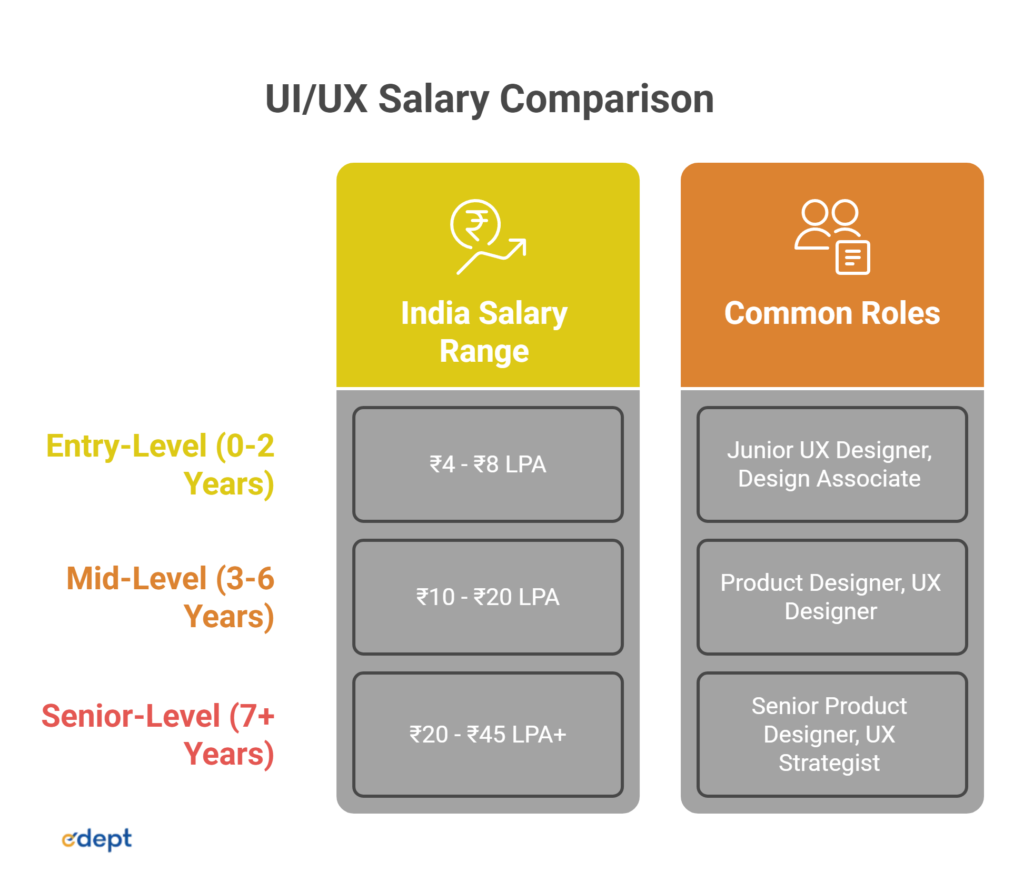
There has been quite a good growth in the salary scope of UI/UX Designers in global markets in the past few years due to the rapid growth in product-based companies and fintech applications alongside digital-first startups. Organizations are now considering user experience a key factor in business, as a better user experience has shown an increase in user retention and revenue growth. For CSE Design students, UI/UX roles offer strong earning potential with good career growth cause of the hybrid working culture.
| Experience Level | Average Salary Range(India) | Common Roles |
| Entry-Level (0-2 Years) | ₹4 – ₹8 LPA | Junior UX Designer, Design Associate |
| Mid-Level (3-6 Years) | ₹10 – ₹20 LPA | Product Designer, UX Designer |
| Senior-Level (7+ Years) | ₹20 – ₹45 LPA+ | Senior Product Designer, UX Strategist |
Entry-Level Salaries
Fresh college graduates who are entering the UI/UX field in India have a salary of around ₹4 – ₹8 LPA, depending on the skills they possess, the companies they are shortlisted for, and the internship and certification experience they bring with them. Top startups and product-based companies offer competitive salaries compared to traditional service-based organizations because of high demand in digital product development.
Mid-Level Salaries
Mid-Level UI/UX professionals with working experience of around 3-6 years can have a salary package between ₹10–20 LPA in India. Mid-level professionals work on product strategy, advanced UX systems, and cross-functional collaboration with developers and product managers. They should be proficient in product design, UX research, and AI product experiences to receive faster salary growth, as these skills are currently in high demand globally.
Global Salary Potential
Globally, there is a high growth in job roles for UI/UX professionals with an increase in international hiring trends. Experienced UI/UX professionals are now working remotely while working for product-based companies residing in other countries, giving them international exposure. Let’s see some variation in salary packages for UI/UX designers across countries.
| Country | Average UI/UX Salary Range |
| India | ₹4 – ₹45 LPA+ |
| United States | $80,000 – $180,000 |
| Canada | CAD 70,000 – CAD 140,000 |
| United Kingdom | £40,000 – £90,000 |
Industries Hiring UI/UX Professionals
Across different industries, there is a vast increase in the demand for UI/UX professionals due to corporations making customer experience and user retention a priority to be successful in today’s economy. Because of this, companies are investing heavily in their websites, mobile applications, SaaS products, AI products, and enterprise software, resulting in a wide range of opportunities for UI/UX professionals. For CSE Design students looking for jobs in this area, this new growth should be considered an advantage to them since most companies are looking for professionals who have experience in both technical tools and workflows related to product design. Some of the many industries that are currently hiring UI/UX professionals run from start-ups and e-commerce companies to global SaaS companies and AI-driven product companies.
| Industry | Average Salary Range |
| Product-Based Companies | ₹8 – ₹30 LPA |
| Startups | ₹5 – ₹18 LPA |
| E-commerce Companies | ₹6 – ₹20 LPA |
Product-Based Companies
UI/UX jobs in the product-based companies represent one of the largest groups of employment, as product usability and customer experience are critical to the success of their business aspects. Companies such as Google, Microsoft, Adobe, Swiggy, Zomato, Razorpay, and PhonePe all invest extensively in product design teams to aid in enhancing user engagement and retention.
Startups
Startups are rapidly hiring UI/UX professionals as they need quick product development, constant prototyping, and a high-quality customer experience to succeed in the market. Therefore, startups typically look for hybrid professionals who can manage aspects of UI design, UX thought process, wireframes, and product strategy on their own, rather than using multiple vendors to meet these demands.
E-commerce Companies
One of the major requirements of e-commerce companies is to optimize their UI/UX, because customer experience dictates sales conversions, retention, and shopping cart completion rates. Amazon, Flipkart, Myntra, Nykaa, and Meesho are just a few examples of platforms that continue to improve their product interfaces to decrease friction and create a better customer shopping experience.
SaaS Companies
SaaS, also known as Software as a Service, companies are one of the fastest-growing employers for UI/UX employees in today’s market. Companies like Zoho, Freshworks, HubSpot, Salesforce, and Notion are actively hiring UI/UX professionals to improve their enterprise product efficiency. SaaS design roles generally offer strong salary growth because businesses increasingly rely on customer-centric software experiences for long-term retention.
Tools Every UI/UX Aspirant Should Learn
The time and effort invested in learning the proper UI/UX tools are very valuable to developing solid design skills, developing professional portfolios, and enhancing employability in product design careers. Collaborative design platforms, wireframing tools, prototyping systems, and interactive product testing software are all key components of modern workflows for UI/UX design. Organizations that hire UI/UX designers tend to look into candidates’ skills for using industry-standard tools effectively. CSE Design students will find that they can gain a greater advantage in the internship, portfolio, and placement in a product-based company or startup by learning these tools.
| Tool | Primary Use | Industry Demand |
| Figma | UI design, prototyping | Very High |
| Adobe XD | Wireframing and interface design | High |
| Sketch | UI and product interface design | Moderate |
| ProtoPie/InVision/Framer | Interactive prototyping and animations | Growing Rapidly |
Figma
Figma is one of the most widely used UI/UX design tools globally. Many product-based companies and startups are using Figma for interface design and prototyping. Figma‘s biggest advantage, for which it is widely famous, is its real-time collaboration feature. It allows designers, developers, and product managers to work on product designs and code them out into production at the same time. Candidates with a strong Figma-based portfolio are bound to get shortlisted for UI/UX design roles.
Adobe XD
Adobe XD is another key tool being used in the design departments for creating wireframes and interactive user flows. Adobe XD brings its own benefits, like the Adobe workspace, which supports responsive design systems and developer collaboration. Learning Adobe XD as a student will help you understand multi-tool workflows to improve flexibility during internships and professional projects.
Sketch
Sketch is another popular interface tool among macOS users for creating UI layouts and design systems. Before Figma even came into the picture, Sketch was actually the most popular design interface tool among design teams. There are still many international product companies that use an older version of Sketch even today for their interface design workflows. Sketch can be useful for students who want to target remote product design jobs where legacy design systems are still active.
Prototyping Tools
Prototyping tools are used to generate interactive product experiences ahead of product development. These tools represent user interaction, navigation systems, animations, and transitions. These days, companies are looking for job seekers who can not just design UI screens but also make realistic prototypes. The ability to develop prototypes is also a great asset for communicating with developers and product teams during the product development cycle.
How to Build a Strong UI/UX Portfolio
A strong portfolio is essential for a UI/UX designer, as it plays a major role in getting internships and jobs in the product design industry. The portfolio is an even more valuable asset to CSE Design students due to the fact that it demonstrates both technical competence and product design. Recruiters usually start by looking at usability thinking, clarity in the design process, visual quality, extent of the research, and project execution, rather than just pretty screens. Based on product hiring trends, job seekers who have a well-organized portfolio and actual case studies will be given more opportunities for interviews than those who are just certified or have only theoretical knowledge.
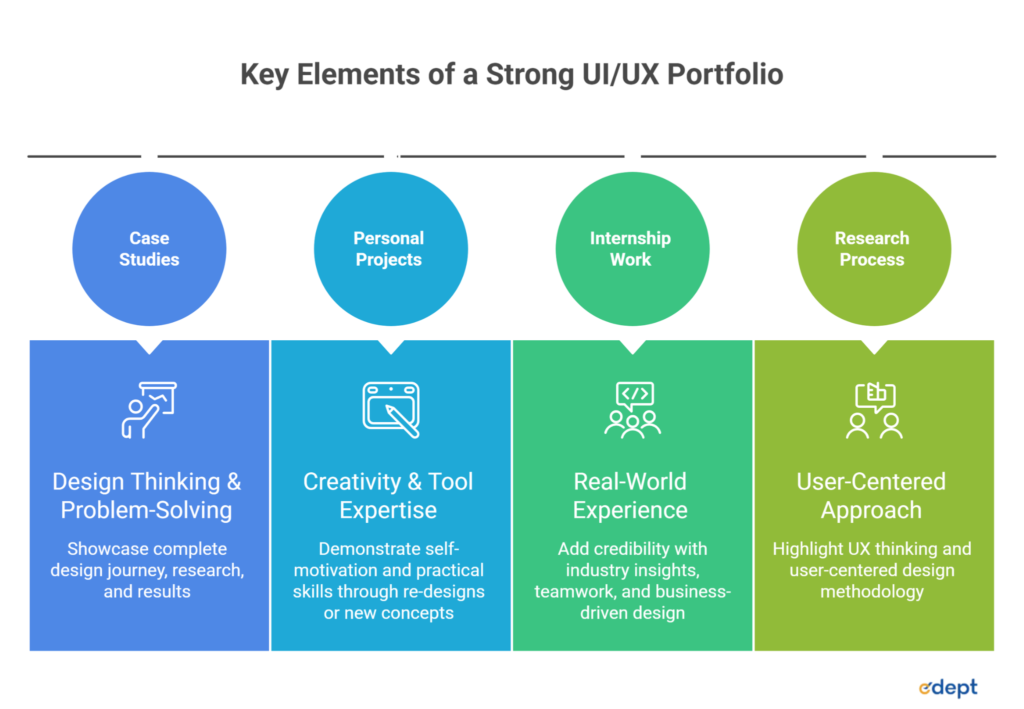
| Portfolio Element | Why It Matters |
| Case Studies | It will show your complete design thinking and problem-solving ability |
| Personal Projects | It shows creativity and practical tool expertise |
| Internship Work | Adds real-world industry experience |
| Research Process | Shows UX thinking and a user-centered design approach |
Case Studies
One of the most crucial components of a UI/UX portfolio is case studies, which outline the entire design journey of a project. Effective case studies provide evidence of problem identification, research, wireframing, testing, and enhancing user experience rather than just a series of final screens. A well-structured case study should have some key essentials like a problem statement, user research insights, ui design iterations, a final prototype, and finally key learning and results. Strong case studies help candidates stand out during product design hiring.
Personal Projects
You can also start building re-design projects for any app that already exists, such as Spotify, Swiggy, Amazon, or Instagram, to kick off your product thinking and portfolio quality. Personal projects allow the recruiter to see that the applicant is self-motivated and continually learning, a trait that an entry-level applicant appreciates. Students can create UI/UX projects for mobile applications, SaaS dashboards, AI product interfaces, healthcare applications, and finance or fintech platforms.
Internship Work
Having internship experience in a UI/UX portfolio makes it more credible as it shows the real-life situation and the way the workflow works. The brief experience that students will gain in internships can give them insight into client needs, developer teamwork, rapid product development cycles, and business-driven design choices. For CSE Design students aiming for product design careers, combining internships with strong case studies and personal projects can significantly improve placement opportunities in startups, SaaS companies, and product-based organizations.
Certifications That Help in UI/UX Careers
Career opportunities in the field of UI/UX can be enhanced by certification, which endorses practical experience, design thinking, and tool expertise within the field. Companies are mainly concerned with portfolios and real-world projects. Still, certifications are useful for freshers to enhance their resumes and add credibility and structured learning in the latest UI/UX workflows. Continuous education through certifications is a good indicator of exposure to industry practice and is used by many recruiters as a second line of selection when hiring. CSE Design students can enhance their chances of placement and salary prospects through certifications, along with their case studies and internships.
| Certification | Approx Course Fee | Key Skills Covered |
| Google UX Design Certificate | ₹10,000 – ₹25,000 | UX research, wireframing, usability testing |
| Interaction Design Foundation Courses | ₹8,000 – ₹15,000 yearly membership | UX psychology, interaction design |
| Product Design Certifications | ₹30,000 – ₹1.5 Lakhs | Product Thinking, SaaS workflows |
Google UX Certificate
The Google UX Design Certificate is one of the easiest and most popular courses for aspiring UI/UX designers. It includes key concepts like user research, empathy mapping, wireframing, prototyping, usability testing, and creating a portfolio with tools like Figma.
Interaction Design Courses
Our courses are well-known and highly valued in the UX community around the world to the extent that they cover the very same principles of usability, interaction psychology, accessibility, human-centered design, and UX strategy. These courses are particularly useful for students who are interested in taking their design skills beyond visual and gaining greater UX thinking skills.
Product Design Certifications
Product Design certifications are geared towards the whole process of digital product design, including UI systems, UX workflows, design thinking, user flows, prototyping, and product-oriented product strategy. But with businesses looking more for people who have an understanding of whole product landscapes, these certifications are gaining in importance. The salary for experienced product designers in the best startups or SaaS companies depends on the specialization and portfolio of their work and their experience in designing products, in the range of ₹15–30 LPA+.
Also read: How UI/UX Designers are important for the Blockchain industry
Why Choose Edept for Career-Focused CSE Design
Building a successful career in UI/UX today requires far more than theoretical knowledge. Recruiters increasingly prioritize candidates who can demonstrate practical problem-solving skills, strong portfolios, and real product-thinking abilities from day one. edept’s career-focused CSE Design programs are structured to bridge the gap between technology, creativity, and real-world product development through industry-driven learning and hands-on exposure. edept’s academic collaborations and industry-integrated learning ecosystem help students gain practical exposure to UI/UX design, AI-driven product systems, human-computer interaction, immersive technologies, and real-world digital product development.
Industry-Relevant Curriculum
edept’s curriculum is based on the latest industry job requirements and the latest product development processes. Students are taught with practical concepts in UI/UX, product design, front-end basics, wireframing, prototyping, and user experience strategies that companies are looking for in a placement. The program combines computer science fundamentals with applied design practices through studio-based learning, design labs, and industry-focused projects.
Hands-On Projects
Practical experience has a significant role in UI/UX hiring as recruiters take a look at the portfolios more seriously than theoretical marks. Key to Edept’s focus is a hands-on approach to learning, including real-world projects, UI redesign challenges, SaaS dashboard design, mobile app interfaces, and usability case studies. Partnerships with organizations like Deloitte, IBM, Practera, HEX, and Upsimpl help students gain exposure to live client briefs, UX research, AI-led products, and enterprise product design systems.
Portfolio Development Support
The most difficult part of a fresher’s journey into the field of UI/UX is creating a meaningful portfolio. With structured case studies, product design processes, prototyping, and real design projects, edept enables students to build professional portfolios that meet hiring standards in today’s marketplace. Students are trained in organizing their portfolios, UX storytelling, presentation of design work, and techniques for describing their work in an interview, gaining them much higher chances of placement.
Placement Assitance
edept focuses heavily on career preparation and placement readiness for UI/UX, product design, and design-tech roles. Students receive support in resume building, portfolio reviews, LinkedIn optimization, internship preparation, mock interviews, and career guidance sessions. Students benefit from a 300+ company recruiting network and placement-focused mentorship designed to prepare them for both domestic and global career opportunities.
Step-by-Step Roadmap to Becoming a UI/UX Professional
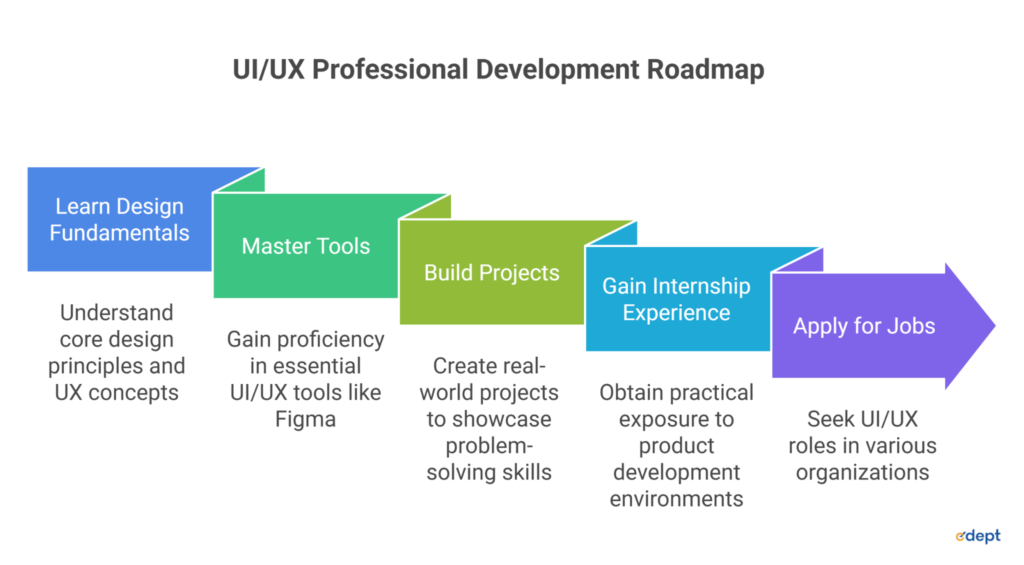
To have a successful career in UI/UX globally, you should have a smart and structured roadmap to go from a beginner to a proficient UI/UX designer. For CSE Design students, having a good skill combination of technical understanding with the idea of modern product design is essential to stand out in the competition and get hired by top organizations. Follow this structured roadmap to build a strong foundation in design thinking, usability understanding, and industry readiness.
Learn Design Fundamentals
The first step you should take as a beginner in the UI/UX field is to learn the core principles of design and user experience. Students should be able to understand basic concepts like typography, color theory, spacing, visual hierarchy, and responsive design structure. Beginners should also learn UX fundamentals like user research, information architecture, and interaction design.
Master Tools
Once students understand the basics of design, they should concentrate on the key UI/UX tools used in the design industry. For the time being, Figma is the most crucial tool for UI design, collaborative workflows, prototyping, and developer handoff. Additionally, students should learn prototyping and interaction design tools like Adobe XD, Sketch, ProtoPie, Framer, and Invision. Employability in product design positions is greatly enhanced by learning design systems, responsive layouts, and interactive workflows.
| Essential Tools | Primary Use |
| Figma | UI design and prototyping |
| Adobe XD | Wireframing and interface design |
| Sketch | Product interface design |
| ProtoPie/Framer | Advanced interactions and animations |
Build Projects
Projects are one of the most important parts of the UI/UX learning journey because recruiters evaluate practical problem-solving ability through portfolios. Students should build real-world projects such as mobile applications, SaaS dashboards, fintech platforms, healthcare interfaces, or e-commerce redesigns. Strong project work helps students stand out during internships and placements.
Gain Internship Experience
Internships provide real-world exposure to product development environments, client requirements, agile workflows, and collaboration with developers and product managers. Even short-term internships can significantly improve portfolio quality and industry understanding.
Apply for Jobs
Once students develop strong portfolios and practical project experience, they can begin applying for UI/UX roles such as UI Designer, UX Designer, Product Designer, Interaction Designer, and Design Associate. Recruiters generally prioritize candidates with:
- Strong portfolio case studies
- Figma and prototyping expertise
- Product thinking ability
- Internship experience
- Basic front-end awareness
Freshers with strong portfolios and practical skills can target placements in startups, SaaS companies, product-based organizations, fintech companies, and global remote design teams.
Future Scope of UI/UX Careers in 2026
The UI/UX sector is poised to expand significantly in 2026 and beyond, driven by ongoing investments in digital products, AI-driven platforms, mobile applications, and customer-centric experiences. The need for professionals who have both a design and technical understanding is growing across startups, SaaS, fintech, and global product organizations.
Growth of Product Companies
Product-based companies are growing quickly and are hiring a lot of UI/UX experts to enhance the performance of digital products, user retention, and customer engagement. Global organizations have been hiring UI/UX designers rapidly in recent years to fulfill their product design needs.
AI Product Design Demand
AI-driven applications and intelligent systems are generating high demand for designers who can create human-friendly and intuitive AI experiences and interfaces. With the rise of AI-driven applications, businesses are on a hiring spree for UI/UX designers proficient in working with AI-based tools and design elements.
Global Remote Opportunities
Today, with the shift to remote work, there are many international startups and product companies looking for skilled UI/UX Designers, anywhere is the New Normal. Remote work culture has opened global career opportunities for skilled UI/UX professionals, allowing them to work with product companies from around the world.
Final Thoughts: UI/UX Design might be the best Career Pathway for CSE Design Students
With the increasing demand for digital products, user experience, SaaS platforms, and AI-powered applications, the scope of UI/UX engineers has been expanding rapidly for CSE Design students. They are well-equipped with a good combination of both technical knowledge and creative problem-solving and product thinking skills, which gives them a great advantage. Today, the role of UI/UX isn’t restricted to just designing, but is also integrated with the development process. Organizations are now seeking individuals who are knowledgeable in both usability and front-end workflows, interaction design, and user behavior. The pairing makes for greater opportunities in startups, product-based companies, fintech, and global remote teams. For students planning long-term careers in design and technology, industry-ready design skills can open high-growth career opportunities in one of the fastest-growing digital industries in 2026 and beyond.