Technology is evolving at a rapid pace, changing on a daily basis. Until not so long ago, artificial intelligence was a topic confined to research papers and university laboratories. But today it has quietly emerged from that restricted space, and it has become an integral part of business operations, marketing, software development, automation and design. Today, it is used in the daily operations of banks, healthcare, software and IT companies, marketing agencies, and education. What just started as experimental chatbots and image generators has now evolved into something far more consequential: entirely new career tracks that did not exist five years ago. As a result, Generative AI Careers are becoming the most promising and in-demand career opportunities for students and professionals in 2026 and beyond.
Now, let us start understanding them in detail. The rapid transformation in Artificial Intelligence has introduced a new technological advancement, known as Generative AI. The projected value of the Generative AI market worldwide is expected to reach US$394.66bn in 2026. Generative AI adoption in India is among the highest globally. Over 90% of Indian enterprises utilize GenAI. The market is exploding, projected to reach ₹671.83 billion by 2030, fuelled by a massive talent pool and significant investment. Analysts, including McKinsey, estimate that GenAI could eventually unlock between $2.6 trillion and $4.4 trillion in additional economic value across global industries annually. As a result, Generative AI careers are becoming the most promising and in-demand career opportunities for students and professionals in 2026 and beyond. Now, let us start understanding them in detail.
In 2026, the career paths are changing dramatically. Just a year ago, AI skills were good to have, but now Gen AI is shaping the entire hiring decision across software, IT, banking, and cloud environments. India alone is expected to cross 20,000+ active Generative AI openings, and the numbers are still climbing. For students who are standing at the crossroads of graduation, this shift matters deeply. What makes this moment different from previous tech transformations is that employers are increasingly valuing applied skills over polished academic credentials. A GitHub portfolio with real AI projects holds more value than just a traditional degree, without any experience. This blog will help you understand where Generative AI careers are actually heading. We will help you walk through what generative AI actually is, why it is reshaping careers so rapidly, which specific roles offer the strongest growth, what skills you need to build, and how to prepare in a way that actually gets you hired.
What Is Generative AI and Why Is It Transforming Careers?
Understanding Generative AI in Simple Terms
Generative AI, in simple terms, is a system that helps you create new content rather than just simply analyzing the existing data. It refers to a category of artificial intelligence that can help you in creating a variety of content, such as text, images, videos, code, audio and many more, which are based on the patterns learned from large datasets. Unlike traditional AI, which was built purely to classify, predict, or detect based on existing data, GenAI can create, speak, draw, compose, program, simulate, and reason and, finally, can produce entirely new output.
The backbone of Gen AI is a type of model which is called an ‘LLM’, or ‘large language model’, and neural networks trained on vast data sets. They learn patterns in the form of text, images, code, and audio, then generate original outputs that match those patterns. OpenAI’s GPT models handle text generation and reasoning. Google’s Gemini processes text, images, and video together. Tools like Midjourney and Stable Diffusion create visual content from descriptions. GitHub Copilot assists developers by suggesting entire functions and debugging code in real time. The main thing is that Gen AI does not tell you what already exists; it helps in producing something new.
Why Companies Are Investing in Generative AI
Nowadays, companies are heavily investing in Gen AI to increase employee productivity, drive personalised customer experiences and reduce operational costs significantly. The companies are using Gen AI to reduce the time spent in content creation, automate customer support, accelerate and improve software development and analyze large amounts of data. GenAI automates various routine knowledge work, such as drafting reports, writing code, and analysing data, thus freeing employees to focus on high-value tasks and strategic initiatives.
Some of the important statistics are:
- 71% to 88% of organizations regularly use GenAI in at least one business function.
- 83% of employees using generative AI say it boosts productivity.
- Generative AI now supports between 0.5% and 3.5% of all U.S. work hours; this could add 0.1–0.9 pp annual productivity growth.
- 62% of organizations are already experimenting with AI agents
- 92% of Fortune 500 firms have adopted the technology, including major brands like Coca-Cola, Walmart, Apple, General Electric, and Amazon.
- 70% of Gen Z have tried generative AI tools, the highest adoption rate of any generation
- 59% of companies believe generative AI will transform customer interactions over the next few years.
- 56% of CX leaders are exploring new generative AI vendors for enhancing customer experience.
- 1 in 4 brands will see a 10% increase in successful self-service interactions by end of 2026
In healthcare, generative AI helps in drafting clinical notes and assists in drug discovery research, reducing documentation time by hours. In education, it helps in personalising learning materials for students at different levels simultaneously. Financial institutions normally use it for risk analysis reports and automated customer communication. Marketing teams generate campaign variations, A/B test copy, and produce localized content at a large scale.
Why Generative AI Careers Are Growing Fast in 2026
Generative AI careers are increasing in 2026 because now the industries have come out of their experimentation phase and have converted to full-scale enterprise integration. Companies need skilled professionals to build, guide, and manage “agentic” AI systems that can execute multiple workflows, reduce operational costs and increase the efficiency of the company.
Rising Global Demand for AI Talent
The global AI talent landscape in 2026 is defined by a massive demand-to-supply ratio of 3.2:1, with an estimated 1.6 million open AI positions and only 518,000 qualified candidates worldwide. The projected value of the Generative AI market worldwide is expected to reach US$394.66bn in 2026. Generative AI adoption in India is among the highest globally. Over 90% of Indian enterprises utilize GenAI. The market is exploding, projected to reach ₹671.83 billion by 2030, fuelled by a massive talent pool and significant investment.
Across the globe, AI startups are scaling at a rapid pace, and large organizations are building their in-house AI teams. The problem is supply: there simply are not enough trained professionals to fill these roles. This is creating a clear gap that students entering the workforce in 2026 can step into. The adoption of smart technologies and automation is contributing to an increase in AI jobs. The rising demand for skilled AI professionals is one of the main reasons which is driving changes in AI salary trends in 2026.
AI Becoming a Cross-Industry Skill
One of the most important shifts in 2026 is that AI, or Gen AI, is not a skill that is confined to only software engineering. AI literacy is no longer optional for non-tech roles. A marketing professional who can manage the AI-driven content workflow has a clear advantage. Business analysts now use AI to generate insights from data and draft executive summaries. Designers collaborate with AI tools before opening traditional software. HR teams use AI for screening and candidate communication.
This cross-industry adoption means that AI jobs for students are not limited to computer science graduates. A psychology major who understands prompt engineering and ethical AI governance can pursue a career in responsible AI. A literature student with strong analytical skills can become an AI content strategist. Industries that are exposed to AI are experiencing nearly 4 times the productivity growth, as compared to those which are less exposed.
Top Generative AI Career Options for Students
Below are the most promising generative AI careers students should watch out for in 2026. 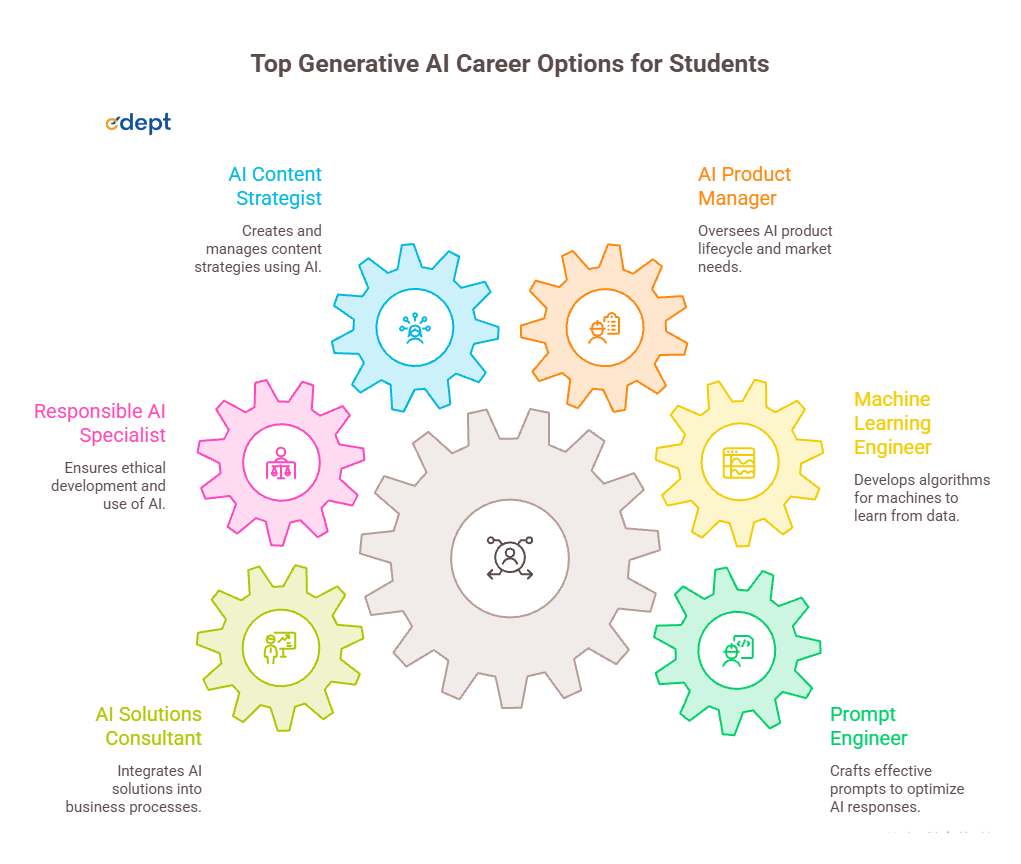
Prompt Engineer
A prompt engineer mainly designs and also helps in refining instructions, which are given to the AI systems to produce highly accurate, consistent, and useful output. They help in experimenting with different phrasing to identify and eliminate errors, hallucinations, or vague outputs. It helps organizations tailor AI tools for practical applications like content creation, customer service, or data analysis. This role is suitable for both technical and creative students. You need to understand not only how language models process instructions, but you also need creativity to frame problems in ways that will get the best responses. As AI tools are more utilized and embedded in business, the demand for prompt engineers is rising day by day.
Machine Learning Engineer
A machine learning engineer helps in building, training, and deploying AI models. They are also responsible for assessing, organizing, and cleaning large, complex datasets for model training. They track model performance in real time and detect any data drift to maintain high accuracy. This is one of the most technically intensive roles in Generative AI. You need advanced proficiency in Python, along with Java/C++. A hands-on experience with scikit-learn, TensorFlow, PyTorch, or XGBoost. You need a strong foundation in linear algebra, calculus, probability, and statistical analysis. You need to have an understanding of cloud platforms (AWS, Google Cloud, or Azure), databases, and version control. It is a high-demand and high-paying role with strong career progression.
AI Product Manager
An AI product manager is responsible for bridging the gap between engineering, data science, and non-technical stakeholders. He owns the development and delivery of AI-powered products. Unlike traditional management, this role requires an understanding of what an AI can do and what it cannot, what the limitations of current models are and how to set a realistic expectation with leadership and customers. It will be an excellent choice for students with an MBA or a business analytics degree background. Here, the growth prospects are strong, especially among the companies that are building AI-based products.
AI Content Strategist
An AI content strategist is responsible for designing, automating and scaling digital marketing operations using AI. They help in building workflows that use AI to upgrade and scale content production while maintaining the brand value and consistency. They also help in analyzing performance data to manage the AI-generated content. This role is growing quickly, as companies are looking to produce more content efficiently. It is well suited for students in marketing, mass communication, and journalism backgrounds. If you know SEO, content management systems, and data analysis, it will be beneficial for you. This role does not require any programming skills; you need creative writing skills.
Responsible AI Specialist
As AI is becoming more powerful and evolving rapidly, the main question is how to use it ethically and safely. A Responsible AI Specialist (often called an AI Ethicist or governance specialist) helps bridge the gap between technical data science teams and business stakeholders. They help ensure AI systems treat all individuals and groups equitably, actively identifying and removing historical biases. They are responsible for designing models whose decisions can be easily understood by humans. They help in prioritising human needs, well-being, and dignity alongside automated advancements. This role is growing as governments and enterprises are beginning to introduce more formal AI governance requirements. It is suitable for students with backgrounds in law, ethics, public policy, and social science. It is one of the newest roles in the AI environment
AI Solutions Consultant
An AI solution consultant helps organizations in understanding, planning and implementing AI systems. It bridges the gap between business challenges and advanced technology. They help in assessing an organisation’s AI readiness, designing scalable automation strategies, and creating workflows to ensure artificial intelligence delivers measurable value and strong RO. They are responsible for designing AI agents and chatbots to streamline repetitive processes and enhance customer experiences. Consulting firms, technology vendors, and AI agencies are actively hiring for these roles. Students from engineering, computer science, or business backgrounds who enjoy working directly with clients and solving complex problems are suitable for this role.
Skills Students Need to Build for Generative AI Careers
Generative AI careers require a blend of technical programming, system architecture, AI workflow design, and human-centric soft skills.
Technical Skills
The technical foundation basically starts with Python, which remains one of the dominant languages for AI development. Beyond basic syntax, you should understand how to work with APIs, handle data formats like JSON and CSV, and use libraries such as Pandas and NumPy for data manipulation. Machine learning is also important to understand how models actually learn from data, what neural networks and inference mean, and how to evaluate model performance.
Various skills in data structuring, cleaning, and managing vector databases are also critical. Next comes the APIs; many tools are accessed with the help of an API, and you need to understand how to integrate these into applications. Cloud platform knowledge is becoming very popular and important for employers. Familiarity with AWS SageMaker, Azure AI, or Google Vertex AI shows employers you can deploy systems in real environments, not just run notebooks locally.
Non-Technical Skills
Non-technical and soft skills are equally important in an AI career. Critical thinking is one of the most underrated skills. The ability to verify the AI outputs, check the facts of generated data, and ensure the AI’s logic aligns with real-world realities is a very important part of critical skills. AI produces outputs quickly, but those outputs are not always accurate, fair, or appropriate. A person should have the ability to evaluate AI-generated content, spot logical errors, and question assumptions; this is what separates professionals from users who do not understand AI. Prompt design is a skill in itself; it requires clarity in thinking and an understanding of how language models interpret instructions. Communication skills matter because AI projects are almost always collaborative, involving technical teams, business stakeholders, and end users.
Portfolio Development
Only theory will not help you get hired. Employers are now looking for candidates who have practical and real-world experience. Employers want evidence that you can apply what you know. Start building a GitHub portfolio that includes AI projects: a chatbot you developed, a content automation tool you built, a data analysis project using AI-assisted insights, or a responsible AI audit you conducted. Even small and unpaid internships on AI projects can enhance your professional credibility. A portfolio will help you tell an entire story about your career in a more structured way in front of an interviewer.
Salary Trends for Generative AI Careers Worldwide
Generative AI roles are usually paid a premium. The current pattern in Gen AI salaries is that they reflect the pace at which the technology is evolving and, along with it, the skills that are connected with working with LLMs, prompt engineering and AI-driven workflows. The entry-level roles usually range between $60,000 and $120,000+ globally; the mid-level roles range between $90,000 and $150,000+; and the senior roles range between $150,000 and $300,000+.
Entry-Level Salary
| Country | Entry-Level Annual Salary | Role Examples |
| United States | $75,000 – $115,000 (USD) | Prompt Engineer, ML Associate, AI Content Analyst |
| Canada | $70,000 to $100,000 CAD | AI Developer, Data Analyst (AI), Junior ML Engineer |
| Germany | €45,000 – €65,000 | AI Consultant (Junior), Data Scientist, NLP Engineer |
| United Kingdom | £40,000 – £58,000 | AI Associate, ML Engineer, AI Product Analyst |
| India | ₹8L – ₹18L | AI Engineer, Data Scientist, Prompt Specialist |
| Australia | AUD $90,000 – $120,000 | ML Engineer, AI Analyst, Data Scientist |
Mid-Level Salary
| Country | Total Compensation (Estimated) | Typical Roles |
| United States | $120,000 – $180,000 | ML Engineer, GenAI Engineer, AI Product Manager |
| Canada | CAD 125,000 – 175,000 | ML Engineer, AI Developer, AI Analyst |
| Germany | €75,000 – €98,000 | AI Engineer, NLP Engineer, ML Engineer |
| United Kingdom | £70,000 – £100,000 | AI Engineer, ML Engineer, AI Consultant |
| India | ₹20 LPA – ₹40 LPA | GenAI Engineer, LLM Engineer, AI Engineer |
| Australia | AUD 85,000 – 150,000 | GenAI Engineer, ML Engineer, AI Architect |
Senior-Level Salary
| Country | Senior-Level Total Compensation (Annual) | Typical Roles |
| United States | $200,000 – $500,000+ | ML Engineer, GenAI Engineer, AI Product Manager |
| Canada | CAD 175,000 – 260,000+ | ML Engineer, AI Developer, AI Analyst |
| Germany | €95,000 – €155,000 | AI Engineer, NLP Engineer, ML Engineer |
| United Kingdom | £110,000 – £217,000 | AI Engineer, ML Engineer, AI Consultant |
| India | ₹45 LPA – ₹80 LPA+ | GenAI Engineer, LLM Engineer, AI Engineer |
| Australia | AUD 180,000 – 260,000+ | GenAI Engineer, ML Engineer, AI Architect |
Remote Work Opportunities
One of the most significant aspects of the Gen AI career path is the global nature of the work. AI development, prompt engineering, and consulting are some of the important job roles that can often be performed remotely, which helps in opening opportunities to work for companies in different countries without relocating. This opens up your access to global companies and international salary opportunities based in India, Southeast Asia, Eastern Europe and Latin America. The freelance platforms are also seeing increased demand for AI specialists who can deliver specific projects. This flexibility is particularly valuable and important for students who want to build international experience early in their careers.
Best Degree and Certification Paths to Enter Generative AI
Entering the Generative AI (GenAI) field requires a combination of foundational computer science, data structures, and hands-on LLM (Large Language Model) frameworks.
Degree Options
Various academic programmes provide a strong foundation for generative AI careers. The most common and relevant degrees include:
- Computer Science: This provides a strong technical foundation for research and engineering roles. Here, the graduates typically have coding proficiency, programming, algorithmic thinking, and familiarity with data structures.
- Data Science: It covers various aspects such as statistical modelling, data analysis, and machine learning, which are directly applicable to many AI roles across many industries.
- BCA (Computer Applications): Best for individuals who want to become AI software or application developers, focusing heavily on system integration and software deployment
- Master of Science (MS) / M.Tech. in AI & Data Science: Highly recommended for advanced roles like AI research engineer or data scientist. These programs focus deeply on neural network architectures and advanced deep learning
- Business Analytics: The students who are interested in AI product management, consulting, strategy roles, and a business analytics degree with a proficiency in AI tools create a strong job profile.
Certifications
If you want a quick, industry-recognized validation for your practical knowledge and skills, then a specialized certification is most valuable. Some of the relevant certifications include:
- IBM Generative AI Engineering Professional Certificate: This teaches practical skills in LLMs, prompt engineering, and Retrieval-Augmented Generation (RAG)
- AWS Certified AI Practitioner: A foundational certification validating understanding of AI/ML concepts and Amazon’s AI ecosystem
- Google Cloud Professional Machine Learning Engineer: This certification covers ML model design, deployment, and monitoring on the Google Cloud environment.
- Microsoft Azure AI Fundamentals (AI-900): A highly popular starting point for career switchers. It teaches core AI/ML concepts and how to interact with Azure’s AI ecosystem.
- Google AI Essentials: A great introductory course designed to help you integrate generative AI tools into your daily workflow to boost productivity and efficiency.
Why Students Should Choose Skill-Based AI Programs Instead of Theory-Only Courses
The students who choose skill-based AI programmes over theory help in bridging the gap between AI capability and real-world applications. Employers in 2026 are heavily focused on what a candidate can do rather than his/her traditional degree. Many traditional academic programmes are based on only theoretical knowledge and framework. These foundations have value, but now the job market scenario and hiring landscape have changed. Employers prefer candidates with live projects, GitHub portfolios, and practical training rather than those who just understand algorithms on paper. Theory teaches you how an algorithm works, but applied AI teaches you how to solve an actual business problem. Graduates are increasingly judged by what they can do, rather than where they obtained their degree.
When a hiring manager reviews your resume, they look for evidence of real-world AI tools you have used, problems you have solved, and systems you have built. Nowadays, internships hold a very important value when you are going for a job interview, especially for AI job roles. Employers look for your practical skills, problem-solving, and critical thinking abilities. Hence, the candidates who can combine structured learning with practical applications can easily outperform a candidate with only theoretical knowledge.
Why Choose Edept for Future-Ready AI Career Preparation
If you are serious about building a career in generative AI, the programme you choose matters as much as the effort you put in. There is a difference between studying AI in theory and being trained to actually work with it. edept’s Master’s in Data Science & AI is built around the second approach. The programme runs as a 1+1 dual-degree pathway; you begin your studies in India through the PGDM in Business Analytics at Shree L.R. Tiwari School of Business Management (SLRTSBM) in Mumbai, and then complete a Master’s in Data Science & AI at Steinbeis University in Berlin, Germany
Industry-Focused Curriculum
The curriculum is built for the job market, not just the examination. On the India side, you work through modules in Python programming, machine learning, data visualisation with Tableau and Power BI, cloud computing, SQL, applied econometrics, and business analytics, the practical toolkit that AI employers expect candidates to walk in with. On the German side at Steinbeis University in Berlin, the focus deepens into artificial intelligence, data strategy and governance, data-driven business models, high-performance computing, and a live innovation project with a real company.
Career Readiness Support
edept provides dedicated support for students navigating the career aspects of international migration, from resume preparation and interview coaching to job-search strategies for specific markets. The goal is not just skill development in isolation but also a clear bridge from learning to landing an international role.
Global Career Exposure
For Indian students who want to enter the AI job market globally, not just domestically, this kind of programme addresses the three things that matter most: the right skills, an internationally recognised qualification, and real exposure to the country where you intend to work. Those three together are what make the difference between a competitive application and a strong one.
Click here to know more
Step-by-Step Roadmap for Students to Build a Generative AI Career
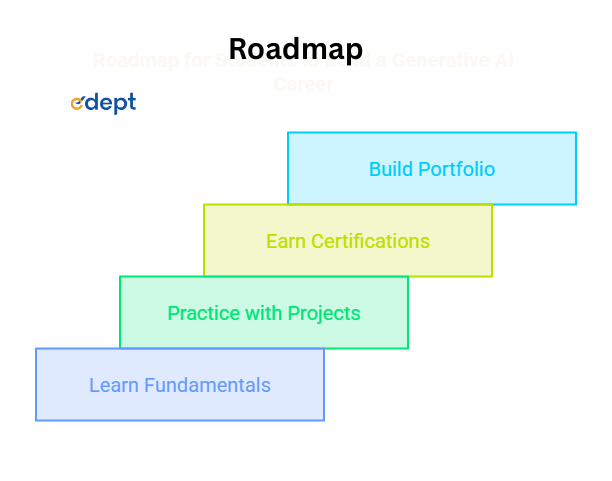
Learn Fundamentals
You should start with the basics, that is, how AI and machine learning work. You should start focusing on linear algebra (matrices, vectors), multivariable calculus (gradients, partial derivatives), and probability/statistics. Start learning Python, as it is the primary language of AI development. Learn data manipulation and visualization using NumPy, Pandas, and Matplotlib. You should start understanding how neural networks, backpropagation, and optimisation work. Learn either PyTorch (the academic/research favourite) or TensorFlow/Keras (industry-standard for production).
Practice with Projects
Theory alone won’t land you a job. You must build a public portfolio (e.g., on GitHub). Start applying what you learn immediately. Build a simple chatbot, create an AI-assisted content workflow, or analyze a dataset using AI tools. The goal is not perfection; it is to encounter real challenges and figure out solutions. Document your projects, including what worked, what failed, and what you learned.
Earn Certifications
Choose certifications that align with your goal. Google, Microsoft, and AWS are all important certifications that can add value to your résumé.
Build Portfolio
You should learn how to design effective prompts to guide models. Build applications using APIs from OpenAI, Anthropic, or Google Gemini. Learn Retrieval-Augmented Generation (RAG) to connect models to external data using frameworks like LangChain or LlamaIndex. Document all your work and projects, and start updating in GitHub.
Apply for Internships and Global Roles
Look for internship opportunities at IT companies, AI-based companies, and startups. Use LinkedIn, Internshala, Wellfound, and Remote OK. Apply for paid roles, unpaid roles, and freelance projects. Remember, nowadays employers value your internship and real-world experience much more than just traditional degrees; hence, an internship certificate is highly valued.
Future Scope of Generative AI Careers Beyond 2026
AI in Every Industry
The integration of Artificial Intelligence is moving from specialized tech jobs into everyday enterprise operations. By 2027 and beyond, generative AI will be embedded in virtually every industry, not as a special project but as standard infrastructure. Healthcare, education, manufacturing, logistics and legal services are all adopting AI tools and trying to embed them in their regular work. AI agents will assist with complex medical data, patient tracking, and personalized treatment plans, requiring professionals who understand both clinical workflows and AI systems. Algorithms will handle complex portfolio management, fraud detection, and regulatory compliance checks. This means the demand for people who understand AI will continuously grow
New Hybrid Roles
The demand is shifting away from purely technical or purely creative roles toward positions that bridge the gap between human intention and machine execution. Some of the new hybrid roles include AI product managers, prompt engineers & AI model trainers, AI ethics & compliance specialists and AI solutions architects. These hybrid roles will start to multiply as professionals will learn to leverage AI within their specific fields rather than treating it as a separate discipline.
Long-Term Salary Growth
The talent shortage in AI job roles is structural, not temporary. As AI systems will become more complex and consequential, the value of people who can design, govern, and improve them will continue to rise. At the rate at which the technology is evolving, there will be a vast talent shortage; hence, the professionals with strong AI knowledge will continue to have attractive salary growth and compensation.
Conclusion
Generative AI careers are evolving rapidly and opening doors to many high-impact job roles across engineering, product, research, creativity, and governance. It’s creating high-growth jobs that did not exist a few years ago, and the momentum is growing continuously. Students can enter this field from multiple educational backgrounds, whether technical or creative, provided they focus on building practical, demonstrable skills.
The good news is that you do not need a computer science degree or a master’s degree to build a career in Generative AI. Several roles, such as prompt engineering, AI content strategist, AI product management, and Responsible AI, are available for non-technical candidates. If you are a student thinking about your career path, 2026 is an excellent time to start moving in this direction. The demand is real, the salaries are strong, and the long-term growth is genuinely promising. Focus on building skills, building your portfolio, and finding programmes that prepare you for the job market, not just the examination hall.