In today’s data-driven economy, organizations rely heavily on data to guide strategic decisions, improve customer experiences, and optimize operations. From startups to global enterprises, data science is transforming how businesses understand trends and solve complex problems. As industries rapidly adopt analytics, the demand for skilled data professionals continues to grow. This shift has encouraged many learners, students, and working professionals to explore opportunities in the field. However, entering data science requires the right learning path and foundational training. Understanding the available learning options and selecting the right beginner-friendly program is the first step toward building a successful career in data science. Choosing the best option among the top data science courses is important to thrive in the Data Science industry.
Introduction
The demand for data science professionals continues to rise rapidly as organizations rely more on data-driven decision-making. From finance and healthcare to e-commerce and marketing, companies are actively seeking professionals who can analyze data, build models, and generate actionable insights. As a result, many learners are exploring the best data science courses for beginners in 2026 to enter this growing field. However, starting a career in data science can feel overwhelming for beginners. The industry requires a mix of technical skills, analytical thinking, and practical project experience. Choosing the right course becomes crucial because a strong foundation determines how quickly learners can progress into real-world roles. Data science is a skill-driven domain, meaning hands-on practice, real datasets, and tool familiarity matter more than theory alone. Beginner-friendly programs focus on teaching core concepts such as Python programming, statistics, data visualization, and machine learning fundamentals in a structured learning path. Selecting the right beginner program in 2026 can significantly accelerate your journey into the data science ecosystem.
What Beginners Should Know Before Choosing a Data Science Course
An individual must know some basic ideas before enrolling in a data science degree to help them learn in this area. The field of data science is a combination of statistics, programming, and analytical science to analyze data. The most elementary knowledge of mathematics and statistics, such as in probability, averages and data distribution, will help learners process the pattern and build some models of analysis. It is also important that logical reasoning is considered because data science is related to the discovery of relationships, the solution of issues, and data-driven decision-making. The other significant aspect is the possession of good program knowledge. The analysis, visualization, and machine learning of data are commonly analyzed, visualized and written in Python or R, and taught as the primary language in most introductory data science classes, as both are extremely popular. Nonetheless, there are numerous data science classes at the beginner level that are created to begin with no coding experience. One should also know the distinction between related disciplines. Data science deals with deriving insights and models of prediction. The main difference between data analytics and artificial intelligence is that the former interprets previous data to make business decision whereas the latter is aimed at developing systems that replicate human intelligence. Entry-level data science courses are designed in such a way that they have a learning progression through steps as they gradually introduce the learner to concepts, tools, and practical projects to ensure that they gain confidence and skills in the field.
Also Read: Data Analyst to Data Scientist: The Ultimate Journey 2026
Top Beginner-Friendly Data Science Courses in 2026
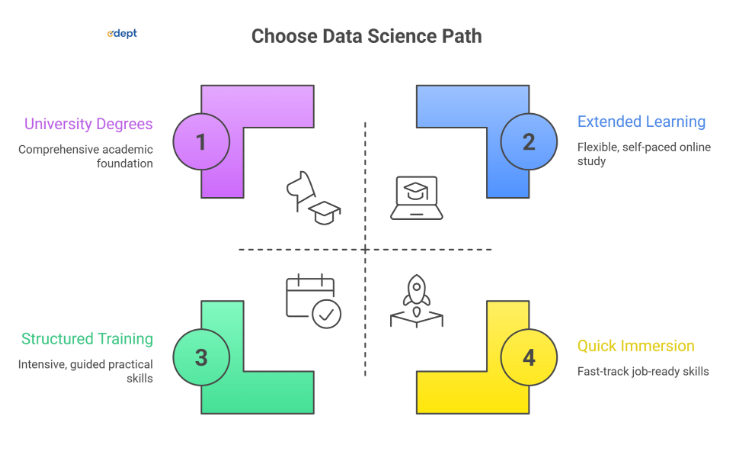
The selection of an optimal course in data science as a beginner in 2026 will rest on the prior knowledge of the learner, career objectives, and the learner’s learning style. Novices now can enter into various entry avenues that are as short as boot camps or as long as full university degrees. Both alternatives have various benefits in terms of time, level of learning, and those related to career. Knowing these types of courses, beginners are able to choose a program that is more friendly to them and their future career prospects.
Foundation & Bootcamp Courses
Foundation or bootcamp-style data science programs are among the fastest ways for beginners to enter the field. These short-term programs usually run between six and twelve weeks and focus heavily on practical, job-ready skills. Bootcamps typically do not require a prior degree in computer science or mathematics, making them accessible to career changers, recent graduates, and even students who have just completed their 12th grade. The majority of beginner-level bootcamps focus on project-based learning, which gives the students an opportunity to work with actual datasets and problems in the industry style. Basic Python programming (data science), basic statistics (concepts and use of Excel), and introductory SQL (SQL databases) are all considered core topics. Basic machine learning concepts and data visualization tools are also introduced by some of the programs. Bootcamps are also beneficial when a learner wishes to learn the data science workflow in the least amount of time possible and develop a portfolio of projects. Due to their intensive structure, they can be used with career switches, fresh graduates, or even people who want to take an entry-level data science course in India but do not want to invest in a multi-year academic program.
Certificate Programs (Online)
Online certificate programs will be one of the most preferred methods of learning data science in 2026. Coursera, edX, and industry-supported initiatives, including the Google Data Analytics Certificate, present organized, beginner-friendly classes which are able to be finished at any speed. Such programs typically integrate video lessons, practical tasks, quizzes, and project work. The advantage of self-paced learning, which is flexible, is valued by many learners, particularly those who are already in employment and do not wish to leave their jobs to upgrade their skills. Industry recognition is one of the greatest benefits of online certification programs. Diplomas from reputable sites and institutions globally recognize competencies and assist students in proving themselves to potential employers as they seek entry-level positions. A lot of websites also enable scholars to access course content at no cost and pay a fee if they want to get an official certificate. To excel in the field of data science, these courses are an easy and adaptable route towards understanding the fundamentals of the field and being exposed to the actual tools of data science being used in organizations.
Diploma Data Science Courses in India
Diploma programs in data science are curated learning programs that usually take between six and twelve months to finish. These programs are commonly taught at universities, technical schools or specialized training institutions and are more inclined to follow a formal curriculum as compared to short boot camps. Diploma programs typically comprise classroom training, mentorship, frequent tests and actual projects. Capstone projects are often given to students and involve simulation training in real industry problem-solving tasks, which allows students to gain practical experience in analyzing, visualizing, and predictive modelling data. The other advantage of diploma courses is that of guided learning. In contrast to self-paced online courses, diploma courses may have instructor-led sessions and collaboration among peers, which may help beginners understand how to do it. Such programs are also well matched with students who like to have strong academic backgrounds and have a known credential that is going to boost their resume.
Undergraduate Programs for Beginners
Undergraduate degrees provide one of the most organized entry points into data science, especially where the student desires a full academic background. Universities are also introducing programs like B.Sc in Data Science or BCA major in Data Science as the need to have data professionals grows. Such degree courses can span three to four years, and they are a combination of both theoretical and practical training. Programming, mathematics, statistics, basic machine learning and database systems are taught to students. It is also common to combine internship and research projects in many universities to expose students to the application in industry. The undergraduate programs are especially useful to those students who join them right after finishing their 12th grade. They offer academic richness, internships, and a well-known degree that is likely to contribute to future career development in the sphere of analytics, artificial intelligence, and data engineering. Overall, beginner learners in 2026 can choose from multiple pathways depending on their learning preferences, career timelines, and professional goals.
PG Certification for Graduates
Postgraduate certification programs are a strong option for graduates who want to transition into data science from other fields. These data science certification programs typically last between six to a dozen months and are industry-specifically oriented as opposed to theory-driven learning. Most institutes also engage the services of technology companies or analytics firms to shape their curriculum so that the training is up-to-date with the needs of the industry. These courses usually involve the mentorship programs, case study, and capstone project, which resemble real business situations. Python is usually studied by students to analyze data, learn the basics of machine learning, visualize it, and work with large data sets. One of the greatest benefits of PG certifications is career support. Numerous programs also provide resume-building services, interview preparation and placement services that can assist learners to enter into entry-level positions. PGs are more appropriate for graduates in disciplines like engineering, commerce, mathematics, or business who are prepared to transition into data science and acquire skills that can be transitioned into the workforce in a comparatively brief period of time.
University Online Degrees with Data Science Concentration
In recent years, online university degrees with a specialization in data science have gained more and more popularity. Fully online undergraduate or graduate courses in data science are now available in many universities so that students can study data science remotely and still receive academic accreditation. The programs usually deal with basic courses like statistics, programming, machine learning, and data engineering, with flexibility for working professionals. The online degree programs are designed and organized in the form of recorded lectures, virtual laboratories and interactive activities that enable students to take their learning at their own pace. One of the biggest advantages of university online programs is their credibility. Because they are offered by accredited institutions, the degree holds the same recognition as traditional on-campus programs. For learners who want a formal academic qualification but need flexible schedules, these programs provide a balanced pathway to learn data science in 2026 while managing other commitments.
Read more: Does Data Analytics Require Coding: A Complete Guide For 2026
Skills & Tools Beginners Will Learn
A well-designed data science course for beginners focuses on building both analytical skills and proficiency with practical tools. Among the early skills that learners acquire is data cleaning and preprocessing, the process of arranging raw data, working with gaps and finishing datasets to analyze them. Entry-level also includes learning simple methods of modeling which are useful in discovering patterns and predictions based on the data. Good knowledge of statistics and hypothesis testing is also necessary since it can help data scientists to corroborate insights and make data-driven decisions. Data storytelling is another important skill, according to which learners are able to turn complex datasets into understandable visuals that can be used to make business decisions.
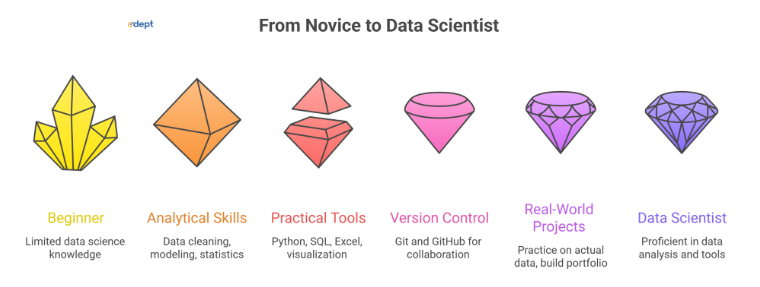
Besides conceptual skills, novice learners get acquainted with the main tools applied in the industry. Python, together with other libraries such as Pandas and NumPy, is popular in data analysis and manipulation. SQL is used to query and manipulate database-structured information. High-level skills in Excel would still be essential in rapid analysis and reporting. The visualization tools include Tableau or Power BI that assist in revealing insights in the form of interactive dashboards. Git and GitHub, which are crucial to version control and collaboration, are also presented to the learners. Real-world projects are also essential since they enable novices to practice concepts on actual data, construct portfolios, and develop practical problem-solving skills that they need in a professional data science role.
How to Choose the Right Course
To choose the most appropriate data science course at the beginner’s level in 2026, it is necessary to take into consideration a number of significant factors. Novice students should start by perusing the curriculum structure so that they ensure that the curriculum has both theory and practical labs. A strong beginner program should include the study of Python programming, statistics, data visualization, and introductory machine learning, and work with real data. Project-based learning is another important consideration. The use of practical assignments and capstone projects in courses contributes to developing a portfolio that provides evidence of real ability to solve problems. Employers are also becoming more interested in people who have the ability to demonstrate project experience as opposed to mere theoretical understanding. The value of the certification of the course also matters. Work programs that are accredited by universities, popular online facilities, or even industry sponsors tend to have more prestige in the employment sector. Also, novices may seek out classes that have mentorship, career advice, and placement services, in particular, when they are looking to find an entry-level position in data science. The learners are also required to review the tools and technologies within the program. Beginners should have Python, SQL, Excel, and business intelligence systems, such as Tableau or Power BI. Finally, consider course duration, cost, and return on investment. Programs that provide flexible learning support, peer communities, and doubt-clearing sessions help beginners stay consistent and complete their learning journey in 2026.
Final Notes: Choosing the Right First Step into Data Science
Going for the best data science course for beginners in 2026 depends entirely on what your learning goals are, your background, and your career timeline. Path for beginners looks like starting through bootcamps, online certification programs, diploma courses, or full undergraduate degrees, each offering different levels of depth and flexibility. Regardless of the format, the most important aspect of learning data science is gaining hands-on experience by using tools like Python, SQL, and data visualization platforms. Real-world projects and practical experience through industrial exposure show your worth to employers, increasing your chances of getting hired. So, before enrolling, always evaluate what your short and long-term goals are, available time, and preferred learning style, which will align with your learning style for your long term growth.
Related Links: