Top AI in Finance careers in 2026 centre on roles like Financial Data Analysts, Machine Learning Engineers in Finance, and Risk Analytics Specialists.
AI in finance is rapidly transforming the financial industry in 2026. The AI market in banking and finance is projected to increase to approximately $190 billion by 2030, which is growing at a compound annual rate of over 30%. Organizations like Gartner predict that by 2030, agentic AI will make at least 15% of daily decisions autonomously, while 70% of finance functions will rely on AI for real-time data. From fraud detection, predictive analysis and algorithmic trading to intelligent customer support and personalization, AI is completely transforming how financial sectors operate across the globe. AI in finance careers is becoming one of the most demanding and exciting career paths in 2026. Whether you are just starting a career in finance or have professional experience, AI is completely changing the way finance professionals work.
According to the KPMG Global Report, 71% of organizations have already integrated AI into their finance operations, while 41% are implementing it at a moderate to large scale, demonstrating the rapid adoption of AI across enterprises. Companies across various sectors such as banking, insurance, investment and fintech are hiring professionals with advanced AI knowledge who understand both finance and technology. This itself has created a huge demand for students and professionals who are interested in building a successful career in AI and finance. Some of the major areas where AI is impacting finance include:
- Fraud detection
- Credit scoring
- Risk management
- Algorithmic trading
- Customer service automation
- Financial forecasting
This blog will walk you through how AI is transforming finance, the top emerging career roles, required skills, salary potential, and future opportunities for students and professionals looking to build a career in AI finance jobs.
How AI Is Transforming the Finance Industry
AI is completely transforming the landscape of the finance industry. They help in fraud detection, predictive forecasting, and workflow automation.
Smarter Risk Assessment
The AI-powered risk assessment tools help in analyzing thousands of data points. Banks nowadays evaluate creditworthiness using certain alternative data sources such as mobile payment behaviour & utility bill records. They do not just depend on traditional methods.
Faster Fraud Detection
Previously, fraud used to be caught days after its occurrence. Nowadays, AI-enabled fraud detection can detect any unusual transaction and detect fraud very rapidly. Fraud losses have reduced by almost 40% and push detection accuracy close to 98% in leading deployments. Machine learning models screen transactions in milliseconds, analyzing signals like location, device fingerprint, and spending patterns.
Automating Repetitive Tasks
AI can help in automating various tasks such as data entry, invoice processing, payroll management, tax calculation and report generation. AI-powered workflow optimization helps in improving internal productivity and reducing processing errors.
Better Customer Experience
Nowadays, customers can get banking services 24/7 with the help of virtual assistants and AI-powered chatbots. HDFC Bank’s Eva and SBI’s SIA provide 24/7 support for balance checks, transaction history, and payment processing, reducing pressure on call centres while improving response times.
Why AI in Finance Is Growing Rapidly
AI in finance is growing rapidly because it helps in massive cost savings, reduces processing times for complex tasks, and enables hyper-personalization for customers.
Massive Growth in Financial Data
The volume of financial data generated daily is rising at a rapid pace. AI systems and automation can help in processing and analysing these large datasets and detecting new patterns and insights. They help in handling heavy data entry, invoice processing, and report generation, thus helping professionals to focus on strategic decisions
Need for Real-Time Decision Making
The finance market moves in milliseconds. AI helps in providing real-time credit approvals, instant fraud blocking, and dynamic portfolio rebalancing. Customers nowadays expect instant loan approvals,, and it is made possible with the help of AI technology. For this reason, hiring has increased in the finance and banking sectors.
Advanced Risk & Fraud Management
AI helps in scanning vast networks of transactions in real-time to flag abnormalities, significantly reducing false positives and financial losses.
Personalized Banking
Virtual assistants and chatbots offer 24/7 client support and tailor-made financial advice without the overhead of traditional branch services. HDFC Bank’s Eva and SBI’s SIA provide 24/7 support for balance checks, transaction history, and payment processing, reducing pressure on call centres while improving response times.
Key Applications of AI in Finance
AI in finance has transformed banking, investment, and operations by automating workflows, detecting abnormalities, and personalizing services.
Fraud Detection Systems
Fraud detection has become the most universally accepted AI application in finance.The traditional-based systems struggle to keep pace with evolving fraud patterns and generate high rates of false alerts. AI algorithms help in analyzing thousands of transactions per second, reducing abnormalities or unusual spending patterns to prevent unauthorized purchases in real-time. Real-world examples:
- Mastercard uses generative AI to scan transaction data across millions of merchants, doubling the detection rate of compromised cards and reducing false positives by up to 200%.
- PayPal’s AI-powered risk engine analyzes over 500 behavioural and transactional signals in milliseconds. By utilizing machine learning algorithms, ranging from logistic regression to deep neural networks.
- The National Payments Corporation of India (NPCI) uses an advanced AI-driven Fraud Risk Management (FRM) system to monitor billions of monthly UPI transactions in real time
Algorithmic Trading
Algorithm trading systems help in analyzing price movements, order flow, economic indicators, and historical patterns to identify trading opportunities and execute positions automatically within defined parameters. Real-world examples:
- JPMorgan’s IndexGPT applies AI to investment strategy and portfolio construction, using large language models to analyze market data and generate recommendations.
- In India, Zerodha and other retail brokerage platforms have introduced algorithmic trading capabilities that give retail investors access to tools previously only available to institutional participants.
- Quantitative hedge funds use advanced machine learning to uncover non-linear patterns in vast datasets, generating alpha: investment returns exceeding broader market benchmarks
Credit Scoring and Loan Evaluation
AI helps in transforming credit scoring and loan evaluation by replacing static, manual underwriting with dynamic, machine learning models. The machine learning credit models process alternative data sources, including mobile payment behaviour, utility bill payment records, employment stability, and transactional history. Real-world examples:
- HDFC Bank and ICICI Bank have implemented AI-powered credit decision systems that reduce processing time on retail loan applications while improving portfolio quality.
- Fintech companies including Lendingkart, KreditBee, and Slice use ML credit models to serve hundreds of millions of creditworthy Indians who are invisible to traditional scoring systems.
- AI-powered lending platforms report reductions in default rates when ML scoring replaces traditional bureau scoring.
Financial Forecasting
AI-driven financial forecasting helps by integrating machine learning and advanced algorithms to analyze massive datasets and predict future outcomes with rapid speed and accuracy. AI models analyse historical trends, seasonal patterns, macroeconomic indicators, and company-specific data to produce more accurate revenue forecasts and cash flow projections than traditional methods. Real-world examples:
- Investment houses like BlackRock (via the Aladdin Platform) use artificial intelligence to run millions of scenarios overnight, fundamentally shifting risk management from manual observation to autonomous, data-driven forecasting
- Global enterprises like Microsoft and Unilever utilize AI-driven continuous intelligence and agentic modeling to minimize forecast variance
AI Chatbots and Customer Support
They act as virtual assistants and are the frontline of customer support in modern finance. They provide instant, 24/7 support for enquiries, such as balance checks, transaction tracking, and FAQs. They help in automating tasks, provide seamless integration, and offer hyper personalization. Real-world examples:
- HDFC Bank’s Eva and SBI’s SIA handle millions of customer interactions monthly.
- Morgan Stanley’s collaboration with OpenAI leverages GPT-4 technology and retrieval-augmented generation (RAG) to transform how financial advisors and institutional staff work
Personalised Financial Services
Artificial Intelligence has revolutionized retail banking and wealth management through hyper-personalized financial services. AI personalization in banking analyzes spending patterns, savings behaviour, life stage signals, and financial goals for each customer. Real-world examples:
- Morgan Stanley uses OpenAI-powered systems to help financial advisors access internal research and data instantly when advising clients.
- Robo-advisors revolutionize wealth management by using artificial intelligence and algorithms to build, monitor, and rebalance portfolios.
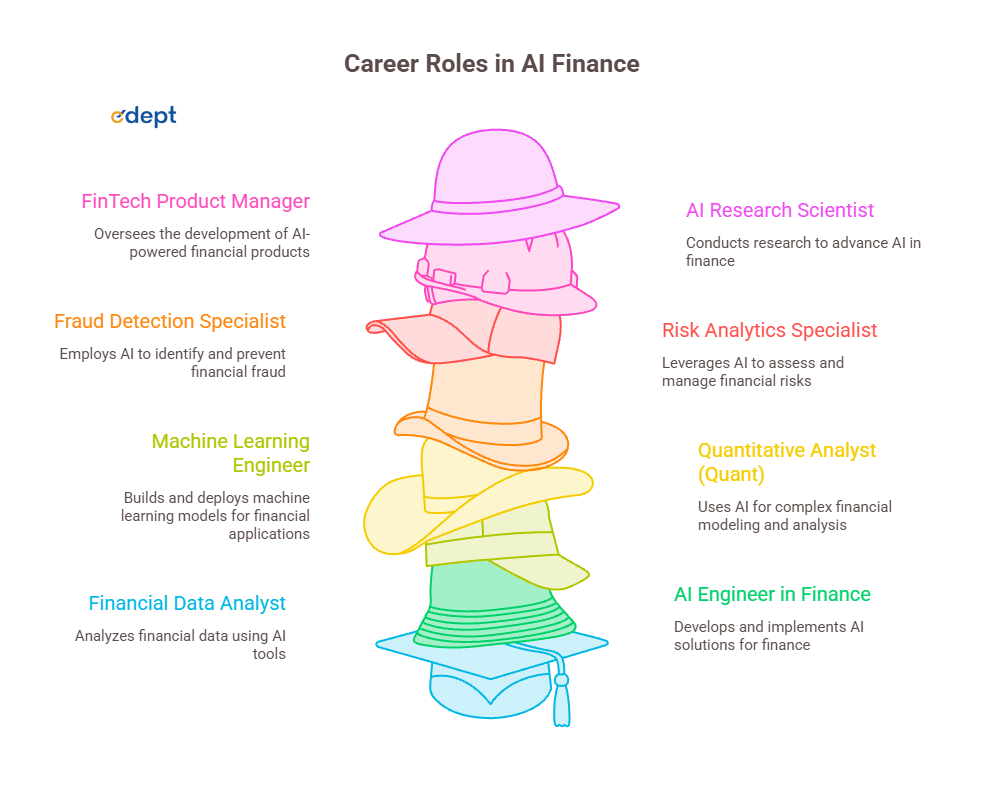
Emerging Career Roles in AI Finance
AI helps in transforming finance by automating repetitive tasks and enhancing human judgement. Emerging career roles help in blending foundational finance expertise (CFA, CA, or MBA) with technical skills such as AI agent orchestration, Python, and prompt engineering. Some of the emerging career roles include.
Financial Data Analyst
A financial data analyst helps in interpreting large datasets to guide business decisions. They use various machine learning tools and predictive analytics to evaluate financial data, market conditions, and investment opportunities.
Required skills: Data analytics, SQL, Python, Excel, Power BI, Tableau, financial modelling.
Salary potential: ₹6–12 LPA (India); $70,000–$110,000 (global).
Future scope: Strong entry-level role with growth into senior analytics and data science positions.
AI Engineer in Finance
An AI Engineer in finance helps in designing, implementing, and maintaining AI systems, machine learning models, and automated agents to optimize corporate finance workflows, fraud detection, risk assessment, and financial forecasting.
Required skills: Python, TensorFlow, PyTorch, machine learning, deep learning, cloud computing (AWS/Azure).
Salary potential: ₹12–30 LPA (India); $120,000–$180,000 (Global).
Future scope: High-demand role as banks and fintechs scale AI infrastructure.
Machine Learning Engineer
Machine learning engineers help in developing and deploying AI models used in banking, trading, fraud detection, and customer analytics.
Required skills: Machine learning, statistical modelling, Python, R, data pipelines, and MLOps. Salary potential: ₹10–28 LPA (India); $110,000–$170,000 (Global).
Future scope: It offers excellent career growth and high salary potential within careers in AI finance.
Quantitative Analyst
They use and apply advanced mathematical and statistical models to evaluate securities, optimize portfolios, and manage risk. Investment banks and hedge funds actively hire professionals who are experienced in quantitative finance.
Required skills: Advanced mathematics, statistics, Python, C++, financial derivatives, stochastic calculus.
Salary potential: ₹15–40 LPA (India); $150,000–$250,000 (Global).
Future scope: High-paying finance role with strong demand at hedge funds and investment banks.
Fraud Detection Specialist
A Fraud Detection Specialist helps in safeguarding organizations by identifying, investigating, and preventing financial crimes. They help in building intelligent systems that monitor transactions, identify suspicious activities, and prevent real-time fraud.
Required skills: Cybersecurity, anomaly detection, machine learning, SQL, risk analytics.
Salary potential: ₹6–14 LPA (India); $80,000–$130,000 (Global).
Future scope: A fast-growing domain as digital payments and threats are expanding globally.
Risk Analytics Specialist
Risk analytics specialists help in predicting financial risks using AI-powered models and support strategic decision-making for banks and insurance firms. They help in managing scorecards and implement risk-mitigation rules using tools like Python, SQL, R, and SAS.
Required skills: Risk management, statistical modeling, Python, R, financial regulations, data visualization.
Salary potential: ₹7–15 LPA (India); $90,000–$140,000 (Global).
Future scope: Critical for banks, insurance companies, and regulatory compliance.
FinTech Product Manager
A FinTech product manager helps in bridging the gap between technology, finance, and user experience. They help in defining the product roadmap, user journey mapping, and feature prioritization for high-stakes financial tools.
Required skills: Product management, agile methodology, financial domain knowledge, data analytics, stakeholder management.
Salary potential: ₹12–25 LPA (India); $100,000–$160,000 (Global).
Future scope: Hybrid business + tech role with strong growth as fintech innovation is growing
AI Research Scientist (Finance)
An AI Research Scientist in finance helps in developing machine learning and deep learning algorithms to solve complex financial challenges, such as algorithmic trading, risk management, and fraud detection. They design predictive models for stock price forecasting, portfolio optimization, and credit scoring using real-time market data.
Required skills: Deep learning, NLP, reinforcement learning, Python, research methodology, PhD preferred.
Salary potential: ₹20–45 LPA (India); $180,000–$300,000 (Global).
Future scope: Advanced career option at top financial institutions and research labs. 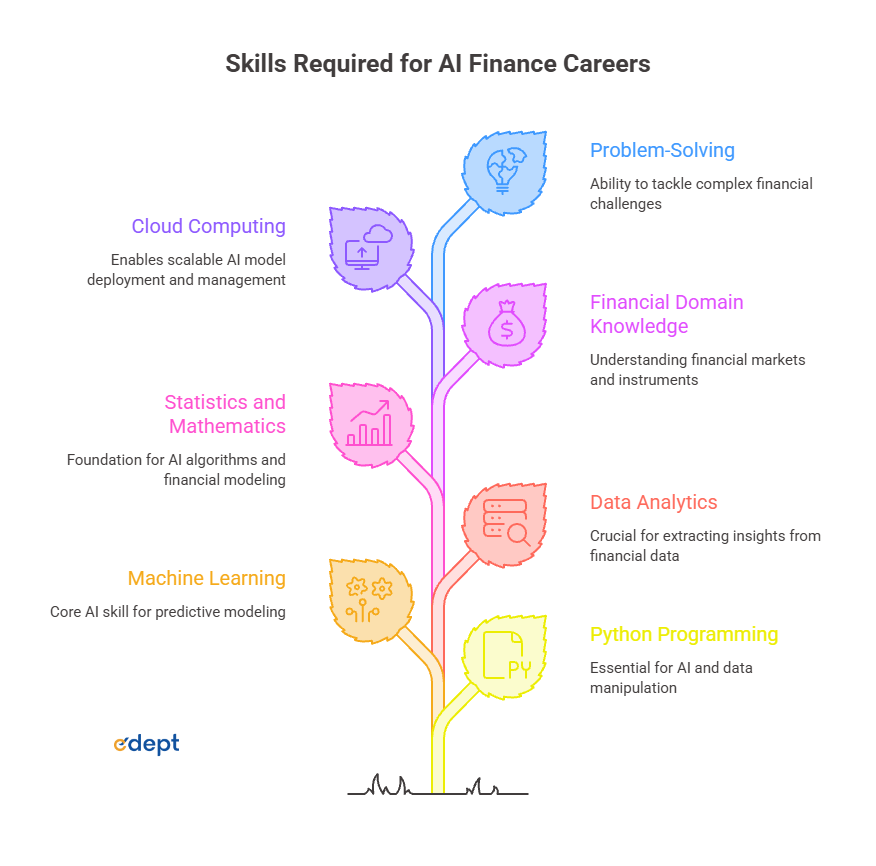
Skills Required for AI Finance Careers
Python Programming
It is the most widely used programming language in AI finance. It is the baseline skill for AI finance careers. It helps in driving algorithmic trading, fraud detection, and risk modelling by bridging raw data analysis and machine learning.
Machine Learning
It is a fundamental requirement for AI finance careers. It involves mastery of supervised/unsupervised learning, time-series forecasting, and libraries such as TensorFlow and PyTorch.
Data Analytics
Data analytics acts as a foundational skill for AI finance careers. It is essential for extracting, cleaning, and querying raw data. Proficiency in tools such as Power BI, Tableau, and Excel helps professionals visualize the financial data and gain insights from it.
Statistics and Mathematics
Mathematics and statistics are used for enabling algorithmic trading, risk management, and fraud detection. algorithmic trading, risk management, and fraud detection. Strong foundations in probability, linear algebra, and calculus are necessary for developing quantitative models and understanding algorithmic behaviour.
Financial Domain Knowledge
In AI finance careers, domain knowledge is the most vital and crucial skill that helps in separating strategic experts from normal coders. Understanding financial markets, instruments, regulations, and accounting principles helps in ensuring that AI solutions are built on solid business reasons.
Cloud Computing
Cloud computing acts as an infrastructure for AI, handling algorithmic trading, risk analytics, and fraud detection. Finance professionals use this to implement scalable machine learning models, store vast datasets, and ensure regulatory compliance. Familiarity with AWS, Azure, or Google Cloud is essential for AI in finance.
Problem-Solving
Problem-solving in finance involves analytical, algorithmic, and critical thinking to translate raw financial data into actionable, automated solutions. It includes streamlining repetitive processes, breaking down complex challenges and formulating behavioural algorithms to spot any suspicious activity.
Industries Hiring AI Finance Professionals
The banking, asset management, and global consulting sectors are the primary drivers of AI finance hiring. Firms in these spaces actively recruit professionals for roles like AI Quantitative Strategists, Financial Data Scientists, and Risk & Compliance Specialists to automate trading, accelerate forecasting, and manage regulatory governance.
Banking
In Banking, it is used for detecting fraud, customer service chatbots, and loan approvals. HDFC Bank, ICICI Bank, and SBI are leading AI adoption in India, along with JPMorgan, Citi, and Goldman Sachs
FinTech Companies
Fintech companies are actively hiring AI finance professionals (like risk analysts, data scientists, and fintech product managers) to drive predictive risk scoring, real-time fraud detection, and automated finance operations. Some of the companies hiring are AlphaSense, HighRadius, Mastercard, Intuit and Upstart Holdings.
Investment Firms
Investment and finance firms are rapidly integrating AI to automate modelling, due diligence, and portfolio management. They hire ML engineers to develop algorithmic trading strategies and portfolio optimization models. Some of the companies hiring are S&P Global, BlackRock, Goldman Sachs, and JPMorgan Chase, along with Anthropic and AlphaSense
Insurance Companies
The insurance companies are actively hiring AI finance professionals to automate financial workflows, optimize claims processing, and detect fraud. They mainly focus on building “AI-native” systems for financial and insurance operations, automating workflows for payments, renewals, and claims. Some of the companies hiring are Allianz, Tata AIG & Tata AIA, Northwestern Mutual, Deloitte & Accenture, and Berkeley.
Wealth Management Firms
Wealth management firms are actively hiring AI finance professionals to build AI agents, automate compliance, and optimize client portfolios. Some of the companies hiring are Morgan Stanley, Goldman Sachs, Deutsche Bank and Dezerv.
Salary Outlook for AI Finance Careers
AI finance careers offer a strong salary outlook.
| Experience Level | India Salary (Annual) | Global Salary (Annual) |
| Entry-Level (0–2 years) | ₹6–12 LPA | $90,000–$120,000 |
| Mid-Level (3–5 years) | ₹12–30 LPA | $150,000–$250,000 |
| Senior-Level (6–10 years) | ₹30–70 LPA | $300,000–$450,000 |
Best Countries for AI Finance Careers
The best countries for AI finance careers are the United States, the United Kingdom, Singapore, and Canada. Now let us discuss in detail.
United States
The US acts as a prime destination for finance professionals who are seeking a lucrative career opportunity, competitive salaries, and a good quality of life. The salary ranges from $60,000 to over $300,000 annually. New York City, Boston, and Chicago are the key cities for finance jobs. Some of the major financial centres, such as Wall Street, Silicon Valley, and Boston, are hotspots for finance careers, offering positions in multinational corporations, startups, and everything in between.
United Kingdom
The United Kingdom, especially London, provides massive advancement opportunities, competitive salaries, and a standard quality of life. The salary ranges from £40,000 to £150,000 or more annually. Salary levels change on the basis of experience, sector, and location, with London providing the highest salaries. London is a major attraction, hosting over 250 banks and numerous financial institutions, including the London Stock Exchange and the Bank of England. Edinburgh and Manchester also provide diverse living experiences, combining cultural richness and extensive professional opportunities.
Singapore
Singapore acts as a dynamic hub for finance professionals. They provide competitive salaries and lower personal income taxes , making Singapore an attractive location for international talent. The salary ranges from SGD 50,000 to SGD 250,000 annually. It provides a great quality of life and scores well on global liveability indexes due to its world-class infrastructure, healthcare, and education systems.
Canada
Canada is becoming a key player in the global financial industry, offering strong economic growth and a stable banking system. With major centres in Toronto and Vancouver, Canada offers excellent career opportunities to professionals who want to blend traditional banking with innovative financial technologies. Toronto is the finance capital, and here salaries range between CAD 50,000 and CAD 150,000 annually.
Germany
In Germany, the finance sector offers competitive salaries, particularly in financial hubs like Frankfurt, which is the nation’s banking capital. It provides a high quality of life, which normally includes excellent public services, a clean environment, and a high level of safety. The salary ranges from €50,000 to €150,000 annually. Frankfurt, which is Germany’s financial heart, is home to the European Central Bank and numerous major banks and financial institutions.
Australia
Australia provides a very vibrant economy and makes a significant contribution to the global finance sectors, especially in cities like Sydney and Melbourne. They provide competitive salaries and a very promising job landscape for finance professionals. The salary ranges between AUD 60,000 and over AUD 200,000 annually. The finance sector is very diverse & sophisticated in nature and covers everything from traditional banking and insurance to innovative fintech startups.
Challenges in AI Finance Careers
Data Privacy and Security
Financial data are very sensitive in nature, and quality data availability is a major concern. The professionals must follow strict data protection regulations while building AI systems that require large datasets. Some of the key data privacy challenges & threats include global compliance overload, data minimisation conflict, prompt leakage & data extraction, and data poisoning & adversarial attacks.
Regulatory Complexity
AI in finance operates under heavy regulation. Regulatory complexity is the primary hurdle in AI finance careers, forcing professionals to constantly navigate shifting laws and model opacity. Regulators often require financial institutions to ensure fairness and non-discrimination. Biased algorithms can create legal risks and damage customer trust.
High Technical Requirements
AI finance roles demand expertise in both finance and technology. To overcome this steep challenge of high technical requirements, professionals must master data science, programming, and algorithmic fundamentals to stay competitive. Some of the essential technical skills include proficiency in Python, understanding ML frameworks, and understanding big data tools such as Apache Spark.
Ethical AI Concerns
AI ethics in finance careers involves balancing rapid innovation with strict regulatory compliance, consumer protection, and data privacy. For finance professionals, the main challenge is to integrate advanced AI into core workflows without violating any ethical principles or risking severe reputational and legal consequences.
Common Mistakes Students Make While Entering AI Finance
Some of the common mistakes which students makes are:
Ignoring Finance Fundamentals
Many students focus only on coding and machine learning while neglecting core finance concepts. Understanding financial markets, instruments, and regulations is essential for building relevant AI solutions. You should always treat AI as an initial draft; always cross-check data before finalising the draft.
Weak Programming Foundation
AI finance requires more than just basic Python knowledge. Students should build strong programming skills, including data structures, algorithms, and software engineering practices. They attempt to build complex machine learning (ML) models or algorithmic trading strategies while skipping foundational math and programming principles.
Not Building Projects
Employers nowadays value practical, real-world experience. Working on real-world projects like fraud detection models, trading algorithms, or credit scoring systems demonstrates capability better than theory-based education alone.
Avoiding Practical Experience
Internships and hands-on experience are very crucial. Theoretical knowledge without practical application leaves graduates unprepared for industry challenges. You should always gain industry experience through working on live projects and through internship opportunities.
Why AI + Finance + Data Skills Create Premium Career Opportunities
When you combine AI, finance and data skills, it creates a premium career combination because it shifts your role from a routine processor of information to a high-level strategic advisor. AI handles heavy data extraction and forecasting; professionals must interpret the results, evaluate risks, and make final decisions. Finance is becoming data-driven. Every financial decision now relies on data analysis. Professionals who can extract insights from large datasets and translate them into valuable, meaningful information are highly valued. AI also helps in improving financial decisions. AI will never replace human judgement; it will help in enhancing it. Professionals who can interpret AI outputs and apply strategic thinking create more value than those who rely on either alone.
Why Choose Edept for AI Career Preparation
If you are serious about building a career in AI, the programme you choose matters as much as the effort you put in. There is a difference between studying AI in theory and being trained to actually work with it. edept’s Master’s in Data Science & AI is built around the second approach. The programme runs as a 1+1 dual-degree pathway; you begin your studies in India through the PGDM in Business Analytics at Shree L.R. Tiwari School of Business Management (SLRTSBM) in Mumbai, and then complete a Master’s in Data Science & AI at Steinbeis University in Berlin, Germany
Industry-Focused Curriculum
The curriculum is built for the job market, not just the examination. On the India side, you work through modules in Python programming, machine learning, data visualisation with Tableau and Power BI, cloud computing, SQL, applied econometrics, and business analytics, the practical toolkit that AI employers expect candidates to walk in with. On the German side at Steinbeis University in Berlin, the focus deepens into artificial intelligence, data strategy and governance, data-driven business models, high-performance computing, and a live innovation project with a real company.
Career Readiness Support
edept provides dedicated support for students navigating the career aspects of international migration, from resume preparation and interview coaching to job-search strategies for specific markets. The goal is not just skill development in isolation but also a clear bridge from learning to landing an international role.
Global Career Exposure
For Indian students who want to enter the AI job market globally, not just domestically, this kind of programme addresses the three things that matter most: the right skills, an internationally recognised qualification, and real exposure to the country where you intend to work. Those three together are what make the difference between a competitive application and a strong one.
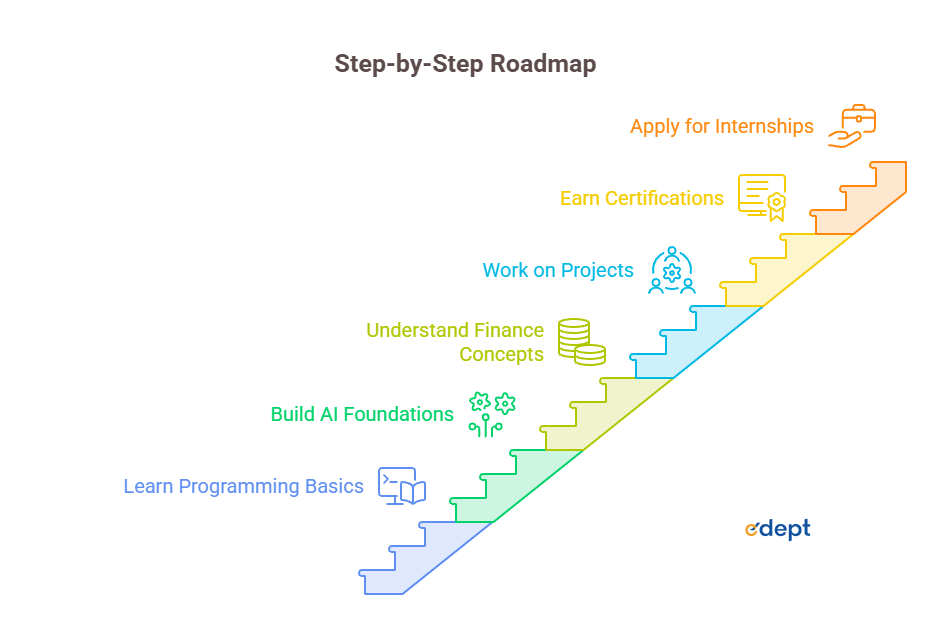
Step-by-Step Roadmap to Build a Career in AI Finance
To build a career in AI finance, the main thing is to bridge the gap between quantitative financial domain expertise and technical AI application.
Learn Programming Basics
You should start with the basics, that is, how AI works. Start learning Python, as it is the primary language of AI development. Learn data manipulation and visualization using NumPy, Pandas, and Matplotlib. Focus on data structures, loops, functions, and object-oriented programming (OOP).
Build AI Foundations
You should start learning standard supervised and unsupervised algorithms for tasks like predicting stock trends, credit scoring, and customer volume. You should start focusing on linear algebra (matrices, vectors), multivariable calculus (gradients, partial derivatives), and probability/statistics. These are not just academic requirements; they’re the language AI speaks.
Understand Finance Concepts
Start learning financial markets, instruments, risk management, and accounting principles. Understand financial statements and finance modelling. Grasp how income statements, balance sheets, and cash flow statements interact.
Work on Projects
Practical project experience helps in transforming the theoretical knowledge into demonstrable skills that employers mostly value. Building real-world applications reinforces learning, creates portfolio pieces, and develops the problem-solving abilities needed for professional AI development.
Earn Certifications
If you want to build a career in AI finance, you should target certifications that help bridge the gap between traditional financial analysis and modern machine learning and prompt engineering. Some of the important certifications are AI for Finance Specialization, AI for Finance Specialization (Corporate Finance Institute), Microsoft Certified: Azure AI Fundamentals and Certificate Program in AI for Trading (IIQF).
Apply for Internships
Start applying for internships to build practical, real-world experience before your first full-time role. They help you gain real-world experience, industry knowledge, and an opportunity for a full-time job offer.
Future Outlook Beyond 2030
By 2030, artificial intelligence, particularly agentic AI, will revolutionize the finance function. Gartner predicts that by 2030, at least 15% of day-to-day finance decisions will be made autonomously. This shift will significantly change how finance operates, with many routine and even complex decisions being delegated to machines. Transactional finance processes are expected to become highly standardized by 2030. AI trading will start expanding; it will become more sophisticated with the integration of generative AI and real-time sentiment analysis from news and social media.
The AI systems will evolve to predict fraud before it happens, using behavioural biometrics and continuous authentication rather than just transaction monitoring. Every customer will start receiving hyper-personalized financial advice, product recommendations, and investment strategies tailored to their unique needs. Fully autonomous banking agents will handle routine transactions, financial planning, and customer service for complex decisions. As digitization will expand more in the future, the demand for AI finance professionals will grow globally, creating various opportunities.
Conclusion
AI in finance careers offers one of the clearest, best-paid, and most future-proof paths available to students and working professionals in 2026. The role of AI in finance is transforming the global finance industry rapidly. AI is making the finance system smarter and more efficient, minimising errors, and making it more secure. Whether you are just starting a career in finance or have professional experience, AI is completely changing the way finance professionals work.
According to the KPMG Global Report, 71% of organizations have already integrated AI into their finance operations, while 41% are implementing it at a moderate to large scale, demonstrating the rapid adoption of AI across enterprises. Companies across various sectors such as banking, insurance, investment and fintech are hiring professionals with advanced AI knowledge who understand both finance and technology. This itself has created a huge demand for students and professionals who are interested in building a successful career in AI and finance. Students who combine AI, finance, and analytics skills will unlock high-paying, future-ready career opportunities.