Corporate governance plays a vital role in shaping how companies grow, operate, and build trust in today’s competitive business environment. Companies today face constant pressure to maintain transparency, follow ethical practices, and ensure accountability in every decision. Corporate governance is often associated only with large enterprises, but small and medium-sized enterprises, SMEs, and MSMEs are the second-highest contributors to the Indian economy. Corporate governance isn’t just for listed companies; it is a very important foundation for SMEs that are willing to grow at a sustainable rate, minimize risk, and build trust among customers, partners and investors. A 9-year study conducted by MSCI found that companies with strong, effective corporate governance have consistently outperformed those without such a governance structure. Not only did they earn more profit, but also stability and a lower volatility rate.
In 2026, running a small or medium enterprise is not at all an easy task; it has become very demanding. You are managing your consumers, cash flows, your team members, and ultimately the growth of the company; all these often at the same time. In the middle of all these, you may feel governance is a distant factor, but it is not, and getting it right can make a big difference. For SMEs, especially those that are running with limited resources, corporate governance provides a necessary framework for making informed decisions, reducing risks, and maintaining accountability.
By implementing proper governance, SMEs can create a foundation for sustainable growth. This guide will break down why corporate governance is so important for SMEs and how you can start building proper and stronger governance practices.
What Is Corporate Governance? (Beginner Overview)
In simple terms, Corporate Governance is a system of rules, practices, processes and structures that is used to guide and control a company. Strong corporate governance builds investor confidence, minimizes the risk of financial scandals, and protects a company’s reputation.
Definition of Corporate Governance
Corporate Governance is the system of rules, practices, processes and structures by which a business is managed and controlled. It defines how decisions are made in the business and who is responsible for them. and how the organisation manages the interests of the stakeholders. It helps in creating a structured framework that helps an organization maintain discipline, accountability and fairness in every business activity.
Key Principles of Governance
Some of the key principles of Governance are accountability, transparency, fairness, responsibility and risk management.
| Principle | What It Means for SMEs | Key Benefit |
| Transparency | Clear financial reporting and open communication with stakeholders | Builds investor and partner trust |
| Accountability | Defined roles for leadership; responsibility for every major decision | Reduces internal conflicts |
| Fairness | Equal treatment of all shareholders and stakeholders | Attracts long-term investors |
| Responsibility | Ethical conduct in business operations and community dealings | Protects brand reputation |
| Independence | Objective oversight of management decisions | Prevents conflicts of interest |
Why Governance Matters for Businesses
Good governance ensures ethical and efficient operations. It plays a very important role in improving the performance of the business, ensuring compliance and maintaining long-term stability. Strong corporate governance builds investor confidence, minimizes the risk of financial scandals, and protects a company’s reputation. It helps in building a clear, structured framework that guides decision-making and promotes efficiency across the organization. When PwC had studied the capital market globally, it summarized that good corporate governance increases access to capital & strengthens public confidence in the market. For an SME, this is a very important factor, as it can lead to faster loan approval, easy supply credit and a credible pitch to the investors.
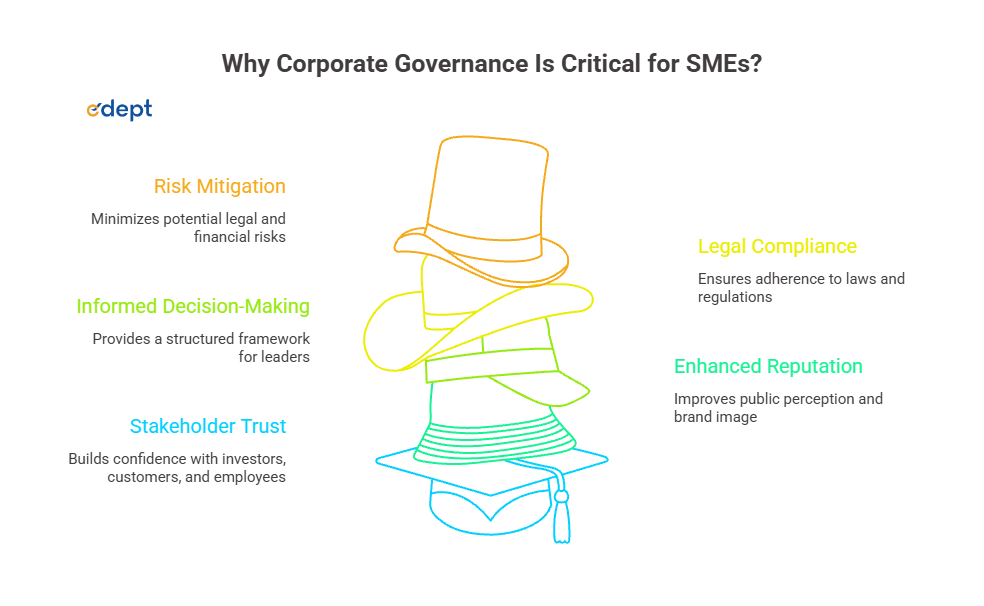
Why Corporate Governance Is Critical for SMEs
Corporate governance is very critical for SMEs. Let us understand why.
Builds Trust with Stakeholders
The investors, partners, customers, and business partners require a higher level of confidence in a business before they decide to deploy funds. That confidence comes from transparency and accountable leadership. When an SME has a very structured governance framework, such as documented policies, audited accounts, and a well-defined decision-making process, this signals that the business is properly arranged. The Indian Ministry of Micro, Small and Medium Enterprises has constantly emphasised that governance is the key to achieving growth and success. When a business has proper governance, it is easy to fund and partner with.
Improves Decision-Making
Implementing a board of directors or any independent advisor encourages diverse perspectives. One of the most common challenges small businesses face is that decisions are made too quickly or by the wrong people. Governance introduces a formal structure, providing a clear framework for evaluating investments, managing contracts and teams, and responding to complex issues. This means the business decisions become more data-driven and properly documented; hence, there are fewer costly errors and faster recovery when things go wrong.
Ensures Legal & Regulatory Compliance
The regulatory landscape in India has grown more complex in recent years. Strong governance helps in removing penalties and risks. This means to stay aligned with the Companies Act 2013. A single MCA notice, a GST mismatch or any labour law penalty can wipe out the profit of a quarter. Good governance ensures that all the documents are well managed, tracked and met consistently.
Key Components of Corporate Governance in SMEs
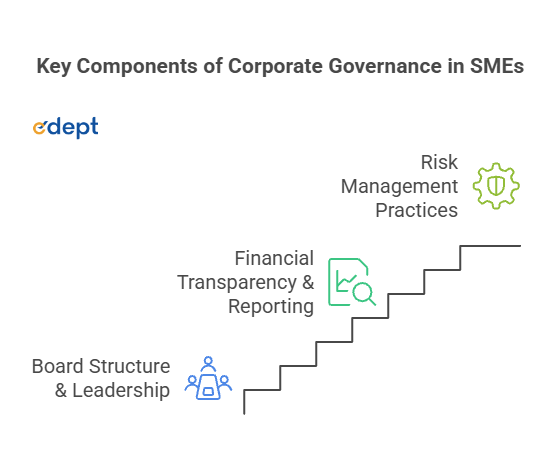
Corporate governance in SMEs refers to the systems of rules, practices, and processes by which a company is directed and controlled. Some of the key components are as follows.
Board Structure & Leadership
Every business, no matter how small it is, benefits from clear leadership accountability. For large companies it means the board of directors, and for small companies it means defining the roles and responsibilities. Some of the key questions to address can be who has the final say in the major financial decisions, who is responsible if something goes wrong, and who reviews the performances. Now if all these are clearly documented and defined, the business runs more smoothly and is not dependent on a single person.
Financial Transparency & Reporting
Maintaining up-to-date and accurate financial records and reports helps in building trust with stakeholders, investors and partners. The businesses which know their numbers in real time can make better decisions. They can easily detect cash flow issues, identify if there is any growth opportunity at an early stage and present a credible image to the external stakeholders.
Risk Management Practices
Risk management in corporate governance helps in identifying and mitigating risks of what could go wrong financially, operationally, or legally and putting them in the right place in order to prevent any major default or any devastating effect on the limited resources.
Benefits of Corporate Governance for SMEs
A study analyzing 1,357 European SMEs from 2014 to 2020 found a positive and significant relationship between corporate governance mechanisms and SME performance, demonstrating that structured governance frameworks directly contribute to business success. Corporate governance provides a strategic advantage for SMEs and MSMEs. Some of them are.
Better Financial Performance
Businesses with a good governance structure consistently showcase strong financial performance. The reason is very common and straightforward: governance introduces discipline, reporting is more accurate, it removes any kind of leakages and it improves capital allocation. Resources are allocated on the basis of data and numbers and not on the basis of assumptions. Research from the IFC found that companies with better governance tend to have higher valuations, a low cost of capital and better profitability, not only for listed companies, but also for private businesses too.
Easier Access to Funding
Whether you are just approaching a bank for a loan, applying for a government MSME scheme or just seeking a private equity investment, governance matters in every step. The lenders and the investors need that confidence that their money is invested in the right place and the capital will be managed responsibly. They look for audited financial records, documented processes, and clear leadership accountability. Companies with strong governance get cheaper debt, fast approvals, and better valuations. Building trust and confidence is a very important factor in this case.
Long-Term Business Sustainability
Most of the SMEs do not fail because of poor products or lack of demand. They fail because of internal conflicts, financial management, leadership conflicts, non-compliance issues and unmanaged risks.Good governance can protect the business against all of these. It builds a well structured foundation that allows a business to survive even if such conditions arises.
Challenges SMEs Face in Implementing Governance
Some of the challenges faced by the SMEs are as follows.
Limited Resources
The most common challenge faced by the SME owner is the cost. Hiring an auditor, or a finance advisor, or a compliance officer – everything costs money that many small businesses are not willing to give. Strict compliance requires specialized staff, independent audits, and dedicated systems. SME owners work in multiple roles. They are usually focused entirely on day-to-day survival and growth, leaving little to no time to dedicate to formal governance frameworks or risk-mitigation strategies.
Lack of Awareness
Many SME owners do not know where to begin with this. Governance can feel complex, as can the corporate concept to them. They don’t realise simple things such as written policies, monthly reviews, and signed minutes already qualify as good governance. The core principles are very simple, and with little knowledge, you can easily implement corporate governance in your organisation.
Resistance to Change
In an SME business where founders have always made business decisions, introducing governance can be a bit difficult at the beginning. It requires sharing authority and sometimes accepting opinions with which they disagree. They fear bureaucracy will slow them down.
Corporate Governance vs Informal Management
Many SMEs still run on informal management, and their decisions are made instantaneously; finances are managed through a single spreadsheet. Now this approach works for small SMEs but not for long; as a business grows, it becomes difficult. The shift from informal to formal is just not an event, but it is a gradual process. But the earlier a business starts this transition, the more profit it can earn in the future.
Structured vs Unstructured Approach
| Factor | Formal Governance | Informal Management |
| Decision-Making | Structured, data-driven, documented | Owner-led, often reactive |
| Financial Control | Regular audits, transparent reporting | Minimal oversight, prone to errors |
| Risk Management | Proactive risk assessment in place | Risks identified only after damage |
| Investor Appeal | High governance builds credibility | Low, hard-to-verify |
| Scalability | Can grow with structured systems | Growth often creates chaos |
| Regulatory Risk | Low compliance systems in place | Highly prone to violations |
Impact on Growth & Scalability
A well-structured company with proper governance can be handed to a professional CEO, sold or even franchised. On the other hand, an informal one cannot be transferred without losing the actual value. This single difference often decides whether an SME will ever cross the ₹50-crore turnover mark.
Risk Exposure Differences
In an informal setup, one wrong decision by a trusted employee can be the reason for the downfall of the company. Whereas for a structured company, with proper governance, internal controls, audits and approvals, it is very easy to detect any issue before it arises.
Role of Technology in Corporate Governance
Technology is transforming corporate governance by enhancing the board’s efficiency, ensuring real-time compliance and reducing risks.
Digital Tools for Compliance
Technology helps in significantly reducing the cost and complexity of governance for SMEs. Digital tools for compliance help in streamlining regulatory tracking, collecting evidence, & assessing risks. They eliminate the use of manual spreadsheets by automating regular monitoring, policy management and audit reporting, ultimately reducing the legal and security costs.
Data-Driven Decision Making
One of the most important technology shifts in governance is that it enables data-driven decision-making rather than decisions made on assumptions. Various business intelligence dashboards, reporting tools, and CRM systems give the SME leaders real-time visibility into their operations.
Automation in Reporting & Auditing
Automation in reporting reduces the risk of human error, increases financial efficiency and makes audits smooth without any errors. For SMEs these are very helpful, as they save time on administrative tasks, and more time can be focused on growing the business with the confidence that the numbers are accurate and up-to-date.
Why Business Professionals Must Learn Corporate Governance
Business professionals must learn corporate governance because it mitigates risks, drives sustainable growth, and helps in building stakeholders’ trust.
Essential Skill for Managers
Corporate governance is no longer a subject for the board members or the company secretaries. It is a very important core skill for managers at every level. If you are a part of budgeting decisions, handling vendor relationships, or reporting to leadership, then you are already within a governance framework.
Importance in Leadership Roles
As a professional, when you move into senior leadership roles, be it in operations, finance, strategy or general management, governance literacy becomes much more important. The leaders who have a proper understanding of governance principles are capable of making strategic decisions, mitigating risks, and building more resilient teams.
Relevance Across Industries
Corporate governance is important for every sector, such as manufacturing, services, technology, healthcare, and retail. Some specific regulations and compliance requirements can vary, but the core principles, which include transparency, fairness, accountability, and responsible management, are universal.
Why Choose Edept for Business & Management Programs
If you want to step into a leadership role with these skills already built in, Edept’s programmes are designed to get you there.
Industry-Relevant Curriculum
Covers governance, compliance, and management practices in line with what employers actually look for in modern business leaders.
Practical Case Studies & Real-World Learning
Learn governance through real business scenarios, case studies on Indian SMEs, listed companies, and global failures like Satyam and Enron and the more recent corporate lapses that shaped today’s rulebook.
Career-Focused Training & Placement Support
End-to-end resume building, interview preparation, mock boardroom exercises, and placement assistance with growth-stage companies.
Programs Designed for Future Managers
A focused portfolio of business management, analytics, and leadership programmes built for students and early-career professionals stepping into decision-making roles.
Best Practices for SMEs to Implement Corporate Governance
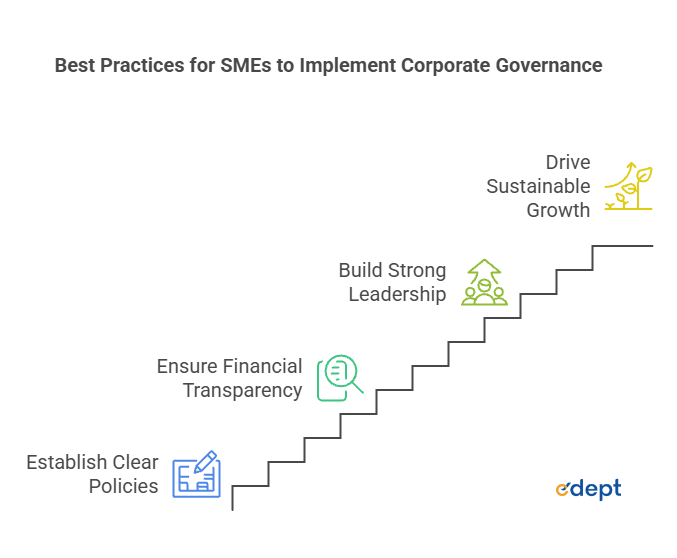
Some of the best practices for SMEs to implement corporate governance are as follows.
Establish Clear Policies & Processes
You should start by documenting the key processes that help you in running your business, such as financial authorisation levels, hiring & exit procedures, contract approval workflows & data handling policies. These do not need to be too elaborate; a clear written policy is good to go.
Ensure Financial Transparency
You should maintain separate business and personal accounts. Conduct regular monthly reviews. Start engaging a qualified accountant and auditor appropriate to your business size. Ensure that every financial decision is documented and reviewed against your budget.
Build a Strong Leadership Structure
You should define the leadership roles very clearly. If you have partners or co-founders, you should document equity agreements and decision-making very clearly. You should consider forming an advisory board; even though it is informal, it should consist of experienced professionals who can provide proper input on major decisions.
Future Trends in Corporate Governance for SMEs
The future trends in corporate governance for SMEs in 2026 are shifting from compliance-driven checklists to the right structures that enable sustainable growth, efficiency and risk resilience.
Increased Regulatory Focus
The regular scrutiny of SMEs is increasing across India and globally. The Ministry of MSME has introduced several initiatives so that it can bring the smaller businesses into a more structured form. GST compliance, labour law digitisation and environmental reporting requirements are all expanding. The SMEs who follow these trends have the capability to go much further than those who wait to react.
ESG & Sustainability Integration
Nowadays, Governance is acting as an enabler for environmental, social, and Governance efforts. The banks, investors, and customers are evaluating businesses based on ESG commitments. For the SME, this means starting to track and report on sustainability as a part of broader governance.
Digital Governance Transformation
Technology is becoming easier and more accessible to SMEs: with AI-powered automated tools, compliance tools, an automated reporting system, and digital board management platforms. The SMEs that have started investing in digital tools and infrastructure will have a significant operation and competitive advantage.
Related Links:
|
Understanding Consumer Behaviour in the Digital Age: What New Managers Should Know |
|
| Which is Better: Excel vs Power BI |
Conclusion
Corporate governance is not just a concept that only belongs to large listed companies. It is a fundamental business practice that helps SMEs to grow confidently, manage risks effectively, attract funding and start building long-lasting trust with the stakeholders. For SMEs, the challenge isn’t just implementing governance; it’s making it work within the realities of limited time, resources, and evolving priorities. But governance does not have to be rigid or complicated. By establishing clear roles and implementing smart insights, it makes this work possible within the realities of limited time, resources, and evolving priorities.
For SMEs, especially those that are running with limited resources, corporate governance provides a necessary framework for making informed decisions, reducing risks, and maintaining accountability. By implementing proper governance, SMEs can create a foundation for sustainable growth. Whether you are an SME or an owner who is looking to formalise business practices or a professional wanting to build governance expertise, the investment you are making towards time and knowledge will surely give you a return across every dimension of business performance.