Choosing between a degree and a skill-based program for a data analytics career is a decision people are considering more seriously in 2026 than ever before. This guide breaks down what each path actually delivers, how salaries compare across experience levels in both India and the US, and what hiring managers are genuinely looking for when they shortlist candidates.
Data analytics is one of the most actively hired fields in the world right now, and the demand shows no sign of softening. Something has shifted in the data analytics job market, and the salary numbers are the clearest signal. Data analyst salaries have climbed by $20,000 since 2025, landing at a current average of $111,000. That kind of growth does not happen in a field where demand is softening. It happens in one where organisations are competing for people who can actually do the work. The way employers evaluate those people has shifted, too. Holding a relevant data analytics certification can push pay up by 10 to 20%, and Robert Half’s research puts the average bump at 16.6% for credentials tied to analytics and business intelligence tools specifically.
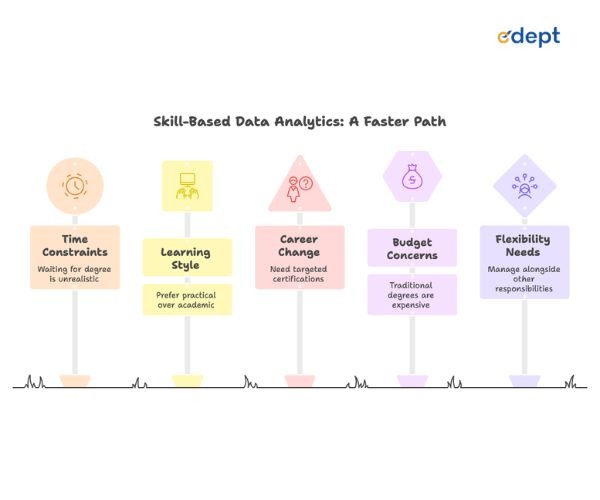
So, which path actually leads to a stronger data analyst career: a skill-based data analytics program or a traditional degree? There is no answer that works for everyone. It depends on where you are starting, how much time you have, what you can spend, and which type of role you are trying to reach.
What this blog does is lay out the skill-based data analytics programs vs traditional degrees comparison honestly, across cost, time, curriculum, career outcomes, and salary, so the decision can be made on evidence rather than on what sounds more impressive or what everyone else seems to be doing.
What Are Skill-Based Data Analytics Programs?
Skill-based data analytics programs have grown significantly in both volume and credibility over the past few years. Before comparing them to traditional degrees, it is worth understanding exactly what they offer and who they are built for.
Definition and Structure
Skill-based data analytics programs are built around a fairly simple premise: get people into analytics roles as quickly as responsibly possible. They are short-term, outcome-focused pathways that cover job-relevant technical skills rather than broad academic theory. The format varies. Some are bootcamps. Some are online certification courses. Some are structured professional certificate programs from education platforms. Duration runs anywhere from a few weeks to twelve months, depending on the depth and the provider. What stays consistent across all of them is the priority. Tools and practical application come first. Employability is the goal, not a formal qualification.
Key Features
The defining characteristics of skill-based data analytics programs are hands-on learning and immediate tool proficiency. Students work with the platforms that appear in real job descriptions: Excel, SQL, Python, Power BI, and Tableau. Projects are built around realistic datasets and business problems rather than textbook scenarios. The learning pace is faster than traditional degrees, and most programs include some form of career support, whether that is resume guidance, mock interviews, or employer connections. This is why they appeal to people who need to demonstrate data analytics certification and practical capability simultaneously rather than in sequence.
Who Should Choose Them
Career switchers are the most natural fit for skill-based data analytics programs. Someone working in marketing, finance, operations, or another domain who wants to move into analytics can develop the specific technical skills needed without completing a multi-year degree. Recent graduates who want to add applied data skills to an existing qualification also benefit significantly. Working professionals who need to upskill without stepping away from employment are another strong match. The flexibility of most skill-based programs allows learning to happen around existing commitments.
What Are Traditional Data Analytics Degrees?
Traditional degrees in data analytics, statistics, computer science, or business analytics take considerably longer than skill-based programs and cover considerably more ground. Understanding what that actually delivers in practice is what makes the skill-based data analytics programs vs traditional degrees comparison genuinely useful, rather than just a surface-level list of differences.
Definition and Structure
Traditional data analytics degrees are bachelor’s or master’s programs offered by universities and colleges. Undergraduate programs typically run three to four years. Postgraduate qualifications take one to two years on top of that. The structure is academic from start to finish, built around semester-based coursework, formal assessments, and a curriculum that moves from foundational theory in the early years toward more specialised application as the program progresses. There is a rhythm to it that skill-based programs do not replicate, and that rhythm is part of what produces a different kind of analytical thinking by the time a student finishes. The credential at the end is formally recognised by institutions, employers, and regulatory bodies in ways that short-term certifications are not universally equivalent to.
Curriculum Overview
Traditional degree curricula in data analytics lean heavily on mathematics, statistics, computer science fundamentals, and business or economic theory. Students spend significant time on topics like probability theory, linear algebra, database design principles, and research methodology before reaching applied analytics coursework. This theoretical depth is the defining characteristic of the traditional degree approach, and it is what distinguishes these programs from the tool-focused curriculum of most skill-based data analytics programs.
Who Should Choose Them
Students who have just finished their secondary education and are not under immediate pressure to enter the workforce are the strongest fit for traditional degrees. Individuals with an interest in pursuing careers in data science, machine learning research, or senior analytics leadership positions are better served by the theoretical foundation offered by degree programs. Those individuals interested in gaining accreditation and the connections associated with earning a degree or those considering entering industries such as government, finance, or health care, where credentials hold particular value, should consider the traditional route as well.
Key Differences Between Skill-Based Programs and Degrees
The differences between these two pathways are not just about length. They reflect fundamentally different approaches to how learning is structured and what it is optimised for. A clear side-by-side view makes the skill-based data analytics programs vs traditional degrees comparison more concrete.
Duration
Skill-based data analytics programs can be completed in three to twelve months. Traditional degrees take three to four years for undergraduate and one to two years for postgraduate. The time difference is not just an inconvenience. It is a genuine opportunity cost consideration, particularly for career switchers who are weighing the income they would forgo during a multi-year degree against the faster entry to earning that a skill-based program enables.
Curriculum Focus
Skill-based programs focus on tools and applied techniques: SQL queries, Python scripts, data visualisation in Tableau or Power BI, and dashboard building for business decisions. Traditional degrees prioritise mathematical and statistical foundations, research methodology, and theoretical frameworks that underpin more advanced analytical work. Neither approach is wrong. They are optimised for different things, which is why the data analyst career path someone is targeting should drive the curriculum choice rather than the other way around.
Learning Approach
Skill-based data analytics programs learn by doing. Students build projects, work through real datasets, and are assessed on output quality rather than exam performance. Traditional degrees are learned by understanding. Students are assessed on their ability to explain concepts clearly. Also, the ability to demonstrate mathematical reasoning and apply frameworks across novel problems. Both approaches produce capable analysts, but they produce different types of capability that suit different types of roles.
Flexibility
Skill-based programs are overwhelmingly delivered online and are often self-paced, meaning students set their own schedule and progress according to their available time. Traditional degrees follow fixed academic calendars with scheduled lectures, tutorials, and assessment deadlines. For someone managing work, family, or location constraints, this flexibility difference is often the deciding factor in the skill-based data analytics programs vs traditional degrees choice before any other consideration even comes into play.
Comparison Table
Both learning paths can lead to strong career opportunities. However, they differ in terms of time, cost, flexibility, and long-term growth. This comparison makes it easier to understand which option fits your career goals, learning style, and plans better.
| Factor | Skill-Based Programs | Traditional Degrees |
| Duration | 3–12 months | 3–4 years (UG), 1–2 years (PG) |
| Cost | Lower | Higher |
| Curriculum | Tools and applied projects | Theory and academic depth |
| Flexibility | Online and self-paced | Fixed schedule |
| Credential | Certification | Formal degree |
| Career Entry | Faster | Slower |
| Theoretical Depth | Limited | Strong |
| Long-Term Growth | Depends on continuous upskilling | Strong foundational growth |
Cost Comparison and ROI
Cost is often what forces the skill-based data analytics programs vs traditional degrees decision for many students, and the numbers on both sides of the comparison are significant enough to matter.
Program Fees
Skill-based data analytics programs vary widely in cost. Google’s Data Analytics Professional Certificate on Coursera costs around $200 to $300 for the full program. Bootcamps from recognised providers typically run between $5,000 and $15,000. Structured programs from specialist education providers like edept sit at price points designed for accessibility while maintaining curriculum quality. Traditional university degrees in India typically range from ₹3 to 15 LPA for private institutions and are subsidised at public universities. International degrees cost considerably more, with US and UK programs running well into six figures in total cost when living expenses are included.
Return on Investment
Across business intelligence and data analytics roles, holding a relevant data analytics certification can boost pay by 10 to 20%, with Robert Half reporting an average 16.6% salary increase for credentials related to analytics and business intelligence tools. For a skill-based program costing $300 to $5,000, the return on a starting salary of $70,000 to $90,000 is recovered within the first year of employment in most cases. Traditional degrees take longer to break even on the cost of tuition, but they build a foundation that supports longer career trajectories with higher ceiling potential.
Hidden Costs
The cost of a traditional degree is rarely just the tuition figure. Accommodation, daily living expenses, and the income that does not get earned during three to four years away from the workforce all add up in ways that students tend to underestimate at the start and feel acutely by the end. The opportunity cost alone, what someone could have earned and saved during that period, is a real financial figure that belongs in any honest cost comparison.
Skill-based data analytics programs carry their own less obvious costs. Self-directed study takes genuine time and discipline, and not everyone accounts for that honestly when they sign up. If the first program does not deliver the outcome it promised, the cost of starting again with a different provider adds up quickly. Neither pathway is as financially clean as the headline price suggests, which is worth sitting with before committing to either one.
Skills and Industry Readiness
Employer expectations in the data analyst career market in 2026 are specific and well-documented. Understanding how each pathway maps to those expectations is one of the most practical dimensions of the skill-based data analytics programs vs traditional degrees comparison.
1. Tools and Technologies Covered
Data visualisation tools are no longer optional in 2026 hiring. Tableau appears in 28.1% of job postings and Power BI in 24.7%, while Microsoft Excel still shows up in 41.3% of data analyst listings, which says something about how embedded it remains in day-to-day analytical work despite everything that has come after it. Skill-based data analytics programs tend to build genuine proficiency in these tools because their curriculum is designed around what job postings are actually asking for right now. Traditional degrees cover them too, but often at a depth that falls short of what employers expect when a candidate sits down for a technical interview.
2. Practical Exposure
The quality of practical exposure is where skill-based programs have the clearest advantage. Real-world projects using messy datasets, business problem framing, and presentation of findings to a non-technical audience are built into the best skill-based data analytics programs from the start. Traditional degrees sometimes struggle to provide the same quantity and quality of applied project work, particularly in the earlier years of the program when theoretical foundations are being laid rather than applied.
3. Industry Alignment
Skill-based data analytics programs are updated more frequently than university curricula because they have fewer institutional barriers to change. When SQL and Python become standard requirements in job postings, a bootcamp can update its curriculum within weeks. A university updating its data analytics degree programme may take a semester or more to implement the change. This lag matters in a field where the tools and techniques that employers expect change meaningfully every twelve to eighteen months.
Career Opportunities and Job Outcomes
The career outcomes of both pathways are ultimately what make or break the skill-based data analytics programs vs traditional degrees comparison for most students. The numbers are worth looking at directly.
Entry-Level Roles
Both pathways can lead to entry-level data analytics roles, including data analyst, business analyst, junior data engineer, and reporting analyst. Entry-level data analyst salaries have climbed to $90,000 in 2026, which reflects just how much the market wants people even at the starting point of a data analyst career. Skill-based programme graduates who have put together a strong project portfolio and earned a relevant data analytics certification are competing for these roles on a genuinely equal footing with degree graduates.
Salary Comparison
The typical range for a fresher job is from Rs. 4 lakh to Rs. 8 lakh in India per year, but the salary range varies based on the location, industry type, and skill set. Mid-skill jobs in the same field pay between Rs. 8 lakh and Rs. 18 lakh. Senior analysts working at product companies can reach Rs. 25 lakh to Rs. 40 lakh or beyond, with specialisation and portfolio quality playing a significant role in where within that range someone actually sits. What is worth noting across both markets is that these salary ranges are accessible to skill-based programme graduates and degree holders alike. The factor that tends to separate candidates at the offer stage is not the type of qualification on the CV. It is the quality and depth of the portfolio sitting behind it.
Hiring Preferences of Companies
The shift in hiring preferences is one of the most significant trends in the data analyst career market. LinkedIn, Google, and many technology companies have formally dropped degree requirements for analyst roles, explicitly moving toward skills-based assessment through technical tests, portfolio reviews, and take-home projects. Consulting firms and financial institutions tend to retain stronger degree preferences at the entry level. The practical implication is that the target employer type should inform the pathway choice as much as any other consideration in the skill-based data analytics programs vs traditional degrees comparison.
Advantages of Skill-Based Data Analytics Programs
Each pathway has genuine strengths that deserve honest representation rather than being framed as a compromise.
Faster Job Entry
The most direct advantage of skill-based data analytics programs is speed. A motivated student can complete a structured program and begin applying for data analyst roles within six to twelve months of starting. For someone who needs to generate income, make a career transition, or establish a data analyst career before market conditions change, this speed is genuinely valuable and not just a convenience.
Industry-Relevant Skills
Because skill-based programs are built around current job posting requirements, the skills they develop tend to be immediately applicable in real roles. A student who completes a program building dashboards in Power BI, writing SQL queries against realistic datasets, and presenting findings in a structured format arrives at an entry-level role, having already done the work in a way that resembles what the job will ask of them from the first week.
Cost-Effective Learning
At a fraction of the cost of a traditional degree, skill-based data analytics programs deliver a faster route to the data analyst career entry point. For both entry-level and mid-career professionals, the right data analytics certification can produce a major salary boost, with someone starting at a typical entry-level salary of $53,500 potentially moving closer to $62,000 to $63,000 with the right credentials. That kind of return from a program costing $300 to $5,000 is financially compelling in a way that a multi-year degree cannot easily match on a pure ROI basis.
Advantages of Traditional Degrees
Traditional degrees are not the default option for people who cannot access anything better. They deliver real and specific advantages that skill-based programs genuinely cannot replicate in every dimension.
Strong Theoretical Foundation
The mathematical and statistical depth of a traditional degree prepares analysts for the more complex challenges that arise as careers progress. Predictive modelling, understanding what sits beneath statistical techniques, and designing analytical frameworks that hold up under scrutiny all benefit from the kind of theoretical grounding that a university programme builds over time. Most short-term programmes cannot fully replicate that depth, and for a data analyst career pointing toward senior analytics leadership, data science, or research, that foundation genuinely matters when you get there.
Recognised Qualification
A university degree is universally recognised by employers, immigration authorities, and regulatory bodies in ways that data analytics certification programs are not consistently equivalent to. For sectors like government, defence, healthcare, and finance, where formal credentials are part of compliance frameworks, a degree is not just preferred. It is sometimes required. International students pursuing work visas also typically find that degree qualifications provide a clearer pathway than bootcamp certificates in most jurisdictions.
Long-Term Career Growth
Traditional degrees provide a foundation that extends beyond the initial data analyst career entry point. The analytical thinking, research skills, and theoretical depth developed during a degree program become increasingly valuable as careers move into senior individual contributor, management, and strategic leadership roles. The degree also provides network access through alumni communities and institutional connections that compound in value over time in ways that are difficult to quantify but consistently cited by professionals who have been in the workforce long enough to experience them.
Which One Should You Choose?
This is ultimately the only question that matters in the skill-based data analytics programs vs traditional degrees comparison, and the honest answer is that it is not a universal one.
Based on Career Goals
If you want to enter the data analyst career market as quickly as possible, build a demonstrable technical skill set, and are targeting roles at technology companies, startups, or organisations that hire based on portfolio and practical assessment, a skill-based program is the stronger immediate choice. If you are targeting long-term progression into data science, analytics leadership, or sectors with formal credential requirements, a traditional degree provides the foundation that skill-based programs alone do not fully build.
Based on Budget and Time
A three-to twelve-month skill-based data analytics program at a fraction of the cost of a university degree makes sense for students who cannot afford to be out of the workforce for three to four years, who need to manage debt exposure carefully, or who simply want to test whether a data analyst career is the right direction before making a larger investment. A traditional degree makes sense for students who have the time, financial support, and long-term vision to make the larger investment worthwhile.
Hybrid Approach
The most practically effective approach for many students is combining both pathways. A student completing a traditional degree in statistics, economics, or business can add a targeted data analytics certification in Power BI, SQL, or Python to significantly improve their competitiveness at the entry level. A skill-based program graduate can pursue a part-time postgraduate qualification over time to build the theoretical depth and formal credentials that open senior roles. Neither pathway has to be a permanent commitment that forecloses the other.
Build high-paying data analytics skills with edept’s industry-focused programs.
edept offers structured pathways designed to take students from foundational knowledge to job-ready analytics capability, combining the practical focus of skill-based programs with the curriculum depth that employers in the current market are looking for. Connect with edept to explore programs built for where the data analyst career market is actually heading.
Why Choose edept for Data Analytics Career Preparation?
edept sits at the intersection of what the skill-based data analytics programs vs traditional degrees often miss. The strongest career outcomes in analytics do not necessarily come from one pathway chosen over the other. They come from practical skill development combined with a structured curriculum, career support, and real-world project exposure that makes a candidate genuinely competitive from the day they start applying.
edept’s data analytics courses are built around the tools and techniques that appear most frequently in real job postings. SQL, Python, Excel, Power BI, and Tableau are all central to the curriculum rather than peripheral additions. Hands-on projects using realistic datasets develop the portfolio that hiring managers actually assess. Placement support that is specific to the data analyst career market, rather than generic career advice, makes the transition from program completion to employment significantly faster and more targeted. The programs are accessible to students from non-technical backgrounds, career switchers, and fresh graduates who want to enter the data analytics profession with demonstrable capability rather than just a qualification.
Conclusion
The skill-based data analytics programs vs traditional degrees comparison does not produce a single right answer. It produces a decision that is right for specific circumstances. The World Economic Forum’s Future of Jobs Report 2025 identifies big data specialists and AI and machine learning specialists among the fastest-growing roles through 2030, with data analytics continuing to rank among the most in-demand professional capabilities across every major economy globally.
For students who need to move quickly, are managing budget constraints, and are targeting roles at skill-first employers, a well-chosen skill-based program with a strong data analytics certification and a portfolio of real projects is a genuinely viable and financially smart pathway into a data analyst career. For students with the time and resources to build a stronger theoretical foundation and a formally recognised credential, the traditional degree offers advantages that compound over the longer arc of a career. The hybrid approach, building both practical certification and formal qualification over time, produces the most complete profile in a market that increasingly rewards analysts who can demonstrate both depth and application. Choose based on where you are starting from, where you want to end up, and how much time and money you are willing to invest to get there.