Healthcare analytics is one of the fastest-growing career paths in the global job market right now, and the demand is spread across countries rather than concentrated in one place. This guide covers the roles available, the salaries you can realistically expect, the skills hiring managers are looking for, and the countries where opportunity is genuinely strongest in 2026.
Healthcare has quietly become one of the most data-intensive industries on the planet, and the numbers behind that shift are genuinely staggering. Healthcare organisations generated 30% of the world’s data in 2025, yet 97% of hospital data goes unused, representing an enormous and largely untapped analytical opportunity. The market being built around closing that gap is growing at a pace that few sectors can match.
So what does healthcare analytics jobs growth actually mean for students and professionals in 2026? It means that hospitals, pharmaceutical companies, insurance providers, and public health agencies are actively building analytics teams and struggling to fill them with qualified people. Healthcare data analyst careers are not a niche specialisation anymore. They are a mainstream and high-growth career pathway that combines healthcare knowledge with analytical skills in a way that the job market values significantly.
This blog covers the key healthcare analytics career roles, which countries are hiring most actively, what the salary picture looks like, what skills the roles require, and how students from diverse academic backgrounds can position themselves for this growing field.
What Is Healthcare Analytics?
Before diving into specific roles and salaries, it is worth establishing what healthcare analytics actually covers, because the field is broader than most people initially assume and accessible to more academic backgrounds than the name suggests.
Definition of Healthcare Analytics
Healthcare analytics is the use of data to improve decision-making across every dimension of healthcare delivery, management, and funding. This includes collecting, analysing, and interpreting data from patient records, hospital operations, insurance claims, clinical trials, and public health surveillance systems. The outputs range from dashboards that help hospital managers track bed occupancy to predictive models that identify patients at risk of readmission before they leave the building.
Such examples include: The healthcare data analyst can prepare a report identifying treatment protocols that yield the most favorable results for patients while using the minimum financial resources. The clinical data analyst would be responsible for managing the data collected during a drug test to ensure statistical validity. A public health analyst might track disease spread patterns across a city to help governments decide where to direct resources. All of these are healthcare analytics career roles, and all are growing in demand globally.
Why It Is Becoming Essential Globally
Several converging trends are making healthcare analytics jobs indispensable rather than optional for healthcare organisations around the world. The digitisation of hospital systems through electronic health records has created vast stores of patient data that were previously locked in paper files. Telemedicine growth, accelerated significantly by the pandemic, has added new streams of remote patient data. Preventive healthcare models, which require identifying at-risk patients before they become seriously ill, depend entirely on analytics to function. Every one of these trends creates more demand for people who can work with healthcare data professionally and competently.
Why Healthcare Analytics Jobs Are Growing Worldwide?
The growth of global healthcare analytics careers is not driven by a single trend. It is the product of several simultaneous shifts that are reinforcing each other across every major healthcare market.
Digital Transformation in Healthcare
Electronic health records have replaced paper systems in most developed healthcare markets, and that shift has created a fundamental new infrastructure layer that generates data continuously across every patient interaction. Automation systems in hospital administration, AI-assisted diagnostic imaging, and predictive health models are all built on top of this data infrastructure. Currently, the healthcare industry generates close to 30% of the world’s entire data, which is expected to increase by 36% annually. The individuals who are able to understand and interpret this information, organize and analyze it, and finally convert it into actions for the benefit of the health care industry are the ones the job market targets.
Demand for Data-Driven Patient Care
Healthcare providers are under increasing pressure to demonstrate that their interventions produce measurable outcomes rather than simply treating volume. This shift toward value-based care requires analytics to measure treatment effectiveness, track patient outcomes, identify where errors are occurring, and demonstrate where operational efficiency can be improved without compromising care quality. Healthcare organisations integrating advanced analytics see an average ROI of 147% within three years, which is the kind of return that convinces hospital boards to invest in analytics teams rather than treating them as optional.
Global Public Health Investments
Government investment in healthcare digitisation is accelerating across North America, Europe, Asia-Pacific, and the Middle East. National health programs are building analytics infrastructure to manage population health at scale, track chronic disease prevalence, respond to infectious disease outbreaks, and allocate limited healthcare resources more efficiently. These public sector investments create a sustained and stable stream of global healthcare analytics careers that run alongside private sector demand rather than competing with it.
Read More: Is Direct Admission in Data Analytics Courses Worth It in 2026?
Top Healthcare Analytics Career Roles
There are many specialisations within healthcare data analytics, and each serves a unique function within the healthcare industry. Knowing what these positions are about allows students to decide which is right for them based on their qualifications.
1. Healthcare Data Analyst
Healthcare data analysts are the most common entry point into healthcare analytics jobs. They work with hospital and patient data to track performance metrics, identify patterns, and create dashboards that give clinical and operational leaders visibility into what is happening across their systems.
Day to day, the work involves pulling data from electronic health record systems, getting it into a state that is clean and usable, building reports and visualisations that actually communicate something, and then sitting in front of non-technical stakeholders and explaining what the numbers mean for the decisions they need to make. Students from data analytics, business analytics, statistics, and even business management backgrounds can move into this role with the right technical skills built on top. From there, the career path runs through senior analyst and analytics manager before opening up into director of analytics or chief data officer roles within hospital systems and larger healthcare companies.
2. Clinical Data Analyst
Clinical data analysts work specifically with data generated during clinical trials, medical research studies, and patient care protocols. They support pharmaceutical companies, research hospitals, and contract research organisations in ensuring that trial data is captured accurately, structured correctly, and analysed in ways that produce statistically valid results.
This role is particularly well-suited to students from life sciences, pharmacy, and biomedical backgrounds who add data skills to their domain expertise. The combination of scientific literacy and technical capability is exactly what clinical research organisations look for and rarely find in sufficient volume. Career paths from this role lead into clinical data management, biostatistics, regulatory affairs, and medical affairs functions within pharmaceutical and biotech companies.
3. Healthcare Business Analyst
Healthcare business analysts sit at the intersection of analytics and operational improvement, using data to identify inefficiencies in how healthcare services are delivered, funded, and managed. They work on projects ranging from revenue cycle optimisation to operational reporting for hospital networks and health insurance companies.
This is one of the more accessible healthcare analytics career roles for students from business, economics, and management backgrounds who have added SQL and data visualisation skills. The role does not require deep clinical knowledge, but it does require understanding how healthcare organisations make money, manage costs, and measure performance. Growth paths lead toward senior business analyst, strategy consulting, and healthcare management roles.
4. Public Health Analyst
Public health analysts use data to understand disease trends, evaluate public health interventions, and support policy decisions at the community and national levels. They work for government health agencies, international health organisations, research institutions, and NGOs.
The information that they deal with may vary from disease surveillance systems to demographic databases, from health environment systems to health behavior surveys. Public health, epidemiology, social science, and health care administration majors may prove very suitable for these jobs if they have knowledge in data analysis. The global growth of public health analytics is being driven by everything from pandemic preparedness investment to chronic disease management programs in aging populations.
5. Medical Data Consultant
Medical data consultants advise hospitals, pharmaceutical companies, and healthcare technology firms on how to build, improve, and use their analytics capabilities. They typically work for consulting firms or as independent specialists with a combination of healthcare domain expertise and analytics implementation experience.
This is a role that usually requires several years of experience in other healthcare analytics career positions before moving into consulting. The compensation at senior levels is among the highest in healthcare data jobs, reflecting the combination of domain expertise, technical skill, and client-facing capability required.
6. Healthcare BI Analyst
Healthcare business intelligence analysts build and maintain the executive dashboards, strategic reports, and data infrastructure that senior healthcare leaders use to make high-level decisions. They work with BI platforms, including Power BI and Tableau, to create visualisations that translate complex operational and clinical data into accessible formats for non-technical audiences.
This role sits at the technical end of healthcare analytics jobs. It calls for strong skills in BI tools, along with sound knowledge of healthcare metrics that are important to the executives. Those students from backgrounds in data analytics, information technology, and business intelligence who gain healthcare knowledge through their courses can make a suitable choice to specialize in this area.
Countries with High Demand for Healthcare Analytics Professionals
Healthcare data jobs are growing globally, but the distribution of demand is not even. These five markets represent the strongest current and near-term opportunities for global healthcare analytics careers.
| Country | Average Healthcare Analyst Salary | Demand Level | Key Employers |
| United States | $75,000–$110,000 | Very High | Hospital systems, pharma, insurance companies |
| Canada | CAD $65,000–$90,000 | High | Public health agencies, hospitals |
| Germany | €45,000–€70,000 | Growing | MedTech companies, pharma, and public hospitals |
| Singapore | SGD $55,000–$85,000 | High | Smart health initiatives, hospitals |
| United Arab Emirates | AED 120,000–200,000 | Growing | Private hospitals, health authorities |
United States
The US healthcare analytics market is the largest and most sophisticated in the world. The US Healthcare Analytics market stood at USD 19.65 billion in 2025 and is projected to reach USD 59.68 billion by 2030 at a CAGR of 24.9%. Employers in this field include hospital chains such as Mayo Clinic and HCA Healthcare, large drug firms, insurers, and health tech companies. There is continuous demand for professionals in the field of healthcare data analysis due to the presence of a highly developed private healthcare industry.
Canada
Canada’s public healthcare system is going through a period of meaningful digital change, with federal and provincial governments putting real money into electronic health record integration, population health management, and the analytics infrastructure that supports both. Healthcare analytics jobs in Canada are growing across hospital networks, public health agencies, and health-focused technology companies that have set up alongside them. For internationally trained analytics professionals with healthcare domain knowledge, the Express Entry immigration pathway makes Canada one of the more practically accessible destinations to target.
Germany
Germany runs one of the most sophisticated healthcare systems in Europe, and it is currently investing heavily in digital transformation across both its public hospital network and a well-established MedTech and pharmaceutical sector. Healthcare data jobs in Germany are expanding in pharmaceutical research, hospital operations, and health insurance analytics, driven by organisations that are building serious analytical capability rather than experimenting at the edges. The EU Blue Card gives internationally trained analytics professionals a structured route in, and Munich and Berlin have emerged as the two main centres for global healthcare analytics careers within the German market.
Singapore
Singapore has deliberately positioned itself as the regional anchor for health technology innovation in Asia-Pacific, backed by sustained government investment in smart healthcare systems, genomics research, and population health analytics. Healthcare analytics jobs in Singapore are concentrated across the hospital system, established research institutes, and a health technology startup ecosystem that has grown considerably over the past few years. The country’s multilingual environment and strong technology infrastructure make it a genuinely attractive base for internationally trained professionals who have their sights set on healthcare data jobs across the Asia-Pacific region.
United Arab Emirates
The UAE is building out its healthcare infrastructure at a pace that few other markets are matching, with significant capital going into private hospital networks, health technology platforms, and digital health initiatives across Dubai and Abu Dhabi simultaneously. Healthcare analytics career scope in the UAE is expanding alongside that infrastructure investment, with the strongest demand currently sitting in hospital operations analytics, health insurance analytics, and public health data management for government health authorities that are modernising how they work with population-level data.
Salary Trends in Healthcare Analytics
Healthcare analyst salary figures vary significantly by country, experience level, and specialisation. Here is a realistic breakdown based on current market data.
Entry-Level Salaries
The starting salary for healthcare data analyst jobs varies by country. In the US, the salary ranges between $55,000 to $75,000. In Canada, the salary ranges between CAD $55,000 to $70,000. In Germany, the salary range is between €38,000 to €48,000. In Singapore, the salary range is between SGD $45,000. The UAE stands out with AED 100,000 to 140,000 annually, and the tax-free structure makes that considerably more attractive in real take-home terms.
Mid-Level Salaries
Three to five years of experience shifts the numbers noticeably. In the United States, the salaries for mid-level health care analytics specialists fall in the range of $80,000 to $110,000, while in Canada, their salary range is between CAD $75,000 to $95,000. In Germany, the range is between €55,000 to €70,000. In India, the salary range for mid-level healthcare analysts is between Rs. 10 lakh and Rs. 20 lakh annually.
Senior-Level Salaries
Senior professionals who have carved out a place in consulting, analytics leadership, or highly specialised clinical data work tend to sit at the top end of the pay scale across global healthcare analytics careers, and the gap between them and mid-level counterparts is not a small one. US senior analytics directors and managers at major healthcare systems earn $120,000 to $160,000 or above. Medical data consultants at top-tier consulting firms can earn significantly more. In India, senior healthcare analytics roles at multinational pharmaceutical companies and health technology firms reach ₹25 to 45 LPA, with leadership roles exceeding that range at the largest organisations.
Skills Required for Healthcare Analytics Careers
The skills that healthcare data analyst careers require sit across three categories, and the strongest candidates develop capability in all three rather than treating them as alternatives.
1. Technical Skills
SQL is the foundational technical skill for virtually every healthcare analytics job. The ability to query relational databases, extract patient and operational data, and build reporting datasets is expected at the entry level. Python is increasingly important for more complex analytical work, including predictive modelling and data processing automation. Power BI and Tableau are the primary visualisation tools in most healthcare analytics career environments, and Excel remains important for operational reporting and ad-hoc analysis. The specific tools matter less than demonstrating genuine proficiency with at least two or three of them through project-based evidence.
2. Healthcare Domain Knowledge
Technical skills without a healthcare context produce analytics that are technically correct but clinically or operationally irrelevant. Understanding how healthcare systems are structured, how patient data is generated and recorded, what the key regulatory frameworks are, including HIPAA in the US and equivalent frameworks in other markets, and what the metrics that matter to clinical and operational leaders actually mean are all forms of domain knowledge that make analytics genuinely useful. Students from life sciences, pharmacy, public health, and healthcare management backgrounds bring this naturally. Students from data and technology backgrounds need to develop it deliberately through coursework, projects, and exposure to healthcare settings.
3. Soft Skills
Healthcare analytics jobs involve presenting findings to clinical and operational leaders who did not train as analysts and who make decisions that directly affect patient care. The ability to communicate complex analytical findings clearly, structure reports that non-technical audiences can navigate, and influence decisions through evidence rather than just producing data are skills that consistently differentiate strong healthcare data analysts from technically capable ones who struggle to have an impact. Problem-solving under real-world constraints, including data quality issues, incomplete records, and organisational complexity, is another soft skill that the healthcare setting specifically demands.
Best Educational Paths for Healthcare Analytics
The healthcare analytics career scope is unusually broad in terms of the academic backgrounds that can access it, which is one of the field’s most practically significant features for students from diverse disciplines.
Degrees
Bachelor’s programs in healthcare management, data analytics, life sciences, pharmacy, public health, business analytics, and computer science all provide viable entry points into healthcare data analyst careers. Each background brings different strengths that map to different specialisations within the field. The candidates who tend to stand out most in hiring processes are those who have paired a degree in a healthcare-adjacent field with data analytics skills built through additional coursework, certifications, or focused self-directed learning. At the postgraduate level, master’s programmes in health informatics, healthcare management, biostatistics, and applied data analytics with a healthcare orientation provide the strongest academic foundation for anyone targeting mid-to-senior level global healthcare analytics careers rather than staying at the entry level indefinitely.
Certifications
Targeted certifications add specific technical or domain credibility to profiles that already have degree-level qualifications. Professional Certification in Google Data Analytics, Microsoft Power BI certification, and specific SQL certification are examples of technical skills certifications. CHDA from AHIMA is a certificate to prove expertise in the healthcare-related domain knowledge. HIMSS provides healthcare IT certifications. Combining one or two technical certifications with domain-specific credentials produces the most well-rounded profile for healthcare analytics jobs.
Why Students Should Consider Healthcare Analytics in 2026
Healthcare data analyst careers are not just growing. They are growing in ways that make them unusually attractive as long-term career investments.
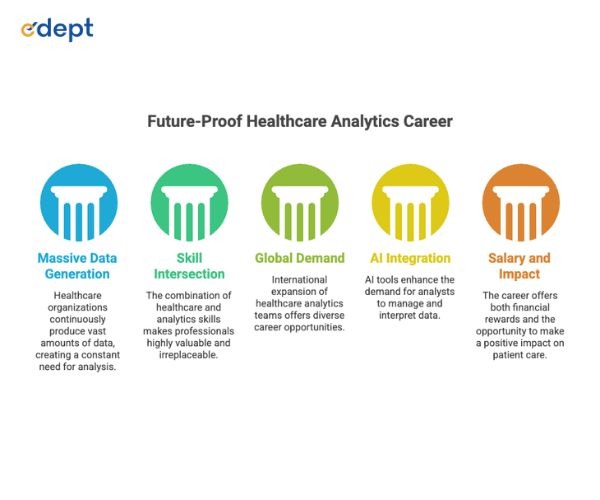
Job security in healthcare analytics careers is structurally strong because healthcare is not a discretionary sector. Demand for healthcare services continues to grow regardless of economic cycles, and the analytics infrastructure that supports that care is increasingly treated as essential rather than optional. Healthcare organisations integrating advanced analytics see an average ROI of 147% within three years, which means analytics investment is justified on financial grounds and is therefore protected even during budget pressure cycles.
The international demand for healthcare data jobs means that skills developed in one market are transferable to others, giving healthcare analytics career professionals more global mobility than many comparable roles. The salary trajectory is strong across all major markets, with specialisation accelerating compensation growth significantly. Perhaps most importantly for many students, healthcare analytics career work has a direct and visible impact on patient outcomes, which provides the kind of meaningful professional context that purely commercial analytics roles often lack.
Learn future-ready healthcare analytics skills with edept’s career-focused programs.
edept offers structured pathways designed to develop the technical skills and healthcare domain knowledge. This knowledge is what employers in healthcare analytics jobs are actively looking for. Contact the edept to explore programs built for the healthcare data job market is heading.
Why Choose edept for Data Analytics Career Preparation
edept builds its data analytics curriculum around what hiring managers in healthcare actually look for, not what looks impressive listed on a brochure. Every tool covered appears regularly in real healthcare analytics job postings, and because the learning is built around projects rather than passive instruction, students walk away with work they can genuinely show rather than a certificate that only confirms they completed the course.
Industry-Focused Curriculum
edept’s programs cover SQL, Python, Power BI, Tableau, and Excel through a curriculum updated to reflect current employer expectations in analytics-intensive sectors, including healthcare. The content is not theoretical. It is built around the kind of analytical problems that healthcare data jobs present in practice, which means students develop the ability to work with messy, real-world data rather than clean academic datasets.
Practical Learning
Projects and case studies within edept’s programs are designed to build the portfolio evidence that healthcare analytics career hiring processes specifically evaluate. Students who complete edept’s programs have documented analytical work to present in applications and interviews, which directly addresses the most common gap between course completion and employment readiness.
Career Support
edept’s placement support is oriented toward concrete outcomes rather than generic career advice. Understanding which employers recruit analytics professionals for healthcare data jobs, how to position a profile effectively for sector-specific hiring processes, and how to prepare for the technical assessments and portfolio reviews that healthcare analytics career interviews typically include are all areas where edept’s career support goes beyond what most programs provide.
Step-by-Step Roadmap to Build a Healthcare Analytics Career
Building toward healthcare analytics jobs does not require following a single fixed path. It requires combining the right elements in the right sequence.
1. Learn Core Data Analytics
SQL, Excel, Python, and at least one visualisation tool form the technical foundation that every healthcare data analyst career requires. These are learnable through structured programs, and demonstrating proficiency through project work matters more than the source of the learning. Starting here before adding healthcare-specific content is the most efficient sequencing for most students.
2. Understand Healthcare Systems
Healthcare domain knowledge does not require a clinical degree. Understanding how hospitals are structured and funded, what electronic health records contain, how insurance and billing work, and what the key regulatory frameworks are can be developed through targeted coursework, reading, and exposure to healthcare environments through internships or project work. This context is what makes technical analytics skills useful in a healthcare setting rather than just generically applicable.
3. Build Projects in Healthcare Data
Public healthcare datasets, including hospital readmission data, disease surveillance records, and clinical trial data, are freely available and provide the raw material for portfolio projects that demonstrate both technical skill and healthcare context. Healthcare analytics career hiring processes consistently evaluate portfolio work, and projects built on realistic healthcare data are significantly more compelling than generic retail or marketing datasets.
4. Gain Certifications
Targeted data analytics certifications validate specific technical skills in a format that healthcare employers can verify. Starting with a Google Data Analytics or Microsoft Power BI certification and adding a healthcare-specific credential like the CHDA builds a credential profile that signals both technical competency and domain commitment to healthcare analytics career recruiters.
5. Apply for Internships and Global Roles
Healthcare analytics internships at hospital systems, pharmaceutical companies, public health agencies, and health technology firms provide the professional context that makes academic skills legible to full-time employers. Healthcare data jobs that target internationally qualified candidates are increasingly posted on LinkedIn and specialised healthcare technology job platforms, and building an internationally positioned profile through platform presence and portfolio visibility improves competitiveness for global healthcare analytics careers.
Also Read: Data Analytics Admission in India: Your Ultimate Document Checklist
Future Scope of Healthcare Analytics Careers Beyond 2026
The growth trajectory of healthcare data analyst careers extends well beyond the current market conditions and is supported by structural trends that show no sign of reversing.
AI-Powered Healthcare Systems
AI is moving from experimental to operational in healthcare analytics at a significant speed. AI adoption has hit 85% across the healthcare industry, and the demand for analytics professionals who can work with AI-generated insights, validate AI model outputs, and translate AI recommendations into clinical practice is growing alongside adoption rates. Healthcare analytics career professionals who develop AI literacy alongside their core analytics skills are positioning themselves for the highest-growth segment of the field.
Precision Medicine
Precision medicine, which tailors treatment to individual patient characteristics including genetic profile, lifestyle data, and environmental factors, is generating enormous volumes of complex data that require sophisticated analytics to interpret. The healthcare data jobs being created around precision medicine in pharmaceutical research, clinical genomics, and personalised treatment planning represent one of the most technically demanding and potentially highest-compensated segments of global healthcare analytics careers in the coming decade.
Global Demand for Analytics Professionals
Asia Pacific is projected to witness the highest growth rate in the healthcare analytics market during the forecast period, with India projected to reach USD 1.17 billion by 2026 and China reaching USD 2 billion by 2026. This regional growth means that healthcare analytics career opportunities are expanding in markets where they were previously limited, creating new entry points for analytics professionals who want to build careers in growing rather than mature markets.
Conclusion
Healthcare analytics jobs represent one of the most structurally sound career investments available to analytics-minded students in 2026, combining stable and growing demand with meaningful professional impact. The global healthcare analytics market is projected to grow from USD 16.54 billion in 2025 to USD 52.83 billion by 2035 at a CAGR of 12.31%, driven by rising healthcare data volumes, increasing demand for cost optimisation, and the adoption of data-driven decision-making across healthcare systems globally.
Data analysts who focus on healthcare have entry opportunities for those educated in data analysis, life sciences, pharmacy, healthcare management, and even business. The reason why most individuals who enter this career end up being hired is due to their ability to develop their technical skills, understand healthcare, and have project experience. The healthcare analyst salary trajectory is strong, the international demand for qualified professionals is genuine, and the work itself contributes directly to how well healthcare is delivered to patients at scale. That combination is difficult to find in most career fields, which is why healthcare analytics career scope is growing as quickly as it is.
Related Links: