Every year, lakhs of students from computer science, engineering, and IT often stand at the same crossroads. They have their degree and a decent grade, along with a genuine interest in technology, but the next step feels very confusing. They are in a dilemma about what they should choose. Should they go deeper into coding with an MCA degree? Push into research and specialization through an M.Tech? Or just step into a leadership role through an MBA in IT? Now let us discuss MCA vs M.Tech vs MBA IT in a more detailed way.
Each of these programmes opens a different new door. MCA helps in sharpening your software development and IT skills so you can build new things. M.Tech pushes you deeper into technical specialization and research, the kind of expertise that solves harder engineering problems. MBA IT sits at the intersection of business and technology, which helps in training you to lead teams and shape strategy rather than just execute it.
The truth is there is no single best degree. What works for a student who loves to do coding will not work for someone who wants to manage a product team. In this blog, we will break down MCA vs M.Tech vs MBA IT using real data and salary figures, industry trends, practical advice, and details on eligibility, curriculum, and available job roles.
Understanding MCA.
What Is MCA?
MCA stands for Master of Computer Applications. It is a two-year postgraduate programme focused on software development, programming, and modern computing technologies. Unlike pure computer science degrees that mostly lean heavily on theory, MCA is built around practical skills, writing code, building applications, managing databases, and deploying software solutions.
The curriculum mainly covers the following:
- Data structures and algorithms
- Database management systems (DBMS)
- Operating systems and computer networks
- Web technologies and full-stack development
- Software engineering and project management
- Electives in AI/ML, cloud computing, cybersecurity
- Major project in the final semester
- Programming fundamentals (Python, Java, C++)
Who Should Choose MCA?
MCA works best for graduates from BCA, B.Sc. IT, B.Sc. Computer Science, or any bachelor’s degree with Mathematics at the 10+2 or graduation level. If you enjoy writing code, solving logical problems and want to become a developer, cloud engineer or data professional, MCA is the best fit for you. Master of Computer Applications (MCA) professionals in India are highly sought after, with a national employability rate of approximately 71%. These IT experts command average starting salaries of ₹3.5 LPA to ₹9 LPA, with senior architects earning upwards of ₹25+ LPA.
Eligibility:
- A 3-year or 4-year undergraduate degree (BCA, B.Sc., B.Com., B.A., B.E., or B.Tech.) from a recognized university.
- Mathematics as a subject at 10+2 or graduation level (mandatory in most universities)
- Minimum aggregate of 50% marks (45% for reserved candidates)
- No engineering degree required, accessible to non-engineering backgrounds
Understanding M.Tech
What Is M.Tech?
‘MTech’ stands for ‘Master of Technology’. It is a two-year advanced engineering degree that goes deep into a specific technical field: Computer Science, AI, Data Science, VLSI, Cybersecurity, or Communication Systems, among others. Where MCA teaches you to apply technology, M.Tech teaches you to research, design, and engineer it. It demands that you easily understand the “why” behind technology, i.e., the algorithms, the architectures, and the mathematical models. Popular specializations include: – Computer Science & Engineering – Artificial Intelligence & Machine Learning – Cybersecurity – Cloud Computing – Data Science – VLSI Design – Robotics & Embedded Systems
The curriculum mainly covers the following:
- Advanced algorithms and computational theory
- Research methodology and technical writing
- Specialisation subjects (Deep Learning, VLSI, Robotics, Signal Processing)
- Seminar presentations and literature reviews
- Lab work and experimental research
- Thesis or dissertation (spans across both years)
- Industry-sponsored or institute-based research projects
Who Should Choose M.Tech?
This role suits best for B.Tech graduates and engineering students who want research depth or plan to work in highly specialized technical roles best. If you enjoy solving hard technical problems and want your postgraduate degree to reflect deep subject-matter expertise, M.Tech is built for that. According to the Graduate Aptitude Test in Engineering (GATE) 2025 report, over 8.5 lakh students appeared for GATE, with only the top 15% qualifying for IIT/NIT admissions.This makes M.Tech a competitive path from the very first step.
Eligibility:
- B.E. or B.Tech degree is mandatory. A 4-year B.E./B.Tech or a relevant Master’s degree (like M.Sc. or MCA) with at least 50-60% marks.
- Generally, you need a minimum of 60% or a CPI/CGPA of 6.0 on a 10-point scale for General/OBC categories. A 5% relaxation (55% marks) is typically provided for SC/ST/PWD candidates.
- Candidates with M.Sc. in Physics, Mathematics, Statistics, or Computer Science, as well as MCA, are eligible for many programs (such as CS, AI, and Data Science)
- GATE score required for admission to IITs, NITs, and centrally funded institutions
- Some private universities accept students without GATE but offer limited scholarship benefits
Understanding MBA IT
What Is MBA IT?
MBA IT is a specialized Master of Business Administration program that combines management education with technology strategy. It is a two-year programme that helps in blending business fundamentals, strategy, finance, marketing, and operations with technology management. You still learn about technology, but the focus shifts to managing it, monetizing it, and leading teams that build it. The core focus is on: Finance, Marketing, Operations, HR, Strategy – IT-focused modules: IT Project Management, Business Analytics, Digital Transformation, Technology Consulting, Data-Driven Decision Making. Emerging areas: AI for Business, Blockchain Strategy, Cloud Economics
The curriculum mainly covers the following:
- Core management subjects: Finance, Marketing, Operations, HR
- IT strategy and digital transformation
- Project management and technology consulting
- Business analytics and data-driven decision-making
- Case studies and business simulations
- Leadership and communication training
- Internships and live industry projects
Who Should Choose MBA IT?
MBA IT is designed for graduates who want to move from a purely technical role to a decision-making one. If you enjoy the business side of technology, such as talking to clients, leading projects, understanding markets, and working with cross-functional teams, this is where you belong. It is especially valuable for B.Tech, BCA, or BBA graduates who want to eventually become product managers, IT consultants, business analysts, or CTOs.
Eligibility:
- A recognized Bachelor’s degree (B.Tech, B.E., BCA, B.Sc., B.Com, etc.) of a minimum 3 or 4 years’ duration from a UGC-recognized university is required. A minimum aggregate of 50% marks is generally expected (45% for SC/ST/PwD candidates). Final-year graduation students who are waiting for their results may also apply. While it is open to all backgrounds, students from computer science, engineering, business, economics, or mathematics are highly favoured.
- Most MBA admissions are based on scores from national or university-level entrance tests. CAT, XAT, CMAT, NMAT, MAT, and SNAP are the most widely accepted exams. Some private universities also conduct their own admission tests.
- The candidates who get selected are typically called for a Group Discussion (GD), Written Ability Test (WAT), and Personal Interview (PI) rounds, where communication skills, industry awareness, and subject understanding are assessed.
MCA vs M.Tech vs MBA IT: Key Differences
Some of the key differences are:
| Factor | MCA | M.Tech | MBA IT |
| Focus | Software development, coding, and practical IT applications. | Core engineering foundations, research, and deep technical innovation. | Business management, project delivery, and technology strategy. |
| Duration | 2 Years | 2 Years | 2 Years |
| Best For | BCA, B.Sc IT/CS graduates | B.Tech, B.E. graduates | Any graduate, especially with work-ex |
| Technical Depth | High (application-level) | Very High (research level) | Moderate (applied for business) |
| Management Focus | Low | Low | Very High |
| Entrance Exam | NIMCET, MAH-CET | GATE | CAT, XAT, MAT, NMAT |
| Career Path | Software Engineer, Cloud Architect, Data Analyst. | R&D Engineer, AI/ML Engineer, Core Hardware/Software Specialist. | IT Manager, Product Manager, Technology Consultant. |
| Ideal For | Students wanting to become software developers, system analysts, or IT architects. | Engineering graduates aiming for R&D, PhDs, or highly specialized tech roles. | Professionals aspiring to be IT product managers, tech leads, or business consultants |
Difference in Curriculum
In MCA, the primary focus is on applied software engineering, application building, and practical IT. The curriculum is built on application development and programming languages, data structures, databases, and increasingly AI and cloud modules layered on top. Here you write programs, build apps, debug systems, and work on live projects. The priority is on doing.
In MTech the primary focus is on advanced computational theory, engineering principles, and research. Here the curriculum goes a bit deeper and narrower, which is built around a specialised technical topic studied in far more mathematical and theoretical detail. Here you study papers, design experiments, prove theorems, and write thesis chapters. The priority is on understanding.
In MBA, the primary focus is Management Information Systems (MIS), IT Project Management, and Enterprise Resource Planning (ERP). Here the curriculum pairs core management subjects (finance, marketing, operations) with technology strategy, so you understand both the business case and the tech behind it. Here you analyse case studies, debate strategy, present business plans, and negotiate deals. The priority is on deciding.
Difference in Learning Approach
In MCA, the learning approach is very practical in nature, application-driven, and focused on industry-standard software development. It bridges the gap between pure science and tech industry needs. The core focus is on programming languages (Java, Python, and C++), database management, web development, and mobile applications.
In MTech, the learning approach is analytical, research-orientated, and focused on deep technical engineering foundations. It involves rigorous mathematical modelling and thesis work. The core focus is on advanced algorithms, computational theory, system design, and niche domains like artificial intelligence/machine learning.
In an MBA, the learning approach is basically case-study-based and strategic. The learning revolves around utilizing technology to drive business outcomes, managing teams, and understanding organizational finance. The core focus is on business strategy, IT project management, digital transformation, enterprise resource planning (ERP), and cybersecurity management.
Difference in Technical Depth
In MCA the technical depth is moderate to high. It provides strong, practical application-oriented software skills. It is highly practical in nature and provides a hands-on curriculum tailored specifically for the software and IT services industry. It is best suited for Software engineers, IT consultants, and system analysts.
In MTech the technical depth is highest. It offers the deepest technical and research-orientated expertise, focusing heavily on theories and advanced engineering concepts. It mainly focuses on theoretical foundations, computational theory, hardware-software integration, and research-based methodologies. It is best suited for core R&D roles, advanced data science roles, and academic or engineering roles.
In an MBA the technical depth is low. It emphasizes mainly business administration, financial management, and IT project delivery. The core focus is mainly on product management, enterprise IT strategy, digital transformation, and business-client communication. It is best suited for IT directors, CIOs, CTOs, and business leaders who help in bridging the gap between technical teams and corporate stakeholders.
Difference in Career Outcomes
An MCA (Master of Computer Applications) helps in preparing you for high-paying, future-proof roles across IT. Top career outcomes include Software Engineer, Data Scientist, Cloud Architect, DevOps Engineer, IT Project Manager, Business Analyst, Cybersecurity Specialist and Ethical Hacker
After completing an M.Tech. (Master of Technology), graduates have specialised domain expertise, leading to advanced career outcomes in Research & Development (R&D), leadership roles, and specialized technical tracks like AI, VLSI, and Data Science. Top career outcomes include Research & Development (R&D) Engineer/Scientist; AI, ML, and Data Science; VLSI & Embedded Systems; Technical Product Management & Lead Engineer; Academia & Higher Education; and Public Sector Undertakings.
An MBA facilitates career progression into leadership, strategy, and management roles. Top career outcomes include a management consultant. Corporate Strategy Manager, Investment Banker / Financial Advisor, Financial Analyst, Marketing Manager, Brand Manager, Sales Manager / Business Development Manager, Operations Manager, Product Manager, IT Manager, and Digital Transformation Lead 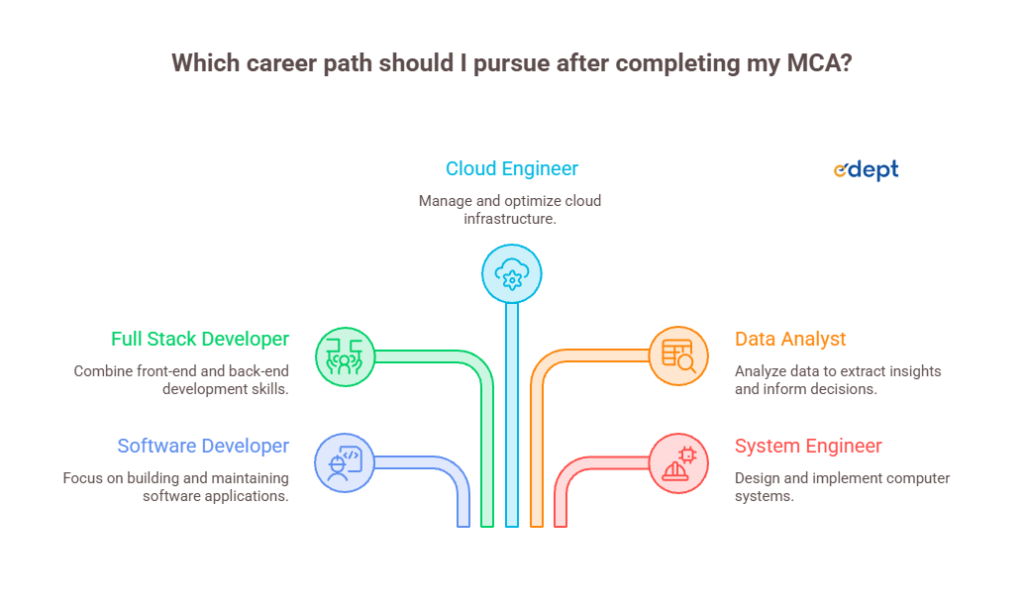
Career Opportunities After MCA
The MCA graduates walk into a wide range of tech roles and have a lot of career options depending on their interests. Some of them are:
Software Developer
They help in designing, building, and maintaining applications across various platforms in different languages such as Java, Python and C++. Average salary ranges between ₹5 and ₹12 LPA.
Full-Stack Developer
Full-stack developers handle both the frontend (user-facing) and backend (server-side) components of web applications. The key skills include JavaScript, React, Node.js, SQL, and APIs. The average salary ranges between ₹6 and ₹10 LPA.
Cloud Engineer
Cloud Engineers help in designing, deploying, and managing scalable cloud computing environments across major platforms. The key skills include AWS, Microsoft Azure, Google Cloud (GCP), Docker, and Kubernetes. The average salary ranges between ₹10 and ₹18 LPA.
Data Analyst
A data analyst helps in extracting, cleaning, and interpreting complex data to help organizations make strategic, data-driven decisions. The key skills include Python, R, SQL, Excel, Power BI, and Tableau. The average salary ranges between ₹8 and ₹15 LPA.
System Engineer
System engineers focus on designing, deploying, and maintaining complex enterprise IT systems and networks. They ensure all the hardware, software, and cloud infrastructure runs reliably and efficiently. The key skills include system administration, network security, shell scripting, and Agile. The average salary ranges between ₹6 and ₹10 LPA. 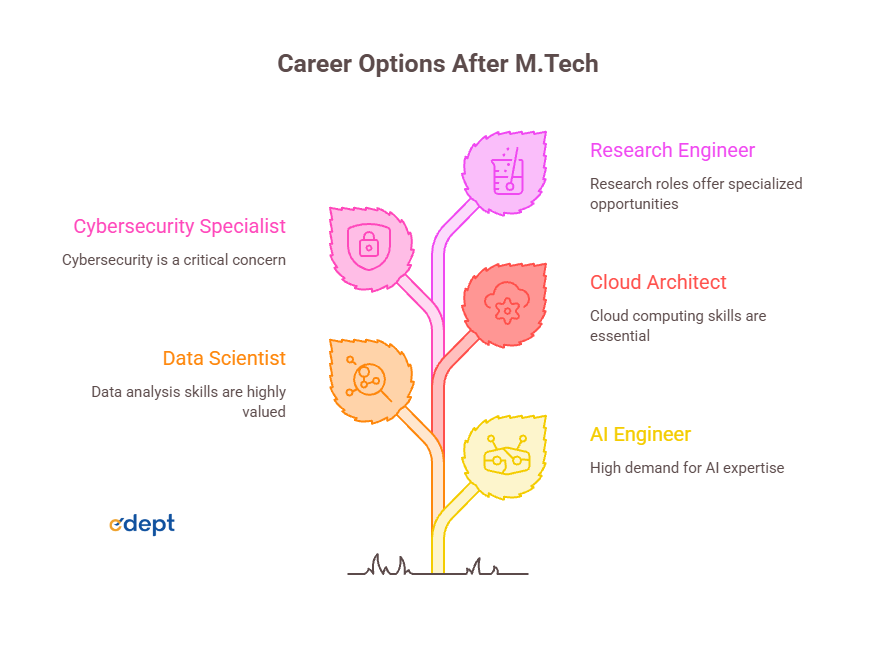
Career Opportunities After M.Tech
An M.Tech. degree provides the advanced analytical skills and deep technical expertise that are required to land high-paying roles in the technology sector.
AI Engineer
AI engineers help in designing, developing, and deploying intelligent algorithms and machine learning models into production. Some of the core skills include Python, C++, TensorFlow, PyTorch, and neural networks.
Data Scientist
Data scientists help in unlocking complex structures and trends hidden within massive datasets. They build predictive models that drive strategic business decisions and optimize performance across finance, healthcare, and retail. Some of the core skills include advanced statistics, R, SQL, machine learning, and data visualization tools like Tableau.
Cloud Architect
Cloud architects help in designing, building, and managing scalable cloud computing systems and digital infrastructure. They ensure that all enterprise software databases run efficiently and securely. Some of the core skills include AWS, Microsoft Azure, Google Cloud, CI/CD pipelines, and MLOps.
Cybersecurity Specialist
Cybersecurity Specialists help in safeguarding enterprise networks, cloud platforms, and data against digital threats and data breaches. Some of the core skills include Ethical Hacking, SIEM solutions, cryptography, and network security frameworks
Research Engineer
Research Engineers heavily focuses on pushing the boundaries of technology by developing new algorithms and evaluating cutting-edge AI or hardware technologies. Some of the core skills include reinforcement learning, distributed computing, computer perception, and deep mathematical modelling.
Career Opportunities After MBA IT
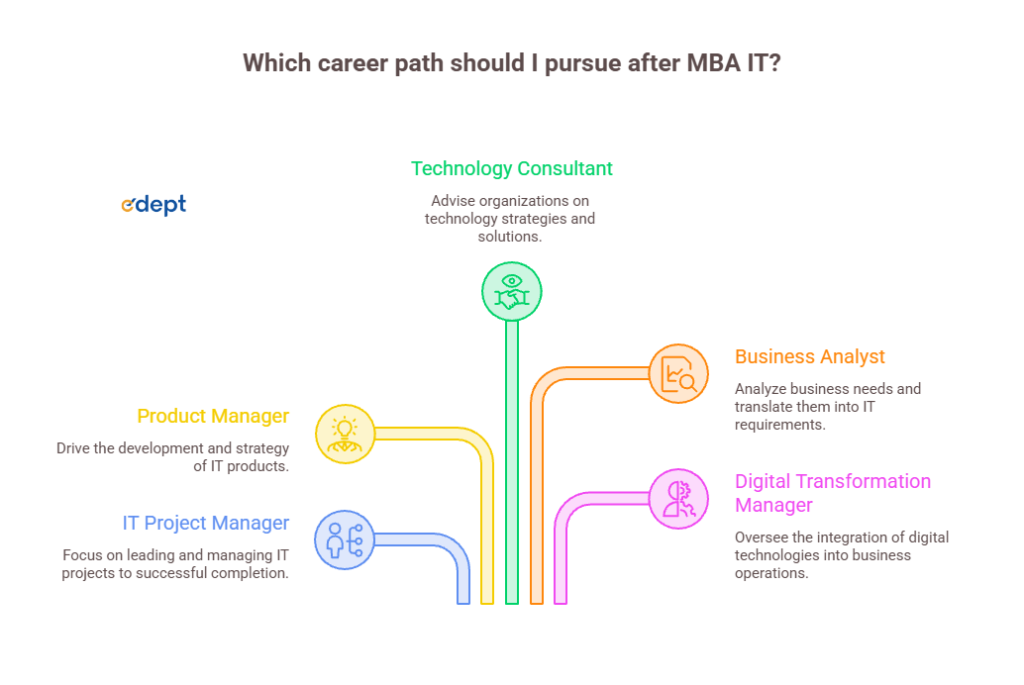
An MBA in IT blends business strategy with technical expertise, opening doors to high-paying roles that bridge the gap between development and corporate strategy.
IT Project Manager
They manage the execution of technology projects, balancing budgets, timelines, and resource allocation to meet organizational goals. The average salary ranges between ₹13 and ₹25 LPA.
Product Manager
They manage the entire lifecycle of tech products. They act as the intersection of business, design, and engineering to define product vision and roadmaps. The average salary ranges between ₹12 and ₹30 LPA.
Technology Consultant
They advise enterprises on digital transformation, cloud adoption, IT systems improvement, and modernizing operations. The average salary ranges between ₹10 and ₹25 LPA.
Business Analyst
They help in decoding complex client needs to translate business requirements into actionable technological solutions. The average salary ranges between ₹7 and ₹15 LPA.
Digital Transformation Manager
They help in leading the teams in implementing new AI, automation, and platform business models to modernize legacy systems. The average salary ranges between ₹15 and ₹35 LPA. 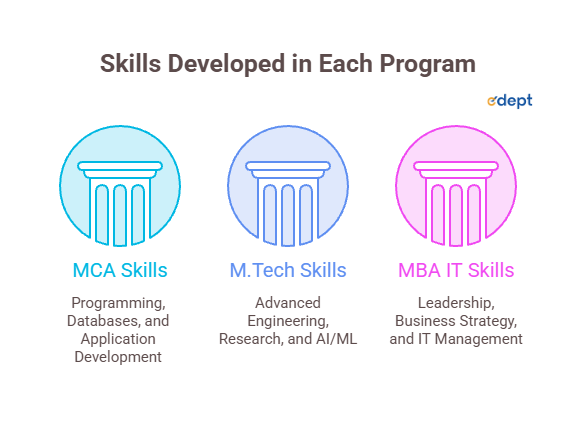
Skills Developed in Each Programme
The skills which are usually built in MCA, M.Tech and MBA are:
MCA Skills
An MCA degree helps you build comprehensive skills in technical programming, cloud architecture, database administration, and system design. Some of the key skills developed in MCA are proficiency in core languages like Java, Python, C++, and JavaScript, including building and deploying web applications, databases and information management. Hands-on & practical experience with cloud platforms like AWS, Microsoft Azure, and Google Cloud, alongside containerization tools like Docker.
M.Tech Skills
An MTech helps you in equipping yourself with advanced technical mastery, research methodologies, and domain-specific problem-solving. Some of the key skills developed in MTech are advanced proficiency in languages like Python, Java, and C++; hands-on application of TensorFlow and PyTorch for machine learning; and deep understanding of digital design, Verilog/SystemVerilog, and analogue circuits. Expertise in CAD modelling tools and learning how to tackle complex, large-scale engineering problems.
MBA IT Skills
An MBA degree focusing on IT develops a combination of managerial strategy with technical execution. Some of the key skills developed in an MBA IT are data-driven decision-making, digital transformation leadership, IT project management, and enterprise software applications. Using software like Python or R to forecast market trends and consumer behaviours; managing digital risks and data privacy policies; and estimating ROI on technical investments and managing IT budgets.
Salary Comparison: MCA vs M.Tech vs MBA IT
M.Tech generally offers the highest starting packages, MBA (IT) offers the fastest path to highly paid management roles, and MCA excelling in immediate, high-growth software development jobs.
| Experience Level | MCA Salary | M.Tech Salary | MBA IT Salary |
| Entry-Level (0–2 years) | ₹4–8 LPA | ₹6–12 LPA | ₹6–14 LPA |
| Mid-Level (3–6 years) | ₹10–20 LPA | ₹15–30 LPA | ₹18–35 LPA |
| Senior-Level (7+ years) | ₹25 LPA+ | ₹35 LPA+ | ₹40 LPA+ |
Globally, a degree in M.Tech offers the highest starting and mid-career salaries, averaging $90,000 to $140,000+ USD, due to advanced R&D and AI/ML specialization. An MBA in IT offers the highest long-term earning potential, with salaries often exceeding $120,000 to $160,000 USD in executive and consulting roles. An MCA graduate starts lower but generally earns between $60,000 and $100,000+ USD.
Which Course Has Better Future Scope?
The NASSCOM 2026 Strategic Review confirms that the Indian IT industry is transitioning from scale-based to value-led growth. Driven by AI deployments, Global Capability Center (GCC) expansions, and the rise of niche mid-tier firms, the industry reached roughly $315 billion in FY26, prioritizing strategic influence over volume hiring.
Future Scope of MCA
The future scope of an MCA in India is highly lucrative, with the data analytics market projected to reach USD 16 billion. The Master of Computer Applications (MCA) degree offers a promising future in the IT industry, and it is driven by rising demands in AI, cloud computing, and cybersecurity. The graduates can easily secure roles such as software developer, data scientist, or cloud architect, with entry-level salaries typically ranging from ₹3 LPA to ₹6 LPA and extending well beyond ₹20 LPA for specialized roles. Some of the high-growth career path include artificial intelligence/machine learning, cloud computing, data science & analytics, and cybersecurity.
Future Scope of M.Tech
An M.Tech provides a strong pathway for deep technical specialization, leading to high-paying R&D, AI, and core engineering roles. Some of the high-demand roles & specializations include Artificial Intelligence & Machine Learning engineer, Cloud Solutions Architect Robotics & Automation Engineer, and, and R&D Scientist
Future Scope of MBA IT
The future of MBA IT is very promising as companies are pursuing digital transformation, AI adoption, and cloud integration. The future is expanding toward high-growth and strategic leadership roles. Some of the key roles includes Technology Product Manager, IT Project Manager Business Analyst / Data Manager, and Cybersecurity Manager.
Which Course Is Best for Different Students?
MCA, M.Tech or MBA: which should you choose depends entirely on your career goals and interests.
Choose MCA if:
- You enjoy coding and want to start building software quickly
- You prefer a broad technical foundation over narrow specialisation
- You come from a non-engineering background (BCA, B.Sc.)
- You want faster entry into IT companies without GATE preparation
- You want an affordable route to a tech career with strong ROI
Choosing the Right MCA Program
If you are seriously considering MCA, the programme you pick matters as much as the degree itself. The edept-powered MCA at Shree L.R. Tiwari College of Engineering (affiliated with Mumbai University and approved by AICTE and DTE Maharashtra) is one of the most industry-aligned options available today. It is a two-year postgraduate programme with three specialization tracks: Data Science & AI, Cybersecurity & Cloud Computing, and Web & Cloud Development, so students can align their degree with the exact skill areas the industry is hiring for in 2026.
Choose M.Tech If:
- You want deep specialization in one technical domain
- You enjoy research as well as theory
- You are comfortable investing time in mastering one technical area thoroughly
- You plan to work in R&D, academics, or highly specialized engineering roles
- You have a valid GATE score and want access to IITs, NITs, or PSUs
Choose MBA IT if:
- You see yourself managing teams and projects rather than writing code full-time
- You want the highest long-term salary potential
- You enjoy the intersection of business and technology
- You want to lead digital transformation initiatives
- You want leadership roles and enjoy business strategy as much as technology
Choosing the Right MBA IT Programme
For students exploring an MBA that genuinely combines IT skills with business acumen, the edept-powered MBA in Business Analytics at SGT University (NAAC A+ accredited, ranked among “Top Emerging B-Schools” by TOI) is worth a serious look. The curriculum runs across four semesters — starting with core management subjects and analytics fundamentals, moving into predictive analytics, time series forecasting, and NLP by Semester 3, and finishing with a capstone project alongside electives like AI & deep learning for business, people analytics, and decision-making with prescriptive analytics.
Common Mistakes Students Make While Choosing
Students often choose postgraduate degrees based on immediate trends, rankings, or peer pressure, rather than matching the program to their long-term career goals.
Choosing Based Only on Salary
The first mistake is to choose a programme based only on the salary numbers found in Google. Starting packages is a very tempting factor, but if the role does not match your strengths, you can rarely sustain it in the long run.
Following Peer Pressure
What had worked for your friend or senior may not work for you or fit your interests, skills, or career vision. Your academic background, aptitude, and goals are unique; treat them uniquely and without any pressure.
Ignoring Career Goals
Often students ignore their career goals and choose a programme that is trending in the market. They fail to understand that what is popular in the present might not be the same in the future. So students must pick a programme with a clear 5-year plan and understand what they could gain from this programme, whether it aligns with their career goals or not.
Not Considering Strengths
You should be honest about whether you’re stronger technically or strategically. Students often come under the influence of family members or friends without first analysing their own strengths and weaknesses. Due to this, students sometimes end up in programmes that do not align with their strengths or interests. So, students are advised to do a self-analysis and avoid following the crowd when choosing any programme.
Industries Hiring MCA, M.Tech, and MBA IT Graduates
MCA, M.Tech, and MBA (IT) graduates are strongly recruited across technology services, consulting, BFSI (banking, financial services, and insurance), and e-commerce. Demand for all three degrees spans across IT services, product-based technology companies, banking and finance, healthcare tech, and consulting. Each sector values a different thing. IT services and product companies lean toward MCA and M. Tech talent for technical execution, while banking, consulting, and healthcare tech increasingly hire MBA IT graduates to lead digital transformation initiatives.
Some of the companies hiring are: TCS Infosys Wipro IBM Accenture Deloitte Capgemini HDFC Tech ICICI Bank EY Google India Microsoft India Amazon
Why Emerging Technologies Matter Regardless of Degree
There was a time when technological skills were considered just an option. But now times have changed. Today, technology is not a separate industry; it is the foundation of every industry. Tech skills have now become survival skills. Degrees are still important, but now employers search for digital literacy, adaptability, and problem-solving. Basic tech skills include data knowledge, AI productivity, cloud-based collaboration and understanding automation.
AI Is Transforming Jobs
AI is transforming the job market; it is reshaping industries and the jobs within them. AI is having a big impact across various sectors such as healthcare, finance, retail, media and education. On one hand, AI is automating various tasks, but on the other hand, it is creating new jobs. Opportunities include AI engineer, data scientist, machine learning specialist, and AI product manager. You should start learning the basics of AI, understand about the AI tools, and stay adaptable.
Cloud Demand Is Growing
According to Gartner, global spending on cloud services is expected to surpass $1 trillion by 2030. This signals that cloud literacy is becoming a growing necessity. The cloud is transforming the entire industry. Businesses are shifting from physical servers to the cloud. Students should understand how systems are built on AWS, Azure, or GCP and be familiar with Python, Java, or deployment pipelines.
Cybersecurity Roles Are Rising
Cybersecurity roles are rising rapidly, with projections expecting 29% job growth by 2034. Breaking into the field without a traditional computer science degree is highly achievable. Instead of formal degrees, employers prioritize demonstrable skills, hands-on capabilities, and understanding of emerging technologies. With over 514,359 cybersecurity job openings nationally, according to the latest CyberSeek data reported by NIST, you will be entering a field that is not just growing; it is transforming and evolving.
Why Choose edept for Career Preparation
Regardless of which of the three degrees you pick, the reality of the 2026 job market is this: a degree alone will not get you the job. Recruiters look for portfolios, certifications, live-project experience, and industry-recognized skills. That is exactly where edept fits into the picture.
Industry-Aligned Programs
edept, founded in 2023 by INSEAD and IIM alumni, works with established universities to run industry-led postgraduate programmes. Its MCA is delivered under the University of Mumbai through Shree L.R. Tiwari College of Engineering, and its MBA in Business Analytics runs through SGT University, a NAAC A+ accredited institution recognised among the “Top Emerging B-Schools” by the Times of India.
Practical Skill Development
Both programmes are built around tools employers actually use, Python, SQL, and cloud platforms in the MCA and Python, R, SQL, and Tableau in the MBA in Business Analytics rather than theory disconnected from the job market.
Hands-On Projects
Students in either programme work through Global Industry Immersion Projects delivered via Practera, structured across a three-step journey: Foundation Immersion, Applied Immersion, and Advanced Immersion, with real client briefs from edept’s global industry partner ecosystem. Add to that Deloitte Learning Academy certifications and IBM-mentored live projects (with top performers nationally, recognised by NASSCOM), and students graduate with a professional portfolio rather than just a transcript.
Future-Orientated Learning
Across both programmes, the focus stays firmly on AI, cloud computing, cybersecurity, and data analytics, the four areas that show up repeatedly across every degree comparison in this blog as the fastest-growing hiring priorities in Indian tech and business. 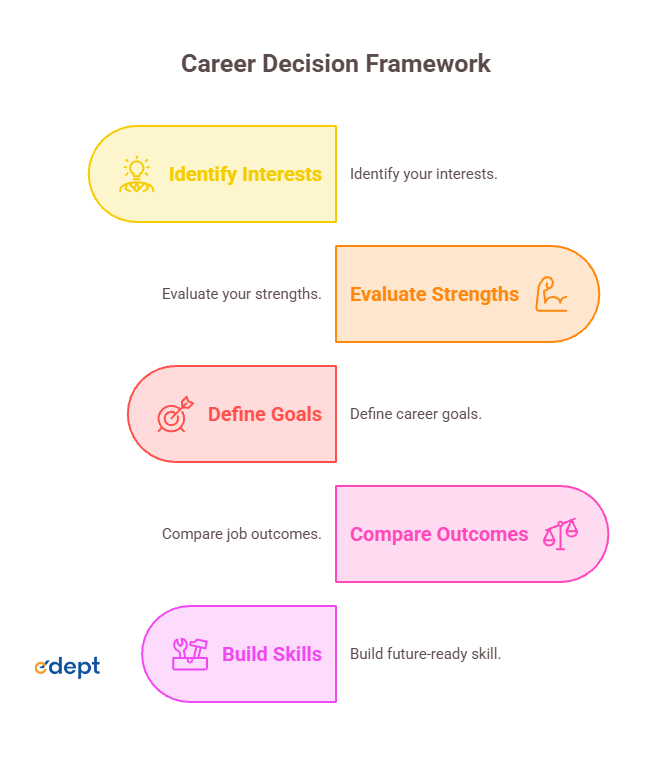
Step-by-Step Career Decision Framework
A comprehensive career decision framework will help you transform the overwhelming choices into a structured, manageable process.
Identify Your Interests
First you should identify your interests, skills, and work environment preferences. You should choose your career on the basis of your interest, such as whether you are drawn to writing code, solving deep technical problems, or leading teams and strategy.
Evaluate Your Strengths
You should be honest about whether you’re stronger technically or strategically. Students often come under the influence of family members or friends without first analysing their own strengths and weaknesses. Due to this, students sometimes end up in programmes that do not align with their strengths or interests. So, students are advised to do a self-analysis and avoid following the crowd when choosing any programme.
Define Career Goals
Often students ignore their career goals and choose a programme that is trending in the market. They fail to understand that what is popular in the present might not be the same in the future. So students must pick a programme with a clear 5-year plan and understand what they could gain from this programme, whether it aligns with their career goals or not. Your career goals are your base for your career decision framework. You should break your aspirations into short-term & long-term milestones and use the SMART framework to set up an actionable target.
Compare Job Outcomes
You should start researching potential job roles to align them with your goals. Evaluate factors like salary ranges, work-life balance, and long-term industry growth. You can research verified compensation and employee reviews from various job portals.
Build Future-Ready Skills
You should start identifying the gaps between your current skill set and your target roles. Regardless of whatever degree you choose, specializing in AI, cloud, and data skills will strengthen your outcomes either way. Start upskilling yourself in these high-demand fields.
Final Verdict: Which Is Better?
There’s no single “best” option here. The right choice depends entirely on what you want your career to look like: technical, deep specialist, or business leader. It depends entirely on your career goals.
Best for Technical Careers → MCA
If you want a technical, application-focused career in software, cloud, or AI development with a strong return on investment within 1–2 years.
Best for Advanced Specialization → M.Tech
If you want deep specialization, love to do research work, and are aiming for R&D, deep-tech, or academic careers.
Best for Leadership Careers → MBA IT
If you want to lead teams, manage products, and enter the business side of technology with the highest long-term salary.
Conclusion
MCA, M.Tech, and MBA IT each have strong, distinct career paths. An MCA is ideal for you if you want to build software and move into IT roles quickly. M.Tech suits students who are chasing deep technical specialization and research-driven careers. MBA IT is best for leadership and management roles within technology-driven organisations.
The truth is there is no single best degree. What works for a student who loves to do coding will not work for someone who wants to manage a product team. The best degree is the one that matches your strengths, your interests, and the version of yourself you want to be five years from now. You should take your time, talk to your mentors, and look beyond brochures and placement criteria. You should remember the degree opens the door, but the skills you build during this journey will help you in securing a great job in the future.