Technology in education has moved well past being a teaching aid. It is reshaping how universities operate, how students learn, and what employers expect graduates to arrive with. This guide covers how modern higher education institutions are using technology across teaching, assessment, administration, and student support and what it means for anyone studying or working in the sector today.
The pace at which technology is reshaping higher education has moved well past the point where institutions can treat it as optional. The global EdTech market reached an estimated $187 billion in 2025 and is projected to hit $214 billion by the end of 2026, while 86% of students worldwide now use AI tools as part of their learning process. Those two numbers sit side by side for a reason. One reflects on where investment is going. The other reflects how deeply students have already folded technology into how they actually learn.
So what is the role of technology in modern higher education? Put plainly, it is the bridge between what universities have historically delivered and what students, employers, and society now actually need from them. Technology in education is not replacing the act of learning. It is changing the conditions under which learning happens, who gets to participate, and how well the outcomes hold up in the real world.
This blog covers what technology in education genuinely means at the university level, how technology improves education in concrete and measurable ways, the benefits of technology in higher education that extend to both students and institutions, and where the field is heading over the next few years.
What is Technology in Education?
Defining technology in education clearly matters because the term gets used loosely in ways that obscure more than they reveal. What it means in practice for higher education is worth spelling out before exploring what it delivers.
Technology in education refers to the planned inclusion of technology in the design and delivery of learning experiences in the classroom. Technology can be applied in numerous ways in educational settings, such as learning management systems for organisation and tracking of the learning process, artificial intelligence platforms that adapt to learners’ performance, virtual learning environments for simulation of professional practice, and collaborative technologies supported by the cloud environment. Modern education technology is not a digitised version of a traditional lecture. At its best, it redesigns what learning looks like in ways that fixed physical environments simply cannot replicate.
How Technology Improves Education?
Talking about how technology improves education in abstract terms does not help anyone make a real decision about it. The improvements that matter are the ones that show up in student outcomes, teaching effectiveness, and institutional capacity. Here is where the concrete changes are actually happening.
Personalised Learning (AI-Based)
Standard university delivery gives everyone in a cohort the same material at the same pace. Some students coast. Others fall behind. Neither group is getting what they actually need. AI-driven personalised learning changes this by doing something traditional delivery cannot: responding to what individual students are actually doing rather than assuming they are all in the same place.
AI-powered tutoring systems work like virtual assistants, giving instant feedback and personal guidance. Predictive analysis is also being used by institutions to identify students in danger of dropping out before the matter escalates. Both of those applications represent a significant shift in how technology improves education at the level of individual student experience, moving from a broadcast model to something that actually adjusts based on what the data shows.
Better Accessibility and Flexibility
Geography, disability, work commitments, and financial constraints have historically shut large numbers of capable people out of higher education. Modern education technology does not fix all of those barriers, but it meaningfully reduces several of them. About 24.7% of higher education students were enrolled exclusively online in Fall 2023, with hybrid models expanding to include 33% of undergraduates participating in at least some distance education by 2024.
Those numbers reflect students who have found a way into higher education that would not have existed for them in a purely campus-based model. Accessibility is one of the most direct human benefits of technology in higher education, and it is growing.
Real-Time Collaboration Tools
Technology in education has changed what collaboration between students actually looks like. Cloud-based platforms let students work on shared projects from different locations simultaneously. Video tools bring seminars and tutorials to students who cannot attend in person. Project management tools develop professional skills when students are still learning about the topic.
Modern educational technology enables collaboration that would have been quite a logistical feat previously for universities with international programs or research collaborations to become a routine process. The skills students develop through these tools also map directly onto the distributed work environments most of them will enter after graduation.
Data-Driven Performance Tracking
When an instructor teaches a cohort of 200 students, they cannot meaningfully track individual progress through observation alone. Modern education technology changes this. Learning management systems capture engagement patterns, completion rates, assessment results, and time spent on different types of content. That data makes it possible to identify a student who is quietly struggling three weeks into a semester rather than at the end of it.
For students, this means more timely and specific feedback. For educators, it means teaching decisions grounded in what is actually happening rather than what the syllabus assumes is happening. Data-driven tracking is one of the less glamorous but most practically significant ways in which technology improves education at the operational level.
Benefits of Technology in Higher Education
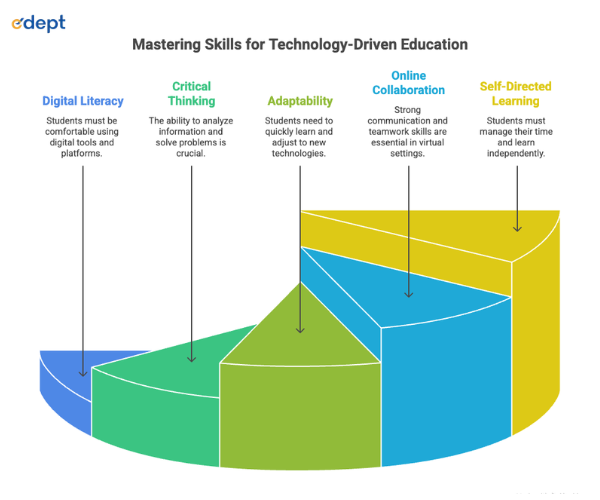
The benefits of technology in higher education show up across students, institutions, and the education system more broadly. These are worth examining individually because they operate through different mechanisms and affect different stakeholders.
Improved Student Engagement
There is a meaningful difference between a student who is physically present in a lecture and one who is genuinely engaged with the material. Technology in education, when it is well-implemented, closes that gap. Interactive content, simulation-based learning, and tools that require students to do something rather than just receive information all shift learning from passive to active. A survey found that 81% of students said digital learning technology improved their grades. Engagement and outcomes are connected, and modern education technology addresses both simultaneously when it is used well.
Cost-Effective Learning
One of the more practically significant benefits of technology in higher education is what it does to the cost structure of learning. Online delivery reduces the need for physical infrastructure. Digital materials are cheaper to update than printed ones. Asynchronous content can serve large numbers of students without requiring proportional increases in teaching staff. For students, the elimination of accommodation and commuting costs that come with campus-based study makes higher education financially accessible to people who could not otherwise afford it.
Global Access to Education
Technology in education makes it possible for a student anywhere in the world to access a program developed by experts somewhere else entirely. This is one of the transformational benefits of technology in higher education because it separates educational quality from geographic proximity in a way that was simply not possible before. The implication for who gets to access genuinely good higher education is significant and still playing out.
Skill-Based Learning Opportunities
Modern education technology has created the conditions for learning that map directly onto what employers actually need. Simulation environments let students practise professional scenarios before they are in professional roles. Industry tools integrated into programs mean students graduate familiar with the software their employers use. Project-based assessments demonstrate practical capability in ways that written examinations alone cannot. These are the benefits of technology in higher education that show up most clearly in how well graduates perform in their first roles.
Enhanced Teaching Methods
Technology in higher education has shifted things for educators just as much as it has for students, and possibly in ways that matter more for the long-term quality of teaching. The range of approaches available to instructors has grown considerably. Flipped classroom models are a good example, freeing up face-to-face time for genuine discussion and practical application instead of using it to deliver information that students could absorb just as well on their own time. Analytics give instructors visibility into which parts of a course are landing and which are not. Routine administrative tasks can be automated. Teachers who use AI tools weekly save an average of 5.9 hours per week, and that time can go toward the parts of teaching that technology cannot replace.
Key Technologies Used in Higher Education
The benefits of technology in higher education come through specific tools. Understanding what those tools are and what they actually do makes the picture more concrete.
1. Artificial Intelligence (AI)
AI is the most significant force currently reshaping how technology improves education. Personalised content delivery through adaptive learning platforms, AI tutors that give students instant feedback without waiting for office hours, predictive models that flag struggling students before they fall too far behind, and natural language processing tools that can assess written work automatically are all sitting inside higher education systems right now, not on the horizon. The pace of AI integration into modern education technology is accelerating, and the institutions deploying it thoughtfully are seeing measurably different student outcomes than those that are not.
2. Learning Management Systems (LMS)
Learning management systems are the operational infrastructure that holds most technology in education together at the institutional level. Platforms like Canvas, Moodle, and Blackboard organise course content, manage assessments, track individual student progress, facilitate communication, and integrate with other tools in the modern education technology ecosystem. A well-configured LMS creates coherence across a student’s experience regardless of how many different courses or instructors are involved. Without it, even well-designed digital content becomes difficult to navigate at scale.
3. Virtual and Augmented Reality (VR/AR)
VR and AR address one of the persistent challenges of university education: how to give students meaningful hands-on experience with scenarios that are expensive, dangerous, or simply impossible to recreate in a traditional classroom. Medical students practicing procedures. Engineering students interacting with complex systems in three dimensions. Architecture students walk through buildings before they are built. These are experiences that text, video, and even sophisticated simulations struggle to match, and modern education technology in the VR/AR space is making them increasingly accessible to institutions that want to close the gap between theoretical and applied learning.
4. Cloud Computing
Cloud computing is what makes most modern education technology practically viable at scale. It allows institutions to deliver content globally without expensive local infrastructure. It gives students access to their learning environment from any device with an internet connection. It enables collaborative tools to function seamlessly across different systems and locations. And it scales with demand in ways that on-premise infrastructure cannot. The cloud segment of educational technology is growing faster than almost any other component of the market, which reflects how foundational it has become to everything else that technology in education delivers.
Why edept Represents the Best of Modern Education Technology?
edept approaches modern education technology with a clear priority: the learning experience only matters if it produces real career outcomes. Here is what makes edept different in practice:
- Industry-aligned curriculum: Programs are built around what employers are hiring for right now, updated continuously rather than on academic cycles that lag behind industry reality.
- AI-powered learning: Students benefit from adaptive technology that personalises learning based on actual performance, closing gaps faster than any one-size-fits-all approach can.
- Real-world projects: Technology in education at edept means engaging with the tools, problem types, and data environments that show up in actual professional roles from the very beginning, not after the foundational theory has been covered.
- Placement support: Resume coaching, mock interviews, and direct connections to employers are woven into the programme from the start rather than bolted on at the end when students are already trying to apply.
- Global accessibility: edept’s platform removes the geographic barriers that have historically limited access to quality education without cutting corners on what students actually receive when they engage with the content.
- Practitioner-led content: Programs are delivered by people who are working in the industries students are entering, not just teaching about them.
Contact edept to explore programs built for where careers are actually heading.
Future of Technology in Higher Education
The direction technology in education is heading for higher education is becoming clearer. Three shifts are worth paying particular attention to.
AI-Driven Classrooms
The AI-driven classroom that is emerging is not just a smarter version of current adaptive learning. It is an environment where AI manages the learning experience comprehensively, adjusting not just content but format, pacing, assessment approach, and peer grouping based on continuous analysis of how individual students are actually performing. The instructor’s role shifts from content delivery toward learning design and personalised student support. Modern education technology is creating conditions where the most valuable thing an educator can offer is the judgment and experience that no system can yet replicate.
Fully Digital Universities
Fully digital universities are not a concept anymore. Several are operational, and the model is growing. These institutions have no physical campus, deliver everything through digital infrastructure, and build academic community through online tools rather than shared physical space. As employer hiring practices shift further toward demonstrated skills and portfolio evidence over institutional prestige, the practical distinction between a degree from a digital institution and one from a traditional campus is narrowing faster than most people in traditional universities are comfortable acknowledging.
Smart Campuses
For institutions that keep a physical presence, technology in education is transforming what the campus actually does. Smart campuses use connected sensors, AI systems, and data platforms to manage energy use, space allocation, student services, and safety more intelligently. Learning spaces adapt to what is happening in them. Student support services use data to identify problems before they escalate. The physical and digital dimensions of university life become integrated rather than operating as separate tracks that students move between.
Conclusion
The evidence for technology in education at the higher education level has accumulated to a point where the question is no longer whether it works. It is how well institutions are deploying it. The global EdTech market was estimated at $187.1 billion in 2025 and is assessed at $214.2 billion in 2026, growing at a CAGR of 14.5% through 2035 to reach $724.6 billion. That growth does not happen in a market where results are unclear.
The higher education market is expected to increase by USD 140.65 billion at a CAGR of 19.4% from 2025 to 2030, with universities reporting dropout rate reductions nearly double those seen at institutions using conventional methods when predictive analytics are deployed for student retention. The benefits of technology in higher education are not theoretical. They are showing up in retention rates, graduate employment outcomes, and the reach of institutions that are delivering programs to students they could never have served through campus-only models. The students entering universities now expect modern education technology to be a feature of their experience, not a bonus. The programs that deliver on that expectation are the ones worth choosing.