Top sustainability analytics careers in 2026 focus on data-driven environmental governance, featuring key roles such as Carbon Data Specialist, ESG Reporting Analysts, and Climate Risk Analysts. Driven by strict global regulations like the EU’s CSRD and local compliance frameworks, corporations are heavily expanding their data teams.
Almost a decade ago, organizations treated sustainability as just a side project that sat in a corner office. Small compliance teams handled it and produced an annual report that nobody outside the company usually read. But today, across nearly every sector of the global economy, sustainability has become a top priority. Investors now want proof, and regulators are demanding numbers. Companies across the world are investing money into renewable energy, circular supply chains, and eco-friendly innovations. This shift has created a career path that did not really exist a decade ago: sustainability analytics. For these reasons, sustainability analytics careers are opening up so fast for students and early professionals.
Across various sectors such as finance, manufacturing, energy, and retail, organizations are now measuring carbon output, energy use, and supply chain conduct with the same effort they apply to revenue and cost. According to the World Economic Forum (WEF), advancements in AI, renewable energy, and green technologies will create 170 million new jobs by 2030. Sustainability is not just a niche field; it is becoming the core of business strategy. In 2026, they will help detect how large companies plan, spend, and report. Companies nowadays expect real numbers on carbon emissions, energy use, supply chain risk, and ESG performance, and they need analysts who can produce those numbers with the same effort as a financial report.
Sustainability analytics careers mean using data to measure, track, and improve environmental, social, and governance (ESG) performance. It is not based on guesswork or speculation; it is a very structured, number-driven approach that helps organization understand their real impact and make better decisions. This blog will walk you through what the field actually involves, which job roles are hiring, what they pay, where the strongest markets are, and how a student can actually prepare.
What Is Sustainability Analytics?
It is simply the practice of collecting,organizing and evaluating internal and external data to measure, improve, and report on an organization’s environmental, social, and economic impacts. It helps in transforming raw data into actionable insights to reduce and optimize resource usage, reduce carbon footprints, and perform responsible business practices.
Definition of Sustainability Analytics
Sustainability analytics is the process of collecting, measuring, cleaning, analyzing and visualizing environmental, social, and governance (ESG) data for better decision-making. It uses data, dashboards, statistics, artificial intelligence and various reporting systems to measure certain environmental impacts, track the performance of ESG, reduce emissions and support decisions related to climate change. It sits at the intersection of environmental strategy and data analysis.It is not based on guesswork or speculation; it is a very structured, number-driven approach that helps organisations understand their real impact and make better decisions. Sustainability Analytics usually covers a wide range of applications such as Carbon emissions tracking, waste reduction reporting, energy optimization, water usage monitoring, and ESG reporting dashboards. These data help companies understand from where their environmental impact comes from, which initiatives are performing well, where the risks are increasing and how the sustainability goals are connected to business performance.
- Strong sustainability analytics helps organizations:
- In establishing a baseline
- A clear idea of how much energy is being used
- From where the maximum emissions come from
- Identify the various impactful reduction opportunities
- Identifying which facilities use most water
- Building dashboards for executives and stakeholders
- Connecting the sustainable metrics with cost savings, risk management and compliance issues.
Why Do Businesses Need Sustainability Data?
Businesses need sustainability data in order to ensure compliance with proper reporting regulations, to secure capital from ESG-focused investors, and to reduce operational costs through resource optimization . Some of the core reasons for businesses to depend on sustainable data are:
- Proper regulatory compliance and risk mitigation
- Help in attracting investment
- Identifies efficiency improvements
- Help in enhancing brand reputation and customer loyalty
- Driving innovation
- Building resilience
- Improving supply chain management
- Increasing stakeholders’ engagement
Regulators, investors, and customers now ask for proof; they do not like to be dependent on speculation or ideas. The EU’s Corporate Sustainability Reporting Directive mandates statutory, independent assurance (starting with “limited” assurance that transitions to “reasonable” assurance) for all reported ESG metrics. In the same way, the International Sustainability Standards Board requires companies to publish their sustainability disclosures at the same time and for the same reporting period as their financial statements.
Why Sustainability Analytics Careers Are Growing Globally
Careers in sustainability analytics are experiencing rapid global growth because modern businesses must transition from qualitative green initiatives to auditable, data-driven compliance. This demand is not just driven by a single trend. It is the result of three forces meeting at once: regulation, investor pressure, and corporate strategy.
Rise of ESG Reporting
The rise of ESG reporting has completely transformed sustainability analytics into a rapidly expanding global career path. It is no longer optional; it has turned into a regulatory requirement in major economies. The demand for ESG reporting roles is growing by 25–30% annually, as sustainability shifts from a voluntary CSR function to core business governance. Driven by SEBI’s BRSR in India and the CSRD in Europe, companies now need professionals who can handle data architecture, carbon accounting, and compliance modelling. Professionals here depend on combining sustainability domain knowledge, data proficiency (SQL, Python, Power BI), and strong stakeholder communication.
Corporate Sustainability Targets
Corporate sustainability is no longer optional now. It is backed by global frameworks and mandatory regulations like India’s Business Responsibility and Sustainability Reporting (BRSR), where companies must track and disclose metrics. Corporate sustainability targets are getting sharper. Net-zero commitments are everywhere, but shareholders and regulators are now asking for proof of progress. Companies need people who can monitor carbon baselines, forecast trajectories, and flag risks before they become liabilities. Some of the key drivers are pathways to decarbonisation and regulatory compliance and frameworks like BRSR (in India) and the Corporate Sustainability Reporting Directive (CSRD) (in Europe) & transparency in the supply chain.
Global Climate Regulations
Strict global climate policies such as Europe’s CSRD and India’s mandatory BRSR are acting as a catalyst for an explosion in sustainability analytics careers worldwide. Data-driven sustainability compliance is now becoming the standard, not the exception. Companies are now hiring professionals who can measure emissions, assess climate risks, and ensure regulatory compliance. The firms that fail to adapt face fines, lose investment, and suffer reputational damage. 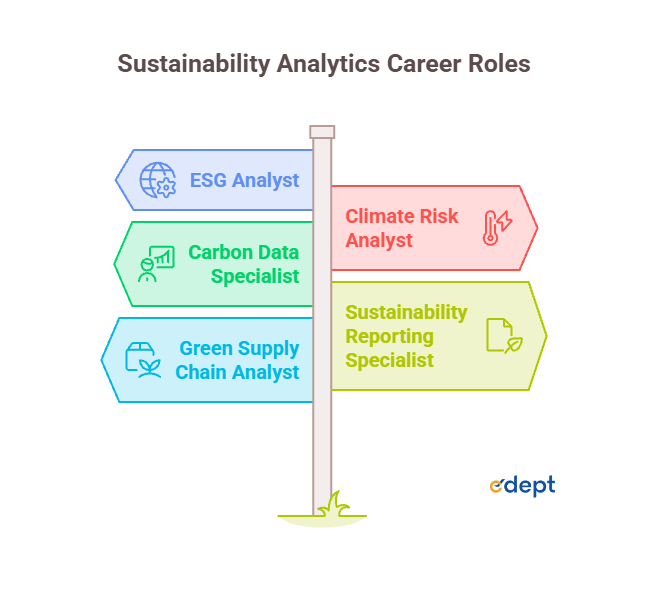
Top Sustainability Analytics Career Roles
Sustainability analytics careers merge data science with environmental strategy to drive corporate climate action. The most in-demand career roles in this sector includes:
ESG Analyst
An ESG analyst helps in collecting, evaluating, and reporting on a company’s environmental, social, and governance performance. The work involves preparing disclosures that meet standards like GRI, SASB, and TCFD, tracking sustainability metrics over time, and ensuring regulatory reporting is accurate and audit-ready. Who can pursue this: Business, finance, or data analytics students who are comfortable working with structured datasets and regulatory frameworks. Industries hiring: Investment firms, banks, consulting companies, and large corporations with public reporting obligations. Future Prospects: It is very strong. As ESG disclosure becomes mandatory across more jurisdictions, the need for skilled analysts will only deepen
Sustainability Data Analyst
This role focuses on the technical side. They help in building dashboards, clean environmental datasets, run statistical models, and report insights to leadership. It’s a strong fit for students who enjoy working in Excel, SQL, or Power BI and want to apply those skills to a subject with real-world stakes.
Who can pursue this: Data analytics students, business analytics graduates, or anyone with a solid foundation in SQL, Python, or BI tools.
Industries hiring: Manufacturing, energy, retail, and any organization with complex operations to monitor.
Future prospects: Excellent. Data skills are transferable, and the sustainability angle adds a specialized layer that helps in attracting premium salaries.
Climate Risk Analyst
They help in evaluating how physical climate events (floods and extreme heat) and transitional risks (new carbon taxes) impact a business’s physical assets and financial performance.
Who can pursue this: Finance, economics, or environmental science students with strong quantitative skills.
Industries hiring: Banks, insurance companies, asset managers, and large corporates with significant physical assets.
Future prospects: This is one of the fastest-growing niches in finance. The Task Force on Climate-related Financial Disclosures (TCFD) has made climate risk a mainstream concern for investors.
Carbon Data Specialist
A Carbon Data Specialist helps in measuring, structuring, and reporting greenhouse gas emissions. By converting unstructured utility, supply chain, and operational data into standardized carbon footprints, they allow organizations to meet international climate regulations like the EU CBAM. They help in ensuring that emissions data is accurate, complete, and aligned with standards like the Greenhouse Gas Protocol.
Who can pursue this: Engineering, environmental science, or data-focused students interested in the technical measurement of emissions.
Industries hiring: Heavy industry, logistics, energy, and any sector with significant scope 1, 2, or 3 emissions.
Future prospects: As carbon pricing and emissions trading expand globally, this expertise is becoming business-critical.
Sustainability Reporting Specialist
They help manage a company’s environmental, social, and governance (ESG) data and prepare regulatory disclosures. They prepare detailed reports for stakeholders, regulators, and investors. They also ensure corporate transparency by ensuring that the sustainability claims are backed by data, aligned with frameworks, and presented clearly.
Who can pursue this: Management, communications, or business students with an eye for detail and an understanding of ESG frameworks.
Industries hiring: Publicly listed companies, consulting firms, and large private organizations preparing for disclosure mandates.
Future prospects: Reporting requirements are only increasing. This role offers stability and clear career progression into sustainability leadership.
Green Supply Chain Analyst
A Green Supply Chain Analyst helps in evaluating and optimising a company’s logistical and operational footprint to minimize environmental impact. They use data to trace the environmental and ethical impact of every link in a supply chain, from raw material extraction to final delivery. They identify inefficiencies, reject non-compliant suppliers, and recommend improvements.
Who can pursue this: Supply chain management, logistics, or analytics students.
Industries hiring: Retail, manufacturing, consumer goods, and logistics companies.
Future prospects: Supply chain resilience and sustainability are now top priorities for global brands. This role is central to both.
Industries Hiring Sustainability Analytics Professionals
Industries hiring sustainability analytics professionals include banking and financial services, consulting firms, manufacturing and engineering, and IT/tech companies.
Finance
ESG investing and climate risk assessment have made finance one of the most powerful sectors for hiring ESG talent. ESG investing is now not a niche strategy; it has moved to a standard practice. Asset managers, banks, and insurance firms need analysts who can evaluate ESG risks, build sustainable investment portfolios, and produce transparent reports for clients.
Manufacturing
Heavy industries are under the most pressure to reduce emissions. Here, analysts help track energy use, redesign processes, and report progress. The companies need professionals who can track carbon and energy usage across complex production networks.
Energy & Utilities
Renewable energy reporting, grid optimization, and decarbonization planning everything require robust data capabilities. As this sector is transitioning from fossil fuels, the need for analytics professionals is growing.
Consulting
Consulting firms are expanding their ESG advisory practices rapidly. They help in serving clients across industries who need help navigating regulations, building reporting systems, and designing sustainability strategies. This helps in creating job roles for analysts, consultants, and project managers with strong data skills.
Supply Chain & Retail
The supply chain and retail organizations are under pressure from consumers and regulators to prove ethical sourcing and low-carbon logistics. The data analysts who can map supply chain emissions and identify sustainable alternatives are currently in high demand.
Companies hiring Sustainability Analytics Professionals
- CRISIL
- PwC
- EY
- CareEdge
- AstraZeneca
- Radisson Hotel Group
- Reliance Industries Limited
- Tata Power
- AECOM
- Cargill
- JPMorgan Chase
- CBRE
Countries Leading in Sustainability Analytics Jobs
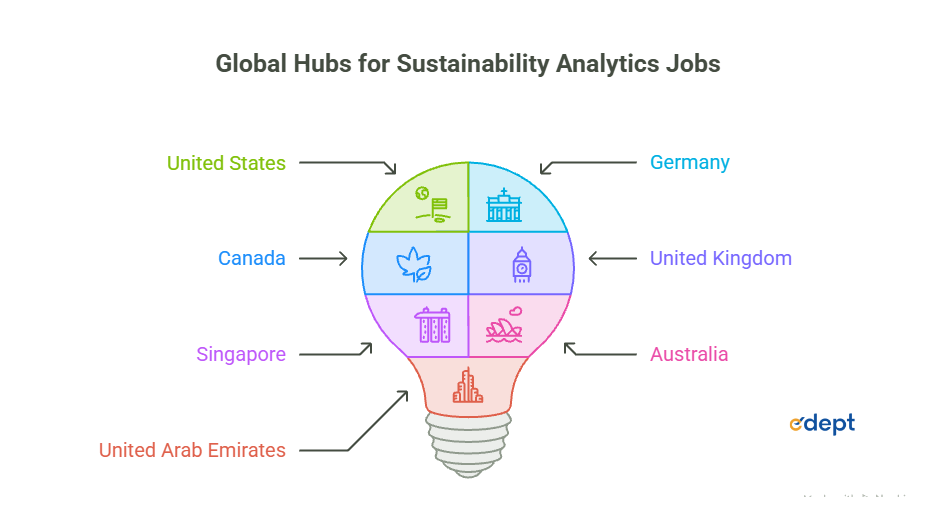
The countries leading in sustainability analytics job roles are:
United States
The United States has been the largest single market for sustainability analytics work, with demand mainly driven by manufacturing and technology-based companies. Here, roles range from ESG Reporting Analyst, Climate Data Scientist to Sustainable Supply Chain Analyst. and the scale of the market means opportunities exist at every level, from entry-level analyst roles to specialized data science positions.
Germany
Germany has become Europe’s renewable energy leader and a key driver of EU circular economy policies. It is one of the largest sustainability job markets in the EU. Demand is mainly across life cycle assessment (LCA) Analysts and energy transition. Analysts, roles that combine technical engineering knowledge with sustainability reporting skills.
Canada
Canada has over 600,000 green jobs currently existing across the country, with the government planning to create thousands more through clean energy and environmental innovation strategies. Canada targets a 40-45% reduction in carbon emissions below 2005 levels by 2030 and net-zero emissions by 2050. This leads to real hiring demand in the country.
United Kingdom
The UK has become a global hub for sustainable finance and green regulation. Financial institutions and energy firms heavily recruit for carbon accounting and climate risk. ESG risk integration analysts and corporate sustainability consultants are among the most demanding roles in UK.
Singapore
Singapore has now positioned itself as Asia’s sustainability finance hub, driven by the Monetary Authority of Singapore’s green finance initiatives. Climate reporting is now mandatory for listed companies in the country, and demand for ESG-related skills has grown sharply over the past few years.
Australia
Australia offers vast opportunities in renewable energy, sustainable agriculture, and environmental consulting. The country has a strong commitment to environmental protection, and sustainability professionals report attractive compensation packages. Mining, construction, and major engineering consultancies are the biggest hirers, recruiting heavily for Sustainability and Resilience Analysts and ESG advisors.
United Arab Emirates
The UAE has currently emerged as the Middle East’s clearest sustainability hiring hotspot, which is backed by an economic diversification push and large-scale green urban planning and clean energy projects. Sustainability Officers and environmental data analysts are in high demand, and salaries in the Gulf are typically tax-free.
| Country | Key Roles | Average Salary Range |
| United States | ESG Reporting Analyst, Climate Data Scientist, Sustainable Supply Chain Analyst | US$70,000 – US$140,000 |
| Germany | Life Cycle Assessment (LCA) Analyst, Energy Transition Analyst | €50,000 – €110,000 |
| United Kingdom | ESG Risk Integration Analyst, Corporate Sustainability Consultant | £55,000 – £110,000 |
| Canada | Sustainability Analyst, ESG Investment Analyst | C$55,000 – C$95,000 |
| Australia | Sustainability and Resilience Analyst, ESG Advisor | AU$100,000 – AU$160,000 |
| Singapore | Sustainable Finance Analyst, Climate Risk Analyst | S$65,000 – S$130,000 |
| United Arab Emirates | Sustainability Officer, Environmental Data Analyst | AED 250,000 – AED 550,000 |
Salary Trends in Sustainability Analytics Careers
Sustainability analytics careers are experiencing rapid growth, driven by mandatory ESG (Environmental, Social, and Governance). The compensation in this field reflects the specialized skills required.
Entry-Level Salary
In India the entry-level salaries with 0-3 years of experience range between ₹4.5 L and ₹8.0 L annually. In the US/Europe, analysts typically make between $60,000 and $93,000, while chief sustainability officers or directors can clear $150,000+ depending on the financial or energy sector.
Mid-Level Salary
In India the mid-level salaries with 3-6 years of experience earn between ₹9 lakhs and ₹15 lakhs per year, with consulting firms and specialized ESG boutiques pushing towards ₹18 lakhs. Mid-level salaries in sustainability analytics and ESG typically range from $70,000 to $115,000 USD globally.
Senior-Level Opportunities
Senior-level sustainability analytics and ESG (Environmental, Social, and Governance) roles command premium salaries globally. In 2026, senior managers and directors typically earn between $110,000 and $200,000 (USD) in the US and EU and from ₹15 lakhs to over ₹40 lakhs (INR) annually in India, depending on the industry.
| Country | Entry-Level Salary (Approx., Annual) | Experienced/Senior Salary (Approx., Annual) |
| United States | US$70,000 – US$85,000 | US$110,000 – US$140,000 |
| Germany | €50,000 – €65,000 | €85,000 – €110,000 |
| United Kingdom | £55,000 – £70,000 | £85,000 – £110,000 |
| India | ₹4.5 L and ₹8.0 L | ₹15 L and ₹40 L |
| Canada | C$55,000 – C$65,000 | C$75,000 – C$95,000 |
| Australia | AU$100,000 – AU$120,000 | AU$130,000 – AU$160,000 |
| Singapore | S$65,000 – S$85,000 | S$100,000 – S$130,000 |
| United Arab Emirates | AED 250,000 – AED 350,000 | AED 400,000 – AED 550,000 |
Skills Required for Sustainability Analytics Careers
Sustainability analytics careers require a blend of data fluency, regulatory knowledge, and subject-matter expertise
Data Analytics Skills
The technical foundation matters as much as the subject-matter knowledge. The professionals need to be comfortable with Excel for basic analysis, SQL for data extraction, and visualization tools such as Power BI and Tableau for building dashboards. Python is also very important for automating data collection and running advanced models. The professionals should have the ability to process large environmental, social, and governance (ESG) datasets, ensuring high-quality and reliable reporting.
Sustainability Domain Knowledge
Employers expect that the professionals are well familiar with ESG metrics and frameworks; carbon accounting principles (particularly the GHG Protocol’s Scope 1, 2, and 3 categories); and the major sustainability reporting frameworks, GRI, ISSB, and CSRD/ESRS, among them. They are capable of evaluating the environmental footprint of products or services from extraction to disposal.
Business Communication Skills
Data alone doesn’t move the significance. The ability to translate a dataset into clear findings and to present that to executives who may not have a sustainability background is what separates analysts who get promoted from those who don’t. The professionals should have the ability to connect sustainability initiatives to business value and reduce risk.
Who Can Build a Career in Sustainability Analytics?
Anyone with a strong foundation in data analytics, business intelligence, or environmental science can build a career in sustainability analytics.
Data Analytics Students
The data analytics students already have a strong technical background. They just need to add ESG domain knowledge through any certification or any specialized course. They can translate raw environmental data into actionable insights. Tech professionals build data pipelines to track supply chain emissions, manage massive ESG databases, and design automated reporting dashboards using tools like SQL, Python, R, and Power BI.
Environmental Science Students
The environmental science students bring strong subject matter expertise, and they typically need to build data and reporting skills to move into analytics-focused roles rather than pure research positions. By using scientific knowledge to conduct complex calculations like life cycle assessments (LCA) and greenhouse gas (GHG) accounting, they understand the physical environmental metrics.
Management Students
Management students are well acquainted with reporting, strategy, and stakeholder-facing sustainability roles. They understand business strategy and stakeholder communication. Adding data literacy and ESG framework knowledge opens doors to reporting and strategy roles.
Business Analytics Graduates
Business analytics graduates’ roles are mostly the right fit. The combination of statistical training, business technology and technical tools aligns closely with what employers want.
Why Sustainability Analytics Is a Strong Career Choice for Students in 2026
Studying sustainability in 2026 is a strategic career decision because demand for sustainability skills is now increasing in almost every sector, from finance to manufacturing. The World Economic Forum (WEF) Future of Jobs Report 2025, drawing on more than 1,000 employers across 55 economies, projects 170 million new jobs by 2030 and a net increase of 78 million, with the green transition alone creating 34 million additional roles. Sustainability analytics is a highly demanding career choice for students due to exploding corporate demand and tightening global regulations. Some of the key reasons why sustainability is a strong career choice are:
- Fast-growing job market and increasing corporate demand
- A skill gap that can most likely benefit you, because demand for green skills is growing nearly twice as fast as supply
- Strict regulatory frameworks like the CSRD (Corporate Sustainability Reporting Directive) and India’s SEBI BRSR
- Very competitive and rising salaries
- A very clear pathway to senior and leadership job roles.
- Creating a measurable real-world big impact, because your work is tied to emissions, resources, and reporting outcomes.
Why Choose Edept for Future-Focused Analytics Careers
Industry-Relevant Programs
edept’s programmes are built around skill-based learning in emerging analytics domains, including the data and reporting competencies that sustainability analytics roles actually require, not generic theory disconnected from what employers are hiring for.
Practical Project Exposure
Students work with real-world datasets and business-style projects, giving them something concrete to show employers rather than just a transcript.
Career Support
edept pairs technical training with placement readiness, interview guidance, and industry alignment, helping students connect classroom learning to the specific roles and markets covered in this article. 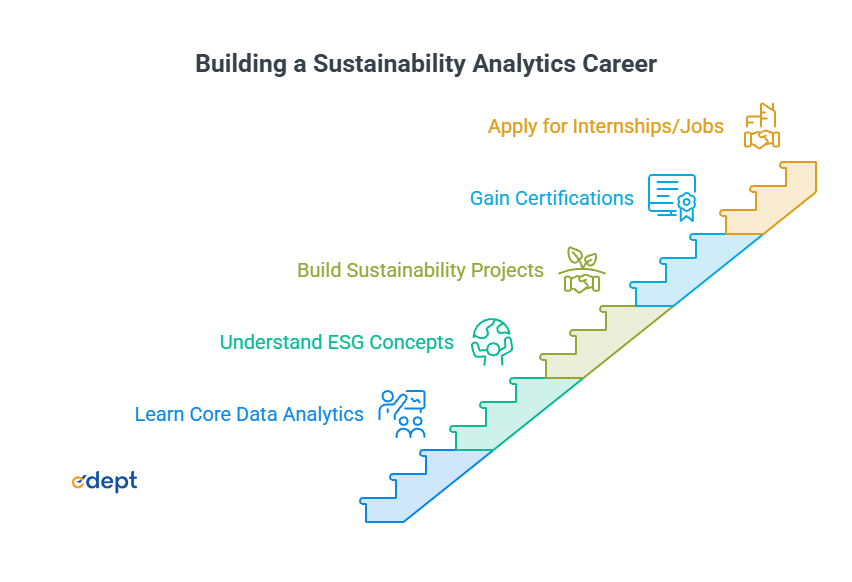
Step-by-Step Roadmap to Build a Sustainability Analytics Career
To build a career in sustainability analytics, you need to master data collection, carbon accounting, and ESG (Environmental, Social, and Governance) reporting frameworks.
Learn Core Data Analytics
First, learn the core data analytics that are needed to build a sustainability career. Start with Excel and SQL, then build toward Power BI, Tableau, or Python depending on the technical depth you want to reach. Free resources on Coursera, edX, and Kaggle are enough to start.
Understand ESG Concepts
Start understanding the ESG concept and learn about the three pillars of sustainability. Learn how carbon accounting works. Familiarize yourself with major reporting frameworks like GRI, SASB, and the ISSB standards.
Build Sustainability Projects
You should start building sustainability projects. Create a portfolio piece. Analyze a public company’s ESG report. Build a carbon emissions dashboard using open data. Document your process and findings.
Gain Certifications
Credentials in ESG reporting, carbon accounting, or sustainability management help strengthen a CV meaningfully, particularly for candidates without a direct environmental science background. Some of the important certifications are CFA Institute ESG Investing Certificate, GRI Academy Certifications, and NISM Certification in Responsible Investment.
Apply for Global Internships and Jobs
Start applying for global internships and jobs. You should start targeting roles that combine data and sustainability. Even an internship in a corporate sustainability team or a consulting firm’s ESG practice can provide the experience that can help you in career growth.
Future Scope of Sustainability Analytics Beyond 2026
ESG Regulations Expanding
Beyond simply complying with 2026 ESG regulations such as the EU’s CSRD or California’s SB 253, the future of sustainability analytics is shifting from a mandatory reporting exercise to a core business infrastructure. More countries are adopting mandatory disclosure rules, which means more companies need analytics support.
Climate Reporting Becoming Mandatory
Climate reporting is becoming mandatory. Companies are now moving away from historical reporting. Modern analytics platforms are now trying to integrate directly into IoT devices, procurement APIs, and ERPs to deliver continuous operational insights
Sustainability Skills Becoming Business-Critical
Sustainability skills are becoming business-critical. They have rapidly evolved from a niche corporate responsibility metric into a core business necessity. Organizations are now required to have workforces equipped with carbon accounting, supply chain transparency, and ESG reporting capabilities to facilitate stricter regulations, reduce risks, and meet shifting investor demands.
Conclusion
Careers in sustainability are now spanning across almost every sector, from energy and finance to fashion, food and the public sector, not just dedicated environmental roles. The World Economic Forum’s Future of Jobs Report 2025 projects that the green transition will create 34 million additional jobs by 2030. A career in sustainability is a role that helps organisations reduce environmental harm, meet social obligations and govern responsibly. For students who are interested in building a long-term career plan, sustainability analytics careers offer demand that’s driven by structural, regulatory, and investor-level forces rather than a passing hiring trend.
Most candidates who enter sustainability do so through one of two routes: a dedicated academic degree or a professional certification that converts existing experience into sustainability credentials. Companies across the world are investing money into renewable energy, circular supply chains, and eco-friendly innovations. This shift has created a career path that did not really exist a decade ago: sustainability analytics. For these reasons, sustainability analytics careers are opening up so fast for students and early professionals