Consumer behaviour in the digital age is defined by hyper-connectivity, instant gratification, and data-driven personalization. Today’s digital consumers actively research products, compare prices, and rely heavily on peer reviews and social proof before making a purchase.
Consumer behaviour and consumer trends are shifting dramatically in 2026. Consumer behaviour in this digital age has evolved significantly. Smartphones, the internet, social media, e-commerce, persistent inflation, and rising digital transformation, along with smarter AI, have transformed how consumers gather information, access options, and make purchases. Consumers today demand that all brands act responsibly and transparently. According to Capgemini’s 2026 consumer report, 71% of shoppers agree they would switch brands if pack sizes or product quality were reduced without prior notice. In fact, 74% of consumers revealed they would switch brands if they had found lower prices elsewhere.
Today’s consumer expects speed, consistency, transparency and convenience. If brands fail to deliver a smooth experience, consumers quickly move on. Consumers today are better informed and well-connected; they compare products, read reviews, and gather information before making any purchasing decisions. A decade ago, a manager could easily plan a quarterly report on consumer behaviour based on last year’s sales and their gut feelings, but that situation has completely changed.
In this digital age, a buyer can easily reach your product at midnight and compare it with at least 4 to 5 competitors before breakfast, then check all the reviews by lunch, and finally complete their purchase by evening through a social media ad, all without even visiting your store. This is the actual reality of consumer behaviour in the digital age. This guide will help you understand what consumer behaviour in the digital age actually means, the forces that are driving it, the frameworks that you need to analyze and the practical strategies that will help the managers plan and stay ahead in this rapid digital age
What Is Consumer Behaviour in the Digital Age?
In today’s digital-first world, consumer behaviour has changed dramatically, and it is influenced by the integration of technology. The rise of AI, digital transformation, and automation enables personalised experiences at a large scale, and it helps consumers to make more informed decisions.
Definition of Consumer Behaviour
Consumer behaviour, in simple language, is the study of how individuals make decisions about what they want to buy and when they want to buy it and how much they are willing to pay for it. Their decision is influenced by various psychological, social, cultural, and economic factors. There are normally five stages of consumer buying: the first stage is when a need or problem arises; the second stage is information search, when consumers do detailed research, check recommendations, reviews, etc. The third stage is evaluating any alternative option. The fourth stage is the purchasing decision, and the final stage is whether the product has met their expectations.
Shift from Traditional to Digital Behaviour
The traditional journey was very simple: a consumer would walk into a store, speak to a salesperson, ask them for their advice and make a purchase. But now the journey looks entirely different. The shift from offline to online has drastically affected the shopping experience. Today, consumers begin their buying journey long before they interact with the brand. They search on social media and Google, check the reviews and ask their network for recommendations. The result is that, when a buyer decides to purchase a product, he is well-informed, he knows his alternative options, and sometimes he has already made a purchase decision.
Why It Matters for Modern Managers
Managers who do not understand the pre-purchase phase of the buyer are already behind. For new managers, this change is a big thing. All decisions must be backed by strong data, not just by assumptions. When you actually know what your consumers are thinking and where they are spending, you can make data-driven pricing decisions, allocate budgets that can convert and anticipate market trends and shifts even before they show up in the sales dashboard and, finally, build a trustworthy consumer experience, not just one-time transactions. Modern managers are expected to combine analytical thinking with business judgement.
Key Factors Influencing Consumer Behavior Today
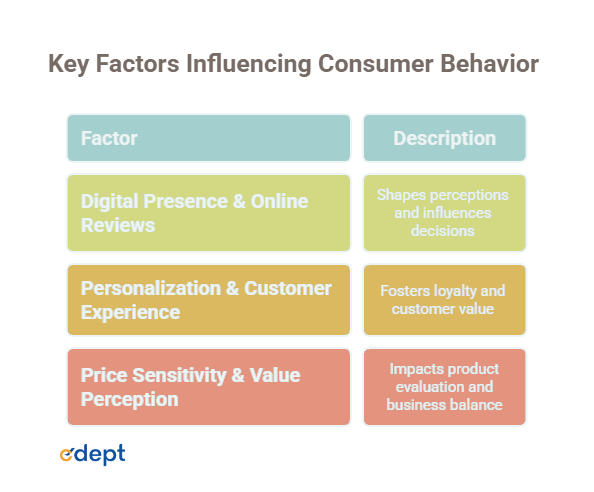
Some of the key factors influencing consumer behaviour today are
Digital Presence & Online Reviews
Consumers today demand that brands act responsibly and transparently. Trust is the ultimate currency of digital commerce. Before a customer even speaks with your sales team, they have already seen your brand; they have researched in detail all your social media accounts and what other customers are recommending about your brand, along with all reviews. Social proof is now a very important factor. Research shows that the majority of consumers do detailed review research of products before buying them. Say, for example, a product with a 4.5 rating and 800 reviews will easily outperform a product with a 5 rating and 3 reviews. Hence, it is very important for managers to manage the digital reputation of the brand.
Personalization & Customer Experience
In 2026, consumers expect highly personalised experiences that are specifically tailored to their preferences, behaviours and past interactions. When they visit a website, they expect it to remember their preference. When they open any product email, they expect it to be personalised, which addresses their specific interests, not some generic message. These personalised expectations have been used by platforms such as Netflix, Amazon, Spotify and many more. For managers, this means you need to build systems, CRMs, and email segmentation tools that will help your team to personalize communication.
Price Sensitivity & Value Perception
Price sensitivity helps in measuring how much price influences a consumer’s purchasing decisions. With inflation and high-rising prices, consumers tend to compare prices more carefully. A customer can easily check 4 competitor prices in under 2 mins; this has made customers more aware. Customers today are willing to pay more if they think the value justifies the product quality. A product with a high price, but backed by transparency, quality, and a good brand story, often wins over a cheaper-priced product.
How the Digital Age Has Changed Buying Behavior
The digital age has transformed the purchasing behaviour of the consumer. Technology has reshaped the consumer habits. The next generation has grown up with advanced technology and AI-generated assistants. They expect instant personalization from brands. Nowadays, before buying any product, modern consumers actively investigate products to minimize the buying risks.
Rise of Online Research Before Purchase
Nearly 96% of shoppers now research products online before buying. Consumers are going through a number of channels before purchasing any product. They check videos, read comments and recommendations, and read blogs and other sources before making any decision. By the time the customer reaches your sales team or checkout option, they have already researched a lot about your product and know all the required information. For managers it is very important to check whether all information related to the product is clearly mentioned or not; the FAQs, review responses, and blogs all need to answer every possible question the customer might want to know before they take the final decision.
Multi-Channel Buying Journey
In India, consumer behaviour blends online and offline channels. They do not just depend on one platform. Suppose they discover any product on Instagram; then they research it on Google and then read the reviews on Amazon and finally complete the purchase on your website. Sometimes they even check a product in the store and purchase it online. Now, if a manager checks only one platform, then he is looking at a very small part of the customer journey. Real customer insights come from connecting various touchpoints such as paid ads, social engagement, email opens, in-store visits, and post-purchase reviews. Managers need to think that this journey is a continuous loop, not just a simple straight line.
Influence of Social Media & Influencers
Social media and influencers play a significant role in the purchasing journey of the consumer. Platforms such as Instagram, Facebook, and YouTube are not just entertainment channels; they help consumers to get convinced. A 30-second ad campaign from a creator whom you trust and admire can do a lot more than a six-month ad campaign. Influencer marketing has now become very popular because it operates on trust. For managers, the main purpose should be to get social proof from real people, because that carries much more branded content.
Consumer Decision-Making Process (Modern Framework)
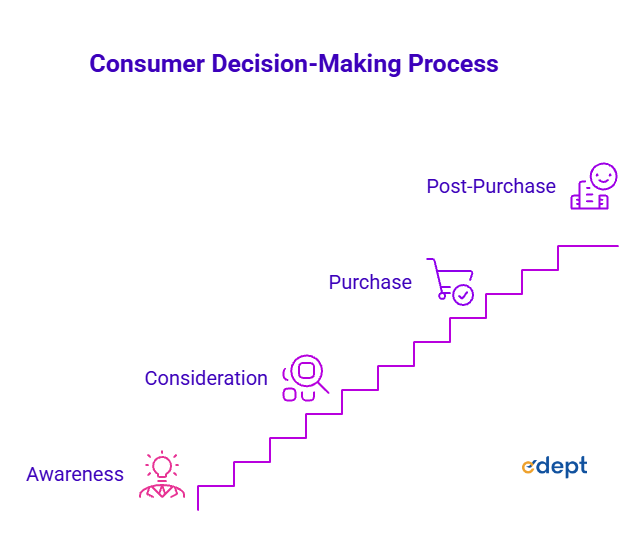
The consumer decision-making process comprises 5 distinct stages. Each step of the consumer decision-making process reflects the consumer’s journey from recognizing a need to the post-purchase evaluation.
Awareness Stage
In this stage, “I didn’t know I needed this,” this moment arrives. This is where a customer’s first encounter with a brand happens. In this digital age awareness can easily be triggered by search results, social media posts, YouTube ads, a trending hashtag or a friend’s recommendation. Managers should focus on being more visible and check where their target audience spends most of their time.
Consideration Stage
At this stage, the customer knows you have a brand and it exists. They compare it with few others. The customer is now evaluating. Your product pages, blog content, case studies, and FAQs all play a very important role here. The customer does full research and comparison so that he can have more clarity and credibility.
Purchase & Post-Purchase Behavior
Purchase behaviour is the final selection and execution of a transaction. Post-purchase behaviour covers the customer’s satisfaction, usage, and evaluation of the item, which determines long-term brand loyalty. The purchase moment needs to be very smooth; complex checkout procedures, unclear return policies and slow-loading pages must be avoided. What happens after the delivery, the unboxing part, the customer support, and the follow-up emails decides whether the buyer becomes a repeat customer or a one-time visitor.
Role of Data in Understanding Consumer Behavior
Data plays a significant role in understanding consumer behaviour. It helps in transforming raw information into actionable and meaningful insights.
Importance of Data Analytics
Data analytics provides businesses with various tools that are used to uncover the patterns in consumer behaviour. By analysing data from various touchpoints such as website visits, social media interactions, and online purchases, businesses can easily identify trends in consumer preferences. This helps in segmenting the audience based on characteristics like age, location, and purchasing behaviour, which enables more targeted marketing efforts.
Customer Insights & Segmentation
All customers are not the same, and treating them in the same way is the most common mistake. Segmentation simply means grouping your customers according to their preferences, behaviour, location, and interests. When proper segmentation is done, it allows a small team to send personalized relevant conversations to thousands of customers, but if it is done poorly and generic messages are sent, then the final output remains zero.
Predictive Behaviour Analysis
Predictive behaviour analysis uses historical data, machine learning, and statistical modelling to forecast future actions. They can forecast what customers are likely to do next, which product will trend in the upcoming months, and which audience is likely to respond to a discount. This will enable the managers to forecast trends, manage inventory, and prepare for seasonal demand fluctuations more accurately.
Key Consumer Behavior Trends in 2026
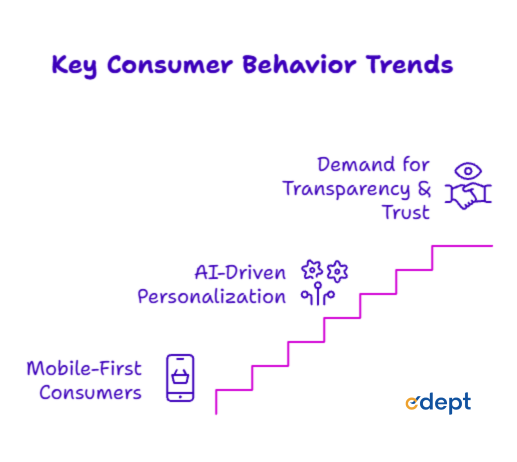
Some of the key consumer behaviour trends in 2026 are as follows.
Mobile-First Consumers
Smartphones are no longer just a communication device; they have become a primary shopping device for a significant portion of the global population. Over 77% of shoppers use their phones for product research and price comparisons. The page speed option on mobile, easy checkout procedure, and mobile-friendly visuals are no longer just extras. If your site takes more than three seconds to load on a phone, you’re losing customers even before they’ve even seen what you sell.
AI-Driven Personalization
AI-driven personalization dynamically adapts to consumer experiences using predictive machine learning algorithms. It influences consumer behaviour by anticipating needs, increasing purchase intent, and driving loyalty. Around 64% of consumers are now using AI tools for product research or discovery, and a meaningful share of them trust AI recommendations more than their own judgment. The brands that are getting success in 2026 are using AI for speed and personalization but they keep human storytelling at the centre.
Demand for Transparency & Trust
Today’s customers, especially Gen Z, are not just passive buyers. They do detailed research on the companies before buying any product; they are well aware of what they want to purchase. They want to know from where the products come and how they are built. Transparency in pricing, supply chain, and data usage has become a genuine and important factor in pricing decisions. The brands that are open about these things create strong loyalty.
Challenges Managers Face in Understanding Consumers
There are critical challenges that managers face in understanding consumers, such as data overload, rapid change in economic conditions and technological advancements. Let’s understand them in detail.
Rapidly Changing Preferences
Consumers’ preferences are shifting very quickly, sometimes due to a viral event or cultural trend, or when a competitor launches a new product. Something that might have worked six months ago may not work today. Nowadays, the consumers’ trust has become fragile, and buyers are very sensitive to price hikes and hidden charges. As a manager, you should have a dedicated team that conducts detailed market research continuously, not just once a year. Outdated consumer data will fail to capture the preference changes in the market, making marketing decisions more difficult.
Data Overload
Organization now collect massive amounts of data, be it from social media insights, email metrics, CRM dashboards, or sales reports. The risk is not the lack of information, but people are drowning in it. The main skill is knowing which metrics matter for your defined goal and which are just noise. As a manager, you should learn to identify the key performance indicators that can help in getting more profitable business outcomes.
Managing Omnichannel Experiences
To deliver the same high-quality, consistent experience across every channel that a consumer may use, be it a website, app, social media, or physical store, is one of the most difficult and complex challenges in modern business. For managers, this requires very good teamwork and coordination between the marketing, sales, and operations teams. It also requires a system that helps in sharing data across various channels so that when a customer contacts a support team, he does not have to explain the entire purchase history from scratch.
Skills Managers Need to Understand Consumer Behavior
To effectively anticipate and meet customer needs, managers must blend human empathy with rigorous data analysis
Analytical & Data Interpretation Skills
Modern consumer behaviour is heavily driven by data. Managers need to understand how to extract and interpret data to get meaningful business insights. The managers need to be comfortable with reading reports and dashboards, identifying trends, and studying metrics.
Digital Marketing Knowledge
Understanding how the digital marketing channel works is very important for the managers. He should be comfortable with SEO, paid ads, email marketing, social media advertising, and content marketing. You don’t need to execute the campaigns yourself, but be aware of how the campaign works, what the output and conversion will be, and what the pricing will be; you should also know how to evaluate whether it is working or not.
Customer-Centric Thinking
The most important and valuable mindset a manager could have is asking themselves, ‘What does this feel like from the customer’s point of view?’ The best managers don’t start with “What do we want to sell?” They start with “What does our customer actually need?” Customer-centric thinking means evaluating every business decision through the viewpoint of the customer.
Why Choose Edept for Business & Marketing Programs
For aspiring managers, classroom theory is no longer enough. You need exposure to real tools, real data, and real consumer scenarios.
Industry-Aligned Curriculum
Edept’s programmes cover the areas modern managers are actually expected to handle: consumer behaviour, marketing analytics, digital strategy, and brand management, built around what employers are hiring for today.
Hands-On Learning & Real-World Case Studies
Instead of just reading about Amazon’s recommendation engine or how Netflix segments audiences, learners work through case studies and live projects that mirror the daily decisions of marketing managers.
Placement Support & Career Guidance
From resume building and mock interviews to industry connections, Edept’s career support is designed to help students transition from learning to leading.
Programs Designed for Future Managers
Whether your goal is marketing, analytics, or general management, Edept’s programmes are structured for people who want to move into decision-making roles, not stay on the sidelines
Strategies for Managers to Adapt to Digital Consumer Behavior
The various strategies for managers to adapt to digital consumer behaviour require leveraging data-driven insights, providing frictionless omnichannel experiences, and building authentic brand communities where the audience naturally engages.
Leverage Data for Decision-Making
You should make data your starting point; start with your existing data before you start investing in new tools. Start implementing a robust CRM to track purchase history, browsing habits, and preferences. This allows managers to automate targeted email campaigns, deliver tailored product recommendations, and boost conversion rates. The managers should build a habit of making decisions based on evidence and not just assumptions.
Focus on Personalization
Personalisation does not have to be building very sophisticated AI tools or automation systems overnight. You should start with proper email segmentation and then send good personalized emails to all the consumers rather than generic messages. Start cutomizing your landing pages to generate more traffic. You should acknowledge the purchase histories before recommending any product to the consumer. All these small steps signal to the customers that you see them as individuals, not just any transaction.
Build Strong Digital Presence
Your digital presence is your first identity to your consumers. Start by building a very good and trustworthy digital presence. That means you should have an active social presence, well-written product pages, fast websites, and consistent branding across every touchpoint. If a customer can’t find you in the first two pages of search results, your competitor has already won them.
Future of Consumer Behaviour in the Digital Era
The future of consumer behaviour in the digital era is shifting towards hyper personalization, urgent gratification and algorithm- and AI-driven purchasing.
AI & Automation in Customer Insights
The role of AI and automation in understanding various aspects of consumer behaviour will deepen further. The predictive models will become much more accurate. The natural language processing will make it very easy to analyze the customer feedback. The various modern automations will help in personalizing customer experience. The managers who will start investing in these tools will see a much brighter and more successful future.
Voice Search & Smart Devices
Nowadays, voice-activated devices are changing how consumers search for various information. More households are integrating smart speakers and voice assistants into their daily lives. The voice queries are longer and more conversational than typed ones, which means content and SEO strategies have to adapt to natural, spoken language. The managers have to build strategies to account for how people speak, not just how they type.
Hyper-Personalized Experiences
The next digital transformation is not just personalization, it’s hyper personalization. AI now predicts consumer needs by analyzing browsing habits and purchase history. Consumers now expect tailored product recommendations and dynamic pricing based on real-time data. The brands building data infrastructure and AI automation now will have a competitive advantage in the next 5 years.
Conclusion
Consumer behaviour in this digital age is changing dramatically, creating both opportunities and challenges for businesses. By understanding the psychological, ethical and technical aspects of consumer behaviour, companies can design more effective strategies to engage with the customers. In 2026, consumers are more informed, selective and well-connected, and they are very quick to switch brands if their expectations are not met. They expect speed, personalisation, transparency, and a brand that genuinely understands them. For new managers, this is both a challenge and an opportunity. There are many tools available, and the data is rich, but what sets one manager apart from the others is the continuous willingness to learn and adapt. They need to start thinking from the viewpoint of the consumers and start planning their strategies for a successful future.