IBM live projects and virtual internships provide students with hands-on experience in Generative AI, Large Language Models (LLMs), and cloud computing before graduation. Through programs like the IBM SkillsBuild initiative and university collaborations, learners engage in 15–60 hours of structured training involving live masterclasses, self-paced modules, and capstone projects.
Most graduates struggle with one thing. They know the theory, but they have not touched real work. Employers today are not just looking at grades. They want candidates who have solved real problems, worked with real teams, and built things that actually work in the real world.
This is where IBM Live Projects come in. These are not mock assignments or textbook case studies. They are real, IBM-mentored industry projects where students use actual tools like IBM Watson and IBM Cloud to solve real business problems, guided by experienced professionals.
For students at edept partner institutions, this means getting a taste of the corporate world months, sometimes years, before they graduate. They learn to work under deadlines, take feedback, present their work professionally, and build a portfolio that speaks louder than a resume.
In this blog, we will look at how IBM Live Projects work, what students actually learn from them, and how programs like edept’s B.Sc. Information Technology with Gen AI at Shree L. R. Tiwari Degree College build this real-world exposure directly into the curriculum.
Why Industry Experience Matters Before Graduation
A degree alone does not guarantee a job anymore. Companies today shortlist candidates based on what they have actually done, not just what they have studied. Here is why hands-on experience has become the real deciding factor.Employers Prefer Job-Ready Graduates
Most recruiters today spend less time on marksheets and more time asking what you have built. Companies want people who can contribute from day one, not people who need six months of training just to understand how a team works.Practical Skills Matter More Than Theory Alone
Knowing a programming language on paper is different from writing code that solves an actual business problem. Practical exposure teaches students how to debug, collaborate, and adapt, skills no textbook can fully teach.Real Projects Improve Placement Success
Students who walk into interviews with real project stories tend to perform better. They can explain what problem they solved, how they solved it, and what the outcome was, which is exactly what interview panels want to hear.Industry Exposure Builds Professional Confidence
Working alongside industry mentors, even briefly, changes how students carry themselves in interviews and on the job. They stop guessing and start speaking from experience.What Are IBM Live Projects?
Before going further, it helps to understand what actually happens inside an IBM Live Project and how it is different from a regular college assignment.Learning Through Real Industry Challenges
Instead of solving a problem invented for a classroom, students work on challenges that businesses are actually facing, with real constraints and real stakes.IBM Mentorship Throughout the Project
Students are not left to figure things out alone. IBM professionals and industry experts guide them at each stage, reviewing work and offering feedback the way a manager would.Exposure to IBM Technologies
Students get hands-on time with tools like IBM Watson and IBM Cloud, along with industry-standard development practices. These projects also come with IBM-recognised certifications and structured internships attached, so the learning does not stay theoretical.How IBM Live Projects Work in edept’s B.Sc. IT with Gen AI Program?
edept has built this real-world exposure directly into its programs. Take the B.Sc. Information Technology with Gen AI at Shree L. R. Tiwari Degree College, Mira Road, a four-year degree affiliated to the University of Mumbai. Here is how the journey unfolds, step by step.Step 1: Learn Technical Foundations
Students first build core concepts across programming, databases, cloud computing, AI, and software development in the B.Sc. IT with Gen AI program, this starts from semester one with subjects like Programming with C and Database Management Systems, and moves into Python Programming, Data Structures, and Operating Systems by semester three.Step 2: Participate in Structured IBM Internship Programs
Once the basics are in place, students step into the IBM Internship Program. This is not a simulation. It is a structured, live internship where top performers are recognised nationally. The top 2,000 performers across the country receive an INR 4,000 stipend, along with an IBM plus NASSCOM joint certification.Step 3: Work on Live Industry Projects
Students then apply what they have learned to solve real business problems, working within real project timelines, just as they would on the job.Step 4: Receive Guidance from Industry Mentors
Throughout the project, students get regular reviews and feedback sessions from mentors, learning best practices the way a new employee would from a senior colleague.Step 5: Present Solutions Like Industry Professionals
By the end, students present their outcomes, document their solutions, and explain the business impact of their work, exactly the skills recruiters look for in interviews.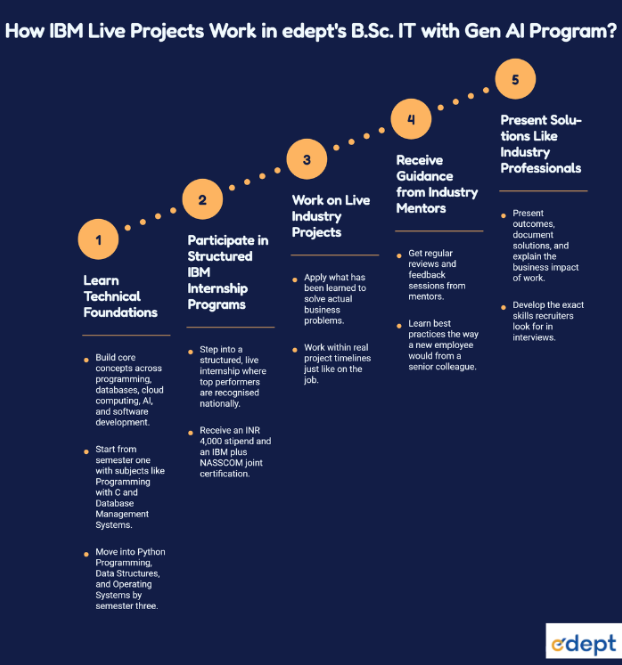
Technical Skills Students Build in the B.Sc. IT with Gen AI Curriculum
Along the way, students pick up a wide range of technical skills that map directly onto what companies are hiring for right now.- Cloud Computing
- Artificial Intelligence
- Software Development
- Data Analytics
- Business Intelligence
- Software Quality Assurance
- Enterprise Networking
Professional Skills Students Build
Technical skills get you noticed, but soft skills are what actually get you hired and keep you employed. Live projects quietly build these alongside the technical work.- Team Collaboration
- Communication Skills
- Critical Thinking
- Problem Solving
- Time Management
- Client Presentation Skills
How IBM Live Projects Improve Placements for B.Sc. IT Students
All this hands-on work adds up to something very concrete: better placement outcomes.- Stronger Resume
- Real Project Portfolio
- Better Interview Performance
- Higher Recruiter Confidence
- Improved Industry Readiness
IBM Certifications Included in the B.Sc. IT with Gen AI Program
On top of the project experience, students also walk away with certifications that carry weight outside the classroom.- IBM Recognised Certifications
- IBM Plus NASSCOM Joint Certification
- Performance-Based Recognition
Industry Exposure Beyond IBM Projects
IBM is one part of a much bigger ecosystem of real-world learning that students get access to.Deloitte Learning Academy Certifications
Students can earn self-paced certifications in AI, data analytics, digital transformation, and business strategy, authored and certified by Deloitte, delivered directly on the edept learning platform.Global Industry Projects
Through partners like Practera and HEX, students work on projects with real global clients including organisations like Salesforce, Infosys, Deloitte, EY, Alibaba, Western Union, the City of Boston, the City of Sydney, and even the United Nations. These global immersion projects run in three stages: a Foundation stage of two to three weeks, an Applied stage of four to six weeks, and an Advanced stage of eight to twelve weeks where students lead a global capstone project.AI-Powered Learning
From the very first semester, students use tools like Claude, ChatGPT, GitHub Copilot, Emergent, and Lovable, not just to study them but to actually build with them. Every assignment and project is done with AI in the loop. This builds up year by year: learning to use AI correctly in year one, integrating it into technical workflows in year two, and building full AI-driven systems by year three.How Industry Projects Are Built into the B.Sc. IT with Gen AI Curriculum
Project work is not something bolted on at the end. It runs through the later years of the programme as a core part of the academic journey.- Industry Mentored Project Engagement
- Project Dissertation
- Project Implementation
- Professional Portfolio Development
- Capstone Project and Jury Presentation
Common Mistakes Students Make Before Placements
Even with all this exposure available, some students still miss out on the full benefit. Here are the mistakes to watch out for.- Focusing Only on Theory
- Ignoring Industry Projects
- Weak Project Documentation
- Not Building a Portfolio
- Underestimating Communication Skills
Why Choose edept’s B.Sc. IT with Gen AI Program at Shree L. R. Tiwari Degree College
All of this comes together in edept’s B.Sc. Information Technology with Gen AI program at Shree L. R. Tiwari Degree College, a NAAC ‘A’ grade, UGC recognised college affiliated to the University of Mumbai, with over 36 years of experience across the Rahul Education group and more than 70,000 students.- IBM Mentored Live Projects: structured IBM internships with real mentorship, IBM Watson and IBM Cloud exposure, and IBM plus NASSCOM certification.
- Deloitte Learning Academy Access: self-paced certifications in AI, data analytics, digital transformation, and business strategy on the edept LMS.
- Global Industry Collaborations: real client projects through Practera and HEX with organisations across Australia, Asia, the US, and Europe.
- AI Integrated Learning from Year One: every assignment and project done with tools like Claude, ChatGPT, and GitHub Copilot from semester one.
- Hands-On Projects Throughout the Programme: from the Field Project in semester 3 to the Capstone showcase in semester 8, project work runs across all 8 semesters.
- 100% Placement Support: resume building, mock interviews, industry projects, internships, and access to 300+ hiring partners including Deloitte, EY, KPMG, TCS, JP Morgan, Flipkart, and Citi, with the highest offer in 2026 reaching INR 10 LPA.
How Students Can Maximize the Value of IBM Live Projects
Having access to these projects is only half the story. What students do with that access makes the real difference.- Take Ownership of Assigned Tasks
- Learn Beyond the Project Requirements
- Ask Mentors for Feedback
- Document Every Achievement
- Build a Professional GitHub and LinkedIn Portfolio
- Use Project Experience During Placement Interviews
Why Industry Projects Matter More for IT Careers?
As hiring keeps changing, this kind of hands-on exposure is only going to matter more, not less.- Employers Will Continue Prioritizing Practical Skills
- AI and Cloud Technologies Will Increase Project-Based Hiring
- Professional Portfolios Will Carry Greater Weight Than Academic Scores Alone
- Industry Collaboration Will Shape Future Education
Conclusion
IBM Live Projects give students something a textbook never can. Real exposure to how work actually gets done. Through mentorship, live projects, IBM technologies, certifications, and structured internships, students build both the technical and professional skills that employers actually look for. Programs like edept’s B.Sc. Information Technology with Gen AI take this further, combining IBM live projects with Deloitte certifications, global immersion projects, AI-powered learning from year one, and support from over 300 recruiting partners. By the time students graduate, they are not just carrying a degree. They are carrying real project experience, real certifications, and real confidence.
Build global-ready skills with Edept’s industry-focused programs
Begin Your Journey!