Moving to a new country to study is not just about only textbooks and timetables. A good community services career choice often begins with a very simple question: can you see yourself helping people during real challenges, not just on the easy days? If that sounds ok with you, then a community services course in Australia can be the first practical step towards work that matters. It is a field built on empathy, communication, professional boundaries, and the ability to support and care for individuals and communities in a very structured & ethical manner.
Choosing to study community services in Australia is a very big decision, and Adelaide is fast becoming one of the most preferred cities for international students who want a practical, career-focused qualification without the pressure of a major metro budget. Now, if you are planning to study community services in Australia, particularly in Adelaide, your first year will be much more than just a series of lectures and assignments. Your first year is about far more than attending classes. It’s about adjusting to a new education system, understanding how Australia’s community care sector operates, building real workplace skills, and laying the foundation for a career that genuinely makes a difference in people’s lives.
The Community Services programme delivered through Auctus Training Institute, in partnership with edept, is built around practical learning rather than classroom theory alone. Students here work through structured workshops, receive mentorship from experienced trainers, and get direct industry exposure through supervised placements. Along with academic support, the students here get guidance on adjusting to life in Australia and assistance in securing work placements. This blog provides you with a realistic overview of what students can expect during their first year, from academics and practical placements to student life, career preparation, and support services.
Why Is Adelaide a Great City to Study Community Services?
Adelaide is considered a premier destination for studying community services because of its strong job market in the health and social assistance sector, a high concentration of non-profits, and an affordable, welcoming lifestyle that provides plenty of real-world volunteer and placement opportunities
Affordable Student-Friendly City
Adelaide is considered one of the most affordable capital cities in Australia for international students, with living costs typically approximately 20% lower than Sydney and 10% lower than Melbourne. Shared accommodation is available from as little as AUD $120–$160 a week in suburbs close to major campuses. Rent, public transport, and daily living costs are lower here, which really matters when you are balancing study with part-time work. The city is compact and well connected; hence, you can get to your campus without spending a lot of money on transport.
Growing Demand for Community Support Professionals
South Australia’s care economy is expanding rapidly, and it is driven by an ageing population where those aged 65 and over are projected to make up a growing share of the state. This surge in demand has caused significant job opportunities across disability support, personal care, and community services. Within this sector, community and personal service workers, which include qualified community work professionals, are expected to grow by 13.5%, adding approximately 188,900 jobs over the next five years.
Safe and Multicultural Environment
Adelaide is considered to have a strong reputation for being safe, clean and welcoming. It has a very well-established multicultural environment that helps international students to settle in easily and build a network.
Excellent Healthcare and Community Care Network
Adelaide has a very strong healthcare infrastructure, including major hospitals, community health centres, and specialist support services. The students who are studying community services are given access to high-quality placement opportunities and exposure to well-organised community care networks. You will experience how services are coordinated and how agencies collaborate.
Understanding the Community Services Programme
A Community Service Programme (CSP) is a very structured, voluntary initiative that connects individuals or educational institutions with local communities to address social needs. Here, the participants engage in direct, hands-on work, such as tutoring, environmental cleanups, or assisting the elderly, to develop civic responsibility and apply knowledge to solve real-world problems.
What Community Services Is All About
Community services are not a single job; they are a broad concept. It supports individuals, families, older adults, people with disabilities, and vulnerable communities to live with dignity and independence. It’s a field built on empathy, but it’s also a genuine profession with clear standards, ethical obligations, and career pathways. When you study community services, you learn how to access needs, coordinate support, collaborate, network with people and communicate effectively.
Career-Focused Learning
The programme is designed in such a way that you can develop practical workplace skills throughout your career journey. Rather than just focusing on theory, this programme emphasises more what you will actually do in a community service role. It includes talking with clients, writing case notes, working with legal and ethical frameworks, and finally collaborating with professionals. The career-focused approach means that when you simply complete your first year, you will have a clear understanding of whether you want to do a specialization in any particular area. 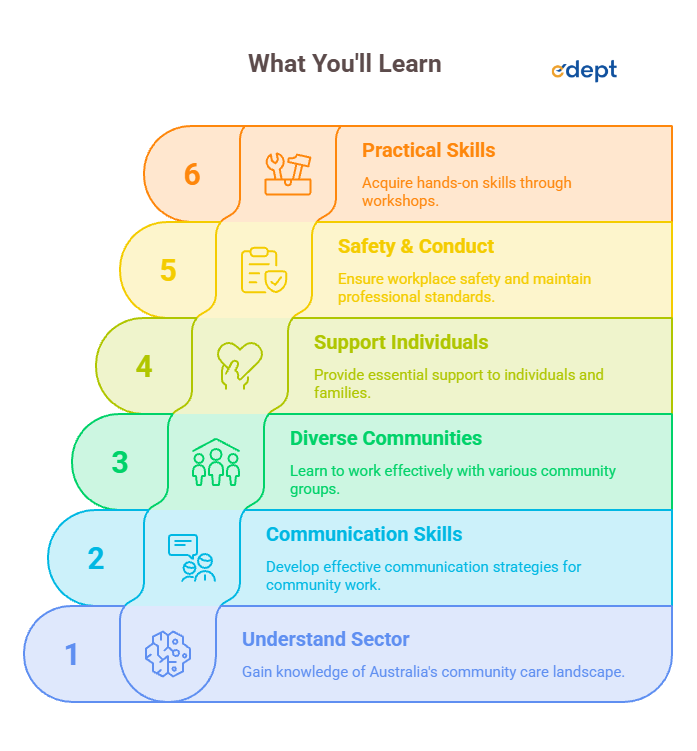
What You’ll Learn During Your First Year
Your first year will prepare you for real-world support work. You will learn how to navigate the Australian care sector, master essential workplace communication, support diverse groups, and ensure client and workplace safety.
Understanding Australia’s Community Care Sector
In your first year, you will build your foundation and get to know how Australia’s community service system is structured. You will understand the different types of services available, how they are funded, and how they connect. Some of the topics include the following:
- Community services system – The structure and function of care networks.
- Ethical responsibilities – Moral duties and rights of the clients
- Professional standards – Rules of the workplace
- Person-centred support – Care method that puts client needs first.
Communication Skills for Community Work
Communication is one of the most important skills that you will start to develop in the first year. Most community services’ work involves talking with people who may be experiencing stress, vulnerability, or difficult life circumstances. Employers consistently rank communication as a top priority when hiring community services workers. It is not just about being friendly; it is about being clear, respectful, and effective in every interaction. Some of the topics include the following:
- Active listening – Fully focused and understanding the speaker.
- Professional communication – Very clear and respectful information sharing.
- Cultural sensitivity – Respecting diverse backgrounds and beliefs.
- Documentation – Accurate and factual record-keeping.
Working with Diverse Communities
Australia is one of the most diverse and multi cultural country. You will start learning. on how to adapt your approach to different cultural expectations around care, family involvement, and communication styles. Some of the topics include:
- Cultural awareness – Start understanding different customs and worldviews.
- Inclusion – Making sure all people feel valued and involved.
- Respectful support – Care that honours a client’s identity.
- Community engagement – Connecting with local groups and resources.
Supporting Individuals and Families
This is where your training starts connecting theory to real client outcomes. A significant part of community services work involves direct support for individuals and families. You’ll learn how to help develop individualized support plans, when and how to advocate on a client’s behalf, and how to refer clients to other services when their needs go beyond what you can directly provide. Some of the topics include:
- Individual support planning – Create personalised care goals.
- Advocacy – Speak up for the client’s rights and needs
- Referral processes Connecting clients with specialists
- Client wellbeing – Improving the mental, physical, and emotional health of clients.
Workplace Safety and Professional Conduct
Community services work carries real responsibility, and this section makes sure you understand the professional boundaries and safety obligations that come with the job. Here you will learn how to assess risk, protect client and worker privacy, maintain confidentiality, and act professionally in every crucial situation. Some of the topics include:
- WHS practices – Safety and health rules for the workplace.
- Confidentiality – Keeping private client details securely.
- Ethics – Doing the right thing in difficult situations.
- Professional behaviour — Respectful and professional manner
Practical Skills Through Workshops
Rather than relying only on lectures, Auctus places strong focus on interactive workshops, coaching, and mentoring built around real workplace scenarios. This means you will spend time practising skills in simulated environments, receiving feedback from experienced trainers, and reflecting on how to improve. This practical approach helps in bridging the gap between knowing something in theory and being able to do it confidently in a real workplace.
Practical Learning Instead of Only Classroom Theory
Auctus’s teaching model is built around the belief that community service skills are best learnt by doing, rather than only theoretical learning. Workshops help in recreating real workplace situations, case studies are drawn from genuine industry scenarios, and one-on-one coaching from experienced trainers means you’re never left to figure things out alone. This practical, applied approach is designed to make your learning directly relevant to real work situations which you’ll encounter in your career.
Interactive Workshops
Most of the practical growth happens in workshops. They are not simple sessions where you just listen to a presentation. Here you take part in role play, debate, group discussions, problem-solving activities, etc. This helps you gain information and build confidence.
Real-Life Case Studies
Case studies are used throughout the whole programme to build realistic scenarios. You will work and analyze realistic scenarios that involve clients with complex needs, and you will work throughout to respond properly. This helps you build critical thinking and problem-solving capabilities.
Industry-Based Learning Activities
Some sessions will bring in industry experts, guest speakers and mentors who can help you with industry knowledge and practical community service settings. Through these experiences, you will gain various insights, which will help you to know how different services operate and what employers are looking for.
Coaching and Mentoring Sessions
Coaching and mentoring sessions are a very important part of your programme. Here you will have access to experienced trainers who can offer guidance, answer your questions, and help you navigate challenges, both personal and academic. This is very helpful for international students who are adjusting to a new education system and a new country both at the same time.
Work Placements: What Students Should Expect
Work placement gives students an exciting opportunity to put their studies, theory and practical lessons into action in the professional field with real-world expertise. It helps students to understand the practical side of education, providing them with various competencies and skills they need to perform well in their respective fields.
Why Placements Are Important
Work placements are where you start applying your classroom learning and gain real-world experiences. They give you the chance to apply your skills in actual community services settings; you can observe and learn from experienced professionals there and start building your identity. Placements are the most valuable and important part of your training.
Learning in Real Community Care Settings
During your placement, you will transition from classroom-based learning to active social service or healthcare environments. You will have the chance to work in environments such as community centres, disability support services, aged care facilities, or family support organizations. There, you will assist with day-to-day activities, begin observing how services are delivered, and gradually take on more responsibilities once you have gained enough confidence.
Working with Industry Partners
Placements help in connecting students with active businesses and non-profit organizations. This gives students certain ideas and insights into current employer expectations and allows them to utilize real industry tools, software, and safety protocols used in daily operations. Auctus & edept provide pre-approved real-world placements with industry partners to give students practical experience before graduation. These partnerships mean you are not left to find a placement on your own. The organizations you work with are evaluated, supportive of learners, and understand the balance between training and contribution.
Building Professional Confidence
Hands-on working experience allows students to test their knowledge and skills in a very supervised and professional space. Completing daily tasks successfully helps in reducing their anxiety and gaining self-confidence. Placements are not just about learning technical skills. They are also about learning how to conduct yourself in a professional environment: how to dress, how to speak with colleagues and supervisors, how to manage your time, and how to handle all the feedback.
Support Available for International Students
Moving to a new country to study is a very serious commitment. The first few months are the hardest, and dedicated support at that time can really make a big difference.
Settlement Support
Moving to a new country is not just about starting a course; it involves various things. Settlement support includes airport arrival, finding accommodation, understanding local transport, understanding your visa conditions, opening a bank account, and getting a tax file number.
Friendly Trainers and Staff
Friendly and approachable staff matter most here. One of the most common pieces of feedback that we get from students is how approachable and supportive the trainers are. They are experienced industry professionals who understand both the academic and practical sides of community services, and they are genuinely committed in your success.
Tips for Living in Australia
Beyond just academic support, you will also receive practical tips for living in Australia. You will be able to understand workplace culture, where to shop affordably, how public transport concessions work, what to do if you get sick, and how to find part-time work that fits around your studies. You will also be able to manage your budget and stay connected with family back home.
Ongoing Student Support
Ongoing support will continue throughout the year, not just during the orientation period. Throughout your first year, you will have access to ongoing assistance, whether you need help with an assignment, advice about a placement concern, or simply someone to talk to about adjusting to life in Adelaide.
A Typical Week as a Community Services Student
A typical week as a community services student is highly demanding. It balances demanding coursework with hands-on field placement. Every week is slightly different. A realistic first-year week might include two or three days of scheduled classes and workshops and one day of independent study or group work.
Monday: Classroom Sessions You attend core lecture theory and start learning about human behaviour, mental health, and social policies. You start building the knowledge needed to understand client needs and social systems, followed by an afternoon session on ethics and case studies.
Tuesday: Practical Workshops You can go to the campus lab for hands-on practice. You start practising role-play counselling sessions, conflict resolution, and first aid. These workshops can help you understand how you should approach your clients in the real world.
Wednesday: Independent study and group work You can complete your assigned readings and write case study reports. In the afternoon, you can meet with project groups to plan community workshops or organize awareness campaigns.
Thursday: Group Discussions You can meet in small groups with your classmates. You can talk about case studies and share feedback on mock counselling roles. You can share your ideas and insights among yourselves
Friday: Placement Preparation You can start focusing on your upcoming fieldwork at a community agency. Start reviewing workplace policies and professional conduct standards.
Saturday: Assignment Work You start working on your reports and finish all your weekly tasks. You type up client assessments, case summaries, and research papers. Also start preparing for upcoming exams. 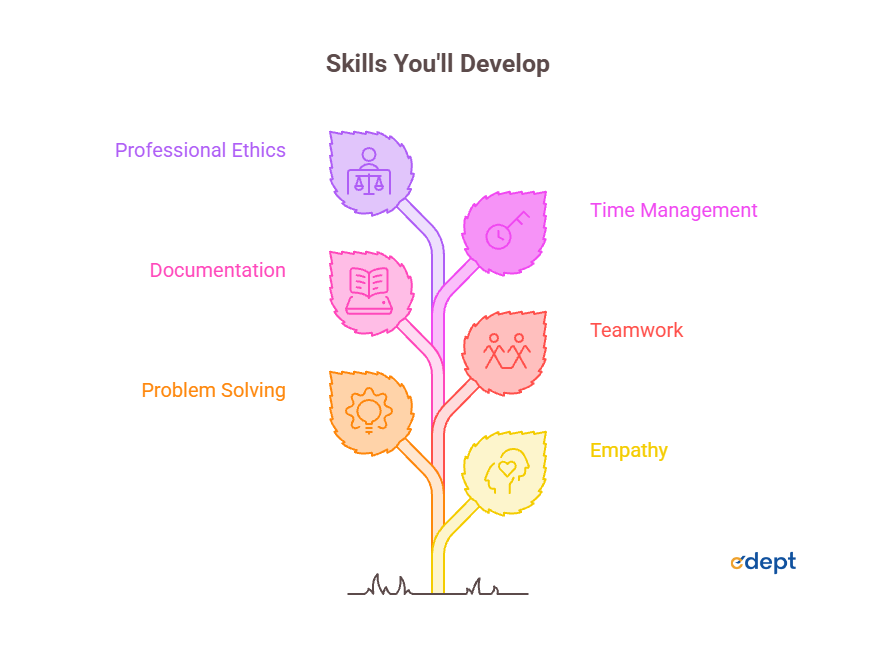
Skills You’ll Develop in Your First Year
In the first year you will develop skills that will help you connect and communicate with people from different backgrounds. You will notice real growth in areas that go well beyond textbook knowledge.
Communication
You will learn to speak clearly and communicate professionally with clients, colleagues, and external agencies. This includes both verbal and nonverbal communication, as well as the ability to adapt according to your audience.
Empathy
Here you will start learning how to understand and share the feelings of others. Empathy is central to community service work. You will start developing the ability to understand others’ perspectives without losing professional boundaries, which helps you build trust and provide effective support.
Problem Solving
You will start learning to find quick answers to everyday challenges. You will start practising analysing situations, identifying options, and making decisions that balance client needs with organizational and legal requirements.
Teamwork
You will learn to work well with your coworkers and volunteers to reach common goals. Learning how to contribute effectively as part of a team is very essential for almost every community services role.
Documentation
You will start learning to write accurate reports and safely keep client records. Here you will practise writing case notes, reports, and referrals that meet professional standards.
Time Management
Here you will learn to finish tasks on time and plan your daily schedule regularly. To balance study, placement, part-time work, and personal life requires solid time management skills. Your first year will guide you in developing systems that will help you manage time effectively.
Professional Ethics
Here you will learn to act in a fair, honest, and respectful way. You will start understanding how to handle challenges, maintain confidentiality, and uphold the rights of the people you support.
Challenges International Students May Face
Some of the challenges faced by international students are
Adjusting to Australian Education
The Australian education system differs from what you are used to, particularly in terms of assessment styles, participation expectations, and academic writing standards. It expects independent research and critical thinking. Start taking advantage of trainer office hours and study groups early, rather than waiting until you feel behind.
Balancing Study and Personal Life
Between classes, workshops, and self-study, often part-time work can quickly lead to burnout. It is easy to feel overwhelmed when you are adjusting to a new country, a new education system, and possibly a new job all at once. Building a routine, connecting with other students, and using support services can help you find balance.
Understanding Workplace Expectations
Australian workplaces are very particular about punctuality, communication, hierarchy, and professional conduct. Your placement preparation and mentoring sessions will help you understand these requirements, but it is normal to feel uncertain at first.
Building Confidence in Communication
If English is not your first language, then you may feel self-conscious at first about speaking in class or during placements. Remember that communication skills develop with practice, and your trainers are there to support you, not judge you. Many international students find that their confidence grows significantly after the first few months.
Career Opportunities After Completing the Programme
Disability Support Worker
They support individuals with disabilities to live independently, participate in their communities, and achieve their personal goals. This is one of the fastest-growing roles due to the ongoing expansion of the NDIS. The average salary ranges between AUD $71,500 and $80,000.
Community Support Worker
They work across a range of community settings to provide practical and emotional support to people facing various challenges. This is a broad role with various good opportunities. The average salary ranges between AUD $70,000 and $85,000.
Community Services Officer
They help in coordinating with client services, managing client intake, and supporting community programmes. The average salary ranges between AUD $72,000 and $85,000
Family Support Worker
They help in assisting families dealing with difficult circumstances, providing guidance, referrals, and practical support to help them achieve stability. The average salary ranges between AUD $75,000 and $95,000
Case Manager
They help in managing a number of clients, assess their needs, develop support plans, and coordinate services from multiple providers. This is a more advanced role that often requires additional experience or further study. The average salary ranges between AUD $80,000 and $105,000 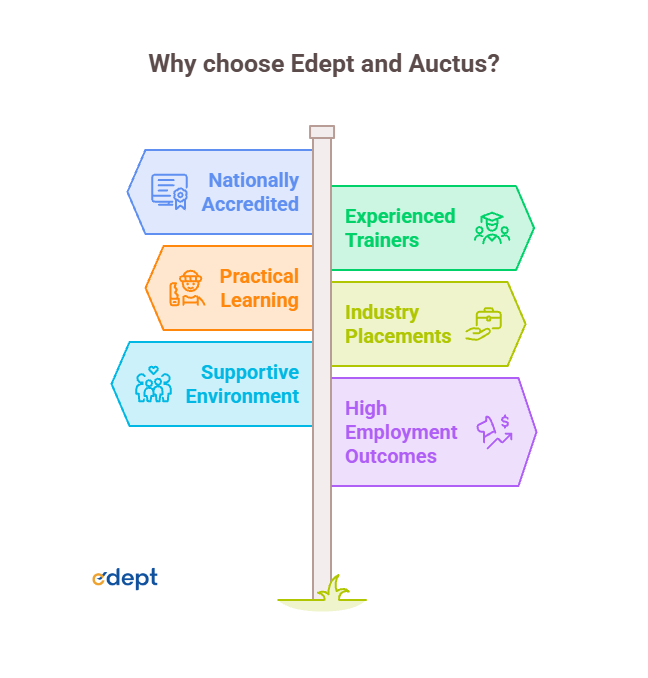
Why Students Choose Edept and Auctus
Nationally Accredited Training Partner
Auctus Training Institute is based right in Australia, and it’s a nationally accredited RTO and CRICOS-registered provider. In plain terms, that means the certificate you earn is officially recognized across Australia, not just something Auctus hands out on its own. edept works closely with Auctus to bring this training to international students, starting with your very first enquiry back home and continuing all the way through to your life in Adelaide. Auctus puts it simply in their own words: they want your time with them to be more than just educational; they want it to be life-changing. That’s not just a slogan. It shows up in how the course is actually taught.
Experienced Trainers
The people teaching you at Auctus aren’t just professionals with only theoretical knowledge. They’ve worked in the field themselves, and they bring real stories and real situations into the classroom. Students who’ve been through the programme talk about this a lot. One graduate, Mirela, said her trainers came with “lots of stories and experiences” and genuinely prepared her for the future. Another student, Ailyn, said the trainers and staff were helpful and friendly from day one. That kind of feedback tells you something important: this isn’t a place where you’re just another face in a big classroom. Trainers notice you, and they care whether you’re actually learning, not just attending.
Practical Learning Approach
Auctus describes their own teaching style as being about workshops, coaching, and mentoring, not sitting through endless lectures. The idea is simple: you learn something, then you practise it in a way that looks like what you’ll actually do on the job. This matters a lot in community services, because the job itself is hands-on. You can’t learn it only from a book.
Real-World Industry Placements
Every level of the course, Certificate III, Certificate IV, and the Diploma, comes with a compulsory work placement. Certificate III students complete 120 hours of placement, and by the time you reach the diploma, you’re doing a minimum of 400 hours, roughly 12 weeks, at an approved workplace. This isn’t something you have to arrange yourself. Auctus and edept organise pre-approved placements with real industry partners, so you walk into a genuine workplace and get real experience before you graduate.
Supportive Learning Environment
Sam Donato, the founder of Auctus, describes their goal as creating “a safe and empowering environment” where students can build real confidence, even in things that once felt out of reach. That’s echoed by students too; several mention feeling comfortable and supported the moment they walked through the doors, not just during class time. On the edept side, support starts even earlier, from your first conversation about studying in Australia, right through your application, your visa process, and settling into life in Adelaide once you arrive. You’re not left to figure things out on your own at any stage.
High Graduate Employment Outcomes
Auctus reports a high placement rate, meaning most graduates find work in their field soon after finishing their course. This lines up with what’s actually happening in Australia right now disability support, aged care, and community services roles are in high demand across the country, and employers are actively looking for qualified people. Certificate III graduates typically move into roles earning around AUD 65,000–75,000 a year; Certificate IV graduates into roles like Disability Team Leader or Community Development Officer, earning AUD 65,000–80,000; and Diploma graduates into leadership roles like Case Manager or Program Coordinator, often earning AUD 80,000–100,000.
Tips to Make the Most of Your First Year
Attend Every Practical Session
You should start attending all practical sessions. Practical sessions are where you build the skills that employers value most. Missing them means missing opportunities to practise, receive feedback, and build confidence.
Participate in Workshops
If you start participating in workshops more actively, it will help you learn more deeply and connect with your peers. You should not be a passive observer; get involved, ask questions, and contribute.
Build Strong Relationships with Trainers
Trainers are your valuable resource for both academic support and honest career advice They can offer advice, placement recommendations, and references. Take your time to connect with them.
Prepare Early for Placements
You should get your documentation, police checks, and NDIS worker screening sorted well ahead of time so nothing delays your placement start. Review relevant policies, and clarify expectations with your placement coordinator.
Develop Professional Communication Skills
You should practise writing emails, case notes, and reports as if you were already in the workplace. The sooner you develop professional habits, the easier your transition to employment will be. You should practise client-facing communication in every workshop opportunity, not just when it’s formally reviewed.
Future Outlook for Community Services Professionals in Australia
The demand for care and support services continues to grow across Australia; the community services sector is becoming an increasingly attractive career choice for many workers wanting meaningful, people-focused jobs. Healthcare alone is expected to grow by 585,000 roles, expanding nearly 26 per cent to become 17.4 per cent of all employment. The demand for community and personal service workers is projected to jump by 341,000 jobs by 2034, pushing the sector’s employment share to its highest on record. The NDIS has also created thousands of new roles that did not exist a decade ago, and Australia’s ageing population continues to drive demand for aged care and home support services.
There is also a clear shift toward community-based care models that keep people out of hospitals and support them to live independently. This creates demand for workers who can coordinate services, support clients in their homes, and work across health and community sectors. The Community Services sector in Australia continues to offer meaningful, long-term career opportunities across aged care, disability, mental health and allied support roles. As demand is growing, employers are looking for professionals with the right skills, training and understanding of person-centred care.
Conclusion
The first year of studying Community Services in Adelaide combines classroom learning with practical skill development, mentoring, and real workplace preparation. You will gain valuable industry exposure through workshops, real-world placements, and continuous support from experienced trainers who understand both the academic requirements and the realities of community work. Your first year is about far more than attending classes. It’s about adjusting to a new education system, understanding how Australia’s community care sector operates, building real workplace skills, and laying the foundation for a career that genuinely makes a difference in people’s lives.
With settlement assistance, practical learning, and strong employment outcomes, edept and Auctus help students confidently transition from education to meaningful careers in Australia’s growing community services sector. Whether your goal is to support individuals with disabilities, work with families in crisis, or eventually progress into clinical care through edept’s nursing programmes, your first year in Adelaide lays the groundwork for a career that matters.