An MCA or Master of Computer Application degree helps students with advanced knowledge of software development, computer systems, databases, networking, and application design. However, in today’s rapidly evolving technology industry, academic knowledge alone is no longer enough to secure high-quality job opportunities. Employers expect graduates to possess practical programming expertise, hands-on project experience, and the ability to work with modern development tools and frameworks. This is why mastering the right MCA programming languages has become essential for students who want to build successful careers in software development. One of the biggest mistakes many students make is focusing only on classroom assignments while overlooking the top programming skills for MCA that companies actively seek during placements. Building expertise in the right MCA programming languages, along with practical projects, version control, and modern frameworks, can make a significant difference during technical interviews. In this guide, we will together discover the most valuable MCA programming languages, understand why they even matter, explore the technologies employers expect you to know, and learn how developing strong programming skills for MCA students can actually improve placement opportunities.
Why Programming Skills Are Critical for MCA Students
In the current environment where competition is stiff within the IT industry, programming skills are not a luxury anymore; rather, they have become a necessity. As employers look forward to seeing practical programming skills among MCA graduates, they require students to acquire problem-solving skills along with practical knowledge of MCA programming languages.
Improve Placement Opportunities
Recruiters prioritize candidates who can write clean, efficient, and scalable code. Mastering MCA programming languages such as Python, Java, JavaScript, and SQL significantly improves MCA placement skills and increases the chances of securing roles in top technology companies.
Build Strong Problem-Solving Ability
Programming promotes logical reasoning and analytical skills as students learn how to decompose difficult problems into more easily managed solutions. Coding skills that are required for MCA enable students to excel in coding tests and software development assignments.
Prepare for Emerging Technologies
AI, Cloud Computing, Data Science, DevOps, and Cybersecurity are some of the technologies that use programming heavily. By acquiring the best programming skills in MCA, students can easily make the shift to these emerging areas of technology.
Meet Industry Hiring Requirements
The current generation of employers is not looking at just theoretical knowledge anymore. What they need are individuals who have knowledge about contemporary programming languages, development frameworks, version control systems, databases, application program interfaces, and software engineering techniques. It is through the knowledge of MCA programming languages and continuous improvement of software development skills that one can become job-ready.
How Recruiters Evaluate Programming Skills
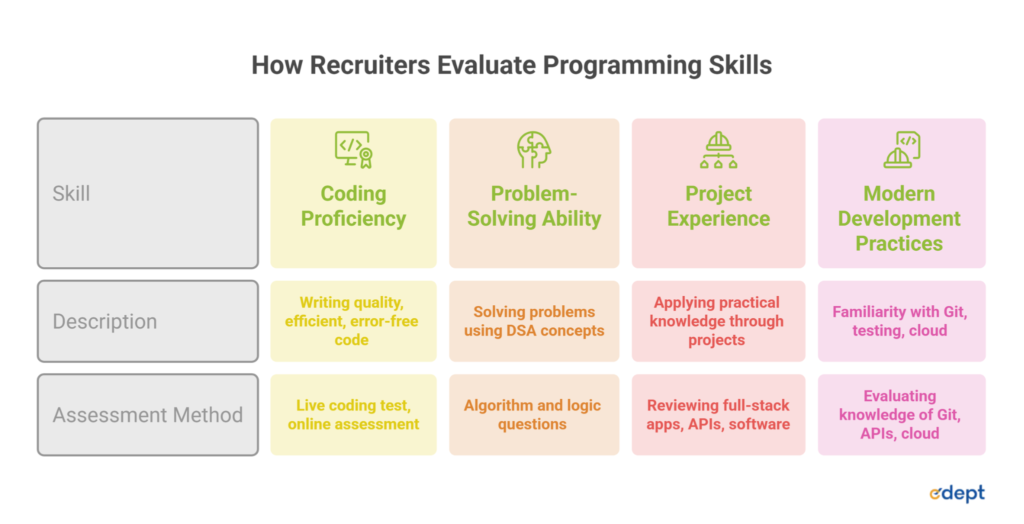
Technical interviews are designed to assess much more than a candidate’s ability to write code. Recruiters want to determine whether MCA graduates can solve real-world problems, build reliable software, and work effectively in modern development environments. Strong knowledge of MCA programming languages, combined with practical experience, significantly improves interview performance and placement success.
Coding Proficiency
The ability of a candidate to write quality, efficient, and error-free code is assessed by recruiters. The candidates are made to give a live coding test or an online coding assessment using any of the MCA programming languages, like Python, Java, JavaScript, or C++.
Problem-Solving Ability
Technical interviews usually involve questions on algorithms and logic in order to judge the level of analysis. The interviewees are required to solve the given problems using concepts of DSA in an effective manner. Problem-solving is one of the key programming skills that MCA students need to have.
Project Experience
Sometimes projects can be worth as much as grades. Employers like people who have made their own full-stack web apps, REST APIs, automation software, and cloud computing solutions. Projects show the application of practical knowledge about MCA programming languages.
Knowledge of Modern Development Practices
Companies also evaluate familiarity with Git, version control, testing, APIs, databases, cloud platforms, and agile development methodologies. Candidates who combine technical expertise with modern development practices possess stronger MCA placement skills and are better prepared to contribute effectively from day one.
Top Programming Skills Every MCA Student Should Learn
Selecting the appropriate programming languages for MCA studies may have a huge impact on your chances of placement as well as the development of your future career. While there is no one programming language that fits all possible career options, having knowledge of several different languages depending on your personal preferences enables you to become a versatile programmer. Here are the best programming skills for MCA students.
| Programming Language | Ease of Learning | Industry Demand | Common Use Cases |
| Python | Easy | Very High | AI, ML, Data Analytics, Automation, Backend |
| Java | Moderate | Very High | Enterprise Software, Banking, Android |
| JavaScript | Easy | Very High | Frontend, Web Applications, Full Stack |
| SQL | Easy | Very High | Database Management, Business Reporting |
| C++ | Moderate | High | System Programming, Competitive Programming |
| C# | Moderate | High | .NET Applications, Desktop Software, Games |
| GO (Golang) | Moderate | Growing | Cloud Computing, Backend Services |
| TypeScript | Moderate | Very High | Enterprise Web Applications, React Projects |
Python
Python is one of the most recommended MCA programming languages because of its simple syntax, versatility, and extensive ecosystem. It is beginner-friendly while being powerful enough for enterprise applications and research. Python is widely used in Artificial Intelligence, Machine Learning, Data Analytics, automation, web development, and cloud computing. Frameworks like Django and Flask make backend development faster, while libraries such as Pandas, NumPy, TensorFlow, and PyTorch support advanced data science and AI applications. MCA students learning Python have various job prospects available to them, such as Python Developer, Data Analyst, Machine Learning Engineer, AI Engineer, Automation Engineer, and Backend Developer. Because of its versatility, Python continues to be one of the most sought-after skills by MCA students.
Java
Java continues to be one of the most trusted MCA programming languages for enterprise software development. Its platform independence, security, and scalability make it the preferred choice for large organizations. Java powers banking systems, enterprise applications, Android development, ERP software, and cloud-native business solutions. Frameworks such as Spring Boot have further increased its popularity for backend development. Learning Java for MCA prepares students for roles including Java Developer, Backend Developer, Software Engineer, Enterprise Application Developer, and Android Developer. As there are numerous Fortune 500 companies that depend on Java, it is always beneficial for future careers.
JavaScript
JavaScript is the foundation of modern web development and one of the most essential MCA programming languages for aspiring Full Stack Developers. Using modern JavaScript (ES6+) enables developers to build highly interactive websites, single-page applications, and dynamic user interfaces. JavaScript works seamlessly with frameworks such as React, Angular, Vue.js, and backend platforms like Node.js, making it indispensable for full-stack development. Students with strong JavaScript knowledge can pursue careers as Frontend Developer, Full Stack Developer, Web Developer, and UI Engineer. Learning JavaScript also strengthens overall software development skills required in today’s technology industry.
SQL
SQL (Structured Query Language) is one of the few MCA programming languages that every software professional should understand. Almost every modern application relies on databases to store and retrieve information efficiently. SQL is used for querying databases, generating reports, data analysis, and database management. It forms the backbone of enterprise software, business intelligence, and analytics platforms. Professionals skilled in SQL can work as Database Developers, Data Analysts, Business Intelligence Analysts, Software Engineers, and Backend Developers. Strong SQL knowledge also complements other programming languages for software developers.
C++
C++ is a very good platform for learning programming fundamentals and programming optimization. It allows the student to think logically, manage memory, and apply algorithms to solve problems. C++ is commonly used in operating systems, embedded systems, game engines, high-performance applications, and competitive programming. Its low-level capabilities make it valuable for understanding how software interacts with hardware. Proficient students in C++ usually join the fields of Software Engineer, System Programmer, Embedded Systems Developer, and Game Developer. C++ is also very helpful for students of MCA who are getting ready for their technical interviews.
C#
C# is a modern object-oriented programming language developed by Microsoft and is widely used within the .NET ecosystem. It supports enterprise software development, desktop applications, web applications, cloud solutions, and game development through Unity. As Microsoft continues expanding Azure and .NET technologies, C# remains one of the valuable MCA programming languages for enterprise careers. Learning C# provides opportunities to build scalable business applications while working with Microsoft’s enterprise technologies. Professionals skilled in C# can pursue roles such as .NET Developer, Software Engineer, Cloud Developer, and Game Developer.
Go (Golang)
Go, commonly known as Golang, is a modern programming language designed for simplicity, concurrency, and high performance. It has become increasingly popular for developing cloud-native applications, distributed systems, APIs, and microservices. Learning Go prepares students for careers as Backend Developer, Cloud Engineer, Site Reliability Engineer (SRE), and DevOps Engineer, making it one of the fastest-growing programming languages for software developers. Companies such as Google, Uber, and Docker actively use Go for backend infrastructure due to its efficiency and scalability. Professionals with Go expertise are increasingly hired for cloud engineering and backend development roles.
TypeScript
TypeScript is a superset of JavaScript that introduces static typing, better tooling, and improved maintainability for large-scale applications. It has become the preferred language for enterprise frontend development. Students studying TypeScript will be able to opt for jobs such as Front-end Developer, Full Stack Developer, React Developer, and Software Engineer. With increasing complexity in enterprise web applications, TypeScript has emerged as one of the most important MCA programming languages.
Programming Frameworks Every MCA Student Should Know
Knowledge of programming languages is just a starting point. It is also expected that students can comprehend frameworks that make the work easier, increase efficiency, and help develop scalable real-life applications. Learning frameworks along with MCA programming languages will boost your resume and MCA placement chances.
Django
Django is a Python framework that is employed to create robust web applications using high-level Python programming. Django employs a batteries-included paradigm in its design, with built-in functionalities for authentication, database handling, and security. The framework is a good choice for creating backend applications for MCA Python learning students.
Spring Boot
Spring Boot framework is one of the most popular frameworks available for developing Java-based enterprise-level applications. The Spring Boot framework helps in developing microservices, REST APIs, and cloud applications in an easy manner without getting into much configuration hassles. Spring Boot learning will complement Java for MCA.
React
React is an extremely popular framework used for writing highly interactive, fast, and reusable UIs using the JavaScript language. React has become an integral part of many contemporary web applications. In conjunction with modern JavaScript (ES6+), TypeScript,t and other tools, React is one of the most valuable MCA programming languages ecosystem skills.
Node.js
Node.js allows programmers to develop quick and scalable applications at the server side by using JavaScript. It is commonly employed for developing REST APIs, real-time apps, and microservices. Learning both Node.js and React will make students full-stack developers and enhance their programming skills.
.NET
Microsoft’s .NET framework, with its backbone language C #, is commonly used for enterprise software development, desktop application development, cloud services, and APIs. .NET is easily integratable with Microsoft Azure, and helps in building high-performing, secure business applications. Learning .NET will open up great career opportunities in enterprise software development for students. By learning these frameworks alongside core MCA programming languages, students gain practical development experience that recruiters actively look for in technical interviews. Framework expertise demonstrates the ability to build production-ready applications, making candidates more competitive for internships, placements, and software engineering roles.
Programming Concepts Beyond Languages
Mastering MCA programming languages is essential, but programming languages alone are not enough to become an industry-ready software developer. Recruiters expect MCA graduates to understand the core concepts that support software design, application development, debugging, and collaboration. Building these technical foundations significantly strengthens coding skills for MCA, improves MCA placement skills, and prepares students for real-world software engineering challenges.
Data Structures and Algorithms (DSA)
Data Structures & Algorithms (DSA) are the crux of programming interviews. DSA prepares students to find solutions by reducing time and space complexity in solving problems. Questions based on arrays, linked lists, trees, graphs, stacks, queues, recursion, sorting, and dynamic programming are common in recruitment interviews. Knowledge of DSA is important along with MCA programming languages.
Object-Oriented Programming (OOP)]
Object-oriented programming enables developers to develop modular, flexible, and maintainable applications. Important concepts like encapsulation, inheritance, polymorphism, and abstraction form an integral part of many programming languages such as Java, C++, C#, and Python. Knowledge of OOP is an added advantage as it provides an edge to students while developing enterprise applications.
Database Design
Almost all applications make use of good database design. Relational database design, normalization, indexing, SQL queries, and data modeling skills allow students to create effective and efficient applications. Database design is an essential aspect of the course, irrespective of the programming languages of MCA.
REST APIs
Today’s applications are integrated using REST APIs. Gaining knowledge on how to build, create, use, and test APIs enables students to integrate the frontend and backend systems successfully. REST API development is an essential skill in web development, mobile applications, cloud services, and microservices.
Version Control with GIT
Git is the benchmark tool for version control and collaborating on software projects. It allows coders to keep track of modifications, deal with branching and conflict resolution, and collaborate effectively on platforms such as GitHub and GitLab. Git is one of the most valued skills in MCA placements since recruiters ask for Git experience.
Software Testing Basics
Writing code is only part of software development; ensuring its reliability is equally important. Understanding unit testing, integration testing, debugging, and basic test automation helps developers identify defects early and improve software quality. Knowledge of testing practices complements programming languages for software developers and demonstrates a professional approach to building robust, production-ready applications.
Read more: MCA Specializations for Better Placements
Emerging Technologies MCA Students Should Learn
The technology industry is evolving rapidly, and programming has become the foundation for every emerging domain. While mastering MCA programming languages is essential, students should also understand how these languages are applied in cutting-edge technologies. Building expertise in these areas not only enhances software development skills but also improves MCA placement skills and opens doors to high-growth career opportunities.
Artificial Intelligence
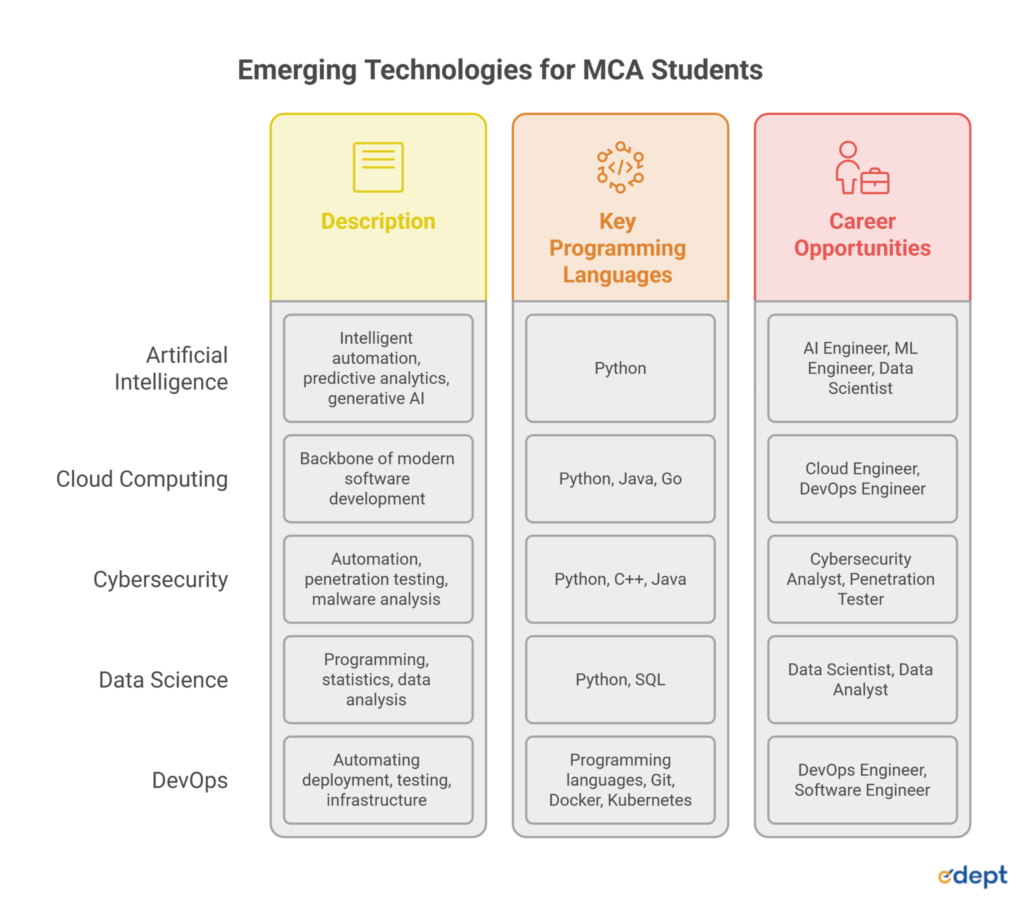
Artificial Intelligence (AI) is revolutionizing businesses using intelligent automation, predictive analytics, and generative AI. Technologies such as Python are essential in building machine learning algorithms, computer vision techniques, and natural language processing programs. Studying AI along with MCA programming languages will help prepare for jobs such as those of an AI Engineer, Machine Learning Engineer, and Data Scientist.
Cloud Computing
Cloud Computing has become the backbone of modern software development. Programming languages like Python, Java, and Go are widely used to build cloud-native applications, microservices, APIs, and serverless solutions. Understanding cloud platforms such as AWS, Microsoft Azure, and Google Cloud significantly strengthens coding skills for MCA and improves career prospects.
Cybersecurity
Cybersecurity professionals rely heavily on programming for automation, penetration testing, malware analysis, and security tool development. Python, C++, and Java are commonly used to build secure applications and identify vulnerabilities, making cybersecurity an exciting career option for students interested in secure software development.
Data Science
Data Science combines programming, statistics, and data analysis to extract valuable business insights. Python and SQL are among the most important MCA programming languages in this field, supporting data visualization, predictive modeling, and business intelligence across industries.
DevOps
DevOps bridges software development and IT operations by automating application deployment, testing, and infrastructure management. Developers use programming languages along with tools such as Git, Docker, Kubernetes, and CI/CD pipelines to build scalable software delivery processes. Learning DevOps complements overall software development skills and prepares students for modern software engineering roles.
Best Programming Skills Based on Career Goals
Choosing the right MCA programming languages depends on the career path you want to pursue. While learning multiple languages is beneficial, focusing on those aligned with your goals helps you build relevant expertise, strengthen MCA placement skills, and improve your chances of securing specialized roles.
Software Development → Java + JavaScript
Java and JavaScript can be considered a perfect combination for those who are looking to specialize in software engineering. While Java is extensively used in developing enterprise applications, JavaScript makes modern web development possible.
AI and Machine Learning → Python
For Artificial Intelligence, Machine Learning, Data Science, and automation purposes, Python is the programming language to use. For students specializing in these fields, Python for MCA students will be an excellent choice.
Cloud Computing → Python + Go
The Python language is widely used in automating tasks, while Go (Golang) gains more popularity for developing cloud-native applications, APIs, and microservices. This combination is ideal for those specializing in cloud computing.
Cybersecurity → Python + C++
The combination of Python and C++ is ideal for cybersecurity specialization. The first of these languages is useful for scripting and security automation, while the second allows understanding of low-level programming.
Full Stack Development → JavaScript + Node.js + React
Those students who are considering specialization in full-stack development should know JavaScript, Node.js, and React. It will help them create responsive frontends and scalable backends.
Salary Outlook Based on Programming Skills
| Programming Skill | Entry-Level Salary | Global Demand | Career Growth |
| Python | ₹6–10 LPA | Very High | Excellent |
| Java | ₹5–9 LPA | High | Excellent |
| JavaScript | ₹5–9 LPA | Very High | Excellent |
| SQL | ₹4–8 LPA | Very High | High |
| Go (Golang) | ₹8–14 LPA | Growing | Excellent |
The choice of MCA programming languages you will pursue will affect your job prospects and salary potential to a great extent. Technologies like Python, Java, JavaScript, SQL, and Go are some of the most in-demand technologies since they drive applications related to software development, Artificial Intelligence, cloud computing, data analysis, and enterprise-level applications. Proficiency in these technologies improves your programming skills, helps you enhance your MCA placement skills, and makes you eligible for high-paying jobs in the IT industry. Salaries depend upon various parameters such as location, experience level, size of the organization, technical skills, certification, and quality of projects. Students who excel in programming concepts along with their application in modern frameworks and projects will definitely earn better-paying positions in the IT industry.
Common Programming Mistakes MCA Students Make
Though many students put considerable effort into studying MCA programming languages, they still face difficulties in their placements due to learning errors. Overcoming such problems will not only enhance your skills in coding for MCA but also help you advance faster in your career as a software developer.
Learning Too Many Languages at Once
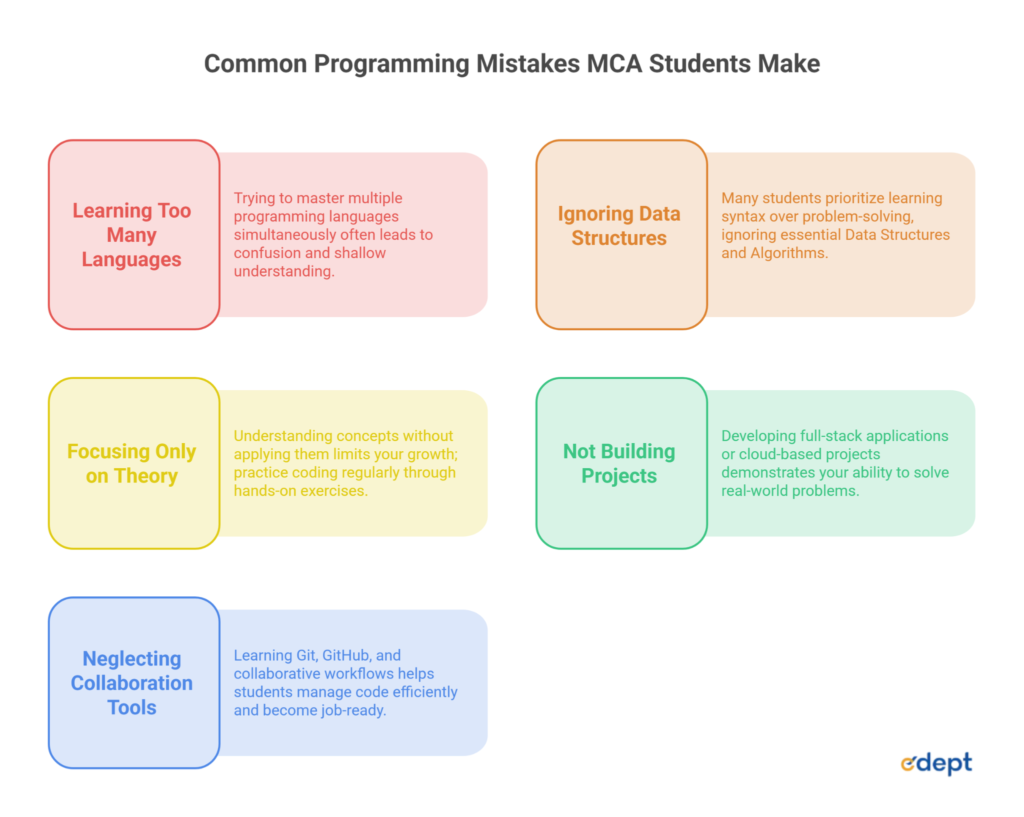
Trying to master multiple programming languages simultaneously often leads to confusion and shallow understanding. Instead, focus on one core language, build strong fundamentals, and gradually expand your skill set based on your career goals.
Ignoring Data Structures and Algorithms
Many students prioritize learning syntax over problem-solving. However, Data Structures and Algorithms (DSA) are heavily tested in technical interviews and are essential for developing efficient software solutions.
Focusing Only on Theory
Understanding concepts without applying them limits your growth. Practice coding regularly and implement what you learn through hands-on exercises to build practical software development skills.
Not Building Real Projects
Recruiters value practical experience as much as academic knowledge. Developing full-stack applications, automation tools, or cloud-based projects using MCA programming languages demonstrates your ability to solve real-world problems and significantly improves your portfolio.
Neglecting Git and Collaboration Tools
Version control is a fundamental industry skill. Learning Git, GitHub, and collaborative development workflows helps students manage code efficiently, contribute to team projects, and become job-ready software developers.
How MCA Students Can Improve Programming Skills
Improving your programming abilities requires more than learning syntax—it demands consistency, practical experience, and continuous problem-solving. Along with mastering MCA programming languages, students should focus on developing real-world software development skills that employers value during placements.
Practice Daily Coding
Dedicate some time to coding on a daily basis. This will help improve your logical reasoning skills, debugging techniques, and increase confidence while working on various MCA programming languages.
Solve Coding Challenges
Practice on platforms such as LeetCode, HackerRank, CodeChef, and Codeforces. Solving coding challenges improves algorithmic thinking, strengthens DSA concepts, and enhances coding skills for MCA students preparing for technical interviews.
Build Portfolio Projects
Develop real-life projects like e-commerce sites, RESTful APIs, chat systems, automation systems, or cloud computing systems. This will not only demonstrate your software development abilities but will also be immensely helpful for MCA placements.
Contribute to Open-Source Projects
Getting involved in open-source projects will help you interact with skilled professionals, learn industry-standard practices, and build a powerful GitHub profile.
Participate in Hackathons
Hackathons encourage innovation, teamwork, and rapid problem-solving while giving you exposure to real-world development challenges and networking opportunities.
Prepare for Technical Interviews
Revise Data Structures and Algorithms (DSA), Object-Oriented Programming (OOP), SQL, operating systems, and core MCA programming languages. Consistent interview preparation, combined with practical project experience, greatly increases your chances of securing top software development roles.
Certifications That Complement Programming Skills
Certifications are a great way to validate your knowledge and strengthen your resume, especially when combined with strong MCA programming languages and hands-on project experience. While certifications demonstrate your commitment to learning, recruiters generally value practical software development skills and real-world problem-solving abilities more than certificates alone. The ideal approach is to combine certifications with a strong GitHub portfolio and industry-relevant projects.
Python Certifications
Python certifications from platforms like the Python Institute, Coursera, and Microsoft help validate your programming fundamentals. They are particularly beneficial for students interested in AI, Machine Learning, Data Science, automation, and backend development, making them a valuable addition for Python for MCA students.
Java Certifications
Oracle’s Java certifications are widely recognized in the industry and demonstrate expertise in Java programming and enterprise application development. They complement Java for MCA and improve opportunities in software engineering and backend development.
Cloud Certifications
Cloud certifications like AWS Certified Cloud Practitioner, Microsoft Azure Fundamentals (AZ-900), and Google Cloud Digital Leader provide proof of cloud computing skills to equip students with the skills needed for contemporary software development and cloud jobs.
Full Stack Development Certifications
Certifications on React, Node.js, JavaScript, Databases, and RESTful API will help the students develop full-stack web development skills that will be very helpful for placements in MCA and as Full Stack Developers.
AI and Data Analytics Certifications
Artificial Intelligence, Machine Learning, and Data Analytics certifications show knowledge of new-age technologies. In combination with MCA programming language skills and problem-solving skills, these certifications give a competitive edge to students in the present-day technology industry.
Why Choose edept for MCA Career Preparation
Success in today’s technology industry requires more than academic knowledge of MCA programming languages. Employers seek graduates who can build real-world applications, collaborate on industry projects, and adapt to emerging technologies. edept focuses on practical, career-oriented learning that helps students develop job-ready software development skills through hands-on experience, industry partnerships, and exposure to modern technologies.
Industry-Aligned Curriculum
The courses offered at edept cater to the existing needs of the industry in areas such as programming, full-stack development, Artificial Intelligence, Data Analytics, Cloud Computing, and Cybersecurity. Students learn competencies that are relevant to the technology jobs of today, not just theory.
Hands-On Programming Projects
The real-life projects, international capstone experiences, and industry immersion programs prepare students for MCA placement skills through projects that are similar to professional software development projects and thus help them build a strong portfolio.
Exposure to AI, Cloud, and Cybersecurity
In partnerships with companies like IBM, Deloitte, HEX, and Practera, students get exposure to areas of AI, cloud computing, cybersecurity, digital transformation, and international industry projects. This helps learners use MCA programming languages in real-world business situations and acquire industry certifications.
Placement-Oriented Skill Development
Coding skills, technical interview preparation, effective communication, collaborative development, and problem-solving are all emphasized in edept, along with hands-on experience and industry exposure. This placement-centric approach provides the necessary software development skills to MCA students.
Step-by-Step Roadmap to Become an Industry-Ready MCA Graduate
Not only does one require expertise in programming languages of the MCA, but being a software professional demands having good technical skills and experience. This will not only help you get placements but also build your career in the long run.
Master One Core Programming Language
Start learning one programming language like Python or Java and build up a good base before moving forward to learn more MCA programming languages.
Learn DSA and OOP
Master Data Structures and Algorithms (DSA) and Object-Oriented Programming (OOP). DSA and OOP are the basic concepts required for interviews and real-life software development.
Build Full-Stack Projects
Implement end-to-end projects using modern technologies like React, Node.js, Spring Boot, or Django. End-to-end projects will help you prove your software development skills and will add value to your resume.
Learn Cloud and DevOps Basics
Have a good understanding of cloud platforms like AWS, Azure, or Google Cloud, as well as technologies like Git, Docker, Kubernetes, and Continuous Integration and Continuous Delivery (CI/CD).
Earn Relevant Certifications
Validate your knowledge through certifications in programming, cloud computing, full-stack development, or AI. Certifications enhance your profile but should always be supported by practical experience.
Create a Strong GitHub Portfolio
Maintain an active GitHub profile showcasing clean code, well-documented projects, and contributions to open-source repositories. A strong portfolio reflects your practical expertise with MCA programming languages.
Prepare for Placement Interviews
Practice coding regularly, revise DSA, OOP, SQL, databases, operating systems, and system design basics. Combining strong technical knowledge with practical projects and interview preparation will help you build excellent MCA placement skills and secure opportunities at leading technology companies.
Future Outlook: Programming Skills Beyond 2030
In conclusion, the future of software development will be impacted by AI, cloud computing, automation, and constantly changing technology. Although future developments in the form of new tools will make coding easier, there will still be an increased need for software development professionals who possess knowledge of MCA programming languages. The key to success lies in developing technical competence and becoming a lifelong learner.
AI-Assisted Development Will Increase
Programming assistants that use AI technology will be able to automate the mundane coding tasks, giving programmers time to work on scaling solutions, problem-solving, and creating innovative ideas.
Cloud-Native Programming Will Become Standard
Developers will also build more cloud-native applications as organizations move to cloud technology. Cloud knowledge will be a critical requirement in the development of software.
Secure Coding Will Gain Importance
Due to the increasing number of cyberattacks, companies will value developers who can create secure code, protect sensitive information, and incorporate security best practices into the software development process.
Full-Stack Developers Will Stay in High Demand
Companies will be hiring candidates who can develop in all areas like frontend, backend, database, APIs, and cloud infrastructure. Knowing several MCA programming languages and frameworks will make a great career path.
Continuous Learning Will Be Essential
Technology changes very quickly, so continuous learning is important. Developers who constantly develop their knowledge in software development, discover new technologies, and adjust to changes in the IT industry will have good MCA placement skills and succeed in the technology sector worldwide.
Conclusion
Learning the appropriate MCA programming languages is another crucial aspect that MCA students must learn in order to have a successful career in the field of technology. Languages like Python, Java, JavaScript, SQL, and Go have continued to be some of the most important languages for software development, Artificial Intelligence, cloud computing, data analysis, and enterprise applications. Nonetheless, technical knowledge is not everything. Students must learn programming along with hands-on development experience and Data Structures & Algorithms (DSA), among other aspects. Acquiring a GitHub portfolio, getting relevant certifications, taking part in hackathons, and continuous learning on various technologies may help enhance the MCA placement skills of the students. With the changing technologies, organizations will require employees who can adapt to new technologies and solve business problems. It means that the more skills an MCA student acquires in software development and continuous enhancement of MCA programming languages, the better placement and salary they are likely to get in the global technology industry.
Related Links:
| Tools every CS and Design students should learn | Top Business Analytics Careers to pursue |
| MCA Specialization for Better Placements | What is Artificial Intelligence? |