Digital Transformation is reshaping every industry at an unprecedented pace. Markets are shifting, customer behavior is evolving, and technology is redefining competitive advantage across sectors. From startups to global enterprises, organizations are rethinking how they operate, engage customers, and generate value in a hyper-connected world. Traditional business models are no longer enough to sustain growth. Leaders must now understand digital ecosystems, data intelligence, and automation-driven efficiency to remain relevant. As we move deeper into 2026, clarity around digital transformation is not just beneficial — it is essential for survival, scalability, and long-term strategic leadership in an increasingly digital economy.
Introduction
Companies no longer compete at the local level; they compete online in a rapidly globalized, fast-moving, data-driven economy. The use of artificial intelligence, automation, cloud computing, and advanced analytics fundamentally transforms the way organizations are run and create value. It is in this space that leaders need to clearly grasp what digital transformation means and why it becomes the determinant of the competitive advantage in 2026. Digital transformation is no longer a strategic initiative of long-term innovations; it is a survival plan. The customers desire quick service, individualized experiences, smooth online experiences, and secure transactions. Meanwhile, competitors with AI are growing bigger with less efficient operations and intelligent decision-making. Those companies that are not adaptable may lose efficiency, agility, and relevance in the market. In the case of business managers, the sense of urgency is evident. Digital transformation is more than just implementing the use of new software tools; it is a process that involves reevaluating the process, redefining customer interactions, and cultivating a culture that embraces ongoing innovation. The managers who will be successful in 2026 will be those who can not only think with strategic business in mind but also be highly digital to steer their organizations into the future, which will be technology-driven.
What is Digital Transformation?
Digital transformation is the integration of digital technologies into all areas of a business to change operations, customer experience, and value delivery fundamentally. It goes far beyond simply installing new software or upgrading IT systems. True digital transformation reshapes how a company thinks, operates, competes, and grows in a digital-first world. It is not just about technology adoption — it involves process redesign, cultural change, and data-driven decision-making at every level of the organization. Businesses must rethink workflows, eliminate manual inefficiencies, empower teams with real-time analytics, and create customer-centric digital experiences. Most importantly, digital transformation is continuous innovation, not a one-time project. Organizations must constantly evolve as technologies and markets shift. To understand it clearly, it helps to distinguish related terms. Digitization means converting analog information into digital form, such as scanning paper records. Digitalization refers to using digital tools to improve existing processes, like automating payroll. Digital transformation, however, reimagines entire business models — such as shifting from physical retail to an integrated omnichannel e-commerce ecosystem. Real-world business digital transformation examples include banks adopting AI-powered fraud detection, retailers using predictive analytics for inventory management, and manufacturers implementing IoT-enabled smart supply chains. These changes do not just improve efficiency — they redefine how businesses create and deliver value.
Why Digital Transformation Matters in 2026
In today’s world, digital transformation is taking over the world, and 2026 will be known as the breakthrough year. With advancements in technology, customers’ expectations are rising too. According to the Salesforce State of the Connected Customer Report, 73% of consumers expect companies to understand their needs and plan their future decisions according to their preferences. Organizations are integrating AI in their workflow at a high rate, with AI-driven competition accelerating rapidly. According to McKinsey’s Global AI Survey, 65% of organizations are already using generative AI regularly in at least one business function. Companies that have integrated AI in their working environment are showing steep growth in their gains in comparison to those that are still not using it. This shift has intensified competition pressure across industries. Cloud adoption is also on the rise among organizations in the current context. Gartner reported that more than 85% of enterprises now follow a cloud-first principle, thus reshaping the IT infrastructure strategies. Also, companies that rely heavily on cloud and hybrid workforce models are using cloud technologies to stay ahead of their rivals. Looking at the digital transformation trends in 2026, cybersecurity risks are also exploding at a dangerous rate. IBM’s Cost of a Data Breach Report 2024 found that the global average data breach cost reached $4.45 million, increasing the need for efficient cybersecurity systems alongside digital transformation strategies. Digital transformation is also showing an increasing trend in global e-commerce expansion. According to Statista, global e-commerce sales surpassed $6.3 trillion in 2024, showing how digital marketplaces are ruling revenue channels. These points show digital transformation trends 2026, technology integration is no longer just a trial and error thing, it is now a core to stay competitive, resilient, and for long-term growth.
Also read: Role Of Technology in Modern Higher Education
Key Technologies Driving Digital Transformation
Let’s discuss some key technological advancements in today’s world that are driving digital transformation in 2026.
-
Artificial Intelligence (AI)
In current times, Artificial Intelligence stands as the core of modern digital transformation strategy. AI allows predictive analytics to facilitate business in forecasting demand, mitigating operational risks, and optimizing decisions. Chatbots using AI serve as an improved alternative to human customer service workers since they offer round-the-clock, immediate replies and alleviate the work pressure on the human employees. Machine learning enhances the efficiency of finance, human resources, and supply chains. Since it could be used to detect fraud in banking to the use of recommendation engines in e-commerce, AI is changing organizational value creation and competitive capability in digitally motivated markets.
-
Cloud Computing
Cloud computing acts as the backbone of infrastructure digital transformation in businesses. It offers scalability, allowing organizations to expand resources without heavy capital investment. SaaS (Software-as-a-Service) solutions streamline operations through subscription-based applications for CRM, ERP, and analytics. Cloud platforms also support remote and hybrid collaboration through shared work environments and secure access systems. Another benefit of using cloud-based ecosystems is having improved agility, allowing businesses to innovate quickly while maintaining operational flexibility.
-
Big Data & Analytics
Big Data and analytics help organizations to transform large amounts of information into strategic insights. The real-time data processing helps organizations make decisions more quickly in departments like marketing, operations, and finance. Rare analytics reveal the behavioral patterns of the customers, enhancing the personalization and retention efforts. Companies that take advantage of the ability of data dashboards and predictive analytics can react to market changes in advance. The future of data-driven intelligence has become a mandatory part of the competitive advantage and performance optimization in 2026.
-
Internet of Things (IoT)
The Internet of Things interlinks devices, sensors, and systems to produce actionable data on operation. IoT is used in manufacturing and logistics to create intelligent supply chains that are tracked in real-time, for inventory maintenance, and for predictive maintenance. Smart devices enhance efficiency in retail, health, and smart cities. When combined with analytics platforms, IoT enables companies to have greater operational visibility and minimize downtimes. IoT enhances digital ecosystems through physical adaptations to digital intelligence.
-
Blockchain
The blockchain technology improves trust and transparency in digital transactions. It offers resistant record keeping, which is secure and cannot be tampered with by hackers, minimizing fraud risks in the finance and supply chain management. Smart contracts are automated and eliminate middlemen, making contracts more efficient and accountable. In addition to cryptocurrencies, blockchain can facilitate identity checks, compliance monitoring, and transparent audit systems. The decentralized design enhances data protection in sophisticated online settings.
-
Cybersecurity Systems
With the growth of digital transformation, cybersecurity systems take a central position in today’s digital transformation landscape. Zero-trust security frameworks make sure that all access requests are validated to reduce internal and external risks. Digital risk management frameworks aid organizations in revealing their vulnerabilities prior to exploitation. Threat detection systems are advanced and employ AI to track the presence of an anomaly in real time. Effective cybersecurity implementation will help to make sure that innovation does not affect data protection, and therefore, secure transformation can be considered sustainable and resilient.
Role of Business Managers in Digital Transformation
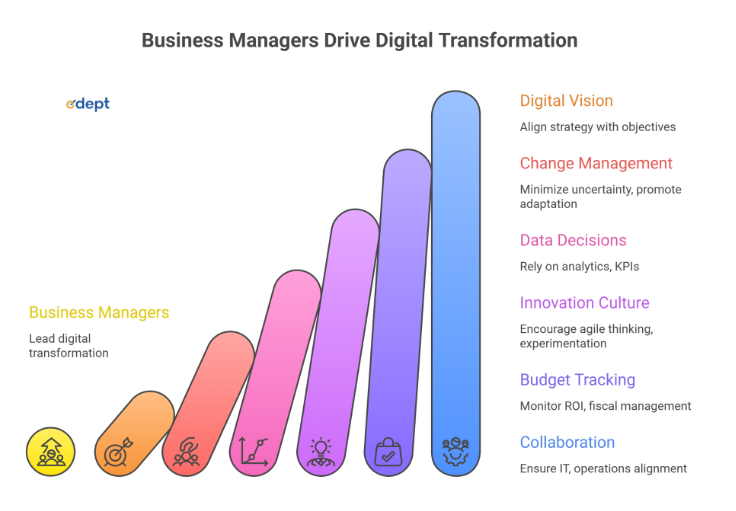
The success of digital transformation in business now depends more on leadership and less on technology in 2026. Business managers are no longer just operational supervisors, it is now leading the digital ecosystems. When IT teams are putting systems in place, managers set the course, make adoption mandatory, and assess influence. McKinsey’s (2024) research indicates that transformation initiatives are 1.8 times more likely to become successful when senior managers are the leaders of the initiative. This underscores a very basic fact that digital transformation is a leadership task. This really shows how organizations rely heavily on business managers in the current digital transformation. Let’s look at some important tasks that a business manager should look over.
-
Drive Digital Vision
Managers must align the digital transformation strategy with core business objectives. Technology must aid in raising revenue, improving efficiency in operations, retaining customers, or expanding the market. Having a definite digital vision means that investments are not made in reaction to something. Leaders must communicate how AI, automation, and analytics contribute to long-term competitive positioning in 2026’s digital economy.
-
Lead Change Management
The resistance to change is also one of the greatest barriers to transformation. Managers should also be involved in minimizing uncertainty by clarifying the advantages of new systems and processes. According to the World Economic Forum, almost half of the workers will require reskilling because of the changes in technology. Managers must invest in training, promote the ability to adapt, and establish psychological safety throughout transitions.
-
Data-Driven Decision Making
Modern managers rely on using dashboards, analytics tools, and real-time KPIs as opposed to relying on intuition. Decision-making based on data enhances accuracy in forecasting, cost-control, and targeting customers. Leaders who use analytics in the day-to-day processes build quantifiable productivity and performance improvements.
-
Foster Innovation Culture
Digital transformation requires experimentation. Managers must encourage agile thinking, pilot testing, and iterative improvement. An innovation-friendly environment allows teams to test AI tools, automation workflows, and digital customer experiences without fear of failure. In 2026, agility defines competitive advantage.
-
Budget Allocation & ROI Tracking
Change programs must have strict fiscal management. Managers need to distribute budgets rationally and monitor ROI by measuring it by such indicators as automation rate, reduction of customer acquisition costs, and increase in revenues using digital channels. Evaluation of impact makes sure that the transformation is value-driven.
-
Cross-Department Collaboration
Effective change requires harmony between IT, operations, marketing, and finance. Managers are intermediaries because they make sure that technology initiatives align with the operational processes and customer strategies. Cross-functional cooperation discourages individual execution and optimizes digital maturity. By 2026, business managers who have a mastery of both business and digital literacy will be in a position to transform successfully and achieve the organization’s long-term growth.
Digital Transformation Strategy Framework for 2026
To implement a digital transformation strategy successfully in 2026, a business-centered strategy has to be structured, measurable, and aligned to business. When organizations approach transformation as a gradual process and not a single upgrade, the long-term outcomes will be more successful. The following is a practical step-by-step model that managers can use.
-
Assess Current Digital Maturity
Begin by evaluating existing digital capabilities, infrastructure, and workflows. Identify technology gaps, data silos, process inefficiencies, and cybersecurity vulnerabilities. A digital maturity assessment provides clarity on where the organization stands and what must evolve.
-
Define business goals.
The change process must be linked to quantifiable business results. Whether it is the goal of customer retention, lowering operational expenses, increasing supply chain visibility, or broadening digital revenue streams, clarity helps avoid the use of technology to make decisions without a strategic approach.
-
Choose relevant technologies
Choose the technologies according to the business requirements, but not according to the trends. The operational efficiency and customer experience improvement should be directly supported through AI, cloud computing, automation platforms, analytics tools, or cybersecurity systems.
-
Invest in talent and training.
Technology in itself is not a transformation driver. Employee adoption can be achieved by upskilling them in data literacy, automation tools, and digital collaboration platforms. Leadership must focus on continuous learning in bridging the skills gap.
-
Implement pilot projects.
Start small with controlled pilot programs. Testing AI-driven automation in one department or digitizing a single workflow reduces risk and generates measurable insights before enterprise-wide rollout.
-
Monitor KPIs.
Measure the performance based on specific KPIs: customer retention rate, cost reduction percentage, rate of process automation, uptime of the system, and contribution to digital revenue. Live dashboards enhance transparency and responsibility.
-
Scale gradually.
Get bigger initiatives going after piloting success. The keys to sustainable development, with ensuring that the organization is not overloaded, are the constant check-in and optimization of its growth. A managed digital transformation strategy can allow 2026 business entities to be innovative and remain in charge of operations and quantifiable contributions.
Common Challenges in Digital Transformation
Digital transformation of business, in spite of its strategic value, is faced with some practical challenges. Implementation cost is high, which may burden the budget, particularly when investing in AI systems, cloud infrastructure, and cybersecurity upgrades. Nevertheless, gradual launches and pilot projects can be utilized to contain the costs and have a quantified ROI.
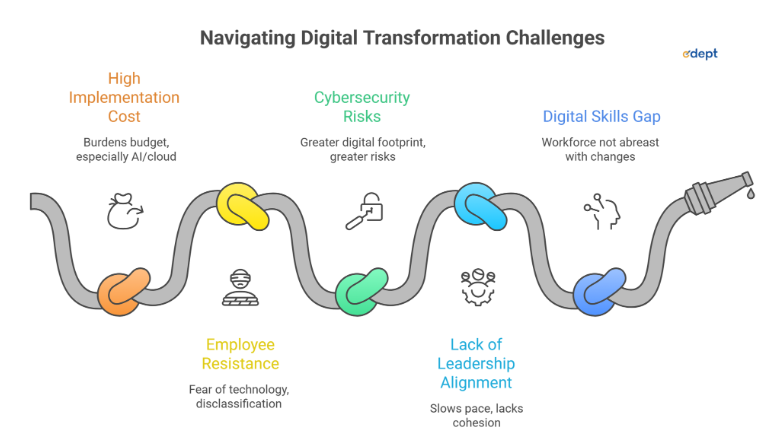
Another typical impediment is the resistance of employees, which is usually fueled by a sense of fear of technologies or disclassification. Effective communication strategies, organized training sessions, and transparency of leaders help a great deal to decrease resistance and increase the adoption rates. The greater the organizations become digital, the greater the cybersecurity risks. The establishment of zero-trust systems, frequent audits, and effective digital risk management systems will guarantee safe transformation. There may be no leadership alignment; this may slow the pace. Top-level transparency and inter-functional cooperation generate cohesion. Finally, the barrier of the digital skills gap is also a serious issue. In order to ensure that the workforce is abreast with the changes in technology, investments in ongoing learning, certification, and in-house upskilling must be made. These problems can be considered stepping stones and not roadblocks when addressed early enough.
Future Trends in Digital Transformation (2026 & Beyond)
The digital transformation trend is no longer an experiment because organizations are moving towards full integration as the organization continues into the year 2026. The new trend is AI-first enterprises, meaning the adoption of artificial intelligence into the core aspect of decision-making, operations, and interaction with customers rather than an auxiliary one. AI, robotics, and advanced analytics are automating all operations, supply chains, manufacturing, and service deliveries. Customer experience is being hyper-personalized, and companies are using real-time data to customize their products, marketing, and interactions on an individual level. Industry 5.0 is also coming up and focuses more on human beings working with intelligent machines to improve creativity and efficiency, and not to substitute human roles. Sustainable digital practices are gaining priority as organizations integrate energy-efficient data centers, green cloud infrastructure, and responsible AI governance. The future of digital transformation in business will be defined by intelligent automation, ethical innovation, and long-term resilience.
Final words: Leading the Digital Evolution Beyond Technologies
Digital transformation is a strategic and not just technical change. It touches on redefining how organizations generate value, compete, and expand in a more digital economy. It is managers with knowledge about digital ecosystems (AI and cloud, data analytics, and cybersecurity) that will spearhead markets with no hesitation. In 2026, leadership requires a hybrid capability, having high business acumen while being a technology expert. Knowing what digital transformation is, it allows managers to use tools and look at the long-term effect. Organizations that align strategy, culture, and innovation will not just adapt to change — they will shape the future of their industries.
Related Links:
Top 10 Emerging Cybersecurity Trends to Watch in 2026 |
Top In-Demand Skills for 2026 and Beyond |
How AI, ML, and Data Science are Reshaping Management Roles |
Secure Coding Practices to Follow in 2026 |