Few countries have digitised as fast as India, and fewer still have done it at this scale. In 2025, UPI completed 228.5 billion transactions by itself. This represents a 33 per cent increase over the previous year, and the total worth of such transactions has passed almost 299.7 trillion rupees. That is not a niche payment tool anymore. It is the financial backbone of everyday life for hundreds of millions of people.
But scale cuts both ways. The same infrastructure that makes digital India so powerful also makes it worth targeting. Check Point Software Technologies flagged this directly in their State of Cyber Security in India 2025 report, which found that Indian organisations were dealing with an average of 2,011 cyberattacks every week during 2025. That figure sits well above the global average, and it reflects something important: the bigger and faster a digital economy grows, the more attractive it becomes to those looking to exploit it.
So why is cybersecurity crucial for India’s digital economy? Simply put, every rupee flowing through UPI, every record stored on Aadhaar, every smart city sensor, and every government portal is a potential target. Without robust cybersecurity in digital India, the very infrastructure that powers this growth becomes its greatest vulnerability.
This blog covers the cyber threats in India that are growing fastest, how they affect the economy, what the government is doing about it, and why cybersecurity expertise is one of the most valuable things a student can build right now.
India’s Digital Growth: Opportunities and Risks
India’s digital economy is one of the most remarkable stories in global technology. From a country where most people paid for everything in cash just a decade ago, India has become the world’s largest real-time payments market. UPI transactions in India now happen at a rate of nearly 700 million per day. Aadhaar has enrolled over a billion citizens. Digital India has connected government services to hundreds of millions of people who previously had no access to them.
But the same infrastructure that makes all of this possible also creates a larger and more complex attack surface for cybercriminals. The more deeply digital India is embedded into how people pay, access services, receive benefits, and run businesses, the more damage a successful cyber attack in India can do. A payment system that handles hundreds of billions of transactions a year is not just a convenience tool. It is a critical national infrastructure, and it needs to be protected like one.
Cybersecurity for digital economy in India is not a niche technical concern. It is a foundational requirement for the entire growth story to hold together. Every digital service that people trust enough to use is built, whether they know it or not, on a layer of security that keeps bad actors out. When that layer fails, the consequences extend far beyond the immediate incident.
How Cybersecurity Helps Protect India’s Growth
UPI and Digital Payments
UPI transactions in India have transformed how the country’s economy moves. With 228.5 billion transactions processed in 2025 and UPI holding an 84.8% share of retail digital payments by volume, the system is now effectively the circulatory system of everyday commerce in India. Fraud prevention and transaction security are what keep that system trustworthy enough for hundreds of millions of people to use for everything from grocery bills to government payments.
UPI does not stay secure on its own. It relies on multiple layers working together, real-time anomaly detection, device binding, two-factor authentication, and AI-powered fraud monitoring, each one catching what the others might miss. AI-driven fraud detection has become particularly important as threats have evolved to include deepfakes and voice cloning, tools that make traditional detection far less reliable. Strip any of those layers away, and the trust that keeps hundreds of millions of people using UPI transactions in India every day starts to crack, and once that trust goes, the entire digital payments ecosystem goes with it.
Secures Aadhaar and Personal Data
Aadhaar is arguably the world’s largest biometric database, with over a billion enrolled citizens. The Aadhaar system is necessary for confirming someone’s identity in many areas, such as banking, welfare distribution, filing taxes, connecting to mobile networks, and getting government services. The Aadhar database is highly attractive to hackers and state-sponsored hackers since it contains personal information. To secure the Aadhar database, India’s cybersecurity measures employ encryption, tokenisation, access control, and real-time system monitoring of the infrastructure processing and storing biometric data.
Breaches of Aadhaar-linked databases have already occurred at the state level, including incidents where welfare portal data, including Aadhaar numbers and bank details, were exposed due to poor configuration. These incidents show exactly what is at risk when cybersecurity for the digital economy India is treated as secondary to speed of deployment.
Shields Smart Cities and IoT Devices
India’s smart city mission is connecting urban infrastructure, including traffic systems, power grids, water management, and public surveillance, to digital networks. While this creates significant operational efficiency, it also means that physical infrastructure can now be attacked through digital means. Imagine a traffic system going haywire or a power grid suddenly knocked offline; that is chaos hitting real people by the thousands.
Digital India’s cybersecurity cannot stop at company laptops and servers. We have to protect those critical operational systems, too. IoT devices? They are sitting ducks – factory passwords left unchanged, updates ignored for years, plugged straight into main networks with zero isolation. As our cities push hard into smart tech, keeping these physical-digital setups secure is not optional anymore. It is about protecting the nation.
Read More: Cyber Threat Intelligence: A Complete Guide to Types, Uses & Importance
Common Cyber Threats in India Today
1. AI-Powered Phishing Attacks
Phishing is not a new and pervasive cybersecurity problem in India. In 2025, it has become much more dangerous. AI-generated phishing and business email compromise account for 22% of incidents and now include voice-cloned and deepfake-enhanced attacks. This means that the fraudulent messages people receive are no longer obviously fake. They can clone a bank manager’s voice, copy a government portal down to the last pixel, and tailor the message using data scraped from your social media or lifted from a previous breach. It no longer looks like a scam because, in many ways, it does not feel like one.
A significant rise in AI-generated phishing was predicted in 2025 by several Indian banks and fintech platforms. Customers were being targeted through WhatsApp messages, fake UPI payment links, and spoofed customer service calls that sounded entirely legitimate. The problem is not just that these attacks are more convincing. It is that they are convincing enough to fool people who consider themselves careful, which makes both technical controls and basic user awareness genuinely necessary in equal measure.
2. Ransomware on Banks and Hospitals
Of all the cyber attacks in India causing real operational damage, ransomware hits the hardest. Banks and hospitals sit at the top of the target list for an obvious reason. They hold deeply sensitive data, and they absolutely cannot go dark, even for a few hours. In June 2025, two Delhi hospitals, Sant Parmanand Hospital and NKS Super Speciality Hospital, had their systems hacked on the same night. The patient data and financial information were breached, and in each case, the hospital had to resort to manual procedures while its electronic system was compromised.
The same happened with Tata Technologies in January 2025 following a ransomware attack against its systems. Ransomware-as-a-service grew 53% in victims globally in 2025, meaning that organised ransomware groups have become one of the most consistent and dangerous cyber threats in India across both private companies and public-sector institutions.
3. Cloud and Supply Chain Hacks
India’s move to the cloud has been fast, and in many cases, the security has not kept pace. Misconfigurations are now one of the most common ways attackers get in, with cloud misconfigurations and identity and access management exploitation accounting for 62% of detections in cloud environments, according to DSCI. Angel One, India’s largest broking firm, found this out the hard way when an unsecured AWS storage bucket exposed the personal and trading data of 7.9 million users.
Supply chain attacks are becoming an especially favoured route into India’s BFSI sector. Rather than attacking an organisation directly, cybercriminals compromise a vendor portal or third-party integration and walk in through a channel that the target already trusts. That is what makes these attacks so hard to catch until it is already too late.
4. Data Breaches from Weak Passwords
For all the sophistication of the cyber attacks in India making headlines, the most exploited vulnerabilities are still the most basic ones. Weak passwords, reused credentials, and the absence of multi-factor authentication continue to hand attackers exactly the access they need without requiring anything particularly clever on their part. Once they have valid credentials, they can move through systems quietly and without triggering alarms.
CERT-IN figures show India faced over 2.2 million cyber attacks from 2021 through mid-2025. That breaks down to more than 3,000 hits every single day. Banks, hospitals, phone networks, and government websites took the worst of it. Here is the real shock: most started with basic weak passwords that nobody changed or secured properly. Many of these incidents traced back to compromised credentials rather than sophisticated zero-day exploits, which underlines how much basic security hygiene still matters alongside advanced technical defences.
How Cyber Attacks Affect India’s Economy
1. Economic Losses from Downtime
When a hospital’s systems go down, it reverts to paper. When a bank’s platform is hit, transactions fail. When a government portal is compromised, services stop. The economic cost of this downtime accumulates quickly. Beyond the immediate disruption, organisations face recovery costs, legal costs, regulatory fines, and in many cases ransom payments. Ransomware continues to feature in over 40% of major cyber incidents globally, with modern operations offering ransomware-as-a-service models that lower the entry barrier for criminals while increasing attack volume.
For India’s digital economy, where the interconnection between digital services is becoming tighter every year, a serious attack on one system can cascade across others. A breach of a payment processor affects merchants. A breach of a cloud provider affects every business running on it. The economic cost of cyber attacks in India is not just what any single organisation loses. It is what the entire connected ecosystem loses when trust breaks down.
2. Lost Trust in Digital Services
The most damaging long-term consequence of cyber attacks in India is the erosion of trust. India’s digital economy depends on hundreds of millions of people choosing to use digital services rather than reverting to cash and in-person transactions. Every high-profile breach makes that choice harder for ordinary people.
When data from welfare portals containing Aadhaar numbers is found indexed on public search engines, it does not just affect the 200,000 people whose records were exposed. It affects the confidence of every citizen who considers using similar services. Cybersecurity in digital India is ultimately about maintaining the trust that makes digital adoption possible at scale, and that trust is far easier to lose than it is to rebuild.
3. National Security Risks
More and more, state-sponsored actors are the ones who pose cybersecurity threats in India. The cyber threat environment in India in 2026 will comprise state-supported threat actors that are particularly perilous due to their patience.
They do not always strike immediately. Many embed themselves quietly within systems, study how operations run day to day, and wait until the timing works in their favour. That approach makes them harder to catch and harder to remove than conventional attackers. It also forces Indian organisations to rethink what cybersecurity actually means. It is no longer something the IT department handles in the background. When the threat sitting inside your network may be connected to a foreign government’s strategic interests, security becomes a question of national and economic survival, not just technical upkeep.
Attacks on power grids, defence systems, and critical government infrastructure represent a category of cyber threat that goes beyond financial crime into genuine national security territory. India’s geopolitical position means it faces threats from sophisticated adversaries who treat cyber operations as an extension of strategic competition, making robust cyber security in digital India a defence priority, not just an enterprise one.
What the Government is Doing to Improve Cybersecurity
CERT-In and Cyber Swachhta Kendra
The Indian Computer Emergency Response Team, CERT-In, is the nodal agency for cybersecurity incident response in the country.It issues advisories, coordinates responses to major incidents, and keeps watch over critical information infrastructure across the country. In 2022, CERT-In raised the bar considerably by requiring organisations to report cyber incidents within six hours of detection. That is one of the tightest reporting windows anywhere in the world, and it signals how seriously the government is treating response time as part of the overall security posture.
Cyber Swachhta Kendra takes a different angle. It functions as the government’s botnet cleaning and malware analysis centre, offering free tools that help Indian users detect and remove malware from their devices. The idea behind it is straightforward: a safer digital environment starts at the device level. The use of endpoints as one of the main entry points for cyber attacks in India remains a reality, and finding an answer to the challenge on the ground adds relevance to this project.
New Data Protection Laws (DPDP Act)
The Digital Personal Data Protection Act came into existence in 2023 and represents a genuine revolution regarding personal data in India, considering that prior to that time, there was no cohesive regulation at all.The Digital Personal Data Protection Act came into existence in 2023 and represents a genuine revolution regarding personal data in India, considering that prior to that time, there was no cohesive regulation at all.The DPDP Act changed that by establishing clear, enforceable obligations for organisations handling personal data, giving individuals defined rights over their own information, and creating an accountability structure that brings India closer to the kind of data protection frameworks already operating in Europe and elsewhere.
Where it connects directly to cybersecurity is in the legal weight it now places on how organisations manage data. Breach notification is no longer optional. Data minimisation, meaning collecting only what is actually needed, is now a requirement rather than a best practice. Purpose limitation, which means using data only for the reason it was collected, is built into the compliance framework. For organisations operating in India, that combination turns cybersecurity from an internal risk conversation into a legal obligation with real consequences attached. Organisations that experience data breaches now face regulatory scrutiny in addition to reputational consequences, which has begun to focus board-level attention on cybersecurity in digital India in a way that voluntary best practice frameworks never quite managed.
Digital India Security Push
The Digital India programme has increasingly incorporated security as a requirement alongside connectivity and digitisation. Investments in a national cybersecurity architecture, including the National Cyber Coordination Centre and the National Critical Information Infrastructure Protection Centre, reflect a recognition that the two cannot be separated. You cannot build a digital economy at scale on an insecure foundation.
Government initiatives around public key infrastructure, digital signatures, and secure government portals are part of the same push. The challenge remains one of execution and coverage, particularly as digitisation extends into smaller institutions, rural areas, and sectors that have historically had limited cybersecurity investment.
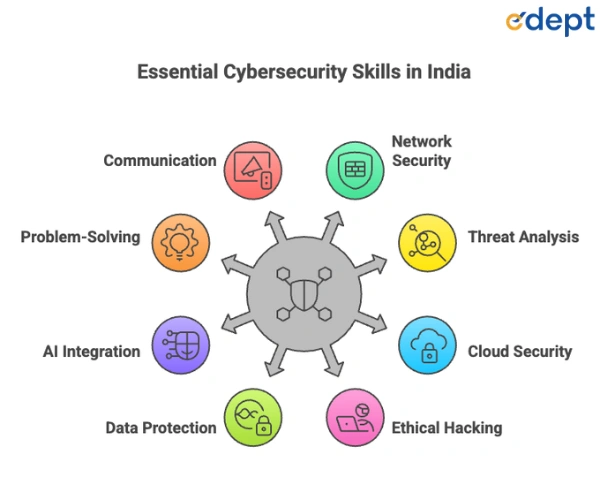
Why Students Should Learn Cybersecurity?
The demand for cybersecurity professionals in India is growing significantly faster than the supply of people qualified to fill the roles. Every organisation that digitises, every fintech that scales, every hospital that moves patient records online, and every government department that launches a digital service needs people who understand how to protect it.
Cybersecurity in India is not just a career in the traditional sense. It is a field where the work is genuinely consequential. The people building and operating India’s cyber defences are protecting the infrastructure that hundreds of millions of people depend on. The skills involved, from network security and malware analysis to cloud security and incident response, are highly transferable across industries and geographies.
For students in India looking at career options that combine strong employment prospects, meaningful work, and genuine growth potential, cybersecurity for the digital economy India sits near the top of any honest list. The gap between available roles and qualified candidates is not going to close quickly, which means the people who build real expertise now are entering a market that genuinely needs them.
Also Read: Everything You Need To Know About Cyber Threat Intelligence: Process, Tools & Use Cases
What Makes edept’s B.Voc. in Cybersecurity & Digital Forensics a Smart Career Move?
If you’re committed to building a career in cybersecurity, this program offers a unique edge. Here’s what makes it stand out:
- Deloitte certification included: Content is authored by the Deloitte Learning Academy, the same material used to train their own professionals globally. You graduate with a Deloitte certification on your CV.
- IBM internship program: Work on live industry projects guided by IBM experts, not simulations. Top performers earn a joint IBM and NASSCOM co-certification plus a ₹4,000 stipend.
- Real industry immersion: Three stages of global industry projects, from foundation through to capstone, building a portfolio before you graduate.
- Dedicated Cybersecurity and Blockchain Centre of Excellence: Hands-on lab access, including a cryptocurrency investigation lab and cloud security training facilities.
- BVS Degree from Mumbai University: A 100%-placement-supported three-year degree in Bachelor of Vocational Studies that is completely recognized.
- Open for everyone: All students who have finished their 10+2 are welcome to apply.
Contact an edept counselor to find out where your journey will lead.
How India Can Stay Safe from Cyber Attacks
Train More Cybersecurity Experts
India’s top priority for stronger cyber defences? Build more skilled professionals at every level. Think incident responders, security analysts, architects, and policy experts.
This means:
- Funding university cybersecurity programmes.
- Backing certification paths.
- Creating clear entry routes for students from all backgrounds.
The skills gap in cybersecurity is a national vulnerability as real as any technical one.
Use AI to Detect Cyber Threats
The same AI capabilities that attackers are using to generate more sophisticated phishing attacks and adaptive malware can be deployed defensively to detect anomalies, identify threats in real time, and respond faster than human analysts could alone. Indian organisations investing in AI-powered security operations centres are building detection and response capabilities that match the pace of the threat environment much more effectively than traditional signature-based approaches. Cyber threats in India are evolving faster than any manual process can keep up with, and AI-assisted defence is increasingly the practical answer.
Easy Safety Tips for Everyone
Not everyone in India’s digital economy is a security professional, and most of the people who use UPI, Aadhaar-linked services, and digital government platforms are not. Basic hygiene practices make a measurable difference at scale. Using strong, unique passwords for different accounts. Turn on two-factor authentication wherever the option exists. If a payment link or message asks for an OTP and you did not initiate the request, do not engage with it. And keep your devices updated regularly because outdated software is one of the easiest ways attackers find a way in. Verifying URLs before entering any credentials or making payments. These are not technical steps. They are habits, and building them broadly across India’s 900 million internet users would significantly reduce the attack surface that cybercriminals exploit every day through cyber attacks in India.
Final Thoughts
India’s digital economy is one of the most significant development stories in the world right now, and cybersecurity is the discipline that determines whether it holds together or becomes its own undoing. According to the India Cyber Threat Report 2026, India witnessed over 265 million cyberattacks in 2025 alone. That figure sits alongside the extraordinary growth of UPI, the expansion of Aadhaar-linked services, and the deepening of digital public infrastructure to tell a single story: India has built something genuinely remarkable, and it is under sustained attack.
Cybersecurity for the digital economy in India is not a technology problem that can be solved with a single product or policy. It requires continuous investment in people, processes, and technology at every level, from individual users building basic digital hygiene habits to organisations running mature security operations and governments maintaining national cyber defences. The organisations and countries that treat cybersecurity in digital India as a strategic priority rather than a compliance checkbox consistently recover faster from incidents, lose less to fraud, and maintain the kind of trust that allows digital services to scale. India has built the infrastructure. Protecting it is the next chapter.
Related Links:
FAQs of India’s Cybersecurity
What is India’s biggest cyber threat in 2026?
The list of threats which will cause sleepless nights to Indian security professionals in 2026 comprises phishing using AI, ransomware attacks on financial organisations and healthcare providers, undetected attacks using cloud misconfigurations, and reconnaissance conducted by nation-states on infrastructure assets. None of this is happening in a vacuum. India’s digital growth has been extraordinary, but the security workforce needed to protect that growth has not kept pace. That imbalance has created openings, and both financially driven criminal groups and state-backed actors have been deliberate about walking through them.
How many cyber attacks hit India daily?
The numbers are striking. CERT-IN’s own data shows more than 2.2 million cybersecurity incidents were recorded between 2021 and mid-2025. That works out to somewhere around 3,000 incidents on an average day, which is not a spike or an anomaly but a sustained baseline. Check Point’s 2025 report puts a weekly figure alongside that: Indian organisations were facing roughly 2,011 attacks per week on average. Taken together, those figures position India as one of the most persistently targeted countries in the world for cyber attacks in India, not occasionally, but consistently, across years and across sectors.
Is UPI safe from hackers?
At the infrastructure level, UPI is well-protected. Two-factor authentication, device binding, and real-time fraud monitoring are all built into the system. Where things get complicated is human behaviour. Most UPI fraud in India does not involve breaking into the platform. It involves convincing real users to hand over OTPs or tap approve on a transaction they did not fully read. The technology holds up. The weak point is how much users understand about what they are being asked to do, which is why awareness around the safety of UPI transactions in India is not a secondary concern but a core one.
Best cybersecurity courses for Indian students?
Anyone serious about entering this field should look for programs that go beyond theory. Network security, ethical hacking, cloud security, incident response, and working knowledge of compliance frameworks like the DPDP Act are all areas employers actively look for. Regarding certifications, the CEH, CompTIA Security+, and CISSP are always top choices for recruiters. The cybersecurity program in degree courses provided through systems such as Edept provides a more defined path to entering the industry by way of practical projects instead of theoretical knowledge alone.
Will cybersecurity jobs grow in India?
The demand is already there, and it is only going to widen. Qualified cybersecurity professionals in India are being hired faster than institutions are producing them. Fintech, healthcare, manufacturing, government services, practically every sector building a digital presence needs people who understand how to secure it. The DPDP Act has added a compliance dimension that makes security hiring a legal necessity for many organisations, not just a technical preference. That dynamic, alongside the rise in cyber threats in India and accelerating digital adoption, means job growth in this space will stay strong for years.
What is the DPDP Act and data privacy?
The Digital Personal Data Protection Act defines the framework within which any business entity conducting itself within India will need to handle the collection, storage, and processing of personal data. This is not a flexible guideline. There are clearly defined conditions for collecting data and the purpose of collecting it, and businesses must inform customers in case there are any data breaches. Cybersecurity stops being something you invest in only to manage risk. Under the DPDP Act, it becomes something you are legally required to get right, with enforcement consequences if you do not. For any organisation operating within India’s digital economy, the DPDP Act turns cybersecurity from a risk management conversation into a hard legal compliance requirement, with genuine enforcement consequences attached.
How to protect Aadhaar from breaches?
One of the more straightforward steps individuals can take is locking their biometric data through the UIDAI portal when biometric authentication is not actively needed. For routine verification, using a masked Aadhaar, which displays only the last four digits, limits how much of the full number gets shared. Being selective about which organisations you hand your Aadhaar details to, and periodically checking UIDAI’s authentication history for any activity you do not recognise, are practical habits that support stronger cybersecurity in India at the individual level.