What Is the Difference Between a PGP Certificate and a Master’s Degree in This Program?
Students, while exploring international study options, often notice that some programmes offer multiple credentials, and they may not immediately understand how these programmes differ. That’s the case with this Global Pathway Program. In the MAS in Data Science, students receive two distinct credentials from two institutions. You receive a PGP certificate from Mahindra University. You also receive a STEM Master of Applied Science in Data Science from Illinois Tech. These are not two master’s degrees. These are two different types of academic recognition, earned at two different stages of one structured journey. This article explains what each credential is, where it comes from, when it is earned, and how both fit into the 6+12 pathway. By the end of this article, you will be clear about the difference between a PGP certificate vs master’s degree.
What Credentials Do Students Receive in the MAS Global Pathway?
The simplest way to understand this is to look at the journey step by step. The programme has two tracks. Students start with the India Track at Mahindra University. After that, they move to the USA Track at Illinois Tech in Chicago. At the end of the full journey, they hold two credentials:
- A PGP certificate from Mahindra University
- A Master of Applied Science (MAS) in Data Science from Illinois Tech
The PGP Certificate from Mahindra University
The PGP certificate is awarded by Mahindra University. It belongs to the Indian phase of the pathway. The India Track focuses on foundational and applied Data Science learning. It helps in building the base you need before moving to an advanced study role. It is important to note: the PGP certificate is not a degree. It is not a master’s degree. It is specifically a PGP certificate.
The Master of Applied Science in Data Science from Illinois Tech
The MAS is awarded by Illinois Tech. This is the STEM-designated master’s degree. You complete this during the USA phase in Chicago. This is the master’s-level credential you earn through the programme. It is the advanced degree that carries the STEM designation and opens the door to post-study work opportunities in the United States.
What Is a PGP Certificate?
A PGP certificate is an academic credential that is awarded by the Mahindra University. In this programme, it connects directly to the six-month India Track. The India Track delivers foundational and applied Data Science learning. It prepares you for the advanced coursework you will face in the United States. The programme identifies this credential only as a PGP certificate from Mahindra University and does not assign a specific expansion of “PGP”. It also does not describe external recognition or equivalency that the programme does not mention. The PGP certificate shows successful completion of the India-stage academic work. 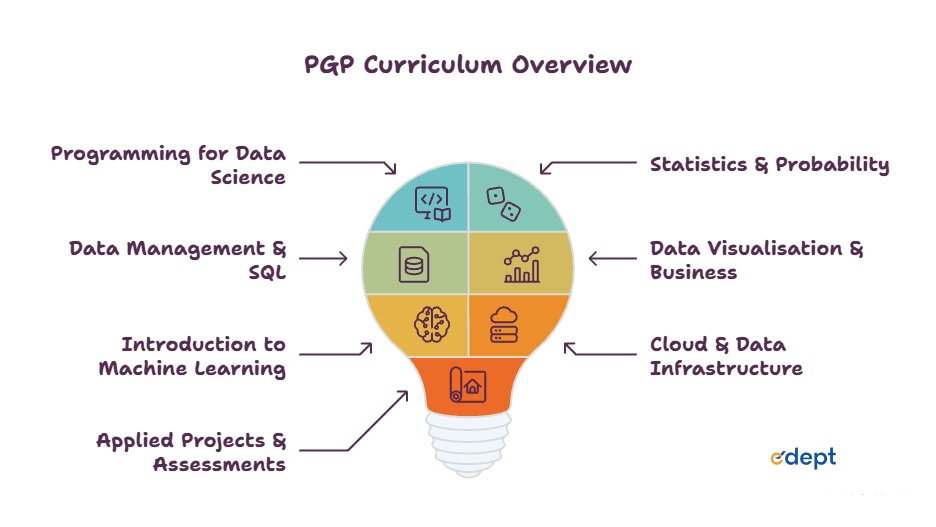
What Do Students Study During the PGP Phase?
The India Track at Mahindra University covers:
- Statistics & Probability for Analytics
- Programming for Data Science (Python)
- Data Management & SQL
- Data Visualisation & Business
- Introduction to Machine Learning
- Cloud & Data Infrastructure Fundamentals
- Applied Projects & Assessments
These subjects help in creating a strong foundation. They help in preparing you for the deeper, more advanced topics you will study in Chicago.
Where Does the PGP Fit Into the 6+12 Model?
The 6+12 pathway starts with six months in India at Mahindra University. This is where the PGP certificate is earned. The PGP forms part of this India-stage academic journey. It’s not a standalone credential that floats on its own; it’s the academic entry point that prepares you for the U.S. phase. According to this programme, India-earned credits align with the U.S. curriculum. This means your learning in India connects directly to what comes next.
What Is the MAS in Data Science Degree?
The MAS stands for Master of Applied Science. In this programme, it refers specifically to the Master of Applied Science in Data Science awarded by Illinois Tech. It is the advanced USA track of the pathway that identifies it as a STEM degree. Students complete the USA phase in Chicago. A graduate certificate and a master’s degree are not the same thing. A certificate only focuses on a specific set of skills in a shorter time frame. A master’s degree offers a broader, deeper level of study. The MAS is a full master’s degree. It requires more extensive coursework and a larger academic commitment than a certificate. 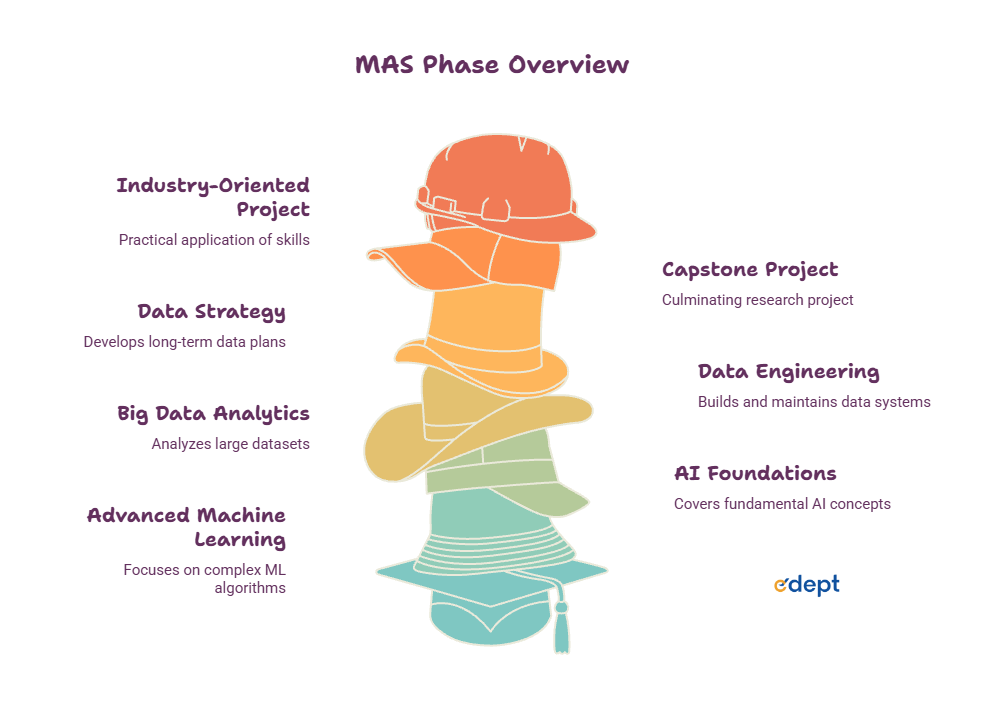
What Do Students Study During the MAS Phase?
The USA track is built on your Indian foundation. Students cover:
- Advanced Machine Learning
- Artificial Intelligence Foundations
- Big Data Analytics
- Data Engineering & High-Performance Computing
- Data Strategy & Governance
- Capstone Project / Master’s Thesis
- Industry-Oriented Project Work
These are advanced, master’s-level topics. They take you beyond the basics into specialized, high-demand areas of data science.
Where Is the Master’s Degree Awarded?
The MAS is awarded by Illinois Tech in Chicago. Illinois Tech is the U.S. partner university in this global pathway. Illinois Tech mainly focuses on engineering, computing, data science, and applied research. Founded in 1890, Illinois Tech is a private research university. It has been ranked 1 in Illinois for best salaries of graduates by the Wall Street Journal / College Pulse 2026. It also ranks 91st nationwide and sits among the world’s top universities. It is recognized as one of five STEM-based institutions and has been named an Opportunity College and University by the Carnegie Foundation and American Council on Education in 2025.
PGP Certificate vs. Master’s Degree: What Is the Difference?
This below table makes the distinction easy and simple to understand.
| Factor | PGP Certificate | Master’s Degree |
|---|---|---|
| Credential | PGP Certificate | Master of Applied Science in Data Science |
| Institution | Mahindra University | Illinois Tech |
| Study Phase | India Track | USA Track |
| Location | India | Chicago, USA |
| Role in Pathway | Foundation and applied learning | Advanced master’s-level study |
| Curriculum Focus | Programming, statistics, SQL, visualisation, introductory ML, cloud fundamentals | Advanced ML, AI, Big Data, data engineering, governance, capstone/thesis |
| Credential Mentioned in Brochure | PGP Certificate | STEM MAS in Data Science |
Certificate vs. Degree
The terminology matters. A certificate and a master’s degree are different types of credentials. A certificate is a short-term, specialized credential that focuses on specific technical skills, whereas a degree is a comprehensive, multi-year academic credential awarded by a college or university that covers both general education and deep foundational knowledge in a field of study. The Mahindra University credential is a PGP certificate, and the Illinois Tech credential is a Master of Applied Science. Neither credential is described as “equivalent” to the other. They’re simply different, and each has its own place in the pathway.
Two Credentials, One Structured Pathway
Students here are not pursuing two separate programmes independently. The credentials form part of one structured global pathway. Your learning in India progresses into the advanced U.S. MAS. Academic continuity is a key feature of this programme. The India-earned credits align with the U.S. curriculum. Your learning in India integrates directly into the advanced coursework in the U.S., and academic continuity between the two phases is one of the programme’s core design features.
Is the PGP Certificate a Master’s Degree?
No. The PGP certificate is not a master’s degree. According to the brochure, Mahindra University awards a PGP certificate. Illinois Tech awards the Master of Applied Science in Data Science. These are both separate credentials from separate institutions. The PGP is not a second master’s qualification, and it shouldn’t be described as one.
Why the Distinction Matters
Understanding these differences helps prospective students to know exactly what credentials they are receiving from each institution. It prevents students from interpreting the pathway as a dual-master’s programme. It keeps communication transparent and honest. When you clearly know which degree you are earning and where it comes from, you can make better decisions about your education and career.
How Does the PGP Lead Into the Illinois Tech MAS?
The academic progression is very clear. The India Track establishes your foundation framework. The U.S. Track helps in building your advanced knowledge. The brochure states that India-earned credits align fully with the U.S. curriculum. This makes the pathway a very structured progression, not just two random programmes that are combined together.
Foundation in India
The Indian track is the foundation stage of the global pathway. It includes six core academic subjects along with components of applied projects and assessments.
- Python Python forms the base of the Indian education track. It is the main programming language that is used to work with data, write logic, and build simple models. This subject helps to enhance your coding knowledge.
- Statistics & Probability They usually form the analytical background for the programme. The thinking and analytics behind every data decision. It teaches you how to read patterns, test ideas, and know when a result actually means something.
- Data Management & SQL They are both very important and core parts of the foundation framework. Here you learn how to deal with databases and how data is stored, organized and retrieved. Almost every company stores data this way, so this is a skill you’ll use daily in any data role.
- Data Visualisation & Business They focus on how you can turn complex data into actionable insights so that people can easily understand and use it. It helps in turning numbers into charts and graphs that are easy to read and explain. The main focus is on interpretation and communication.
- Introduction to Machine Learning Here you move from learning foundational analytics to the basics of machine learning. Supervised and unsupervised learning basics, regression, and classification algorithms. You will have your first look at how machines “learn” from past data to predict what happens next, the core idea behind most Data Science work.
- Cloud & Data Infrastructure Here you will be learning how data is stored and processed on cloud platforms like AWS or Azure. This is an introductory fundamentals-level subject that lays the fundamental foundation for the more advanced infrastructure topics at Illinois Tech.
- Applied Projects & Assessments Applied projects and assessments run along with the six subject areas, giving students a chance to put what they learn into practice before moving to the USA phase. Here you can apply what you have learned in the Indian track, and it provides a very smooth progression since credits earned in India align with the U.S. curriculum.
Advanced Study in Chicago
The USA Track is the Master of Applied Science in Data Science (STEM), completed on campus at Illinois Tech in Chicago. Here, the curriculum becomes more advanced and specialized
- Artificial Intelligence Foundation AI is a very important part of the advanced curriculum. Here you will be looking at how systems go beyond prediction to reasoning and automated decision-making.
- Advanced Machine LearningIt is built on the Introduction to Machine Learning covered in India. Students learn more advanced and complex concepts here. They go deeper into building smarter models that handle real-world, messy data.
- Big Data Analytics It focuses on analysing large and complex datasets. Here you will be learning to work with datasets too large for a normal computer, using tools built specifically to handle that scale.
- Data Engineering & High-Performance Computing It covers technical infrastructure and building the pipelines that move and clean data before anyone can analyse it. You will learn to build robust data pipelines, ETL processes, and data warehousing architectures.
- Data Strategy & Governance It focuses on how data is managed, governed and strategically used within an organization.You will understand how organisations manage data responsibly: who owns it, who can access it, and how it’s kept secure and compliant
- Capstone / Thesis It is your final, real-world project. You apply everything that you’ve learned and use it to solve an actual business problem, from start to finish. It often includes a comprehensive, hands-on research project or industry collaboration.
- Industry-Oriented Project Work These programmes include projects, labs, and collaborations with global employers. This reflects a practical approach that connects classroom learning with real-world projects thatstudents will encounter in their real work experience.
Academic Continuity Across the Two Phases
The brochure states that India-earned credits align with the U.S. curriculum. The pathway is designed as a structured progression. What we can say is that the programme is built so that your India learning connects directly to your Chicago learning.
What Is the Value of Having Both Credentials?
Both credentials have value because they represent different stages of the same journey. We frame this around the structure of the pathway, not inflated credential claims. It helps to see the two credentials as markers of two different stages in the same academic journey.
Recognition of the India-Based Academic Phase
The PGP certificate from Mahindra University demonstrates completion of the India-stage academic component. It shows that you have completed foundational and applied Data Science learning. Mahindra University is backed by the Mahindra Group. It is a multidisciplinary institution with a strong emphasis on technology, analytics, and applied learning. It offers modern campus facilities, advanced labs, and digital infrastructure.
A U.S. STEM Master’s Degree
The MAS in Data Science from Illinois Tech is a STEM-designated master’s degree programme. It includes advanced coursework and project work in Chicago. STEM designation matters because it affects your post-study work options in the United States. A STEM master’s degree is a comprehensive graduate credential that opens doors to higher-level roles and longer work authorization.
A Combined Academic Journey
You get to study in two institutions. You get two study environments. You get one structured academic pathway. The total journey is six months in India plus twelve months in the USA. The credentials work together to tell the full story of your education.
Does the MAS Degree Offer U.S. Career and Work Opportunities?
Yes, but this is a feature of the master’s degree, not the PGP certificate. The brochure states that STEM graduates may be eligible for up to 36 months of OPT. OPT here stands for Optional Practical Training. It is the work authorization that allows F-1 students to work in the U.S. after graduation. The brochure also lists career areas and roles, including:
- Data Scientist
- Senior Data Analyst
- Machine Learning Engineer
- Data Engineer
- Product & Growth Analyst
- Business Analytics Manager
We do not imply that the PGP itself provides U.S. work authorization. The PGP is the India-phase certificate. The work authorization comes from completing the STEM master’s degree at Illinois Tech. We also do not guarantee employment or OPT approval. Immigration rules are subject to change, and individual eligibility depends on meeting all requirements.
STEM Designation of the MAS
The MAS is specifically described as STEM in the brochure. This provides links to post-study work eligibility. STEM graduates may apply for a 24-month extension on top of the standard 12-month OPT, creating a total of up to 36 months of work authorization. This is a significant advantage for international students who want to build a career in the United States.
Career Support and Employer Exposure
The programme provides career support and employer exposure. Students connect with companies across technology, finance, healthcare, consulting, and more, including companies such as Google, Microsoft, Amazon, Meta, IBM, Deloitte, Accenture, EY, PwC, Allianz, JPMorgan Chase, Goldman Sachs, PayPal, Siemens, and BioNTech. However, placements are not guaranteed. The brochure states this clearly. Career support helps, but your outcomes depend on your skills, effort, and market conditions.
PGP Certificate and Master’s Degree: How the Student Journey Works
| Stage | Institution | Outcome |
| Stage 1 | Mahindra University | Foundational & Applied Data Science Learning |
| Stage 2 | Mahindra University | PGP Certificate |
| Stage 3 | Illinois Tech, Chicago | Advanced Master of Applied Science (MAS) in Data Science |
| Stage 4 | Illinois Tech, Chicago | STEM Master’s Degree |
Key points to remember:
- The two credentials correspond to different stages of the same pathway.
- The six-month India phase comes before the 12-month U.S. phase.
- The final master’s credential comes from Illinois Tech.
Understand Your Credentials Before Applying
Let us summarize the distinction clearly.
- PGP certificate = Mahindra University
- Master’s degree = Illinois Tech
Both credentials belong to the same 6+12 Global Pathway. But they represent different stages and different types of credentials. The PGP certificate recognizes your foundational learning in India. The master’s degree is the STEM MAS in Data Science from Illinois Tech. It is the advanced credential that completes your journey. If you are considering a Data Science master’s in the USA, this pathway offers a smart cost structure. You begin in India to reduce tuition and living expenses. You pay U.S. costs only during the Chicago on-campus phase. The total estimated cost of attendance is approximately $78,500, compared to around $109,000 for a traditional 18–20 month programme in Chicago. That is a saving of roughly $30,600.
The programme also includes IELTS training at no extra cost, end-to-end support from application through graduation, and a 98% visa acceptance rate at Illinois Tech. Ready to take the next step? Explore the edept × Mahindra University × Illinois Tech Global Pathway Program to understand the curriculum, admissions process, and credentials. Know exactly what you will earn, where you will study, and how it fits your career goals.