Digital forensics is a branch of forensic science focused on identifying, preserving, analyzing, and documenting digital evidence from devices like computers, phones, and networks to reconstruct cybercrimes or support legal proceedings. It acts as a “cyber detective” role, crucial for investigating data breaches, fraud, and theft, often referred to as computer forensics or cyber forensic investigation.
What is Digital Forensics? Let’s address one of the most commonly asked queries. Today, the world is highly interconnected through instant messages and transactions, highlighting the presence of digital footprints. Digital forensics simply refers to the science of identifying, collecting, analyzing, and documenting digital evidence. In the event of cybercrimes, data breaches, online scams, or corporate conflicts, the underlying foundation is nothing but digital forensics. They do the investigation and serve justice. Digital forensics has evolved rapidly with the rise of cybercrimes. According to global reports by Ventures, globally, cybercrime numbers are expected to cross $10.5 trillion per year by 2026. This makes digital investigations more critical. It helps not only to track hacked systems but also to recover data, as digital forensics plays a vital role in both criminal and civil cases.
As digital forensics tools are being used worldwide, the requirements for skilled digital forensics professionals are rising. So digital forensics is not just technical but also analytical.
What is Digital Forensics?
Digital forensics refers to a branch of forensic science that is based on scientifically recognizing, collecting, preserving, analyzing, and presenting digital evidence. This is used to support criminal investigations and to give any type of cybercrime response. It helps civil conflicts, making sure the data’s integrity is legally verified. Cybersecurity teams can use digital forensics to identify the cybercriminals behind a malware attack, while law enforcement agencies can use it to analyze data from a murder suspect’s device. Many people confuse cyber forensics with digital forensics, which is not right. Cyber forensics deals with internet or network-related crimes. While digital forensics deals in a broader sense with devices.
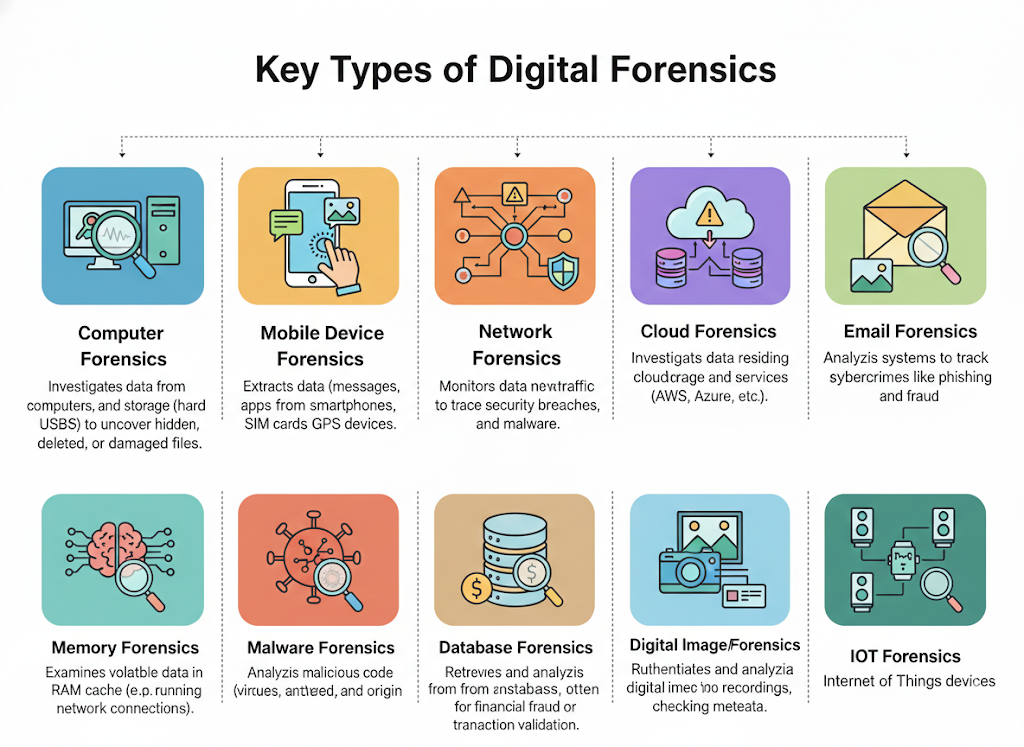
Types of Digital Forensics
There are various types of digital forensics. So, to help you understand each one of them is important.
| Forensic type | How it works investigation |
| Computer forensics | Data from laptops, computers, storage, and hard drives. |
| Mobile device forensics | Messages, photos, apps, sim cards. |
| Network forensics | Network traffic, security breaches, and malwares |
| Cloud forensics | Data that is stored in cloud storage or services like AWS. |
| Email forensics | Cybercrimes in emails, such as phishing, spam, and fraud. |
| Memory forensics | Volatile data in RAM and cache. |
| Malware forensics | Analyzes viruses or ransomware. |
| Database forensics | Retrieves data from the database or any type of transactional fraud. |
| Digital forensics | Digital images, video recording or any type of metadata. |
| IoT forensics | Data from internet of Things device. |
How Digital Forensics Works
Digital forensics is a scientific process and involves various stages. The first stage among the five core stages is identification and collection, which involves experts securing devices to prevent data tampering. Then next is preservation of original devices securely, as analysis is based on the copy to maintain data integrity. The third stage is examination and analysis. This is where the investigators use special tools like Encase or FTK. This involves recovering data, examining system logs, and analyzing hidden data. The last stage is reporting and presenting. This means you synthesised the findings into a brief report for legal proceedings.
Career Scope In Digital Forensics
Applicants in digital forensics have access to a vast range of career opportunities. Digital forensics is a rapidly growing field due to the increasing number of cybercrimes, with average salaries of $95,000 and more for specialized positions. The major job roles include Digital Forensics Investigator, Incident Responder, Malware Analyst, Forensic Analyst, and Cybersecurity Consultant. Experts concentrate on investigating cybercrime, responding to security incidents, examining malicious software, and managing digital evidence. Significant opportunities are available in law enforcement and government agencies such as the FBI and the NIA. Demand is also strong from BFSI, IT companies, and the Big Four accounting firms.
Common job titles include malware analyst, information security analyst, cybercrime investigators and forensics consultant.
Job Roles In Data Forensics
There are various job roles in digital forensics. So among those, we will discuss a few that are most commonly seen.
| Job role | About |
| Digital Forensic Analyst | Analyses digital data, prepares investigation reports, and recovers data. Very common for entry-level. |
| Incident Responder | It recognises and contains cyber attacks in real time. It also preserves data. |
| Cybercrime investigator | Working closely with law enforcement agencies to stop online crimes. |
| Forensic consultant | This is about giving expert advice to the legal team. |
Essential Skills Required
To grow a successful career in digital forensics and be a professional, you must develop strong skills. We’ll look into four skills that are very important. First is technical knowledge. It is necessary to operate certain systems, networks, and databases. Second is legal awareness. As a digital forensics expert, you must understand the cyber law and have proper knowledge. Know how to handle evidence and compliance requirements. Third is analytical skills. These skills are important for investigators to connect digital clues, and it helps reconstruct events more accurately. Giving attention to every detail is very important. Lastly, strong documentation and communication skills where you present the findings to the courts, clients, and senior management. These skills together help a digital forensic expert.
Popular Digital Forensic Tools
Digital forensics use much advanced tools for its digital forensics lifecycle. Below we discuss some tools so it’s easier to get an insight or a basic idea of the tools that are used during forensics investigation.
| Tools | Usage |
|---|---|
| FTK | It is a forensic tool kit used for imaging and deep data analysis. |
| X-Ways Forensics | Used for manual analysis. |
| Wireshark | Used for network packet capture. |
| Volatility | It is a RAM analysis tool. |
| DumpZilla | Used to extract browser data like history or passwords. |
Salary And Growth Opportunities
The salary ranges depend on the job position and expertise. For entry-level forensics analysts, the salary expectation can be between INR 4-7 LPA. But for more experienced professionals, it can range between INR 12-15 LPA or even more. According to data, globally, digital forensic experts on average earn between $80,000 to $120,000 per year. Although it depends on your skills, expertise, and experiences.
How To Start A Career In Digital Forensics
Starting a career is more important than any course, education, or certification. Having insight on digital Forensics life cycle in cybersecurity is important before you pursue a career in this field in the future. It starts with making reports and then finding evidence. Experts help reveal digital crimes and also secure justice. Their work also builds trust and requires legal knowledge. Certifications that are best for digital Forensics in India are GIAC Certified Forensic Examiner or GCFE, GIAC Certified Forensic Analyst or GCFA, Certified Computer Examiner or CCE, certified forensic computer examiner or CFCE, Digital Forensics Essentials or DFE, EnCase Certified Examiner or EnCE.
As for education, platforms such as edept help you gain career-oriented, hands-on learning experiences with cybersecurity courses. Click here to apply.
Conclusion
Now that we have an insight into what digital forensics is, it is clear to us that this field is all about technology, law, and investigation. As cybercrimes are rapidly evolving, digital forensics comes into the picture with a high demand. It has become a part of justice and security. It comes with strong competence, ranging salaries, and various job roles with global demands. A digital forensics expert needs to gain hands-on expertise in the profession before developing their career further. Continuous learning also guides you on the right path in this dynamic career. For those wanting to study cybersecurity, it is a rewarding career path for sure.
FAQs
What is digital forensics in simple terms?
Digital forensics simply refers to the science of identifying, collecting, analyzing, and documenting digital evidence. Whenever a cybercrime, data breaches, online frauds or corporate disputes happen, then the backbone is none but digital forensics.
Is digital forensics a good career in India?
Yes. Forensics specialists help organisations to prevent data breaches and understand how attacks happened. This makes the digital forensics lifecycle central to breaking down cybercrime and providing justice.
What skills are needed for digital forensics?
The skills needed for digital forensics are technical, legal knowledge, analytical thinking and documentation.
Which tools are used in digital forensics?
The tools used for digital forensics are EnCase, FTK, X-Ways and Wireshark. These tools are specialised to help in digital forensics investigations.
What is the salary of a digital forensic analyst?
For entry-level forensics analysts, the salary expectation can be between INR 4-7 LPA. But for more experienced professionals, it can range between INR 12-15 LPA or even more.
How to become a digital forensic expert?
To become a digital forensic expert, you should gain real-life hands-on experiences, have a relevant certification, and have relevant education.
Is digital forensics part of cybersecurity?
Yes. Digital forensics is a very important branch of cybersecurity.
What industries hire digital forensic professionals?
Industries like law firms, IT firms, healthcare, consultation firms and government agencies hire digital forensics.
What is the future of digital forensics?
The future scope for digital forensics is pretty strong, as a rise in cybercrimes has been reported, with the demand for more digital forensics. As the world has evolved with online banking and education.
Can freshers start a career in digital forensics?
Yes, with a proper career guidance and mentorship platform like edept, any fresher can gain education and hands-on expertise in digital forensics and start a career.