Most IT professionals hit a ceiling at some point. The technical skills that got them there stop being enough. Moving into leadership, strategy, or product roles requires something different. An MBA for IT professionals bridges exactly that gap. It takes what you already know and adds the business depth, communication ability, and strategic thinking that senior roles genuinely require. This blog covers everything you need to know.
How is an MBA useful for IT Professionals?
The conversation around MBA for IT professionals has changed considerably. It used to be about prestige or a change of direction. Now it is about leverage. IT professionals who add an MBA to their profile are not abandoning their technical background. They are building on top of what they already know, adding a layer that pure technical expertise rarely develops on its own. LinkedIn’s 2025 Emerging Jobs Report found that roles sitting at the crossover of technology and business leadership, such as product management, IT consulting, and data strategy, have grown by over 35% in the past two years. Notably, MBA holders in IT are filling a disproportionate share of those positions. That is not a coincidence. What is MBA in IT, and what does it actually do for someone already working in the sector? The short answer is that it provides the business fluency, leadership skills, and strategic perspective that technical roles rarely develop on their own, and those are exactly the qualities that determine who moves up and who stays put.
What is an MBA in IT?
Before deciding whether an MBA in IT is the right move, it helps to be clear on what it actually involves and how it differs from a general MBA. The distinction matters more than most students realise when they start comparing programmes.
An MBA in the IT sector is a postgraduate management programme designed specifically for professionals working in or around technology. It covers the standard MBA curriculum, including finance, strategy, operations, and marketing, but anchors those subjects in a technology context. Subjects such as IT governance, digital transformation, enterprise systems, data analytics, and technology strategy sit alongside core management modules, enabling students to think across both domains rather than just one.
What sets MBA programs for IT professionals apart from a general MBA is the relevance of the application. A general MBA teaches you to manage businesses. An MBA in the IT sector teaches you to manage technology-driven businesses, which is a meaningfully different challenge. As organisations become more dependent on digital infrastructure, the people who can lead at the intersection of technology and business are increasingly the ones running things.
For someone already working in IT, the question is not whether this knowledge is valuable. It clearly is. The question is whether investing two years and a significant amount of money in a structured programme produces better outcomes than simply accumulating experience on the job. For most IT professionals looking to move into senior leadership, consulting, or product roles, the evidence consistently says yes.
Best Suited MBA Specialisations for IT Professionals
Not every MBA specialisation serves IT professionals equally well. Some build directly on technical foundations, while others open completely new career directions. Choosing the right one depends on where you want to go, not just where you are coming from.
MBA in Analytics and Data Science
For IT professionals with a background in data engineering, software development, or systems architecture, an MBA in analytics and data science is one of the most natural progressions available.
- This specialisation builds management and strategic thinking on top of data expertise, producing graduates who can lead analytics functions rather than just contribute to them
- Roles like Chief Data Officer, Analytics Manager, and Data Strategy Consultants are increasingly filled by people with this exact combination of technical grounding and business training
- It is among the best MBA for IT professionals who want to stay close to data while moving into leadership
MBA in Information System Management
MBA in Information System Management focuses on the governance, strategy, and operational management of technology within organisations.
- This is particularly well-suited for IT professionals in system administration, ERP management, or IT operations who want to move into CIO or IT Director tracks
- Subjects typically cover enterprise architecture, IT governance frameworks, cybersecurity management, and digital transformation strategy
- For IT professionals whose career goal is to lead an organisation’s technology function rather than just contribute to it, this specialisation provides the most direct pathway
MBA in Business Analytics
MBA in Business Analytics sits at the crossover between data, strategy, and business decision-making, and it has become one of the most sought-after specialisations among IT professionals looking to move into management.
- The programme develops the ability to translate data findings into business recommendations, a skill that sits at the heart of most senior analytics and strategy roles
- IT professionals with development or data backgrounds find that the transition into this specialisation is smoother than into more finance-heavy MBA tracks
- edept’s MBA in Business Analytics, offered through Shree L. R. Tiwari Institute of Management and Technology in Pune, is built specifically around this combination, covering Python, SQL, Tableau, predictive analytics, machine learning, and AI applications alongside core management subjects
MBA in IT and FinTech
MBA in IT and FinTech has emerged as a distinct specialisation as the financial services and technology sectors have converged more deeply than anyone predicted a decade ago.
- This track is particularly relevant for IT professionals working in banking technology, payment systems, blockchain, or financial software development
- Subjects typically include digital banking, regulatory technology, blockchain strategy, and financial product development, alongside standard management content
- Career outcomes cluster in consulting, product management, and technology leadership roles at financial institutions and FinTech companies
MBA in Project Management
For IT professionals who have spent years delivering projects and want to formalise and scale that expertise, an MBA with a project management focus provides both the credential and the broader business context that senior delivery roles require.
- This specialisation develops programme management, stakeholder management, resource allocation, and strategic delivery skills that go well beyond standard PMP certification territory
- IT project managers who add an MBA to their profile consistently report that the business context it provides changes how they engage with senior stakeholders and how those stakeholders engage with them
- It is one of the best MBA for IT professionals whose immediate goal is to move from delivery management into broader operations or consulting roles.
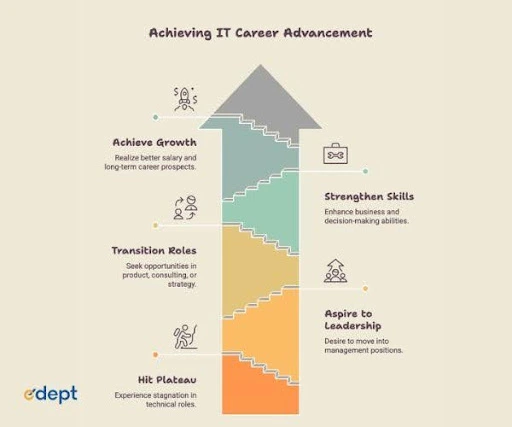
How Will an MBA Help IT Professionals?
The practical question for any IT professional considering an MBA is not whether it adds value in theory but how it changes outcomes in practice. The answer sits across several dimensions that compound over a career rather than showing up all at once.
Vocabulary and Fluency
The most immediate change is vocabulary and fluency. IT professionals who pursue MBA programs for IT professionals consistently report that they become more effective in cross-functional conversations almost immediately. Understanding how finance, marketing, and operations teams think allows them to frame technical decisions in business terms, which changes how those decisions are received and acted on.
Network
The second change is the network. An MBA cohort typically includes professionals from finance, consulting, marketing, and operations alongside other IT professionals. Those relationships, built over two years of collaborative work, become a career-long professional network that produces opportunities that no job board surfaces. For IT professionals whose networks tend to be heavily concentrated in technology, this diversification has real career value.
Ambiguity
The third change is confidence in ambiguity. Technical roles tend to reward precision and correctness. Management roles require making decisions with incomplete information, managing competing priorities, and leading people through uncertainty. MBA programs for IT professionals build this tolerance for ambiguity through case studies, group projects, and simulations that replicate what senior roles actually feel like.
Finally, there is the credential itself. Like it or not, many organisations use the MBA as a filter for senior leadership roles. IT professionals who want to compete for those positions without the credential are fighting a structural disadvantage that the MBA removes.
Career Prospects After an MBA for IT Professionals
The roles available to IT professionals after completing an MBA are broader and better compensated than most candidates expect when they start the programme. Here is a breakdown of the most common and highest-value career paths.
IT Manager
IT managers oversee technology teams, infrastructure, and systems within organisations. An MBA adds the people management, budgeting, and strategic planning skills that make IT managers more effective and more promotable.
Business Analyst
Business analysts translate business requirements into technical solutions and vice versa. IT professionals with an MBA are particularly well-positioned for this role because they understand both sides of that conversation without needing to guess.
Product Manager
Product managers own the strategy, roadmap, and delivery of a product from concept to market. The combination of technical understanding and business strategy that an MBA for IT professionals develops is almost exactly what product management requires.
Consultant
Technology consultants advise organisations on how to use technology to solve business problems. An MBA adds the client management, strategic thinking, and business case development skills that separate strong consultants from technically capable ones who struggle with the commercial side.
Chief Technology Officer (CTO)
The CTO role requires deep technical credibility combined with board-level business fluency. An MBA provides the second half of that equation and is increasingly a stated preference in CTO job descriptions at mid-size and large organisations.
Data Scientist
Senior data scientist roles increasingly require the ability to scope projects, manage stakeholders, and communicate findings to non-technical audiences. MBA programs for IT professionals build exactly this layer of capability on top of technical data skills.
Entrepreneur
IT professionals who want to start their own businesses benefit from MBA training in areas like financial modelling, market analysis, fundraising strategy, and business planning that technical education rarely covers.
Salary Table
Explore the salary ranges across key IT and business roles in India, from entry-level analysts to senior executives, to benchmark your career growth and earning potential.
| Job Profile | Salary (INR per annum) |
| IT Manager | INR 12L to 25L |
| Business Analyst | INR 6L to 15L |
| Product Manager | INR 15L to 30L |
| Consultant | INR 10L to 22L |
| Chief Technology Officer (CTO) | INR 30L to 80L+ |
| Data Scientist | INR 10L to 22L |
| Entrepreneur | Variable |
Benefits of an MBA for IT Professionals
The benefits of an MBA for IT professionals extend beyond salary and job title. They shape how IT professionals are perceived, how they operate, and what kind of work they are trusted with over the long term.
Career Acceleration
IT professionals who complete MBA programs for IT professionals consistently move into senior roles faster than peers who bank on experience alone. Technical credibility combined with a management qualification sends a clear signal to hiring managers. It says this person is ready to lead, not just deliver. Experience builds competence. The MBA builds the case for the next level.
Domain Diversification
A technology career goes deep. It rarely goes wide. An MBA in IT sector changes that by pulling professionals into finance, marketing, operations, and strategy in a way that day-to-day IT work simply does not. That breadth is what makes professionals genuinely useful when organisations are working through complex, cross-functional challenges rather than purely technical ones.
Global Perspective
Third is the global perspective. Many MBA programs for IT professionals include international case studies, global industry projects, and cohorts with diverse national and professional backgrounds. This exposure builds the cultural intelligence and global business awareness that senior roles in multinational organisations increasingly require.
Professional Network
Fourth is the professional network. The relationships built during an MBA programme are often the most durable career asset graduates take away from the experience, and for IT professionals whose networks are heavily technology-weighted, the diversification an MBA cohort provides has compounding value over decades.
Finally, there is the confidence that comes from completing something demanding. An MBA is not easy, and IT professionals who complete one alongside work commitments demonstrate exactly the kind of resilience, time management, and sustained commitment that leadership roles require.
edept’s MBA Programmes for IT Professionals
edept offers MBA programmes specifically designed for professionals who want industry-aligned, career-first learning without stepping away from work entirely. Here is what makes edept’s offerings particularly relevant for IT professionals:
Industry-integrated curriculum
edept’s MBA in Business Analytics & Finance at Shree L. R. Tiwari Institute of Management and Technology covers Python, SQL, Tableau, predictive analytics, machine learning, Generative AI, and blockchain alongside core management subjects, making it directly applicable to IT professionals rather than requiring them to start from scratch
Real project experience
Global Industry Immersion Projects, in collaboration with Deloitte, IBM, and NASSCOM, give students live client exposure rather than simulated case studies, which is exactly what employers look for when hiring from MBA programmes
Recognised credentials
Students graduate with Deloitte Learning Academy certifications and IBM-NASSCOM joint certifications alongside their degree, giving them a credential stack that carries weight with the technology and consulting employers most likely to hire them
Placement support
100% placement assistance with access to 300+ recruiting partners means IT professionals completing the programme have structured support for the transition into their next role, rather than navigating it alone
Flexible learning designed for working professionals
The programme is structured to accommodate professionals who are managing work commitments alongside study, which is the reality for most IT professionals pursuing an MBA mid-career
Mentorship from practitioners:
edept connects students with industry professionals who have worked in technology and business leadership roles, providing guidance grounded in how organisations actually assess and develop senior talent
Conclusion
The case for an MBA for IT professionals has never been stronger, and the data from 2026 supports that assessment clearly. Technical skills remain the foundation, but they are no longer sufficient on their own for IT professionals who want to move into leadership, consulting, product, or entrepreneurial roles. Years of IT experience build technical depth. They rarely build the business fluency, strategic thinking, or professional network that senior roles actually demand. That gap is real, and it shows up at exactly the wrong moment in a career. The World Economic Forum’s 2026 Future of Jobs Report puts leadership and business strategy in the top five skills employers will chase through 2030. Worth noting too: technology professionals carrying both a technical background and management credentials keep pulling ahead of peers when salary reviews and promotions come around. Prestige alone does not make an MBA right for an IT professional.
If you are an IT professional looking to make that move and want a programme built around industry-aligned learning, real project experience, and structured career support, edept’s MBA programmes are worth exploring. They are designed for professionals who are serious about what comes next and want an education that reflects that.
Explore what edept has to offer and take the next step in your career today!