Define career goals and specialization to filter programs that align with target industries (e.g., healthcare, finance) and roles (e.g., Data Scientist vs. Data Analyst). Determine whether you prefer technical roles that require deep programming or strategic roles focused on business analytics, and consider whether you need hybrid skills such as cybersecurity and data analytics.
Data Science is experiencing exponential growth in popularity, fueled by the adoption of technologies such as AI, ML, cloud computing, and data-led decision-making. According to reports from NASSCOM and Deloitte, there are more than 84,000 live Data Science openings in India at present, while the country will require more than 1 million such professionals by 2027. Simultaneously, around 200,000 data-based vacancies continue to exist because of a lack of qualified talent. Due to growing demand, thousands of aspirants are now joining various job-focused Data Science programs to create future-proof careers in Data Science. Yet, the process of finding the most appropriate course has become increasingly challenging. The main reason is that many courses concentrate on theoretical aspects, offer obsolete curricula, and provide little practical experience and placements. Joining the wrong course may lead to various issues such as inadequate skills, low employability rates, and bad ROI. A professional-oriented course in Data Science should be designed to facilitate the development of industry-relevant skills, project development, certification attainment, and preparation for hiring. In this guide, we will cover every aspect you need to know when enrolling in a Data Science Program, helping you make the smart choice for a successful data science career.
Define Your Career Goals First
Before choosing a job-focused data science program, you must first establish a clear career path to pursue. The Data Science discipline is diverse, with multiple specializations, each demanding a specific skill set. Failing to do so means that one might end up learning about unnecessary subjects and overlooking important aspects of the industry. By identifying your target role early, you can evaluate whether a data science course aligns with your career aspirations and provides the right practical exposure.
Identify Target Roles
Since different career paths in Data Science have different responsibilities, you must identify which roles appeal most to you. A Data Analyst works on business insights using data visualization techniques, whereas a Data Scientist uses predictive analysis and algorithms to solve challenging business problems. An ML Engineer, on the other hand, develops and implements machine learning systems.
Required Skill Set for Each Role
While a Data Analyst requires skills such as Excel, SQL, Power BI, Tableau, and the basics of Python, a Data Scientist is expected to have solid knowledge of statistics, machine learning, Python programming, and data modeling. Similarly, an ML Engineer may be required to know Scikit-learn, TensorFlow, cloud computing platforms, and MLOps.
Short-Term vs Long-Term Goals
If your focus is on entering the workforce soon, make sure to select a program that emphasizes hands-on experience, projects, and job placement services. On the other hand, if you plan on specializing in any field such as AI, Machine Learning, or high-level analytics, then opt for a program that offers more specialized training.
Evaluate the Curriculum Structure
The curriculum is an integral aspect of choosing an education path for job-related Data Science training. A comprehensive curriculum will need to include both theoretical and practical aspects, as well as real-world applications. Many educational institutions offer Data Science education courses; however, they may differ in terms of depth, applicability, and hands-on experience. Before enrollment, check which areas are taught to see if they fit the demands of the market.
Topics Covered
An educational path for aspiring Data Scientists must involve teaching the basics and foundations of the subject matter. The topics should include programming with Python, statistics, probability, SQL, data visualization, and machine learning. All those subjects are vital in many positions in Data Science and are mentioned in the vast majority of job advertisements.
Depth vs Breadth
Programs vary in terms of how much material they cover compared to the depth of knowledge attained. When choosing an introductory program, one should choose a course that covers the basics before advancing to more complicated subjects. Good programs have enough depth in areas such as analytics, machine learning, and data engineering; programs that introduce learners to many different tools but fail to develop them fully should be avoided.
Modules Relevant to Industry Needs
The best Data Science training programs not only teach theoretical knowledge but also have modules that deal with real-life problem-solving. Coursework should involve case studies, application of predictive analytics, AI applications, and problem-solving scenarios in decision-making processes. Such training is usually complemented by capstone projects or even live industry projects. Many current industry-oriented programs offer modules related to AI, cloud computing, and analytics projects.
Also read: Will AI replace Data Analysts?
Check Tools & Technologies Included
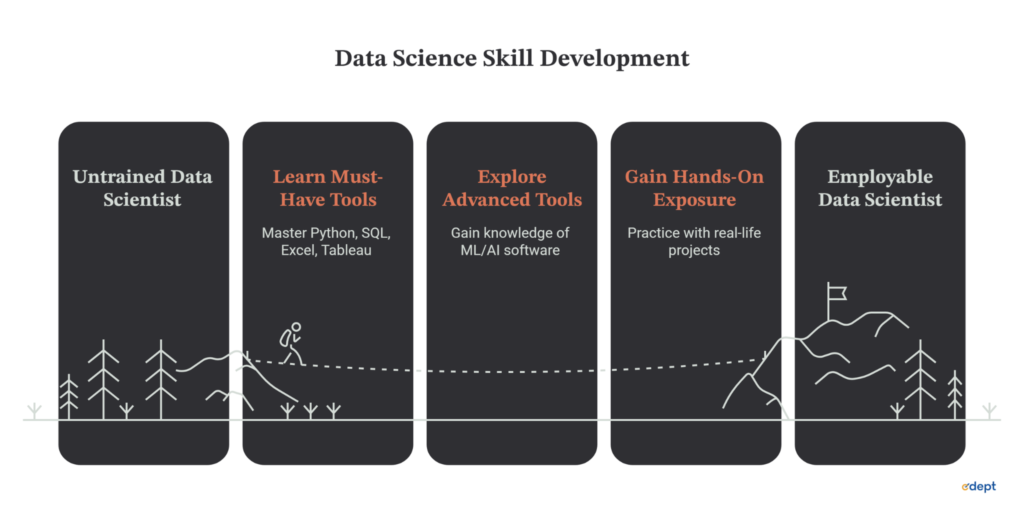
The tools and technologies taught in a data science course for employment purposes must be aligned with what is actually used by companies in practice. Although concepts matter, recruiters tend to measure prospective employees’ competency in using industry-standard software for data analytics, visualization, machine learning, and business intelligence purposes. Before joining the course, check whether you will gain practical insights into working with these tools.
Must-Have Tools
All would-be Data Scientists are expected to know how to effectively leverage Python, SQL, Excel, and visualization software like Tableau or Power BI. The use of such software enables data cleaning, analysis, reporting, dashboard creation, and decision-making. These skills are essential for an entry-level Data Analyst or Data Scientist position.
Advanced Tools
As your career advances, companies expect knowledge of machine learning and AI-related software. An ideal data science training program must incorporate machine learning and AI software like Scikit-learn, TensorFlow, PyTorch, and cloud-based analytics platforms that will enable practitioners to create predictive models, automate business tasks, and implement AI solutions.
Hands-On Exposure
However, knowing these tools alone is insufficient; students must learn through practice using real-life problems. Courses that offer practice opportunities using industry datasets, machine learning projects, capstones, and industry challenges will be more effective. For instance, the edept Data Science Training Program features industry challenges, practical learning experiences, initiatives by IBM, and capstone projects to enhance practice.
Focus on Practical Learning & Projects
When we talk about the biggest element that differentiates between an average course and a job-focused data science program is practical learning implementation. Organizations look for candidates who can actually provide their services in their business work since day one, instead of just having theoretical learning. Projects are also an important part to show off your technical skills.
Real-World Projects
One must look out for courses that feature projects involving datasets from industries and problems encountered in the business world. Students must receive training in essential skills like data cleansing, data visualization, data prediction, and business analytics. Completing projects will help students learn about the entire process of Data Science and its application in solving business problems.
Portfolio Development
A well-designed portfolio will certainly increase job opportunities in an extremely competitive job market. Good programs will always motivate students to create a GitHub portfolio, present their project results, and document the case studies they have done. Such a portfolio will clearly demonstrate to the recruiter one’s competence and problem-solving skills.
Capstone Projects
The most useful part of any Data Science course may be the capstone project because it gives an idea about the student’s ability to work in the real world. Capstone projects are designed to assess whether students can use the knowledge gained through the course to solve real-world business problems using multiple competencies. Recruiting agencies often pay attention to capstone projects when assessing candidates for employment positions in the Data Science field.
Review Placement Support & Career Services
Having a strong curriculum and technical skills are essential, but they are only a part of what makes a job-focused data science program effective. Career support, industry exposure, internships, and placement support play an important role in helping students transition from learning to employment. Before you opt for any program, evaluate how it can support you as a student throughout your job search journey.
Placement Assistance
Many universities and institutions make placement promises, but that should not lead students to divert from focusing on the actual support provided. A job-focused data science program should offer structured career guidance, internship opportunities, job referrals, and employer networking. For example, edept’s Data Science program provides 100% placement support through a network of 300+ recruiting partners, helping students access opportunities across technology, analytics, and AI-driven industries.
Resume & Interview Preparation
Having good technical knowledge alone will not help you secure a Data Science role in a reputed organization. Effective career services should include resume-building workshops, LinkedIn profile optimization, mock interviews, aptitude preparation, and communication skills training. These activities do help students to present their projects, certifications, and technical skills more effectively during recruitment processes.
Hiring Partner Network
Industry connections also create valuable opportunities for internships, projects, mentorships, and placements. To cite an example, the edept Data Science Program includes job placement, career guidance, resume building, mock interviews, and a recruiting network of over 300 partners. edept strengthens your employability through industry certifications from Deloitte, IBM, and NASSCOM, along with IBM internship opportunities for top performers and dual capstone plus industry projects that provide practical experience valued by recruiters.
Power the Data Revolution, Become a Data Science Expert. Click Here!
Compare Program Duration & Flexibility
When choosing a job-focused data science program, flexibility should be the primary asset, alongside curriculum quality and industry exposure. The right program should fit your learning goals while providing enough practical training to prepare you for real-world Data Science roles. Students should evaluate the duration, learning structure, projects, certifications, and career support before enrolling.
Full-Time vs Part-Time
Full-time programs are ideal for students who want an immersive learning experience and faster career progression. Part-time options offer greater flexibility for learners balancing academics, internships, or other commitments. Choose a format that allows you to consistently develop your technical and practical skills.
Self-Paced vs Live Classes
Self-paced learning provides flexibility, while live sessions offer direct interaction with faculty, mentorship, and structured guidance. Programs that combine both approaches often deliver a better learning experience by balancing convenience with personalized support.
Time Commitment Required
Data Science requires consistent practice across programming, analytics, machine learning, and project work. Look for programs that go beyond classroom learning by including industry projects, internships, certifications, and capstone experiences. For example, edept’s Data Science program includes industry projects, dual capstone projects, Deloitte, IBM, and NASSCOM certifications, IBM internship opportunities, and a GenAI Practitioner Certificate to help students build job-ready skills throughout their learning journey.
Analyze Cost vs Return on Investment
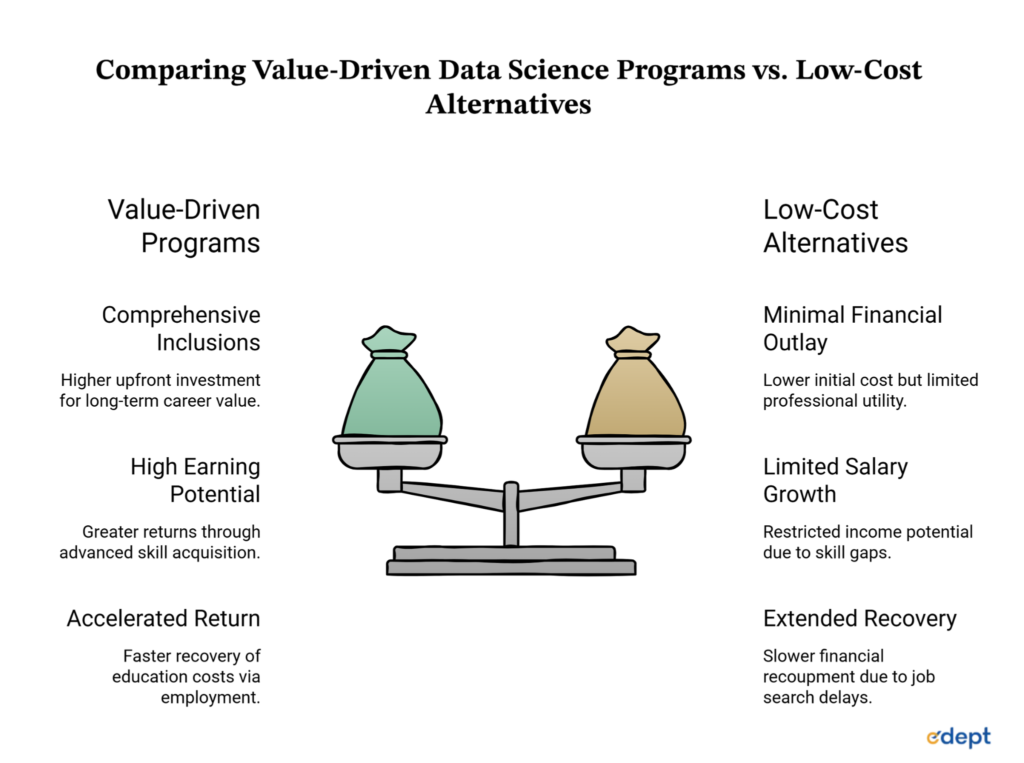
In choosing a data science course focused on gaining employment, one should look at more than just the cost of the course in terms of ROI. A good course is not only more valuable in the long run but will provide far greater returns in the future compared to an expensive course with little outcome.
Program Fees
The cost of a job-focused data science program can vary depending on the curriculum, industry exposure, certifications, and career support offered. Instead of evaluating a program solely on tuition fees, students should assess the overall value it provides. For example, programs that offer certifications from organizations such as IBM, Deloitte, and NASSCOM, along with industry projects and internship opportunities, can provide stronger career outcomes and a better long-term return on investment.
Expected Salary Outcomes
One of the biggest advantages of pursuing a Data Science career is the strong earning potential across various roles. Salary packages typically increase with experience, specialization, and technical expertise.
| Job Role | Average Entry-level Salary |
| Data Analyst | ₹3.5 – 6 LPA |
| Business Analyst | ₹4 – 7 LPA |
| Data Scientist | ₹5 – 11 LPA |
| Machine Learning Engineer | ₹6 – 12 LPA |
| Data Engineer | ₹5 – 10 LPA |
| NLP Engineer | ₹6 – 12 LPA |
| AI Engineer | ₹6 – 15 LPA |
Payback Period
Payback period means that after getting a job, how soon can one get his/her money back that was spent on education. Those programs that help one to get practical skills, industry-certified projects, placement assistance, etc., make for a shorter payback period.
Verify Certifications and Credibility
Before joining any data science program based on employment purposes, you should make sure that the institute, curriculum, certifications, and industrial partners are credible in some way. Being in a credible program can benefit you by making your CV look good, giving your employer confidence in your profile, and increasing your chances of landing a suitable job.
Recognition
Make sure that the program comes from a university or an accredited institute. This will increase its credibility as a program and add some prestige to the education you will obtain from it.
Recognition in Industry
When talking about any certifications, it is necessary to see whether the institute has established some partnerships with the industry, giving you an insight into real-life problems that you would solve after graduating from the program.
Career Successes of Alumni
As an additional indicator, you can check out some stories written by previous students or some information concerning their careers after graduation. If they are doing well, chances are high that you will also do just fine.
Red Flags to Avoid
Every data science program will not guarantee the results they claim. It is important to consider whether you are taking a relevant program with practical exposure before applying for the course. Some programs may not meet expectations, and identifying potential pitfalls before starting can save you valuable time and money in the long run.
No Real Projects
It is common knowledge that most industries require candidates to demonstrate experience using a diverse dataset and implementing a solution. This means that an educational program should provide practical exposure to students via projects, case studies, industry-based courses, and other opportunities to enhance practical expertise.
Outdated Curriculum
Data Science evolves daily, and new programming languages, techniques, cloud environments, analytical approaches, and machine learning frameworks emerge regularly. This means that choosing a program that covers outdated material or does not include modern aspects of the industry will make you less employable after graduation.
Unrealistic Placement Claims
Some educational institutions may claim to provide job placement upon completion of their program, but cannot offer any proof of success. Such programs will not provide employment assistance or offer internships; therefore, they may be suspicious. Instead, choose a reputable educational institution offering career services and practical training.
Conclusion
Choosing the right job-focused data science program can have a significant impact on your career growth, employability, and long-term earning potential. Before enrolling, evaluate the curriculum, tools, and technologies covered, project-based learning opportunities, faculty expertise, certifications, placement support, and overall return on investment. A strong program should help you build practical skills, gain industry exposure, and prepare for real-world Data Science roles. Remember that not all programs offer the same value. Taking the time to research, compare options, review alumni outcomes, and assess industry relevance can help you make a more informed decision. Focus on programs that combine technical training with hands-on projects, career services, and industry-recognized certifications. Before making your final choice, compare multiple programs carefully and select one that aligns with your career goals, learning style, and professional aspirations. The right investment today can help you build a successful and future-ready data science career.
Related Links:
| Data Science Courses for Beginners | Is Data Science a High-Paying Job? |
| Data Analyst to Data Scientist | Does Data Analytics require Coding? |