India is short of data professionals by a margin that is not closing anytime soon, with demand expected to cross 11 million by 2026. If you have been wondering whether now is the right time to pursue a data analyst career, the answer is straightforwardly yes. Salaries, skills, job roles, and a practical starting roadmap are all covered here.
India is generating data faster than its workforce can make sense of it. The country’s datasphere is expected to hit 2.9 zettabytes by 2025, and organisations across every sector are sitting on information they simply do not have enough skilled people to interpret and act on. The 2025 Jobs on the Rise survey of LinkedIn ranks data analyst jobs as one of the top ten growing jobs in India, alongside increased hiring for technology, finance, health care, retail, and manufacturing sectors. So is data analyst a good career in India in 2026? Directly put, yes. The combination of a genuine talent shortage, salaries that have been rising consistently, and career opportunities in data analytics spreading across industries makes this one of the stronger professional directions available to both freshers and working professionals right now. This blog covers what the role actually involves, what data analyst demand in India looks like sector by sector, realistic salary figures, and how to build the skills that get you hired.
What is a Data Analyst?
Before committing to any career path, it is worth understanding exactly what the role involves day to day, not just the job title. Data analytics scope in India has grown considerably, and the work itself has evolved alongside it.
A data analyst collects, organises, and interprets data to help organisations make decisions that are grounded in evidence rather than instinct. The role sits where statistics, technology, and business understanding overlap, and it shows up across virtually every industry that generates meaningful volumes of information, which in 2026 means almost all of them.
Types of Data Analysts
The data analyst title covers several distinct specialisations depending on the function and sector.
| Type | Focus Area |
| Business Analyst | Improving business processes using data |
| Financial Analyst | Analysing financial data for investment and planning |
| Marketing Analyst | Measuring campaign performance and customer behaviour |
| Healthcare Analyst | Interpreting clinical and operational data |
| Operations Analyst | Optimising supply chain, logistics, and internal processes |
| Product Analyst | Using data to guide product development decisions |
| BI Analyst | Building dashboards and reports for business intelligence |
Who is a Data Analyst?
Understanding who fits this role naturally helps freshers and career changers assess whether it is genuinely right for them, rather than just chasing demand. Careers in data analytics suit a specific kind of professional mindset.
A data analyst is someone who asks questions of data and finds answers that the business can actually use.The actual work involves pulling data from several different sources, working through it until you are confident it is reliable, digging into it to find patterns or anything that does not add up, and then putting your findings in front of people who did not run the analysis and need to understand it quickly.
The difference between a data analyst and someone who is good with spreadsheets comes down to that second part. Technical skills get you to the numbers. Business acumen determines whether those numbers mean anything useful to the people making decisions.The analyst does not just produce numbers. They interpret what those numbers mean for the organisation and communicate that interpretation clearly enough to influence decisions. This is why careers in data analytics tend to suit people who enjoy problem-solving, are comfortable sitting with detail, and can hold a conversation with both technical teams and senior stakeholders without losing either audience.
Why Choose Data Analyst as a Career in India?
Plenty of technology careers are competing for attention in 2026, so it is worth being specific about what makes data analytics scope in India genuinely worth your time rather than just another option on a crowded list.
- Job security that holds up: There is a human layer to data analyst work, the interpretation, the context, the communication, that current AI tools support rather than take over. Employers are not replacing analysts. They are looking for more of them.
- Salaries that have been rising: Entry-level data analyst packages in India have moved upward consistently over the past three years. Mid-level professionals who have built the right combination of skills are earning figures that hold up well against established technology roles that have been around far longer.
- Sector variety: Career opportunities in data analytics are not concentrated in one corner of the economy. Banking, e-commerce, healthcare, logistics, telecommunications, and government are all active hiring markets. Getting into this field does not mean tying yourself to a single industry for the rest of your career.
- Flexible working arrangements: Few technology roles offer the remote and hybrid flexibility that data analyst positions do. If working arrangements matter to you alongside salary and growth, this career holds up well on that front too.
- Room to grow: Starting out as a data analyst does not mean staying there. The role is a well-recognised stepping stone into data science, machine learning, and analytics leadership. The foundation you build transfers directly into more senior directions when you are ready to pursue them.
For freshers in particular, data analyst is good for freshers because the entry requirements are more accessible than most people assume, and a structured programme can take someone from foundational knowledge to genuinely job-ready within six to twelve months of consistent effort.
Read More: Is Direct Admission in Data Analytics Courses Worth It in 2026?
How to Become a Data Analyst?
Many people want to move into data analytics but are not sure where the starting point actually is. The good news is that data analyst demand in India has created multiple entry routes, not just one.
- Start with the foundations: Statistics, basic mathematics, and an understanding of how data is structured and stored are where everything else builds from. Free resources and structured courses both serve this stage well.
- Pick up the core tools: SQL, Excel, and Python appear in data analyst job descriptions across India more than any other tools. These three are the ones to learn before anything else.
- Get comfortable with visualisation: Power BI and Tableau are widely expected at interview stage. Working familiarity with at least one of them is worth developing early.
- Work with real data: Kaggle, government open data portals, and personal projects all give you something to show employers beyond a list of completed courses.
- Go through a structured programme: Guided learning adds credibility and provides the kind of practical, supervised experience that self-study rarely replicates fully.
- Apply before you feel ready: Data analyst is good for freshers who start applying while they are still learning. Entry-level hiring often values foundational competency. Also, genuine enthusiasm really shows and hirers spot that or priortise over prior experience.
What Does a Data Analyst Do?
Before committing to any career path, knowing what the work actually looks like on a Tuesday afternoon matters more than what the job title sounds like. Careers in data analytics follow a recognisable rhythm of core activities that show up consistently regardless of which sector you land in.
Data Analyst Tasks and Responsibilities
- Pulling data from internal systems, databases, and external sources, often from several places at once that do not always talk to each other cleanly
- Cleaning and validating datasets until the information is accurate enough to trust and usable enough to build on
- Running exploratory analysis to find trends, patterns, and anything that looks like it does not belong
- Building dashboards and reports that turn analytical findings into something a non-technical reader can follow without needing a walkthrough
- Presenting insights to stakeholders who did not run the analysis and need the conclusions explained in plain language
- Sitting with business teams to work out what questions the data should actually be answering before anyone starts looking
- Keeping an eye on ongoing metrics and raising the alarm when something shifts in a way that warrants attention
- Feeding data-backed recommendations into decision-making processes rather than leaving conclusions sitting in a spreadsheet nobody reads
- Working alongside data engineers and data scientists when the analytical problem is too large or complex to handle from one side alone
- Keeping documentation up to date and holding data quality standards across projects so the work remains reliable over time
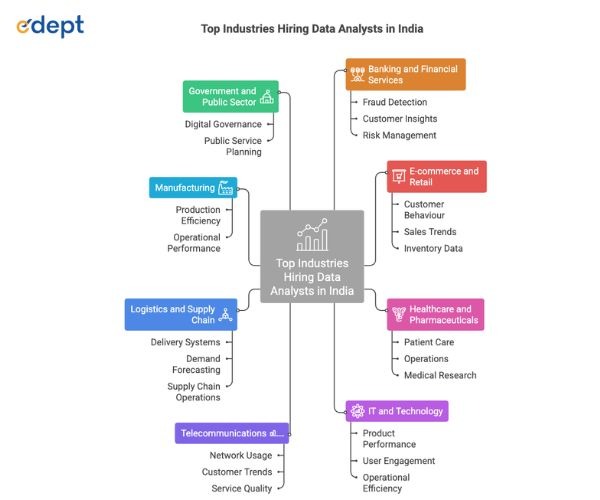
Why is Data Analyst in High Demand in India
Data analyst demand in India is being pushed up by several forces that are not going to reverse in the near term, and understanding them helps explain why data analytics scope in India keeps widening.
India’s digital economy is expanding at a pace that creates data faster than most organisations can process it. UPI transactions crossed 100 billion in a single year. E-commerce, fintech, healthtech, and edtech are all generating information at a scale that requires dedicated analytical capability to extract anything useful from. The government’s push toward data-driven decision-making through Digital India is adding public sector demand alongside private industry hiring.
Global capability centres operating out of India, over 1,700 according to NASSCOM, are increasingly housing analytics functions for multinational organisations. This creates stable, well-paying data analyst roles tied to global demand rather than domestic market swings alone.
The reach of career opportunities in data analytics has also moved well beyond the established technology hubs. Cities including Ahmedabad, Jaipur, Kochi, and Coimbatore are all seeing real growth in data analyst hiring as regional economies digitise and local organisations start building their analytical capability from the ground up.
What are the Tools and Technologies Used by Data Analysts?
The tools you know determine the roles you can apply for. Also, it gives you an understanding of the remuneration you might receive from the employer. Here is a breakdown of what data analysts are actually using across these three markets in 2026.
| Tool / Technology | Purpose |
| SQL | Querying and managing relational databases |
| Python | Data manipulation, analysis, and automation |
| Microsoft Excel | Data organisation, pivot tables, and basic analysis |
| Power BI | Business intelligence dashboards and reporting |
| Tableau | Data visualisation and interactive reporting |
| R | Statistical analysis and data modelling |
| Google Analytics | Web and digital marketing data analysis |
| Apache Spark | Large-scale data processing |
| Jupyter Notebook | Interactive data analysis and documentation |
| Git | Version control for analytical code and projects |
Skills Required for Data Analyst Career
Building a profile that stands out in the careers in data analytics job market requires both technical capability and the softer skills that employers consistently look for, alongside the technical side.
Technical Skills
- SQL: Shows up in more data analyst job postings across India than any other single skill. Use daily for extracting and controlling data from relational databases.
- Python or R: Python is the more common of the two in Indian hiring. Used for data cleaning, analysis, and building the pipelines that feed analytical work.
- Data visualisation: Power BI or Tableau proficiency is expected in most mid-to-senior data analyst roles. Pick one and go deep before worrying about the other.
- Excel: Still part of daily life in most data analyst roles, regardless of how sophisticated the surrounding toolkit is.
- Statistics: Distributions, hypothesis testing, correlation, and regression sit underneath almost all meaningful analytical work.
- Machine learning basics: Not required everywhere, but showing up more frequently in postings as data analyst demand in India shifts toward more sophisticated work.
Soft Skills
- Communication: Explaining findings to people who did not run the analysis is often harder than running it. This skill matters as much as any technical one.
- Problem-solving: Defining the right question is frequently harder than finding the answer. Analysts who do this well are noticeably more valuable than those who wait to be told what to look for.
- Attention to detail: Data quality errors that reach decision-makers have real consequences. Catching them early is part of the job.
- Business awareness: Understanding the commercial or operational context around the data being analysed makes the insights produced considerably more useful to the people receiving them.
- Curiosity: The analysts who find the most valuable things in data tend to be the ones who keep asking questions when others have stopped looking.
Educational Requirements for Data Analyst
The educational landscape for data analyst roles in India is more flexible than many people coming from non-technical backgrounds expect, which is part of what makes data analyst good for freshers from a wide range of academic starting points.
A bachelor’s degree in mathematics, statistics, computer science, economics, or engineering gives you a recognised foundation and is the most common educational background among practising data analysts in India. That said, it is not the only way in. A meaningful number of working data analysts in India have come from commerce, social sciences, or other fields entirely and have built their technical skills through structured programmes and deliberate self-directed learning over time.
What employers look for alongside educational background is evidence that you can actually do the work. A portfolio of projects showing real analytical thinking, certifications from recognised programmes, and the ability to demonstrate tool proficiency when questioned in an interview all carry genuine weight in hiring decisions for career opportunities in data analytics.
For students from non-IT or non-engineering backgrounds, the path takes a bit more groundwork but is entirely achievable. Building foundational mathematics and statistics knowledge before moving into technical tools is the approach that tends to work best, and purpose-built programmes like those offered by edept are designed specifically for people making exactly this kind of transition.
Career Opportunities in Data Analyst in India
Career opportunities in data analytics stretch well beyond the data analyst role itself. Here are the positions most accessible from a strong analytics foundation.
Data Analyst
The core role. Collecting, cleaning, analysing, and presenting data to support business decisions. Available across all major sectors and most Indian cities with a growing technology presence.
Business Analyst
Sits between data insights and business process improvement. Needs strong communication alongside analytical capability and is particularly common in consulting, banking, and enterprise technology firms.
Business Intelligence (BI) Analyst
Focused on building and maintaining the dashboards, reports, and data pipelines that give stakeholders ongoing visibility into key metrics. Power BI and Tableau are the central tools.
Data Scientist
For data analysts who have been building their programming and machine learning skills with a clear direction in mind, a data scientist is the role that tends to come next. The work moves into building predictive models and tackling analytical problems that sit beyond what standard reporting and exploratory analysis can handle.
Power BI Developer
This is a focused specialism that lives within the broader business intelligence space, centred specifically on designing, developing, and keeping Power BI solutions running well. Organisations running on Microsoft infrastructure hire for this consistently, and demand has stayed strong as more businesses standardise on the Microsoft ecosystem.
SQL Developer
A role that suits analysts who genuinely enjoy working close to where the data lives. The focus is on database design, management, and writing complex queries that extract exactly what is needed from large and often messy data environments. Comfort with database architecture is what separates a good SQL developer from someone who can only write basic queries.
Product Analyst
Product analysts sit inside product teams and use data to understand how people actually use a product, which features are landing, and where users are dropping off or getting stuck. Technology companies and startups are the most common employers, and the role feeds directly into how product decisions get made.
Financial Analyst
This role takes data skills and points them squarely at financial planning, investment analysis, risk assessment, and performance reporting. The technical side is important, but so is a genuine understanding of how finance works, because the two have to sit comfortably alongside each other for the work to be credible.
Marketing Analyst
Marketing analysts measure what is working across campaigns, channels, and customer segments and work out what the numbers are actually saying about performance. Google Analytics, CRM data, and attribution modelling are the tools most central to the role day to day.
Data Engineer
The role that builds and looks after the infrastructure that analysts depend on to do their jobs. It is more technical than most analyst positions, requiring strong programming skills and a solid grasp of how data pipelines are architected, maintained, and scaled over time.
Also Read: Data Analytics Admission in India: Your Ultimate Document Checklist
Data Analyst Salary in India 2026
Salaries have been moving in one direction across careers in data analytics for the past three years, and the difference in earnings between professionals with practical, certified skills and those without has kept growing alongside overall demand. Position Salary Range (Per Annum) Entry-Level (0 to 2 years) Rs. 3.5 lakh to Rs. 7 lakh Mid-Level (3 to 5 years) Rs. 8 lakh to Rs. 16 lakh Senior-Level (6 or more years) Rs. 18 lakh to Rs. 35 lakh or more
Specialisations such as data scientist, machine learning engineer, and cloud data engineer are invariably above these numbers by a significant factor. Location is important as well. Bengaluru, Mumbai, and Hyderabad have always had better deals to offer when compared to other cities for similar positions, and this hasn’t changed even as recruitment activities have expanded to other cities across India.
Future Scope of Data Analyst in India Beyond 2026
Data analytics scope in India beyond 2026 is shaped by structural trends that are not reversing, and understanding them gives a clearer picture of where career opportunities in data analytics are heading.
AI and machine learning are being woven into analytical workflows in ways that expand what data analysts are expected to understand. But rather than narrowing the role, this is expanding its value. Analytic professionals who are capable of working with AI technology, challenging its findings critically, and infusing human intelligence into data-based advice will find themselves in higher demand than ever before.
India’s position as an analytics center in the world is only going to strengthen from here on out. The combination of a large English-speaking talent pool, lower costs relative to Western markets, and improving educational infrastructure means global organisations will keep building and expanding analytics capability here. This keeps data analyst demand in India structurally high regardless of short-term economic noise.
Sectors including electric vehicles, agritech, climate technology, and digital health are all building data infrastructure from scratch, and all of them will need analytical talent to make sense of what that infrastructure produces. Career opportunities in data analytics in these areas are currently modest but growing at a pace worth paying attention to.
Salary Bifurcation Based on Position Levels
Pros and Cons of Being a Data Analyst
| Position Level | Salary Range (Per Annum) |
| Entry-Level (0 to 2 years) | Rs. 3.5 lakh to Rs. 7 lakh |
| Mid-Level (3 to 5 years) | Rs. 8 lakh to Rs. 16 lakh |
| Senior-Level (6 or more years) | Rs. 18 lakh to Rs. 35 lakh or more |
How edept Helps You Build a Career in Data Analyst
Finding a programme that builds job-ready data skills rather than just covering theory at surface level is harder than most people expect. edept is built around closing exactly that gap for students and career changers in India.
- Curriculum built around real hiring needs: edept’s data analytics programmes are designed around what employers in India are actually looking for in 2026, not what a syllabus written several years ago assumed they would want. The content stays current because the job market does not wait for outdated curricula to catch up.
- Hands-on training over theory: SQL, Python, Power BI, and statistical analysis are all covered through projects that reflect actual analytical work rather than textbook exercises designed to tick boxes. Students leave with things they can show a hiring manager, not just certificates they can list on a CV.
- Mentorship and portfolio support: For freshers and career changers, edept provides structured mentorship alongside portfolio development support that gives learners something concrete to present when they start applying.
- Direct connections to hiring partners: Placement assistance at edept means active introductions to employers who are genuinely looking for data talent, not a generic job board link sent at the end of the programme.
- Learning paths that meet you where you are: Whether you are starting from scratch, coming from a non-technical background, or looking to formalise skills you have already been picking up on your own, edept structures the journey around your actual starting point rather than assuming everyone arrives with the same foundation.
Start your data analytics career with edept today.
Conclusion
The numbers that frame the data analyst career conversation in India in 2026 are worth sitting with. India’s technology sector generated over $200 billion in exports in 2024, and the analytical capability required to support that level of digital activity continues to grow faster than the available talent can fill it. Separately, the World Economic Forum’s Future of Jobs Report 2025 places data analysts and scientists among the top five roles expected to see the strongest global growth through 2030, and India’s position within that global trend is more favourable than most other emerging markets.
Is data analyst a good career in India? For anyone prepared to build genuine skills and stay current with how the field is moving, the answer is yes by a meaningful margin. Data analytics scope in India is wide, the career opportunities in data analytics are real rather than speculative, and the salaries reflect a market that needs more qualified professionals than it currently has access to. Pick one tool, build consistently, get real project experience behind you, and start applying before you feel entirely ready. The demand is already there. What the market needs is more people ready to meet it.
Related Links: