The comparison between Data Scientist vs AI Engineer has gained more traction in the industry due to the growing influence of Data Science and Artificial Intelligence. These two career options are the fastest-growing careers in the world of technology that allow you to explore innovation, solve difficult tasks, and find innovative solutions.
The problem is that for many people, it is difficult to distinguish between these professions since both of them require programming and analytics. Data Scientists primarily analyze data to uncover insights, support business decisions, and build predictive models. In contrast, AI Engineers focus on designing, developing, and deploying intelligent systems that can automate tasks and learn from data.
Whether you’re interested in solving business problems through analytics or building advanced AI-powered applications, selecting the right direction depends on your interests, strengths, and career goals. AI engineering generally offers faster near-term growth and a higher salary ceiling due to the rapid explosion of generative AI, large language models, and production-ready applications. Data science provides broader stability and foundational corporate integration, but its growth has matured into more specialized or analytical tracks. Users on Reddit generally agree that the two fields divide into statistical exploration versus scalable system building.
Understanding the Difference Between a Data Scientist and an AI Engineer
Although Data Scientists and AI Engineer work with data and artificial intelligence, their responsibilities are different, creating a strong data scientist vs ai engineer. A Data Scientist focuses on analyzing data to generate insights that support business decisions, while an AI Engineer builds and deploys intelligent systems that automate tasks and solve complex problems. Both roles are highly sought after, and the Master’s in Data Science & AI equips students with business, analytics, and AI knowledge through modules spanning Business Analytics, Machine Learning, Artificial Intelligence, Data Visualization, and Data Exploration & Analytics.
What Does a Data Scientist Do?
A Data Scientist transforms raw data into meaningful insights that help organisations make informed business decisions. Their work combines statistical analysis, programming, visualization, and business understanding to solve real-world challenges. Typical responsibilities include:
- Collecting and analysing data from multiple business sources.
- Identifying business insights by recognising trends and patterns.
- Using predictive analytics to forecast future outcomes.
The programme develops these capabilities through modules such as Business Statistics, Marketing & Consumer Analytics, Applied Econometrics for Business Analytics, Python Programming for Analytics, Data Visualization & BI Tools (Tableau/Power BI), Introduction to Data Management (SQL & Databases), and Supervised and Unsupervised Machine Learning.
What Does an AI Engineer Do?
AI Engineers focus on designing, developing, and deploying intelligent systems that can learn from data and automate decision-making processes. Key responsibilities include:
- Designing AI systems for business and technology applications.
- Building intelligent applications using artificial intelligence techniques.
- Developing machine learning models for prediction and automation.
The Germany track strengthens these technical capabilities through modules such as Artificial Intelligence, Data Exploration & Analytics, Data Strategy & Governance, Data Management & High Performance Computing, Digital Infrastructure & Software Development, and Research & Science Project.
Key Responsibilities comparison between Data Scientist vs AI Engineer
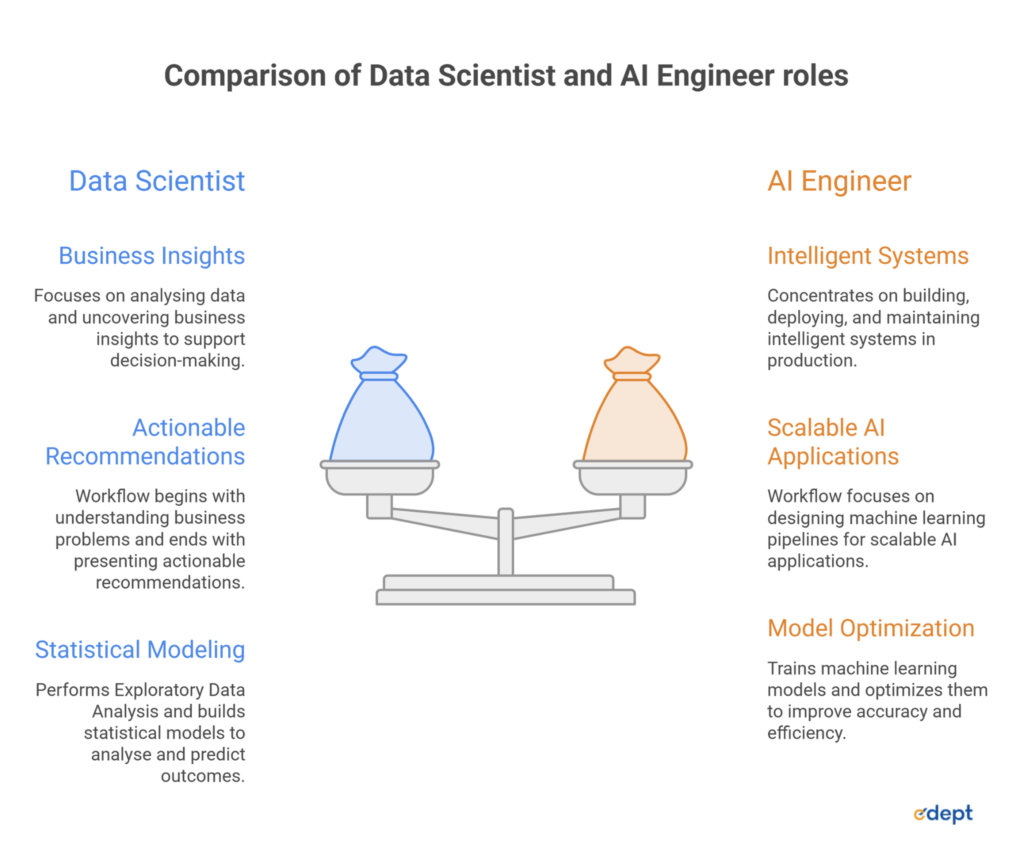
A Data Scientist focuses on analysing data, uncovering business insights, and supporting decision-making, while an AI Engineer concentrates on building, deploying, and maintaining intelligent systems.
Daily Responsibilities of a Data Scientist
A Data Scientist’s workflow typically begins with understanding a business problem and ends with presenting actionable recommendations to stakeholders. Rather than simply analysing data, they help organisations make informed decisions based on evidence. A typical workflow includes:
- Collecting data from multiple business and operational sources.
- Cleaning and preparing datasets to ensure data quality and consistency.
- Performing Exploratory Data Analysis (EDA) to identify trends and patterns.
- Building statistical models to analyse and predict outcomes.
These responsibilities are supported by programme modules including Business Statistics, Python Programming for Analytics, Data Visualization & BI Tools (Tableau/Power BI), Marketing & Consumer Analytics, Applied Econometrics for Business Analytics, and Introduction to Data Management (SQL & Databases).
Daily Responsibilities of an AI Engineer
Unlike Data Scientists, AI Engineers spend most of their time developing and operationalising intelligent systems. Their workflow focuses on building AI solutions that can be deployed and maintained in production environments. A typical AI Engineer workflow includes:
- Designing machine learning pipelines for scalable AI applications.
- Training AI and machine learning models using large datasets.
- Optimising models to improve accuracy and efficiency.
The programme develops these competencies through advanced Germany-track modules such as Artificial Intelligence, Data Management & High Performance Computing, Digital Infrastructure & Software Development, Data Strategy & Governance, Data Exploration & Analytics, and the Research & Science Project.
Skills Required for Data Scientists vs AI Engineers
Technical Skills
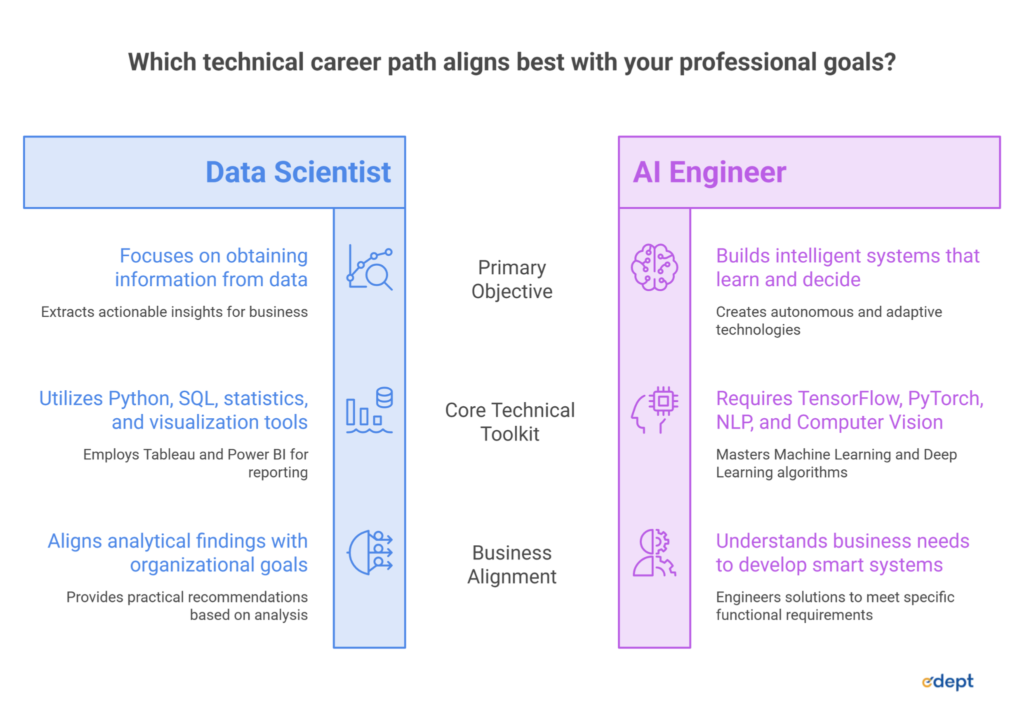
There are many commonalities between the technical requirements of both professions; however, their respective key priorities differ. In the “Data Scientist vs AI Engineer” discussion, Data Scientists place more emphasis on obtaining information from data, whereas AI Engineers have more interest in building intelligent systems that learn and decide.
The Data Scientist role requires an excellent command of Python to analyze and develop models based on the data. This professional also uses SQL to query and manage databases and knows the basics of statistics to make interpretations of the results. Tableau and Power BI are among other tools used by the Data Scientist to build dashboards and generate visual reports. In addition, one must know how to visualize and apply Business Analytics to give practical recommendations on the results of the analysis. The AI Engineer requires an advanced level of expertise in the Python programming language as well as profound knowledge of Machine Learning and Deep Learning algorithms.
Such professionals usually works with the TensorFlow and PyTorch frameworks to create, train, and optimize the AI models. Moreover, knowledge of NLP and Computer Vision is needed to develop intelligent applications like chatbots, recommendation engines, image recognition systems, and autonomous technologies.
Soft Skills
Technical expertise alone is not enough to succeed in either profession. Both Data Scientists and AI Engineers need strong soft skills to solve complex problems and work effectively within multidisciplinary teams. In addition, problem-solving and critical thinking help professionals to analyze problems, consider various alternatives, and make decisions.
Effective communication skills are necessary since technical concepts should be delivered to managers, customers, and other people who do not have a technical background. Another key skill that both professionals should possess is collaboration, as they have to cooperate with software developers, business analysts, product managers, and domain experts. It is important to mention that business understanding is one more crucial component of these jobs. In particular, Data Scientists usually align their analytical findings with the goals of the organization, while AI Engineers should understand business needs to develop smart systems.
Therefore, the comparison of Data Scientist and AI Engineer shows that it is possible to say that the combination of analytical skills and good interpersonal skills helps professionals in both areas to achieve success in their work.
Educational Pathways for Both Careers
Both Data Scientists and AI Engineers require a strong foundation in mathematics, programming, data analysis, and business problem-solving. While many professionals begin with undergraduate degrees, specialised postgraduate programmes help develop the technical and practical skills needed for advanced roles in data and AI.
Degrees and Certifications
Students interested in pursuing careers in Data Science or Artificial Intelligence often come from backgrounds such as:
- Computer Science
- Information Technology
- Data Science
- Artificial Intelligence
- Mathematics
- Statistics
Students who complete the programme graduate with dual qualifications: a PGDM in Analytics from Shree L.R. Tiwari School of Business Management (SLRTSBM), Mumbai, and a Master’s in Data Science & AI from Steinbeis University, School of Next Practices, Berlin.
Importance of Hands-on Learning
Practical experience is essential for applying classroom concepts to real-world business and AI challenges. Employers value candidates who can demonstrate their skills through projects and industry exposure. The programme supports hands-on learning through:
- Innovation Projects integrated into the curriculum.
- Internships in India to gain practical industry exposure.
- Company projects in Germany that connect classroom learning with real business applications.
- Research & Science Project during the Germany track to strengthen analytical and technical expertise.
In addition to these opportunities, students are advised to develop a good portfolio in their professional career by getting involved in open-source development, working on their own data and artificial intelligence projects, and presenting their work via GitHub or similar websites.
Industries Hiring Data Scientists vs AI Engineers
Common Industries
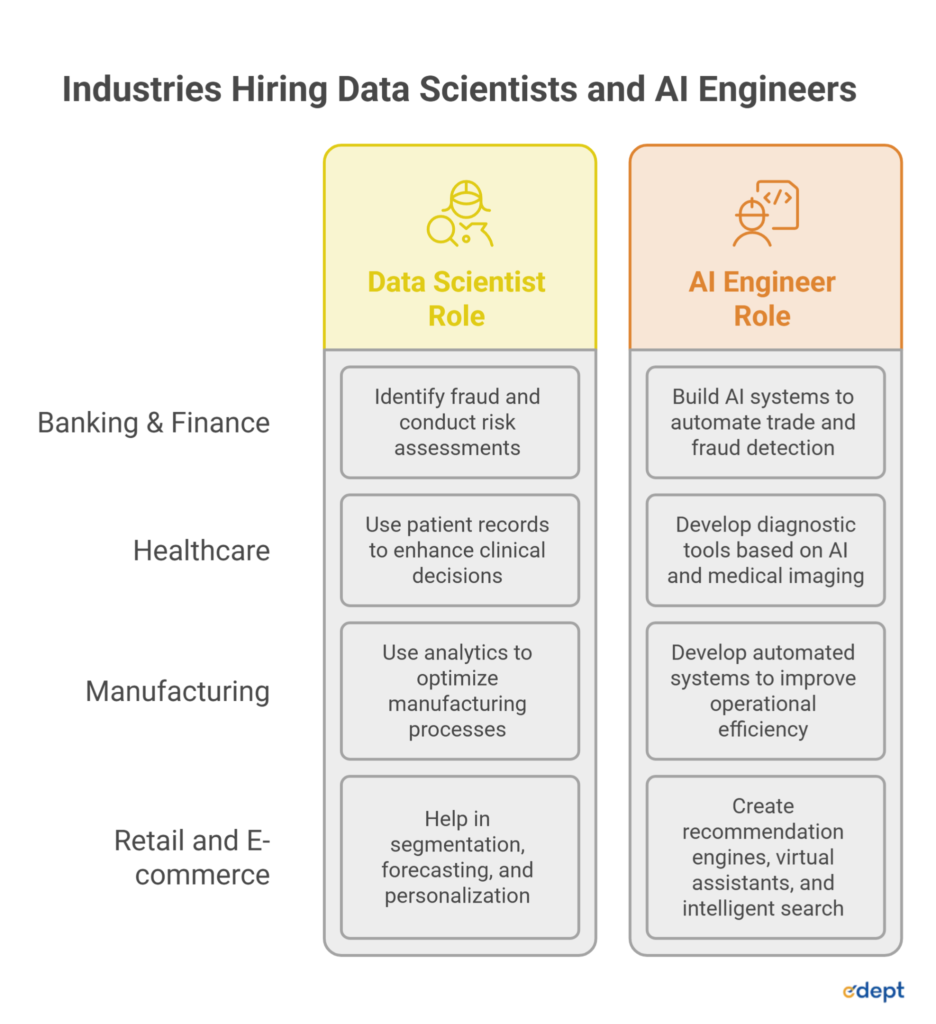
Demand for both Data Scientists and AI Engineers is steadily increasing in almost all industries. About the comparison between Data Scientists and AI Engineers, both professionals have an equally important role to play, but their job roles differ according to the business and technology needs. In the Banking & Finance industry, Data Scientists help identify fraud and conduct risk assessments.
AI Engineers build AI systems that help automate trade and fraud detection systems. On the other hand, Data Scientists use patient records in the healthcare industry to enhance clinical decisions, whereas AI Engineers develop diagnostic tools based on AI technology and medical imaging. Manufacturing organizations make use of analytics to optimize their manufacturing process, whereas AI Engineers develop automated systems that help in improving the efficiency of operations. Industries like Retail and E-commerce rely heavily on Data Scientists who help them in segmentation, forecasting, and personalization, whereas AI Engineers help them by creating recommendation engines, virtual assistants, and intelligent search systems.
Industries such as Automotive, Telecommunication, Technology, and Consulting are some examples of other industries that are recruiting professionals from both backgrounds.
Emerging Industry Applications
Quick technological advancements in Artificial Intelligence provide career prospects for both professions. Generative AI creates new possibilities in content creation, software engineering, customer service, and automation due to language and image generation AI. AI Engineers develop intelligent decision-making abilities in autonomous vehicles, drones, and industrial robots, whereas Data Scientists use operational data to enhance their performance. AI systems help in manufacturing by optimizing production lines and predicting equipment failures prior to their occurrence. AI can predict the likelihood of disease in patients to deliver a more effective treatment. In business, it is used for personalized marketing through the delivery of recommendations according to customers’ behavior and preferences. Machine learning is used to detect cybersecurity threats and anomalies. The above examples prove that both AI and Data Science careers will further evolve as companies will be interested in data-driven innovations.
Career Growth and Future Opportunities
The Master’s in Data Science & AI prepares students for this evolving landscape through a curriculum that combines business analytics, machine learning, artificial intelligence, and industry-focused learning, supported by internships in India and company projects in Germany in comparison to Data Scientist vs AI Engineer.
Career Progression
Although the career paths differ, both offer continuous opportunities for growth as professionals gain technical expertise, business knowledge, and leadership experience. Typical Data Scientist career path:
- Junior Data Scientist
- Data Scientist
- Senior Data Scientist
- Lead Data Scientist
- Chief Data Officer (CDO)
Typical AI Engineer career path:
- Machine Learning Engineer
- AI Engineer
- Senior AI Engineer
- AI Architect
- Head of AI
The following list of highly sought-after career options can be found in the programme brochure: Data Analyst, Senior Data Analyst, Data Scientist, Machine Learning Engineer, AI Specialist / AI Engineer, BI & Analytics Consultant, Data Engineer / Cloud Data Engineer, Digital Transformation Analyst, and Product & Innovation Analyst. They represent a variety of industries ranging from Automotive, Industrial Technology, Software & Cloud, Consultancy, Finance, HealthTech, to Startups. Thus, there is a growing demand for Data Science and AI experts. Both fields are growing very quickly thanks to the continuous development of technologies such as machine learning, artificial intelligence, cloud computing, and analytics. People who constantly improve their technical knowledge and gain business insight at the same time will find themselves in good positions to become leaders.
How to Choose the Right Career for You
Questions to Ask Yourself
The choice of career paths depends on how well each aligns with your interests and strengths. Therefore, while making a decision when comparing Data Scientist vs AI Engineer, it should be noted that both options provide good career prospects; however, they represent quite different job responsibilities. If you like dealing with statistics, processing big data sets, creating impressive visualizations, and solving business-related problems using data, then being a Data Scientist might be the perfect option for you.
As a rule, Data Scientists cooperate with business teams and help organizations make the right decisions based on complex data analysis. If you feel like presenting findings and influencing company strategy with your analytics skills, you will find this profession to your liking. At the same time, if you love algorithms, machine learning, deep learning, and software development, then a career as an AI Engineer seems to be more interesting. If you like to create intelligent software and train AI, then you will definitely like this profession.
Ultimately, the Data Scientist vs AI Engineer decision should be based on your personal interests rather than job titles or market trends. Building strong technical fundamentals first allows you to explore both fields and gradually specialize in the career that best matches your skills and aspirations.
How a Master’s in Data Science Builds the Foundation for Both Career Paths
A well-designed master’s programme equips students with the knowledge and practical skills needed to pursue either Data Science or Artificial Intelligence. Rather than limiting learners to a single specialization, it builds a strong foundation across programming, analytics, machine learning, and business problem-solving, giving graduates the flexibility to choose the career path that best matches their interests.
In the Data Scientist vs AI Engineer discussion, this versatility is one of the biggest advantages of a comprehensive postgraduate education. The Master’s in Data Science & AI begins by strengthening core technical competencies through Python Programming for Analytics, SQL & Database Management, Business Analytics, Data Visualization & BI Tools, Machine Learning, Artificial Intelligence, and Cloud Computing. Students also develop analytical thinking through subjects such as Business Statistics and Applied Econometrics, preparing them to solve both technical and business challenges.
In addition, the programme builds on the career readiness of the students through innovation projects, internships in India, and project work in Germany so that the students can put their classroom knowledge into practice in industry. In the Germany track, the students get exposure to international education by learning advanced courses like High Performance Computing, Data Strategy & Governance, Artificial Intelligence, and Data Exploration & Analytics. With additional language classes in German and dual-degree possibilities, the programme equips students with the option of trying out several careers before selecting between Data Science and AI Engineering as their specialty.
Conclusion
The Data Scientist vs AI Engineer debate is not about choosing a better career—it is about understanding how each role contributes to today’s technology ecosystem. Data Scientists focus on analyzing data and generating insights that support business decisions, while AI Engineers build intelligent systems that automate processes and power innovative applications. Together, they play complementary roles in helping organizations solve complex challenges and drive digital transformation. The right career choice depends on your interests, preferred work style, and long-term professional goals rather than which job title is more popular. If you enjoy business analytics and data-driven decision-making, Data Science may be the ideal path. If you are passionate about algorithms, machine learning, and building intelligent software, AI Engineering could be a better fit. Regardless of the direction you choose, building strong fundamentals in programming, analytics, mathematics, and machine learning first will provide the flexibility to specialize, adapt to emerging technologies, and achieve long-term career success.
Related Links:
| Top Business Analytics Careers | Data Analytics Course Syllabus |
| Soft Skills for Data Analytics | Data Science courses for Non-IT Students |