Hidden admission criteria for Data Analytics programs often extend beyond standard GPA and degree requirements to include specific prerequisite coursework in statistics, programming, or mathematics, which non-technical applicants may need to complete via bridge courses or conditional admission.
Technology is a vast topic, and it evolves with each passing decade. Trends change, tech stacks change, but one thing remains the same: the use of data. To gather insights from data and to create action plans based on this data for the benefit of businesses, this is where the demand for data analytics professionals comes in. In industries like finance, technology, healthcare, and retail, demand for data analyst professionals is skyrocketing. As more students aim to build a career in data analytics in India, the number of courses promising placements has also increased.
Guaranteed placements can be seen everywhere across different private institutes or bootcamps, but the reality is quite different. Not all data analytics courses with guaranteed placement actually deliver their promises. Their representative do tell you that they are linked with top organizations, but they don’t have perfect data to back their claims of placements.
Many programs focus heavily on theory, which leaves students unprepared for real-world roles. On the other hand, there are some career-integrated programs that combine academics, industry exposure, and global opportunities. This creates an easy pathway towards employment for students.
In this guide, we will help you understand how to choose the right data analytics course for you. We will guide you on what exact qualities of a program to check, like curriculum quality, industry alignment, internships, real company projects, and international exposure. Understanding all the important points will help you decide the perfect course to choose from, so you can invest in a program that truly leads to job opportunities, not fake promises.
Why Placement Matters in Data Analytics Courses
When it comes to students enrolling in courses, they are not just enrolling for the sake of it; they are investing time, money, and effort with one clear goal, that is to get a good job. This is why choosing a data analytics course with guaranteed placement is essential for you.
The main hurdle nowadays that students face when enrolling in courses is that many courses don’t teach what exactly the companies expect from the students. They may give you theoretical knowledge, but employers expect you to work with real data, tools, and business problems from day one. This is where placement-focused programs make a difference.
Courses that actually integrate internships, live projects, and industry exposure will help you bridge this gap between what you know and what employers want effectively. Programs that actually provide internships in India, along with projects in international environments, provide students with hands-on experience even before they graduate. This gives them the upper hand ahead of those who have no hands-on experience under their belts.
Additionally, a well-designed career support program that includes interview preparation, mentoring, and guidance on working in global environments also improves the placement outcomes significantly. In simple terms, the right course will take you step by step from a candidate to a working professional.
Read more: Top 10 data analytics tools for beginners
What “Guaranteed Placement” Really Means
Many students often misunderstood the term “data analytics course with guaranteed placement”. Multiple institutes use this term as their marketing phrase, but in reality, the placements entirely depend on multiple factors, including your performance, skills, and participation.
During your search for data analytics courses, you will come across different types of placement promises like:
- Placement Assistance: Includes benefits like resume building, interview preparation, and access to hiring networks, but does not guarantee a job.
- Recruitment Partnerships: Institutes collaborate with companies to create direct hiring pipelines.
- Job Assurance: Some programs offer job opportunities if you meet specific criteria, like attendance, project completion, and performance benchmarks.
- Internship to Full-Time Conversion: This is one of the most effective pathways for students to work on real projects and transition into full-time roles based on performance.
Out of all the points, students gain hands-on experience through internships and working on real company projects in a strong career-oriented program. It is very important for students to understand that “guaranteed placement” usually comes with conditions of its own. Most programs expect you to actively participate, complete projects, and meet academic standards.
Smart students look beyond the label of “guaranteed placement”. They look at the past data of the program, what the course actually brings to the table for students, other than just fake promises. You are investing in securing your job career, so choose wisely and always go for the courses that actually complete their promises.
Key Criteria When Choosing a Data Analytics Course
Going for the right data analytics course with guaranteed placement claims requires more than just looking at marketing claims. You should always check whether the program actually prepares you for real-world roles and also long-term career growth. Let’s look at some of those criteria to look for when choosing a data analytics course.
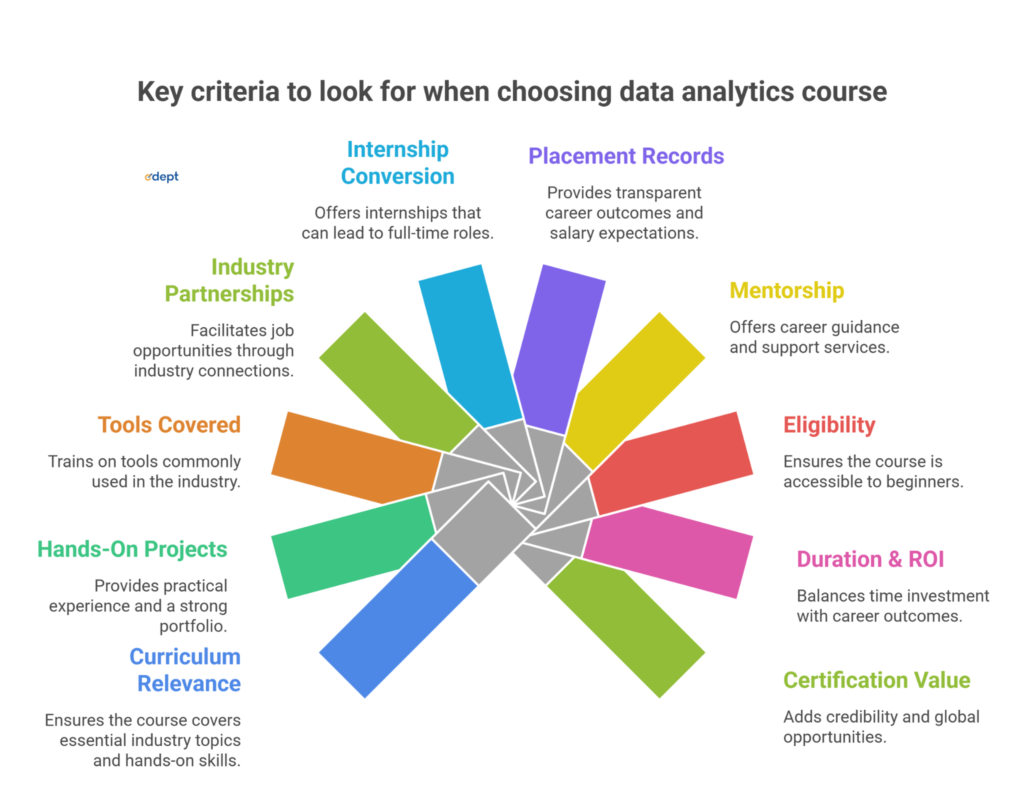
1. Curriculum Relevance
A strong program must cover every industry-relevant topic like data analysis, statistics programming, and business applications. Curriculum should not be just theoretically based, but should also include other hands-on exposure skills.
For example, a well-curated industry-aligned program includes modules like Python, data visualization tools, SQL, machine learning, and other topics based on business analytical concepts. These ensure students gain practical knowledge aligned with industry needs.
2. Hands-On Project & Portfolio
Practical experience is critical. Programs or courses that offer innovative projects, actual data, and research opportunities allow learners to create impressive portfolios.
Having an impressive portfolio will enable you to show your unique skill set, particularly problem-solving skills, which are highly valued by recruiters globally.
3. Tools Covered
The course should train you on the tools that companies actually use in their organizations.
- Advanced Excel & spreadsheet modelling
- Python for analytics
- Data visualization tools like Tableau or Power BI
- SQL & database management
Courses that include these specific tools will prepare you for job-ready roles rather than just academic understanding.
4. Industry Partnerships
Most institutions offering these courses are associated with well-known organizations in some form or another. Industry linkages help students secure jobs more easily. Courses with ties to global universities that offer practical learning through actual company projects can give students an added advantage.
5. Internship to Job Conversion
A job-oriented data analytics course is considered good enough only if it includes internships. Programs specifically designed to offer students internships in India create a pathway for full-time roles based on performance.
6. Placement Records & Transperancy
Don’t just believe in those marketing campaigns and ads when it comes to placement records of an institution. Always check if the course shares actual career outcomes. There are many programs out there with strong highlights, like having assured placements in job roles like Data Analyst, AI Engineer, and BI Consultant. They also show demand indicators such as 100,000+ data and tech job vacancies, and good salary outcomes starting from €45,000–€80,000. This level of transparency indicates real career potential.
7. Mentorship & Career Services
Career guidance and mentoring can contribute greatly to successful placements. When choosing a program, see if they offer services such as interview training, career counseling, and assistance working abroad. Having a structured support system will improve your career outcomes.
8. Eligibility & Entry Requirements
Some advanced courses will assume you have some knowledge about math, logical thinking, or computer programming.
But effective beginner-friendly classes offer guidance, structure, and gradual advancement, thus being more available to many students.
9. Duration & ROI
When students enroll in any courses and programs, they are not just investing their money, they are also investing their time and hard work. Before enrolling, always evaluate whether the time investment matches the outcomes as per your goals.
Programs that actually combine academic learning with early career exposure and international opportunities deliver better ROI in comparison to short-term courses.
10. Certification Value
A course backed by a trusted institution adds credibility to it. Having programs offering dual qualifications from Indian and international universities provides stronger academic recognition and global career opportunities.
Red Flags to Watch Before Enrolling in a Data Analytics Course
Not all courses in data analytics offer guaranteed job placement and live up to their promises. The students will be tricked if they do not confirm the information correctly, which will waste both time and money. Therefore, it is essential to pay attention to specific red signs.
Major red flags you should not ignore before enrolling:
Huge placement claims with no data to back: If a program can’t mention exact job roles, salary ranges, or career outcomes, that’s a warning sign. Reliable programs provide transparent information regarding the opportunities and career paths.
Lack of practical exposure: Courses without internships, live projects, or real-world applications fail to prepare the candidates for actual job roles.
No industry mentors or bad career support: Without proper guidance from someone who has actually walked the path you are about to take, you will struggle to convert skills into jobs.
In addition to all these warnings, offering impossible guarantees without any requirements can be another warning sign. Legitimate programs will always make it clear that placements are based on one’s performance and contributions to the projects. Also, having an unclear fee structure indicates poor transparency.
Also read: Data analytics courses for students
How to Evaluate Placement Support
Before you enroll in any data analytics course with guaranteed placement, you should always verify whether the placement support is actually true or just a marketing claim. Having a simple checklist can save you from taking any wrong steps.
First, start asking for documented placement data, including job roles, industries, and salary ranges. Reliable programs clearly share outcomes like roles in data analytics, AI, and business intelligence. Alongside this, having a realistic career path is important too. Try connecting with the alumni of the course on LinkedIn. They will give you honest insights into whether the course actually helped them secure jobs or was a waste of money and time.
Apart from all these, always verify the industry exposure of the program. A strong program includes internships, real company projects, and hands-on exposure to real-life working projects and tools, not just classroom learning. Always check if the course provides career services like interview preparation, mentoring, and guidance for working in professional environments. Programs like Edept’s data analytics course focus on all these aspects, giving you relevant industry exposure as a student, making you job-ready for the present and the future.
Always ensure that there is a clear pathway from learning to employment, not just fake promises that many programs nowadays make. If a course passes all these checks, it’s worth considering.
Conclusion
Choosing an appropriate Data Analytics program that assures job placement is no longer about trusting in empty promises but about weighing the results. The best program does not involve only academic instruction but is more about equipping the learner with the skills to be ready for the job.
Courses that include internships, real-world projects, global exposure, and structured career support create a clear pathway to employment. Authentic programs don’t just teach you, they prepare you to get hired by reputed organizations.
Always give priority to transparency, curriculum quality, and industry alignment over vague marketing claims. Make the best decision, as your whole career depends on it.
Related Links:
| Which is better? Excel or Power BI | Business Domain Knowledge in Data Analytics |
| All about data visualization tools | Data Analytics Course: Fees, Benefits, Applications, and Insights |