A comprehensive cloud computing career roadmap for 2026 involves building foundational IT skills, mastering a primary cloud provider, learning DevOps tools, and gaining hands-on experience through projects.
Technology is a vast sphere considering the advancements it has seen over the past decade. To power apps and websites, which are core essentials in a tech body, cloud computing is becoming its backbone. As companies are moving their infrastructure to cloud servers, the demand for skilled cloud professionals is increasing with each passing year. You need a precise cloud computing career roadmap to guide you to take the right steps for your career goal.
According to industry reports, over 95% of organizations are expected to run most of their workloads on the cloud by the end of 2026. This shows how massive the career opportunity is for aspirants in this field. Though when it comes to beginners, they fail to cope with one key question: Where do I start?
In this guide, we will take you, as a beginner, on a ride on how you can crack your dream role in cloud computing, while providing you with a step-by-step cloud computing career roadmap. We will cover all the key skills required, certifications, tools, and job roles to help you build a successful career from scratch.
What is Cloud Computing & Why It’s a Top Career Choice?
Cloud computing in today’s tech-dominant world is transforming how businesses operate, making it one of the most in-demand career paths today. From startups to global organizations, businesses rely on cloud platforms for scalability, cost efficiency, and performance.
What is Cloud Computing?
Cloud computing is basically the process of delivering computing services like servers, storage, databases, networking, and software over the internet, instead of using local systems.
It is mainly divided into three types:
- IaaS (Infrastructure as a Service): They provide virtual servers and infrastructure
- PaaS (Product as a Service): Offers platforms for development and application deployment
- SaaS (Software as a Service): Delivers software through the internet, like Gmail, Zoom, etc.
Why Cloud Careers Are in High Demand
Cloud computing is at the center of digital transformation. Businesses are shifting from traditional systems to cloud-based infrastructure for better flexibility and cost savings.
Multiple reports from platforms like LinkedIn and IDC show a 2x growth in demand for cloud, DevOps, and data roles, making cloud skills one of the most valuable in tech today.
Career Scope in 2026 and Beyond
The future of cloud computing looks extremely strong. The global cloud services market is projected to reach $2-3 trillion by 2030, driven by AI, big data, and digital transformation.
Some key benefits cloud computing offers are:
- High job demand
- Strong salary growth
- Global career opportunities
- Long-term job security
Read more: Cloud vs DevOps: Which path to choose?
Types of Cloud Computing Career Paths
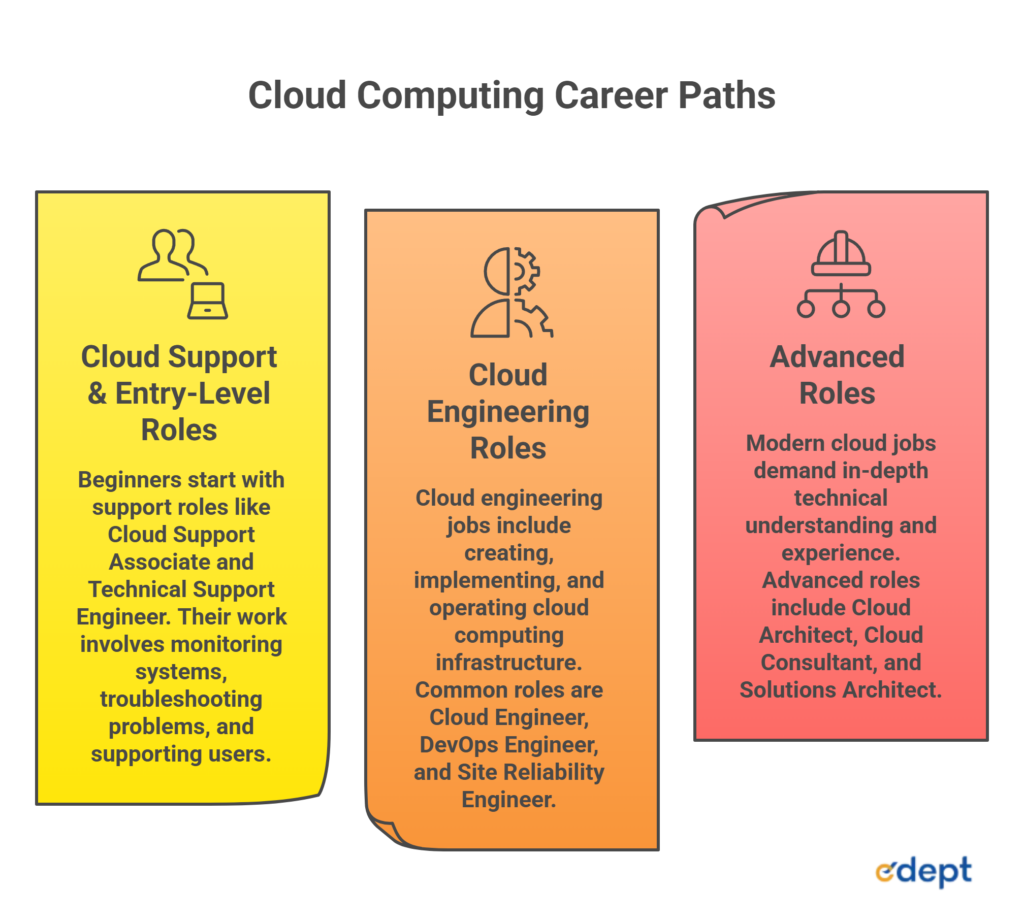
Cloud computing is a vibrant sector offering multiple career paths, depending entirely on your skill level and experience. Beginners can start with support roles and gradually move into engineering and advanced roles with experience.
Cloud Support & Entry-Level Roles
Beginners new to this field start their cloud computing career at entry-level positions. The roles vary, including Cloud Support Associate, Technical Support Engineer, and Cloud Operations Executive. Their main work is oriented toward monitoring systems, troubleshooting problems, and supporting users.
You, as a beginner, will know how to operate on cloud systems in practical circumstances and develop a robust knowledge base in cloud infrastructure through working in these roles.
Cloud Engineering Roles
Cloud engineering jobs include operations like creating, implementing, and operating cloud computing infrastructure. The most common ones are Cloud Engineer, DevOps Engineer, and Site Reliability Engineer (SRE).
These professionals utilize tools and platforms to automate processes and manage servers and server reliability.
Advanced Roles
Modern cloud jobs demand in-depth technical understanding and experience with cloud computing infrastructure. Advanced roles include Cloud Architect, Cloud Consultant, and Solutions Architect.
These professionals develop large-scale cloud systems, develop strategies, and guide organizations on the use and optimization of the cloud.
Skills Required to Start a Career in Cloud Computing
To have a successful career in cloud computing, beginners need a mix of core IT fundamentals, cloud platform knowledge, and practical technical skills. Employers are looking for candidates who can easily understand and operate on systems with hands-on experience with cloud tools.
Core Technical Skills
You need to know the basic IT concepts before you can immerse yourself in cloud platforms. It is important to have knowledge of networking, operating systems (particularly Linux), and computer fundamentals.
Knowledge of how systems interact, how servers operate, and how data flows across networks builds the foundation of cloud computing.
Cloud Platform Skills
Once you have strong basics, you can start learning at least one significant cloud platform like AWS, Microsoft Azure, or Google Cloud Platform (GCP).
All platforms provide services in computing, storage, databases, and networking. The majority of beginners start with AWS because of its popularity, but Azure and GCP are popular in the industry as well.
Additional Skills
To stand out among the top candidates, you should develop strong supporting skills too. It includes:
- Scripting for automation with Python and Bash
- Basic security knowledge to secure cloud systems
- Understanding of DevOps tools and CI/CD pipelines
- Familiarity with databases and APIs
Mastering these skills will help you work more efficiently with improved job readiness.
Also read: Intersection of cloud computing and cybersecurity
Step-by-Step Cloud Computing Career Roadmap
The idea of starting a career in cloud computing is daunting, but having an organized roadmap can make the task much more manageable. With the right steps, beginners can establish strong foundations and slowly progress to well-paying jobs in cloud computing.
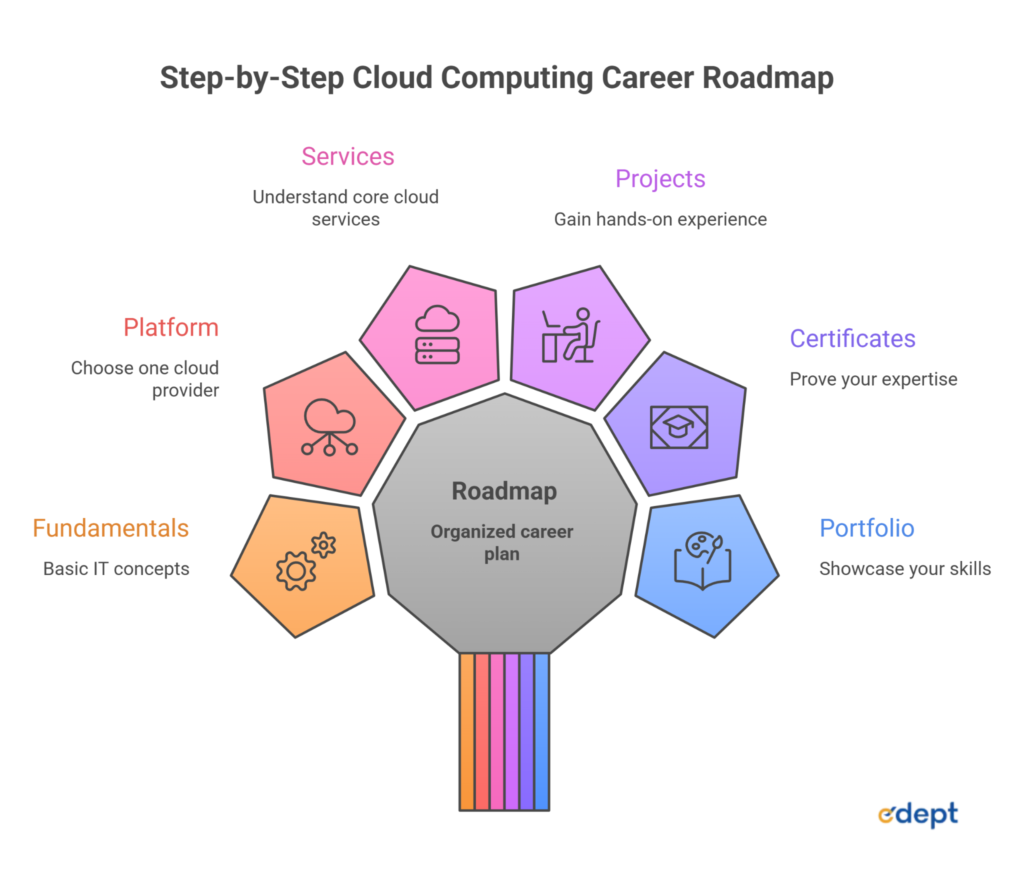
Step 1: Learn Basic IT Fundamentals
Start with some fundamental concepts such as networking, operating systems (Linux), and computer basics. The way servers, networks, and systems operate is essential when moving to cloud platforms.
Step 2: Choose a Cloud Platform
Select one platform to start with: AWS, Microsoft Azure, or Google Cloud Platform (GCP). AWS is popular, Azure is popular in enterprise settings, and GCP is popular in data-oriented jobs.
Step 3: Learn Core Cloud Services
Understand essential cloud services such as:
- Compute (Virtual Machines)
- Storage (Cloud storage systems)
- Databases (SQL/NoSQL)
- Networking (VPC, load balancing)
These services are the backbone of the cloud infrastructure.
Step 4: Work on Hands-On Projects
Work experience is essential. Build projects like:
- Placing a website on the cloud.
- Installation of a cloud database.
- Deploying applications
- Practical learning enables you to learn in a real-life situation and instills confidence.
Step 5: Earn Certificates
Certifications show your expertise and increase your chances of employment. Begin with entry-level certifications and progressively upgrade to higher-level certifications. Some famous certifications include Amazon Certified Solutions Architect, Microsoft Certified: Azure Fundamentals (AZ-900), and Google Cloud Associate Cloud Engineer.
Step 6: Build Portfolio & Apply for Jobs
Prepare a portfolio of your projects, certifications, and skills. Apply to such positions as Cloud Support Associate, Junior Cloud Engineer, or DevOps Trainee.
Taking a step-by-step approach, emphasizing hands-on learning, and slowly acquiring expertise in key cloud skills paves the way for you to succeed in cloud computing.
Why Choose Edept for Cloud Computing Programs
To develop an effective cloud computing career, it is very important to take the correct learning path. The cloud computing program powered by edept runs in partnership with Shree L. R. Tiwari College of Engineering, which is aimed at closing the gap between academic learning and real industry requirements.
Industry-Focused Curriculum
The program is developed keeping the industry demand in mind, covering key areas such as cloud computing, big data, analytics, cybersecurity, and technologies based on AI. Students are taught the concepts that are directly aligned to the job roles in the real world.
Hands-On Training & Projects
Important benefits of the program, like Live projects, industry immersion programs, and real-life case studies, provide students with real-world experience.
International partnerships with companies like Deloitte, IBM, and Practera enable students to work on real business issues and create a powerful portfolio even before graduation.
Placement Assistance & Career Support
The program offers 100 percent placement support, resume construction, mock interviews, career advice, and access to a 300-plus recruiting network.
Flexible Learning Options
The structured learning method integrates academic learning with practical exposure, and thus is appropriate for beginners as well as those who are career-oriented learners.
Top Certifications for Cloud Careers
Certifications are essential in developing a successful career in cloud computing. They authenticate your competencies, enhance credibility, and boost your likelihood of employment. In 2026, the majority of businesses are seeking those candidates who have established cloud certifications plus practical experience.
Beginner Certifications
If you are starting as a beginner, these certifications will help you understand cloud fundamentals from scratch:
- AWS Certified Cloud Practitioner
- Microsoft Azure Fundamentals (AZ-900)
- Google Cloud Digital Leader
Intermediate Certifications
Once you gain basic knowledge, intermediate certifications focus on the real-world implementation and management of cloud systems.
- AWS Solutions Architect – Associate
- Microsoft Azure Administrator (AZ-104)
- Google Associate Cloud Engineer
Advanced Certifications
Advanced certifications are for professionals aiming for senior roles like architects and consultants.
- AWS Solutions Architect – Professional
- Google Professional Cloud Architect
- Azure Solutions Architect Expert
These require deep expertise in designing scalable and secure cloud systems.
Salary Trends in Cloud Computing
One of the most lucrative fields of IT presently is cloud computing, with its high demand and lack of qualified specialists worldwide. With more companies moving to cloud infrastructure, salaries are on the rise at all levels of experience.
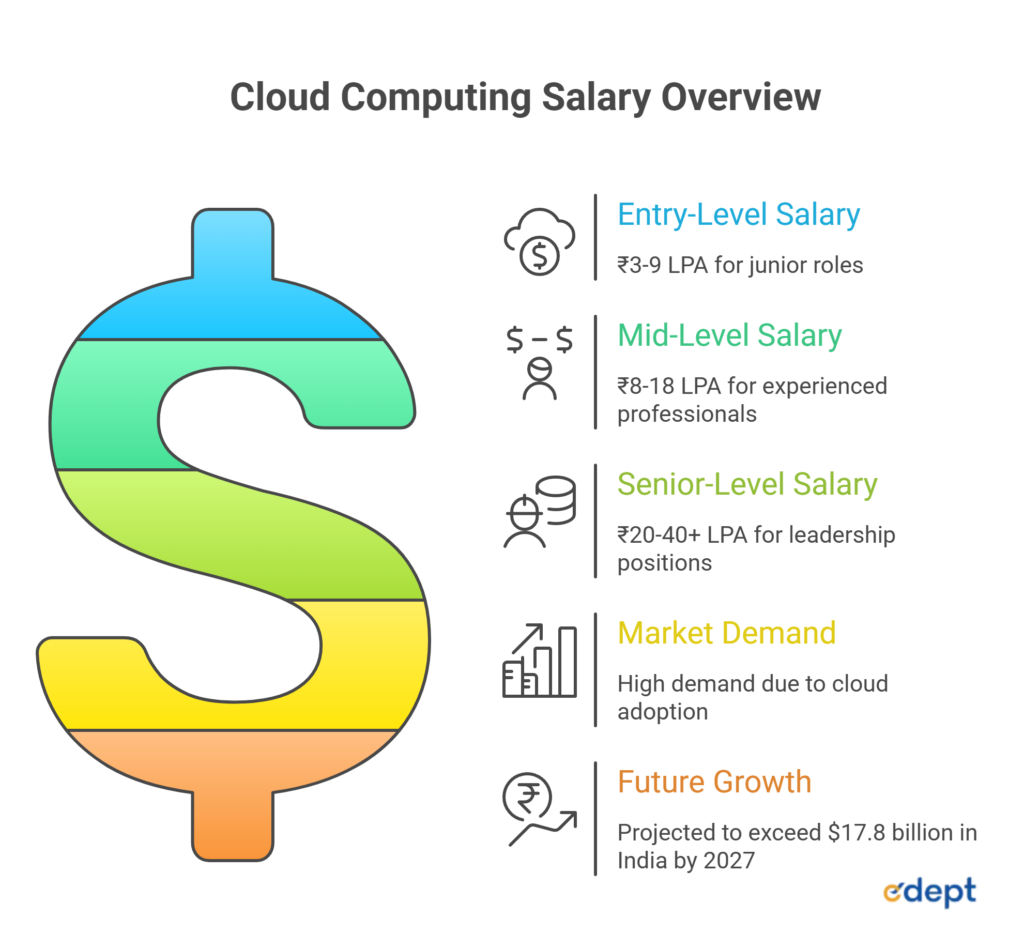
Industry statistics indicate that by 2027, the cloud expenditure in India is projected to surpass the 17.8 billion mark, showing tremendous demand in the field of cloud professionals and significant percentage increases in salary.
Entry-Level Salary
The typical salary for an entry-level position, such as a Cloud Support Associate or Junior Cloud Engineer, is ₹3-6 LPA.
A starting-level job with certifications and practical project experience will earn a candidate up to ₹7 -9 LPA.
Mid-Level Salary Growth
With 25 years of experience, professionals transition into roles such as Cloud Engineer, DevOps Engineer, or Site Reliability Engineer. The salary would be between ₹8 LPA and ₹18 LPA based on expertise and skill.
Rapid salary increases are observed in professionals with expertise in automation, cloud safety, and DevOps tools.
Senior-Level Salary Potential
The salaries of senior professionals such as Cloud Architects and Cloud Consultants range between ₹20 LPA and ₹40 LPA+.
These positions include system design of large-scale systems, cloud strategy, and team leadership.
Common Mistakes Beginners Should Avoid
It is an exciting time of the year with a lot of beginners venturing into a cloud computing career, but most beginners end up dragging their feet in building their cloud computing career, through making unnecessary mistakes. By avoiding these, you can save time, enjoy increased learning efficiency, and increase your odds of being hired sooner.
Learning Without Practice
This is one of the largest errors, as it is possible to concentrate on the theoretical background without real practice. You cannot simply watch tutorials or read concepts, but you must put what you learn into practice.
Cloud computing is a pragmatic subject, and employers want you to have experience working with actual cloud implementations.
Skipping Fundamentals
Numerous amateurs leap immediately into cloud computing without knowledge of fundamentals such as networking, Linux, and system architecture.
In the absence of solid foundations, the high-level cloud concepts are hard to comprehend and implement.
Not Building Projects
It is not just enough to be certified. Most of the candidates go through courses without demonstrating actual work.
To test your skills, recruiters seek out projects and hands-on experience.
Read more: Everything about Cloud security
How to Get Your First Cloud Job
Entering cloud computing may seem daunting; however, when you do it right, the process of getting your first job becomes a lot easier. Skills, projects, and evidence of applied knowledge are sought by recruiters, rather than certificates.
Create a Good Resume
In your resume, it is important to make mention
- Familiar cloud platforms (AWS, Azure, GCP)
- Certifications completed
- Hands-on projects (very important)
- Simple technical (Linux, networking, scripting)
- Make it plain, narrow, and proficient, and not just theory-based
Practice Interviews
Cloud interviews are concept and practical thinking tests. You will need to prepare:
Fundamentals of cloud concepts (IaaS, PaaS, SaaS)
Scenario-based questions
Problem-solving and troubleshooting
Confidence could be improved with the help of mock interviews and practice platforms.
Apply Through the Right Channels
Use platforms like:
- Naukri
- Company career pages
- Referrals (very powerful)
Also apply for roles like:
- Cloud Support Associate
- Junior Cloud Engineer
- DevOps Trainee
Future Scope of Cloud Computing Careers
Cloud computing is poised to take over the future of technology, and therefore, cloud computing is one of the most stable and high-growth career paths. With businesses steadily moving towards using digital solutions, the demand for cloud professionals will continuously increase in various industries.
Integration with AI & Data Science
The cloud platforms are emerging as the basis of AI, machine learning, and big data applications. Businesses depend on cloud infrastructure to process huge amounts of data and to run intelligent software.
Growth in Cloud Security
As cyber threats continue to rise, many organizations are spending a lot of money on cloud security and data protection. Such occupations as cloud security engineer and compliance specialist are expanding quickly.
Increasing Global Demand
Cloud computing is an international expertise, which presents opportunities on both international and local levels, as well as jobs. Talented professionals are scarce, and companies around the globe are employing cloud experts.
Conclusion
Cloud computing presents a career opportunity that is among the best in 2026 and beyond. Being highly demanded, with competitive pay, and a global focus, it is an ideal career choice for beginners in the tech industry who can set their goals.
Your successful cloud career step-by-step can be achieved with the help of a structured roadmap, which includes learning the basics, selecting a platform, creating projects, and gaining certifications.
The most important success factor is the emphasis on practical skills and experience in the real world and lifelong learning.
Related Links:
| Cloud Computing Job Roles | What is Cloud Security? |
| How does cloud security work? | Cloud Skills for Placements |