BBA and BBM generally offer better initial Return on Investment (ROI) than B.Com, with average starting salaries ranging from ₹3–5 LPA compared to B.Com’s ₹2.5–4 LPA. While B.Com programs typically have lower tuition fees, management degrees (BBA/BBM) provide broader corporate entry opportunities and higher early-career earning potential.
After completing your 12th commerce, choosing the right degree is essential, keeping the interest of students and return on investment (ROI). With an increase in education costs and increasing competition in the job market, students today are more focused on how much value a degree delivers in terms of salary, career growth, and long-term opportunities. Considering the investment in returns, BBA vs BCom vs BBM ROI is a key factor to consider when going for the right degree.
This becomes even more important in 2026, with talent hiring shifting towards skills-based hiring, with employers giving preference to practical knowledge over college degrees. In line with the current trends in the industry, organizations are increasingly hiring applicants with industry exposure, certifications, and real-life skills rather than academic qualifications.
This blog gives a comprehensive comparison of BBA vs B.Com vs BBM, comparing fees, trends in salary, scope of career, and ROI that will enable you to choose the right option.
Understanding ROI in Education (Why it Matters)
Having an understanding of ROI in education will help you keep every key aspect, like time, money, and effort, on track. It includes factors like tuition fees, time invested, job opportunities, starting salary, and long-term growth.
What is ROI in a Degree?
Return on Investment(ROI) in the context of education refers to the value you get from your degree compared to what you spend on it. It includes key factors like tuition fees, time invested, job opportunities, starting salary, and long-term growth.
For example, a low-cost degree offering a decent salary will offer better short-term ROI, while a higher-cost degree with strong career growth can provide better long-term ROI.
Key Factors That Impact ROI
Some key factors to consider when determining the ROI of a degree:
- Course Fees: Total investment required
- Placement Opportunities: Job availability after graduation
- Skill Development: Practical exposure and tools
- Career Growth: Long-term salary potential
Look for programs that combine academic knowledge with practical training, internships, and certifications, which tend to deliver higher ROI.
Why ROI Matters in 2026 Career Decisions
The job market in 2026 is rapidly evolving as a result of automation, artificial intelligence, and digital transformation. Employers are putting more emphasis on candidates who are job-ready and can deliver on the first day of employment.
The importance of degrees that incorporate industry projects, certifications, and practical learning is becoming more important than traditional theoretical programs.
Overview of BBA, BCom, and BBM Degrees
Before we start comparing the ROI of these three degrees, it is important to understand what each degree actually offers. While there are commerce-related programs, they differ significantly in focus, skill development, and career direction.
What is BBA?
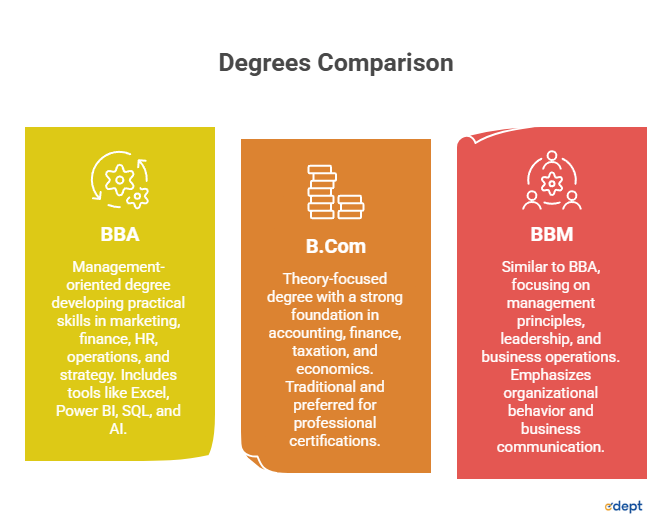
BBA (Bachelor of Business Administration) is a management-oriented degree that is aimed at developing practical management skills. It covers key aspects such as marketing, finance, human resources, operations, and business strategy.
Other tools, such as Excel, Power BI, SQL, and some experience with AI, fintech, and data-driven decision-making, are also components of modern BBA programs, in particular, those with specializations, such as Finance and Analytics.
Internships, live projects, and industry collaborations are examples where students gain practical experience to prepare them to work in real-world environments.
What is BCom?
B.Com (Bachelor of Commerce) is a theory-focused degree with a strong foundation in accounting, finance, taxation, and economics.
It is one of the most traditional commerce degrees and is highly preferred by students who want to pursue professional certifications like CA, CMA, or CFA.
While it provides strong conceptual knowledge, it often lacks practical exposure unless supplemented with additional courses or internships.
What is BBM?
BBM (Bachelor of Business Management) is similar to BBA and focuses on management principles, leadership, and business operations.
The curriculum emphasizes organizational behavior, business communication, and managerial skills, making it suitable for students interested in business roles. However, compared to modern BBA programs, BBM may have slightly less industry integration in some colleges.
Course Fees Comparison (Investment Required)
Having a good understanding of the cost of education is the first step in evaluating your degree’s ROI. Each degree we consider: BBA, BCom, and BBM has a different fee structure depending on the college, infrastructure, and level of industry exposure.
BBA Course Fees
The average cost of a BBA degree is between ₹1 to ₹5 lakh, varying by the college and specialization. Higher programs with industry exposure, certifications, internships and global immersion projects are usually on the higher side.
As an example, BBA programs that combine with finance, analytics, and real-world projects have better career outcomes, which can justify the increased investment.
BCom Course Fees
B.Com is one of the cheapest commerce degrees, which has a range of ₹20,000 to ₹2 lakh as the course fee.
B.Com has good ROI in the short-term, particularly among students who intend to add other certifications to the degree, such as CA or CFA.
BBM Course Fees
BBM course fees usually range between ₹50,000 and ₹3 lakh, placing it between BBA and B.Com in terms of investment.
While it offers management knowledge, the ROI depends heavily on the college’s quality and the level of practical exposure provided.
Salary Comparison After Graduation
When considering ROI, salary is one of the most important factors. While starting salaries may look similar across BBA, BCom , and BBM, differences look clear when you consider skills, specialization, and long-term growth potential.
According to reports from platforms like Naukri and AmbitionBox, entry-level salaries in commerce and management roles vary based on domain and skillset.
BBA Salary Trends
At the entry level, BBA graduates will have an average of ₹3.5 LPA to 7 LPA. The skills in analytics, financial tools, or digital marketing can provide even higher packages.
BBA programs with a focus on finance, analytics, and certifications tend to be more likely to end up in a higher-paying consulting, fintech, and business strategy role.
BCOM Salary Trends
The average pay of BCom graduates ranges between ₹3 LPA and ₹6 LPA. But individuals who have taken professional qualifications such as CA, CFA or CMA can enjoy a significant growth in salary over time.
BBM Salary Trends
At the entry level, BBM graduates earn between 3.5 LPA to 6 LPA. Salaries are determined based on the job and sector, and career prospects are in management, operations and sales.
Growth is comparable to BBA but can differ depending on the exposure to practical experience and specialization.
Fees vs Salary vs ROI Comparison Table
| Degree | Avg Fees | Entry Salary | ROI Type | Best For |
| BBA | ₹1L – ₹5L+ | ₹3.5 – ₹7 LPA | Long-Term ROI | Management, analytics, consulting |
| B.Com | ₹20K – ₹2L | ₹3 – ₹6 LPA | Short-Term ROI | Finance, accounting, CA/CFA |
| BBM | ₹50K – ₹3L | ₹3.5 – ₹6 LPA | Balanced ROI | General management roles |
Career Opportunities & Industry Scope
When we talk about degrees, career scope plays a key role, considering the ROI of the degree. The broader the opportunities and growth potential, the higher the long-term returns. While all these degrees do offer good career options, their industry reach and growth trajectories are very different.
BBA Career Scope
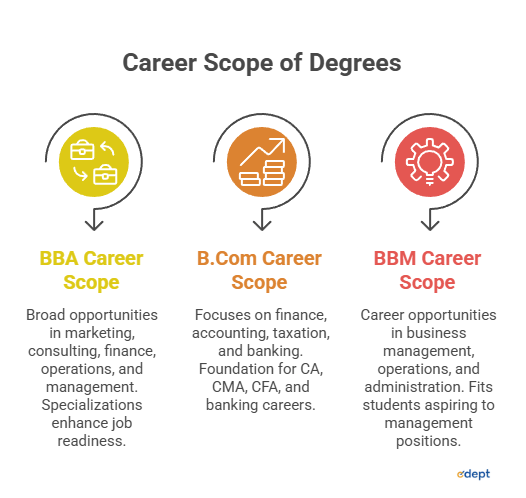
BBA has one of the broadest career scopes in every industry. The graduates have opportunities to join such areas as marketing, consulting, finance, operations, and management.
The newest BBA programs with finance and analytics specializations open opportunities to become a financial analyst, business analyst, and strategy consultant. Internships, live projects, and industry exposure are often included in the curriculum, which enhance job readiness.
BCom Career Scope
B.Com is very much concerned with finance, accounting, taxation and banking. It forms a great foundation towards professional careers such as CA, CMA, CFA, and banking careers.
Graduates are usually employed in accounting firms, financial institutions and corporate finance departments. Nevertheless, career development usually relies on further certifications and specialization.
BBM Career Scope
BBM provides career opportunities in business management, operations and administration. It fits well for students who aspire to pursue careers in management positions in any industry.
Nevertheless, the amount of exposure to the industry and specialization can be different across colleges as compared to the modern BBA programs.
Read more: Is BBA Enough or Should You Pursue MBA Immediately?
ROI Comparison – Which Degree Performs Better?
When we compare BBA, BCom, and BBM, ROI depends entirely on key factors like time horizon, cost, and career growth. No degree is perfect, with each performing differently based on your career goals and how you build your skills.
Short-Term ROI
In short term, BCom offer the best ROI because of its low fees and decent entry-level salaries. Students can recover their investment quickly, especially if they start working right after their graduation.
Best degree choice: BCom
Long-Term ROI
Over the long term, BBA tends to deliver better ROI, especially when combined with an MBA or specialization in fields like analytics, finance, or marketing.
Programs that include industry exposure, certifications, and real-world projects significantly improve long-term earning potential.
Skill-Based ROI
In 2026, ROI is increasingly driven by skills rather than degrees. Candidates with practical knowledge, tools, and certifications earn more regardless of their degree.
Degrees that focus on hands-on learning, internships, and industry collaboration outperform traditional theoretical programs.
Why Skill-Based Learning Improves ROI
The degree itself does not qualify as the biggest factor influencing ROI in 2026, instead it is the skills you develop during and after your degree. Employers are more willing to hire those candidates who are able to put the knowledge to real-life situations, and therefore, skill-based learning would be vital to higher returns.
Gap between Degree and Job Market
The gap between learning in academics and expectations in the industry is one of the primary reasons why students find it difficult once they come out of school. The traditional degrees tend to be more theoretical, and companies require more practical knowledge, tools, and problem-solving skills.
This disparity lowers the level of employability and slows down career development.
Importance of Practical Exposure
Live projects, case studies and internships are among the most effective means of job preparation. Working on real-world problems, students have a better understanding of industry needs and perform well in interviews.
Such programs that incorporate industry projects, global exposure and practical training help the students to develop better portfolios and shine.
Role of Certifications & Internships
The certifications confirm your competence and make you more credible in the job market. Coupled with internships, they will help you acquire real experience prior to graduation, which is very important to recruiters.
The certifications in such fields as finance, analytics, digital marketing, and business tools can greatly increase your potential salary.
Why Choose Edept for Career-Focused Programs After BBA/BCom/BBM
When your objective is to maximize ROI after graduation, then it is important to choose the right program. Collaborative programs with Shree L. R. Tiwari School of Business Management, powered by edept, are developed to provide high employability and readiness to work in industry.
Industry-Aligned Curriculum
The program integrates the foundations of business with finance, analytics, and new technologies such as artificial intelligence, financial technology and blockchain, so students study what the industry requires.
Practical Learning & Live Projects
Students are engaged in live industry projects, internships and global immersion programs where students can work on real-life projects before graduation.
Partnerships with organizations such as Deloitte and IBM give exposure to actual business issues and work processes.
Practical Support & Career Guidance
Our program offer 100% placement assistance, including resume building, mock interviews, and access to a wide industry network.
Programs for High-ROI Careers
Specializations do include finance, analytics, digital business, and management, which are among the highest-paying and fastest-growing career domains.
Explore edept’s career-focused programs and build a high-ROI career from day one. Click here
Higher Education Impact on ROI
Higher education does impact significantly the ROI of your degree. While a bachelor’s degree provides the foundation, advanced education or specialization often shows the long-term salary growth and career progression.
BBA+MBA Career Path
One of the most prevalent and successful management career paths is a BBA coupled with an MBA. An MBA allows you to focus on a specific field such as finance, marketing, consulting, or business analytics, which prepares you for a more highly-paid position.
The salaries of graduates of good MBA programs may vary between ₹10 LPA and ₹25 LPA +, depending on the institute and specialization.
BCom + Professional Courses (CA/CFA)
B.Com students also tend to get professional certifications such as Chartered Accountant (CA), CFA, or CMA, which greatly enhance career opportunities.
The qualifications also provide access to well-paying jobs in investment banking, auditing and corporate finance with salaries increasing at a high rate over time.
BBM + Specialization Options
Graduates of BBM can also increase their ROI through taking MBA or other specialized courses on marketing, Hr or analytics.
Although BBM gives a foundation in management, specialization is required to get a higher increase in salary and advancement in the career.
Skills That Maximize ROI After Graduation
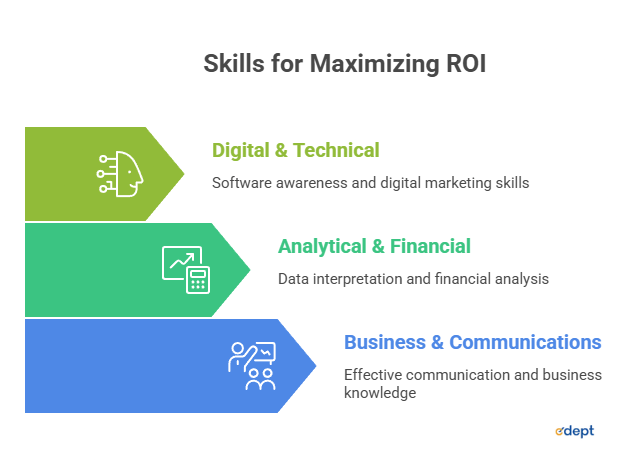
No matter what degree you opt for between BBA, B.Com, or BBM, your ROI ultimately depends on the skills you build alongside your degree. In 2026, employers prioritize candidates who can apply knowledge, use tools, and solve real business problems.
Business & Communications Skills
Effective communication and business knowledge are imperative in every industry. Such skills as presentation, negotiation, teamwork, and leadership can assist you in working successfully in jobs that require client, team, and management skills.
Clear communication of ideas and decision-making are the characteristics of professionals that become prominent in the early years of their careers.
Analytical & Financial Skills
In the contemporary data-driven world, analytical thinking is highly appreciated. Financial analysis, data interpretation, problem-solving, and decision-making are essential skills required to work in finance, consulting, and analytics.
Knowledge of such tools as Excel, financial models, and reporting systems can contribute greatly to better employment opportunities.
Digital & Technical Skills
It is now almost impossible to do any business job without digital skills. Awareness of software such as Excel, Power BI, SQL, digital marketing software and simple analytics software will provide you with a competitive advantage.
Current courses, which involve exposure to AI, fintech, and data analytics, can help keep students up-to-date with industry trends.
Which Degree Should you Choose?
Choosing between BBA, B.Com, and BBM entirely depends on your career goals, interests, and long-term plans. Instead of following trends, focus on what aligns with your strengths and the kind of career you want to build.
- Choose BBA if:
- You want to have a career in management, consulting, marketing, or business analytics
- You have plans to pursue MBA or specialization later
- You prefer practical learning and industry exposure over theoretical learning
Choose B.Com if:
- You are interested in finance, accounting, taxation, or banking
- You have plans for CA, CFA, CMA, or other professional certificates
- You want a low-cost degree with strong fundamentals
Choose BBM if:
- You want to enter management roles with a flexible approach
- You prefer a balanced mix of theory and management concepts
- You plan to specialize later through an MBA or skill-based courses
Conclusion
BBA, B.Com, and BBM has its own benefits as far as ROI is concerned. B.Com offers the highest ROI in the short-run, because of its low cost and stable employment. BBA has the greatest ROI in the long term, particularly when it is paired with specializations or an MBA. BBM is a medium that provides a balanced approach, and its success can be achieved through developing skills and further education.
In 2026, degrees will not be the influential factor, but skills, practical exposure, and certifications will help you on your academic journey. Choose your steps wisely, build skills consistently, and focus on long-term growth to maximize your ROI.
Related Links:
| Best career paths after BBA | Best BBA Specialization |
| Modern Business Management Growth | Top mistakes business management students make |