Businesses today generate enormous amounts of data through customer interactions, online transactions, connected devices, enterprise applications, and digital platforms. However, data by itself has little value unless organizations can transform it into meaningful insights that support better decisions. This is exactly where Business Intelligence for IT professionals has become indispensable. In this blog, you’ll learn why Business Intelligence for IT professionals is becoming one of the most valuable skills in today’s technology landscape, the key competencies students should develop, and how Business Intelligence can unlock career opportunities across industries.
What Is Business Intelligence?
Business Intelligence (BI) is the process of gathering, managing, analyzing, visualizing, and representing business data to make informed decisions. Rather than depending on any guesses or assumptions, the organization uses Business Intelligence in order to turn data into knowledge, which will be used to make plans and solve any problems.
How Business Intelligence Differs from Data Analytics
Business Intelligence concentrates more on what occurred and what caused it. BI offers descriptive and diagnostic information based on data gathered from business practices that have occurred in the past and currently.
| Business Intelligence | Data Analytics |
| Focus on historical and current data | Uses historical data to predict future outcomes |
| Provides descriptive and diagnostic insights | Provides predictive and prescriptive insights |
| Uses dashboards, reports, and KPIs | Uses statistical models, AI, and machine learning |
| Supports operational and strategic decision-making | Supports forecasting, optimization, and business planning |
Rather than competing, Business Intelligence and Data Analytics complement each other. Organizations often use BI to understand current performance while leveraging Data Analytics to anticipate future opportunities and challenges.
Why Every Business Uses BI Today
In the modern digital economy, companies produce huge amounts of data daily from their customers, employees, finance systems, web pages, mobile apps, and Internet-of-things devices. In the absence of Business Intelligence, all this data goes unused and brings no value at all. With Business Intelligence, organizations turn complex data sets into meaningful information that helps improve company performance.
Why Business Intelligence Is Growing Rapidly
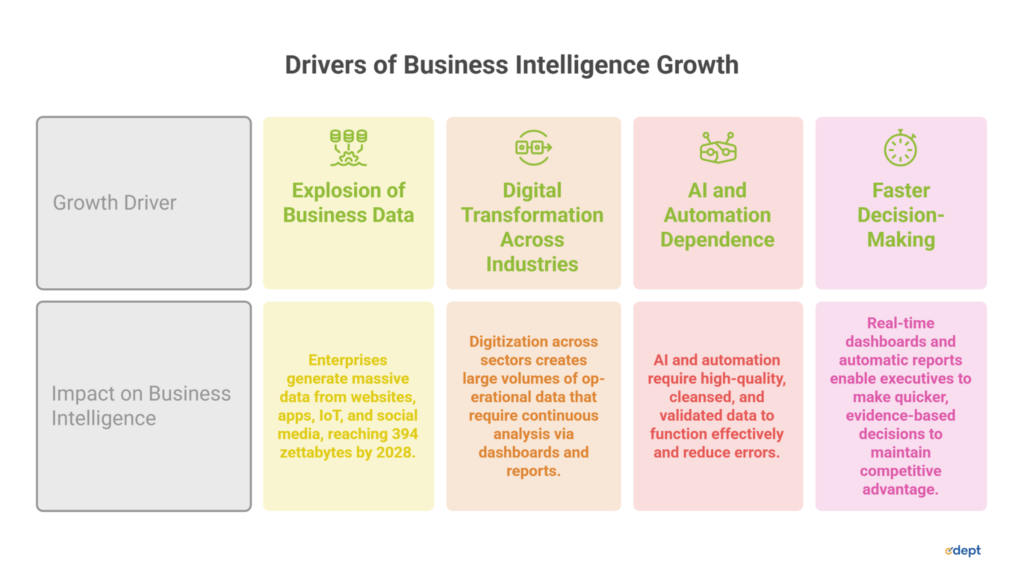
The need for Business Intelligence for IT practitioners has grown tremendously due to the increasing digitization of businesses. Every digital touchpoint, every online transaction, and even every connected device creates data that businesses can harness to improve their performance and make better decisions.
Explosion of Business Data
Modern enterprises generate massive amounts of data from various sources like websites, mobile applications, Internet of Things (IoT) gadgets, enterprise software, social media, and customers themselves. IDC forecasts that the total global datasphere will reach 394 zettabytes in 2028, illustrating how much data enterprises have to handle and process.
Digital Transformation Across Industries
The digital revolution is impacting virtually all industries, including banks, health care providers, retailers, manufacturers, logistics companies, telecommunication firms, and government agencies. Companies are using technologies like cloud computing, enterprise systems, and digital processes to streamline their operations and provide better experiences for customers.
AI and Automation Depend on Quality Data
Artificial Intelligence and automation are now critical components of business processes; however, the effectiveness of these technologies fully depends on data quality. AI algorithms get knowledge based on past business data, and automation systems need correct and consistent data to work properly.
Faster Decision-Making Drives Business Success
In the competitive environment of modern enterprises, quick and effective decision-making plays a decisive role. Modern executives and managers cannot use only the reports compiled manually at the end of each month and expect to respond to the changes in the market and customer requirements in time.
Why IT Professionals Need Business Intelligence Skills
The continuous digital transformation of companies has made the scope of responsibilities of IT specialists broader than developing software and providing infrastructure maintenance. Today, there is an expectation from businesses for the technology team to design solutions that not only work effectively but also provide some kind of insights.
Software Developers Build Data-Driven Applications
Today, however, software applications go beyond simple transaction processing and automation of workflow processes. The applications should give useful information to the users through dashboards, reporting, and analytical components that can enable them to make better decisions.
Data Analysts Turn Information Into Insights
Data analysts play one of the most important roles in helping organizations transform raw information into valuable business insights. Their work extends beyond collecting data—they interpret patterns, measure performance, and communicate findings that guide strategic decisions. Some of the core responsibilities supported by Business Intelligence include:
- Data visualization using charts, graphs, and dashboards.
- KPI tracking to measure organizational performance.
- Business reporting for executives and operational teams.
- Decision support through meaningful insights and performance analysis.
Cloud Engineers Manage Enterprise Data Platforms
Cloud computing has transformed how organizations store, process, and access business information. Cloud engineers are responsible for building scalable infrastructure that enables secure and efficient data management across cloud environments. Their responsibilities often include:
- Managing cloud-based data warehouses.
- Designing secure data storage architectures.
- Supporting business reporting infrastructure.
- Optimizing data availability and system performance.
AI Professionals Depend on Business Data
Artificial Intelligence systems are only as effective as the data used to train them. Poor-quality or incomplete datasets often lead to inaccurate predictions, biased models, and unreliable business outcomes. For AI professionals, Business Intelligence provides several important advantages:
- Access to clean, structured datasets for model training.
- Better identification of business trends and patterns.
- Improved monitoring of model performance using dashboards.
- Easier communication of AI insights to business stakeholders.
Cybersecurity Teams Use BI for Threat Intelligence
Cybersecurity has become increasingly data-driven as organizations monitor thousands of security events every day. Security teams collect information from firewalls, endpoint devices, cloud platforms, authentication systems, and network infrastructure to identify potential threats. Business Intelligence supports cybersecurity through:
- Security dashboards that provide real-time visibility into threats.
- Risk analysis to identify vulnerabilities and prioritize remediation.
- Incident reporting for faster investigation and response.
- Compliance monitoring to meet regulatory and organizational requirements.
IT Managers Make Strategic Technology Decisions
Technology leaders are responsible for ensuring that IT investments support broader business objectives. Business Intelligence enables IT managers to make informed decisions by providing accurate performance metrics, operational insights, and financial data. Business Intelligence supports IT management by enabling:
- Resource planning to allocate teams, infrastructure, and budgets efficiently.
- Performance measurement through dashboards and key performance indicators.
- Cost optimization by identifying inefficiencies and improving resource utilization.
As digital transformation continues across industries, the ability to combine technical expertise with business understanding has become a defining characteristic of successful technology leaders.
Core Business Intelligence Skills Students Should Learn
Being a successful professional in the modern tech industry takes much more than mere technical skills. Businesses today need individuals who can do data analysis and assist in making decisions using data. For this reason, Business Intelligence for IT professionals integrates business and technical skills to address real-life problems.
Data Visualization
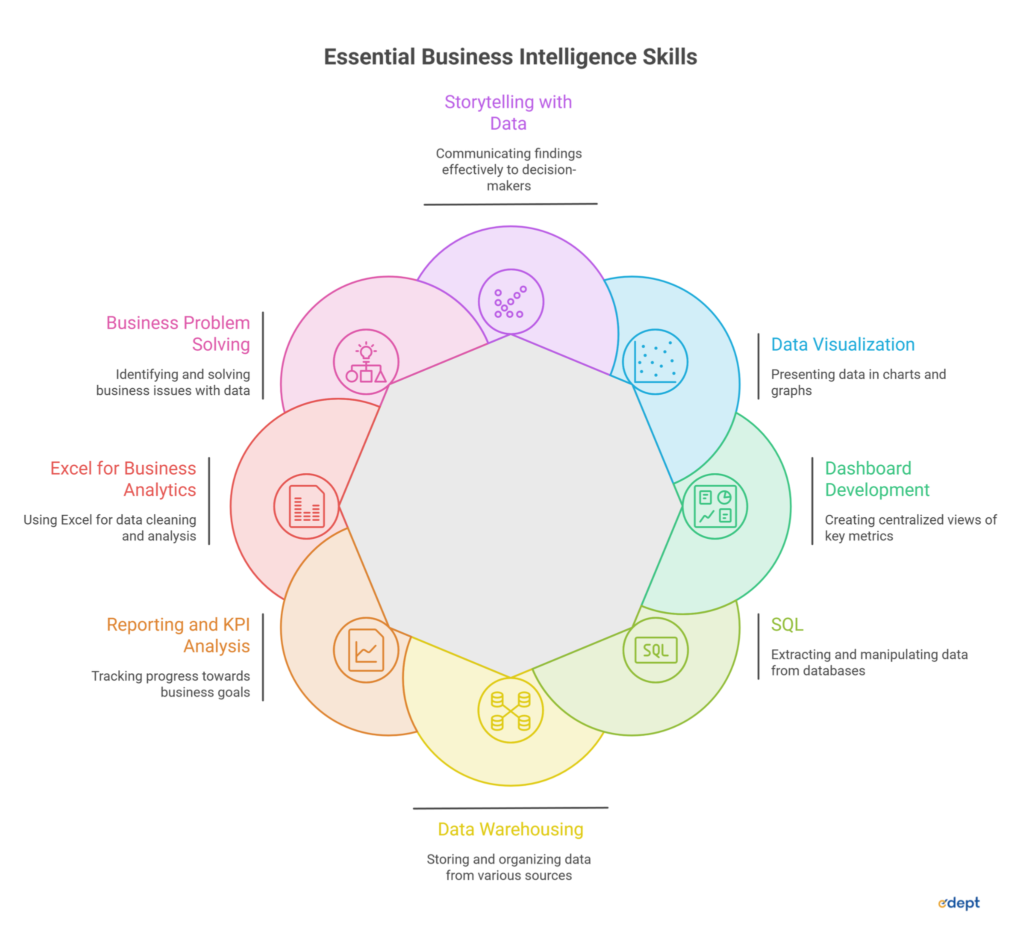
Visualization of data is the process through which information is presented in charts, graphs, dashboards, and reports. Rather than analyzing spreadsheets, trends can be identified, comparisons made, and business metrics monitored through visual representation of data.
Dashboard Development
Dashboards provide a centralized view of key business information by displaying multiple performance metrics in one place. Business Intelligence professionals design dashboards that allow managers to monitor real-time data, track key performance indicators (KPIs), and identify issues before they impact business operations.
SQL
Another key skill that a professional in Business Intelligence should have is Structured Query Language (SQL). Because all the corporate data resides in relational database management systems, SQL provides tools necessary to extract, manipulate, and analyze data. By learning SQL, students will be able to create queries to extract business insight, make reports, as well as to build datasets for visualization.
Data Warehousing
Business intelligence relies on the collection of accurate and organized data. Data warehousing is an approach where various types of information from different business processes are collected and stored in a centralized database.
Reporting and KPI Analysis
The use of reports and KPIs enables companies to track their progress towards business goals. Reports are produced by the professionals in business intelligence and track various factors like income growth, customer service, operational efficiencies, project status, and company financial success.
Excel for Business Analytics
Although modern Business Intelligence platforms offer advanced analytics capabilities, Microsoft Excel remains one of the most widely used tools for business reporting and data analysis. Organizations continue to rely on Excel for data cleaning, calculations, pivot tables, forecasting, and quick visualizations.
Business Problem Solving
In addition to data analysis and manipulation, Business Intelligence is about solving business issues. IT specialists need to know what the organization wants to achieve, understand problems related to its operations, and offer solutions based on data.
Storytelling with Data
A well-analyzed problem does not provide much benefit when decision-makers do not understand it. Data storytelling is about how to deliver findings to decision-makers in a coherent, understandable manner to enable them to make an informed decision.
Why Technical and Business Skills Must Work Together
Technical expertise enables IT professionals to build software, manage databases, develop AI models, and maintain cloud infrastructure. However, understanding how technology supports business objectives is equally important.
Read more: Best Business Intelligence Tools for Managers
Industries Hiring IT Professionals with BI Skills
The demand for Business Intelligence for IT professionals is growing across almost every industry. As organizations generate more data through digital operations, they need skilled professionals who can collect, analyze, visualize, and interpret that information to support smarter business decisions.
Banking and Financial Services
Banks and financial institutions rely heavily on Business Intelligence to monitor transactions, assess financial performance, detect fraud, manage risks, and ensure regulatory compliance. BI dashboards help decision-makers analyze customer behavior, evaluate investment performance, and improve operational efficiency.
Healthcare
Healthcare organizations generate large volumes of clinical, operational, and administrative data every day. Business Intelligence helps hospitals, clinics, and healthcare providers analyze patient outcomes, optimize resource allocation, monitor treatment effectiveness, and improve service delivery.
Retail and E-commerce
Retail businesses use Business Intelligence to understand customer preferences, monitor sales performance, forecast demand, and optimize inventory management. E-commerce platforms analyze browsing behavior, purchasing patterns, and marketing performance to deliver personalized shopping experiences.
Manufacturing
Manufacturing companies use Business Intelligence to improve production efficiency, monitor equipment performance, reduce operational costs, and maintain product quality. Real-time dashboards enable managers to track production metrics, identify bottlenecks, and optimize manufacturing processes.
Information Technology
The Information Technology sector itself is one of the largest employers of professionals with Business Intelligence skills. Technology companies analyze application performance, customer engagement, cloud infrastructure, software usage, and operational metrics to improve products and services.
Logistics and Supply Chain
Logistics and supply chain organizations depend on accurate data to manage transportation, inventory, warehouse operations, and delivery networks. Business Intelligence helps businesses monitor shipments, forecast demand, optimize routes, and identify supply chain disruptions before they affect customers.
Telecommunications
Telecommunication companies generate massive amounts of network, customer, and service data every day. Business Intelligence enables providers to monitor network performance, analyze customer usage patterns, predict service demand, and improve overall customer experience.
Government
Government agencies increasingly use Business Intelligence to improve public services, monitor program performance, manage budgets, and support evidence-based policymaking. BI enables departments to analyze large datasets related to healthcare, education, transportation, taxation, and public administration.
Career Opportunities Combining IT and Business Intelligence
As organizations increasingly rely on data-driven decision-making, professionals who combine technical expertise with business understanding are in high demand. From developing analytics platforms to designing cloud data infrastructure, Business Intelligence for IT professionals opens doors to diverse career paths across industries.
Business Intelligence Analyst
A Business Intelligence Analyst helps organizations make informed decisions by collecting, analyzing, and visualizing business data. They design dashboards, generate reports, and identify trends that improve operational performance. Responsibilities:
- Build interactive dashboards and reports.
- Analyze business performance and KPIs.
- Identify trends and business opportunities.
- Support executives with data-driven insights.
Required Skills:
- SQL
- Power BI or Tableau
- Data visualization
Career Growth: Business Intelligence Analyst → Senior BI Analyst → BI Manager → Head of Business Intelligence
Data Analyst
Data Analysts collect, clean, and interpret data to help organizations solve business problems. Responsibilities:
- Collect and clean datasets.
- Perform statistical and trend analysis.
- Create reports and visualizations.
- Support business decision-making.
Required Skills:
- SQL
- Excel
- Python or R (preferred)
Career Growth: Data Analyst → Senior Data Analyst → Analytics Lead → Data Science or Analytics Manager
Business Analyst
Business Analysts bridge the gap between business teams and technology teams. They identify business requirements and ensure projects align with organizational goals. Responsibilities:
- Gather business requirements.
- Analyze business processes.
- Recommend technology improvements.
- Coordinate with stakeholders and development teams.
Required Skills:
- Business analysis
- Process mapping
- SQL (basic to intermediate)
Career Growth: Business Analyst → Senior Business Analyst → Product Manager → Business Transformation Manager
Data Engineer
Data Engineers design and maintain the infrastructure that supports Business Intelligence and analytics. Responsibilities:
- Develop data pipelines.
- Build and maintain data warehouses.
- Integrate multiple data sources.
- Ensure data quality and scalability.
Required Skills:
- SQL
- Python or Java
- ETL tools
Career Growth: Data Engineer → Senior Data Engineer → Data Architect → Head of Data Engineering
BI Developer
BI Developers create Business Intelligence solutions that enable organizations to monitor performance through dashboards, reports, and analytical applications. Responsibilities:
- Develop BI dashboards.
- Design reporting solutions.
- Optimize database queries.
- Maintain BI applications.
Required Skills:
- SQL
- Power BI, Tableau, or Qlik
- Database management
Career Growth: BI Developer → Senior BI Developer → BI Solution Architect → BI Manager
Analytics Consultant
Analytics Consultants help organizations implement Business Intelligence solutions and improve data-driven decision-making. Responsibilities:
- Assess business needs.
- Recommend BI strategies.
- Implement analytics solutions.
- Train teams on BI tools.
Required Skills:
- Business Intelligence platforms
- Data analysis
- Consulting
Career Growth: Analytics Consultant → Senior Consultant → Analytics Manager → Director of Analytics Consulting
Product Analyst
Product Analysts use Business Intelligence to evaluate product performance, customer behavior, and market trends. Responsibilities:
- Analyze product usage data.
- Track product KPIs.
- Identify customer behavior patterns.
- Support product development decisions.
Required Skills:
- SQL
- Data visualization
- Product analytics
Career Growth: Product Analyst → Senior Product Analyst → Product Manager → Director of Product Strategy
Cloud Data Engineer
Cloud Data Engineers build cloud-based data platforms that support Business Intelligence, analytics, and AI applications. Responsibilities:
- Design cloud data architecture.
- Manage cloud data warehouses.
- Build scalable data pipelines.
- Support enterprise reporting systems.
Required Skills:
- AWS, Azure, or Google Cloud
- SQL
- Data warehousing
Career Growth: Cloud Data Engineer → Senior Cloud Data Engineer → Cloud Data Architect → Cloud Solutions Manager
Career Comparison
| Job Role | Typical Responsibilities | Key Skills | Average Salary (India) | Future Growth |
| Business Intelligence Analyst | Dashboards, reporting, KPI analysis | SQL, Power BI, Tableau | ₹6–12 LPA | High |
| Data Analyst | Data analysis, reporting, visualization | SQL, Excel, Python | ₹5–11 LPA | High |
| Business Analyst | Business requirements, process improvement | Business analysis, SQL, communication | ₹7–14 LPA | High |
| Data Engineer | Data pipelines, warehouses, ETL | SQL, Python, Cloud | ₹8–18 LPA | Very High |
| BI Developer | BI dashboards and reporting solutions | SQL, Power BI, Tableau | ₹7–15 LPA | High |
| Analytics Consultant | BI implementation and consulting | Analytics, BI tools, presentation | ₹8–18 LPA | Very High |
| Product Analyst | Product metrics and customer insights | SQL, analytics, visualization | ₹8–16 LPA | Very High |
| Cloud Data Engineer | Cloud data platforms and reporting infrastructure | Cloud platforms, SQL, ETL | ₹10–22 LPA | Very High |
Salary ranges are approximate for professionals in India and vary based on experience, location, industry, and employer.
How edept Helps Students Build Business Intelligence Skills
As the need for Business Intelligence for IT professionals increases, students are required to be more than just theoretically prepared. They need practical skills, knowledge of industry norms, and the ability to solve practical problems related to business. edept’s B.Sc. IT with Gen AI course aims to fill this gap between classroom preparation and professional needs through practical training along with education.
Industry-Aligned BSc IT Curriculum
The curriculum of edept’s B.Sc. IT program takes into account the changing requirements of the tech industry. Apart from the fundamental courses on IT, the course provides exposure to some advanced topics like big data, artificial intelligence, cloud computing, and tech applications in the business world.
Data Analytics Learning
Data analytics constitutes a major component of the curriculum at edept. The learners get familiarized with the process of analysis of data sets, trend spotting, interpretation of business information, and communication of findings to make decisions.
IBM Live Projects
A vital highlight of the program is that it provides learners with an opportunity to undertake IBM Live Projects, whereby learners have a chance to apply the knowledge acquired in class to practical business situations.
Deloitte Learning Academy Certifications
Through Deloitte Learning Academy Certifications, students gain exposure to industry-relevant concepts that complement their academic learning. The certification programs cover areas including:
- Data Analytics
- Artificial Intelligence (AI)
- Digital Transformation
- Business Strategy
Global Immersion Projects
edept also offers Global Immersion Projects, giving students the opportunity to explore international business environments and understand how organizations use technology and data to solve complex business challenges.
Practical Learning Through Projects
Practical learning is an integral part of the program. Students work on multiple academic and industry-oriented projects that allow them to apply concepts learned throughout the course. By combining an industry-aligned curriculum, data analytics training, IBM Live Projects, Deloitte Learning Academy Certifications, Global Immersion Projects, and project-based learning, edept equips students with the practical knowledge and experience needed to develop Business Intelligence for IT professionals.
Business Intelligence vs Artificial Intelligence
Although Business Intelligence (BI) and Artificial Intelligence (AI) are closely related, they serve different purposes. Business Intelligence focuses on analyzing historical and current data to help organizations make informed decisions, while AI uses data to identify patterns, make predictions, and automate tasks.
| Business Intelligence | Artificial Intelligence |
| Analyzes historical and current data | Learns from data to identify patterns |
| Supports business decisions | Makes predictions and recommendations |
| Uses dashboards and reports | Enables intelligent automation |
| Relies on human interpretation | Generates machine-driven insights |
| Business-focused | Prediction-focused |
Also read: Top Business Analytics Careers in Consulting Firms
Common Mistakes Students Make
Creating a successful career in the field of Business Intelligence for IT specialists does not only involve acquiring a set of technical knowledge. There is no doubt that many students pay too much attention to coding, yet they neglect some important business and analytical skills.
Learning Only Programming
Programming is an important skill for information technology professionals. However, coding alone does not make one qualify for jobs in Business Intelligence. Combine programming with SQL, data visualization, reporting, and Business Intelligence.
Ignoring Business Concepts
While many students are conversant with technology, they find it hard to relate it to business goals. Be conversant with some basic concepts in business, including strategies, finance, marketing, and operations.
Avoiding Data Visualization Tools
Students pay more attention to data analysis but do not work with data visualization tools like Power BI or Tableau. Learn to create interactive dashboards and reports delivering information clearly for both technical and non-technical audiences.
Not Building Analytics Projects
Learning without application reduces practical knowledge. Recruiters commonly examine portfolios to test one’s ability to solve problems in the real world. Practice analytics on real data, develop dashboards, and display your work through an online portfolio or GitHub account
Weak Communication Skills
Even accurate analysis has limited value if it cannot be explained clearly. Develop presentation, writing, and storytelling skills to communicate insights confidently and support better business decisions.
Not Understanding Business Problems
Students often focus on technical issues without fully understanding the business problem at hand. Before embarking on any project, understand the business issue, define the business objectives, and use data to offer suggestions for solving the problem.
Tips for Students to Build Business Intelligence Skills
Developing Business Intelligence for IT professionals requires consistent practice and exposure to real-world business scenarios. The following tips can help students build both technical expertise and analytical thinking.
Learn SQL Early
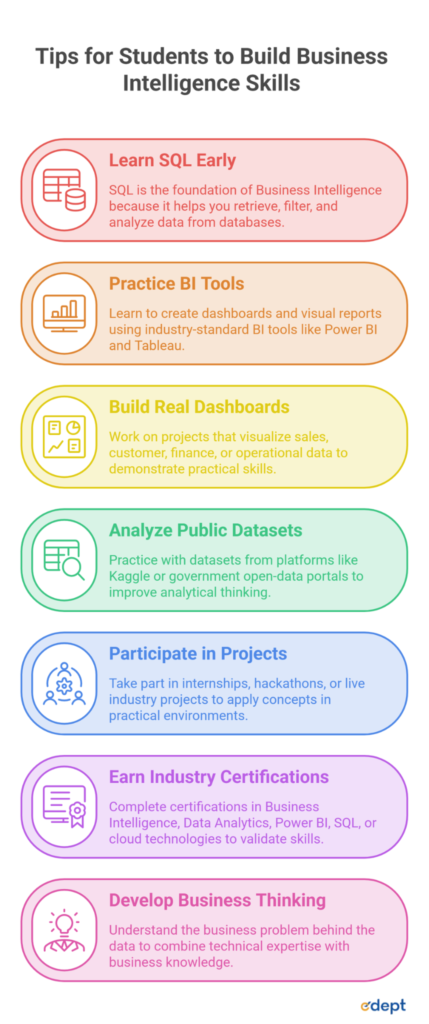
SQL is the foundation of Business Intelligence because it helps you retrieve, filter, and analyze data from databases. Start with basic queries before progressing to joins, aggregation, and subqueries.
Practice with Power BI and Tableau
Learn to create dashboards and visual reports using industry-standard BI tools like Power BI and Tableau. These skills are highly valued by employers across industries.
Build Real Dashboards
Work on projects that visualize sales, customer, finance, or operational data. A portfolio of dashboards demonstrates your practical skills during placements and interviews.
Analyze Public Datasets
Practice with datasets from platforms like Kaggle or government open-data portals. Solving real-world business problems improves analytical thinking and decision-making skills.
Participate in Live Projects
Take part in internships, hackathons, or live industry projects to apply Business Intelligence concepts in practical business environments. Real project experience strengthens both your resume and confidence.
Earn Industry Certifications
Complete certifications in Business Intelligence, Data Analytics, Power BI, SQL, or cloud technologies. Certifications validate your skills and enhance your employability.
Develop Business Thinking Alongside Technical Skills
Don’t focus only on tools, but also understand the business problem behind the data. Strong Business Intelligence professionals combine technical expertise with business knowledge to deliver meaningful insights.
Future Outlook: Why BI Will Become Even More Important
As digital transformation accelerates, Business Intelligence for IT professionals will become an even more valuable skill. Organizations will increasingly rely on data to improve efficiency, drive innovation, and stay competitive.
AI Will Increase the Need for Quality Business Data
AI systems are only as effective as the data they use. Business Intelligence ensures data is accurate, organized, and reliable, creating a strong foundation for AI-powered solutions.
Organizations Will Depend More on Data-Driven Decisions
Businesses are moving away from intuition and toward evidence-based decision-making. Professionals with Business Intelligence skills will help organizations analyze trends, monitor performance, and make smarter strategic decisions.
BI Will Integrate with Cloud and AI Platforms
Cloud computing and AI are becoming integral to modern Business Intelligence solutions. IT professionals who understand these technologies alongside BI will be well-positioned for future career opportunities.
Business and Technology Roles Will Continue to Merge
Modern organizations expect IT professionals to understand both technology and business objectives. Developing Business Intelligence for IT professionals equips graduates to bridge this gap and deliver greater business value over the next decade.
Conclusion
Business Intelligence has become an essential skill for modern IT professionals as organizations increasingly rely on data-driven decision-making to improve efficiency, innovation, and business performance. Professionals who combine technical expertise with Business Intelligence for IT professionals can contribute more effectively across software development, cloud computing, artificial intelligence, cybersecurity, and digital transformation initiatives. edept’s B.Sc. IT with Gen AI program prepares students for this evolving landscape through an industry-aligned curriculum, practical data analytics training, IBM Live Projects, Deloitte Learning Academy certifications, Global Immersion Projects, and hands-on learning experiences.
Related Links:
| Everything about IBM Live Projects | MBA in Business Analytics |
| Business Analytics vs Data Analytics | Future of Business Analytics Education |