The United States leads in sheer salary potential for cybersecurity professionals, followed closely by Australia, while Canada offers the most competitive compensation when factoring in cost-of-living adjustments and universal benefits
Cybersecurity is quietly becoming one of the highest-paying global technology careers due to increasing cyber threats, cloud adoption, and regulatory compliance needs. Studies from the IMF report that cybercrime will cost the world $23 trillion in 2027, an increase of 175% from 2022. Microsoft estimates there are approximately 600 million cyber attacks globally each day, with over 97 billion exploitation attempts and 36,000 malicious scans per second. The global cybersecurity spending market will reach USD 240 billion in 2026, a 12.5% increase from 2025.
With cyber threats increasing globally, cybersecurity salaries are rising at a very fast rate, and they are well-compensated in the technology industry. The annual global damage costs for ransomware multi-stage extortion attacks are forecasted to reach USD 74 billion in 2026. Currently, 70% of cloud breaches are expected to originate from compromised identities, rather than software flaws. Human error and misconfigurations will account for 95% of cloud security failures in 2026. Every organization now requires a professional who can protect its computer systems and network. As ransomware, AI-driven threats, and cloud vulnerabilities are continuously growing, companies are ready to pay top salaries for security professionals. This is why hiring for security roles has shot up across the United States, Canada, and Australia – these three countries consistently rank among the best places across the globe to build a cybersecurity career
If you are a student who is planning to study abroad or a working professional who is looking for a change in their career, the first thing that usually comes to your mind is, “How much will I actually earn?” “Will the move be worth it?” “Which country can provide me with job stability, competitive and attractive salaries and a long-term settlement option?” The cybersecurity salary usually depends on the job role, geographic location, industry, experience, certifications, and advanced skills, such as AI and cloud computing. In this blog, you will get a clear idea about the three countries that provide the best cybersecurity jobs, along with good salaries, a clear immigration pathway and details about the cost of living. By the end, you will actually know which country fits your career plan, not just which one has the biggest number on the salary chart.
Why Cybersecurity Is a High-Growth Career Worldwide
Before we start comparing the salaries, let us first understand why cybersecurity is a high-growth career worldwide.
Increasing Global Cyber Threats
Ransomware attacks are rising sharply at a very fast rate, targeting almost all businesses, be they small businesses or critical national infrastructure. The annual global damage costs for ransomware multi-stage extortion attacks are forecasted to reach USD 74 billion in 2026. The healthcare industry will face the highest breach costs. On average, we can expect USD 12.6 million per incident. Beyond ransomware, the data breach attacks continue to cost companies millions in losses and fines and ultimately damage their reputations. The healthcare industry will face the highest breach costs. On average, we can expect USD 12.6 million per incident. Next comes cloud misconfiguration, which has become one of the leading causes of corporate data losses. 70% of cloud breaches will originate from compromised identities, not software flaws. Human error and misconfigurations will account for 95% of cloud security failures in 2026.
Digital Transformation Creating Security Needs
Remote work, which had become standard across industries during the pandemic, created a permanent security challenge that many organizations are still solving. Enterprise cloud systems, once a bonus feature, are now the backbone of daily operations at most companies. AI has matured rapidly, and now the attackers use advanced algorithms to launch automated, highly sophisticated attacks on corporate systems and AI platforms. This has created explosive demand for specialized professionals skilled in AI governance, secure model deployment, and advanced machine learning
Talent Shortage Driving Higher Salaries
The global cybersecurity workforce gap remains at a critical high, with nearly 4 million unfilled roles worldwide. Despite being steady growth, industry estimates indicate a significant global supply-demand gap with millions of open, unfilled cybersecurity roles. This talent shortage is driven by a lack of specialized training among existing employees, which results in severe business vulnerabilities and contributes to a rise in data breaches.
Factors That Affect Cybersecurity Salaries Globally
Not every cybersecurity professional earns the same salary, even within the same country. There can be two analysts with the same qualifications, living in the same country, but they are earning different salaries. Let us understand why.
Job Role
The title mentioned in your offer letter matters more than most people realize.A SOC analyst who is monitoring alerts & running incident response earns considerably less salary than a security architect who is responsible for designing organizational infrastructure. The ethical hackers and penetration testers who are responsible for finding vulnerabilities before attackers earn salaries at a premium rate. The security consultants who are responsible for working with multiple clients command premium salaries.
Experience Level
Experience is one of the major factors that affect cybersecurity salaries across the globe. The entry level, such as SOC analysts, often starts with lower pay ranges, as the main focus is on practical system monitoring and alerting. The mid-level professionals with 3-5 years of experience moving into engineering or incident response can see a sudden jump in their salaries of up to 20-30%. The senior-level professionals with ten years of experience, particularly those who are managing teams, leading projects, or a part of strategic decision-making, sit at the top of the pay scale in each country.
Certifications
The certifications help in validating your knowledge and act as proof of your skills. Earning certifications such as Certified Information Systems Security Professional (CISSP) or Certified Chief Information Security Officer (C|CISO) frequently boosts your earning potential by 10-15%. CompTIA Security+ is one of the standard certifications that are recognized by most industries. Cloud security certifications such as AWS, Google or Microsoft have become valuable and are recognised across all industries. Specialized designations like the Certified Ethical Hacker or Certified Network Defender highlight high-demand tactical abilities.
Location and Industry
Where you are working and for whom, help in shaping your salary range significantly. Countries like the United States, Switzerland, and Germany offer the highest nominal salaries, with US professionals often commanding entry-level wages around $90,000 and top-tier CISOs exceeding $236,000 annually. San Francisco usually pays more than Dallas; Sydney pays more than Perth. Your salary also depends on the industries you are working in. Finance and defence healthcare typically pays a bit more than the average salary because security failures in these sectors are very severe. 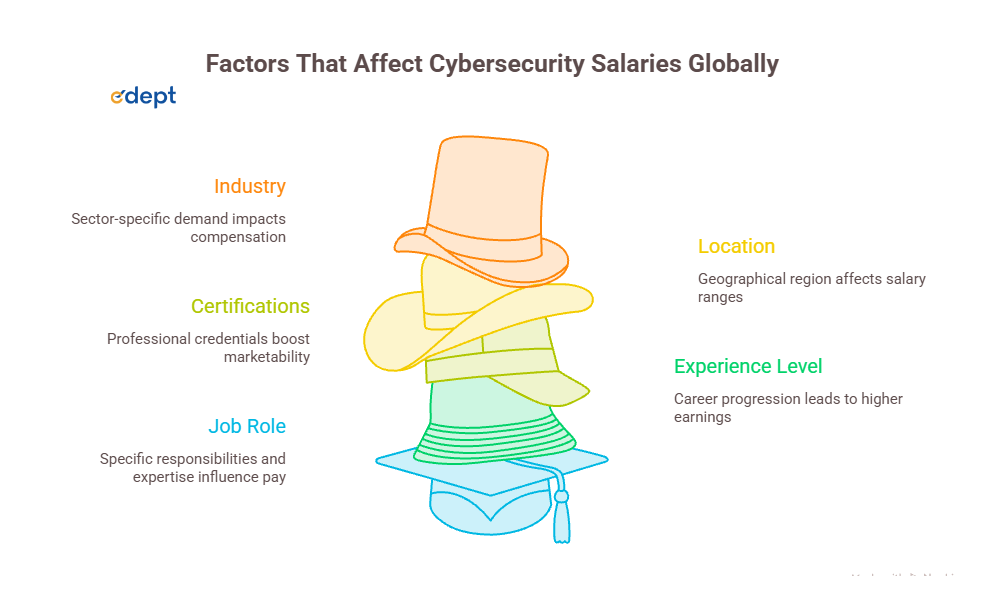
Cybersecurity Salaries in the United States
Cybersecurity jobs in USA are growing more quickly than any other IT domain due to digital transformation, cybercrime escalation, and cloud adoption. The US faces a workforce shortage of over 500000 cybersecurity professionals, forming a massive hiring demand. The key job roles include cybersecurity analyst, SOC analyst, cloud security engineer, penetration tester, GRC consultant, and CISO. Cybersecurity jobs in USA for freshers are expanding across healthcare, finance, defence, SaaS, and government agencies. Their salaries start from six figures for skilled professionals. The USA remains the most lucrative global market for cybersecurity careers.
Entry-Level Salary
The entry-level cybersecurity salaries in USA usually range between $65,000 and $90,000, with a median starting salary of $75,000. The base pay depends on your specific role, geographic location, and skills. The junior SOC analyst earns between $55,000 and $80,000. A first-year cybersecurity analyst averages around $73,682, while a cybersecurity engineer can begin closer to $83,649. Obtaining a U.S. security clearance adds an immediate $10,000 to $20,000 premium to entry-level base salaries. Earning foundational certifications like CompTIA Security+ or AWS Certified Security are highly valued by the USA employers
Mid-Level Salary
The mid-level cybersecurity professionals with 4-7 years of experience in the US typically earn a base salary between $115,000 and $150,000 annually. With a performance bonus, specialized skills, the salary ranges typically scale up to $160,000 – $212,000 depending on the exact role and location. Mid-level roles such as security engineer, network security analyst, and SOC team leads typically earn between $105,000 and $150,000. Mid-level professionals significantly boost their earning potential by obtaining certifications like CISSP, CISM, or OSCP.
Senior-Level Salary
Senior-level cybersecurity professionals in the US typically earn between $150,000 and $280,000+ annually, depending on specialization and location. Senior security engineers and architects earn between $150,000 and $210,000, while a Chief Information Security Officer (CISO) can earn from $180,000 to over $400,000.
Top Paying Cities
Geographic location significantly impacts cybersecurity jobs in USA. Austin offers no state income tax, maximizing take-home pay, while San Francisco offers the highest compensation ($150K–200K) but expensive housing. New York has a strong demand for financial services such as firms and banks and global enterprises. Indianapolis offers outstanding value for new hires with 31.8% job growth; Washington D.C. excels for government cybersecurity analyst jobs in the USA with clearance premiums; and Raleigh strikes a balance between affordability and 59% employment growth, creating a variety of opportunities for foreign professionals.
Key Industries Hiring
The top industries hiring cybersecurity professionals in the US include technology, banking and financial services, healthcare, government, and professional services. Healthcare has become one of the fastest-growing hiring sectors. One important note: the United States offers the highest salaries, but it also has the highest cost of living. Rent in San Francisco or New York can easily consume 35–40% of your take-home. The professionals considering a move to the USA should keep in mind the housing, healthcare and taxation costs.
Cybersecurity Salaries in Canada
Cybersecurity jobs in Canada are witnessing prompt growth due to rapidly increasing cyber threats, strict data protection regulations, and digital transformation. Organizations across healthcare, finance, technology, and government actively hire cybersecurity analysts, consultants, engineers, and cloud security experts. Canada is a hub offering diverse opportunities for entry-level specialists, international candidates, and experienced professionals, including those from India. With a strong demand and supply gap in the market, cybersecurity jobs in Canada provide stable employment, long-term career advancement, and competitive pay across both private and public sectors.
Entry-Level Salary
Entry-level cybersecurity professionals in Canada typically earn a base salary between $65,000 and $85,000 CAD. The salaries usually depend on the specific job role, your certifications, and the city you are located in. Toronto / Ottawa / Vancouver have the highest starting salaries, generally ranging between $80,000 and $98,000 CAD. Halifax / Calgary / the Prairies have starting salaries typically falling in the $60,000 to $75,000 CAD range.
Mid-Level Salary
Mid-level cybersecurity professionals in Canada (3 to 7 years of experience) typically earn between CAD $85,000 and $140,000 annually, depending on their specific role, location, and certifications. Salaries are highly competitive, with broader market ranges extending upwards to CAD $165,000 for specialized positions. Holding credentials like CISSP, CISM, or OSCP is highly valued by employers.
Senior-Level Salary
Senior-level cybersecurity professionals in Canada typically earn between CA $120,000 and CA $195,000 annually. Highly specialized roles such as architects, consultants, and management roles can reach total compensation beyond CA $200,000. Exact salaries heavily depend on the specific role, your geographic location, and the employing organization. Executive roles such as Chief Information Security Officers (CISOs) often command significantly higher packages, bridging CA $200,000 to over CA $350,000 when bonuses and equity are combined.
Top Paying Cities
Toronto, Vancouver, Montreal, Calgary, and Ottawa have established themselves as the top cities in Canada for cybersecurity jobs, with Toronto leading the way as the primary hub due to its robust financial sector and thriving technology development. While Vancouver has distinct digital media roles, Montreal offers AI and bilingual benefits, Calgary caters to the energy industry, and Ottawa benefits from its proximity to the government, providing a variety of opportunities with varying costs of living.
Key Industries Hiring
The cybersecurity talent gap in Canada remains critical. Major hiring spans four key sectors: financial services & banking, public sector & government, technology & SaaS providers and healthcare & utilities. It is driven by escalating cybercrimes, widespread cloud adoption, and stricter data regulations. The top Canadian cybersecurity hiring companies include Hayes, along with prominent firms such as Deloitte, PwC, and big tech companies like Google and Microsoft. One important note: Canadian salaries are lower than US numbers, but the country offers something the US currently does not: a predictable, points-based pathway to permanent residency through Express Entry and the PNP.
Cybersecurity Salaries in Australia
Australia is a global hub for cybersecurity careers. With the rise in strict data laws, cybercrime, and data transformation have created a massive demand for skilled cybersecurity professionals. However, the scope of cybersecurity in Australia continues to grow across government, healthcare, retail, banking, and cloud service providers. The key cybersecurity job opportunities in Australia are SOC Analyst, Cloud Security Engineer, Security Analyst, Penetration Tester, and Cyber Risk Consultant. The organizations invest a lot in security operations, governance frameworks and threat intelligence. The cybersecurity salary in Australia varies significantly depending on the experience level. Entry-level roles start around $110k-$120k AUD; the mid-level roles expect $135k-$150k+; and senior/lead roles often exceed $155k-$200k. These salary ranges vary due to locations, specific skills & certifications.
Entry-Level Salary
Entry-level cybersecurity professionals in Australia typically earn a base salary between AUD $60,000 and AUD 110,000 per year. Salary usually depends on job location, role and skill set. Major tech hubs such as Sydney and Melbourne typically offer the highest pay for a higher cost of living. The average starting salary for a cybersecurity analyst ranges between AUD $65,000 and $85,000. The graduate IT security specialist earns between AUD $70,000 and $80,000. Candidates with prior experience in general IT support, systems administration, or networking often have better starting salaries.
Mid-Level Salary
Mid-level cybersecurity professionals in Australia with 3–5 years of experience typically earn an annual base salary ranging from $90,000 to $155,000 AUD. Salaries vary significantly by state. For instance, cybersecurity roles in cities like Canberra and Sydney tend to command premium rates compared to other regions. The salary depends on specialization, location and specific industry. The general cybersecurity analyst usually earns between $90,000 and $130,000 AUD. The cybersecurity engineer earns between $120,000 and $155,000 AUD
Senior-Level Salary
Senior-level cybersecurity professionals in Australia typically earn between AUD $130,000 and $220,000 annually, depending on specific roles and location. Executive positions, such as Chief Information Security Officers (CISOs), command even higher packages, often reaching up to AUD $360,000 or more. The senior cybersecurity analyst / engineer earns between $130,000 and $185,000, and the security architect earns between $160,000 and $210,000.
Top Paying Cities
The top cities for cybersecurity jobs in Australia include Sydney, Melbourne, and Brisbane, offering huge demand, competitive salaries and major tech hubs. Cities like Canberra & Perth are also top choices for cybersecurity jobs, especially for the government & research industry. Sydney leads in tech investment, while Brisbane offers the highest average salaries, reflecting a developing ecosystem. Moreover, the major companies like Deloitte and Atlassian and global ones are providing opportunities for roles in finance, tech and government
Key Industries Hiring
In Australia, cybersecurity professionals are dominantly hired by the financial services, government/public sector, technology/IT services, and healthcare industries. The top companies hiring for cybersecurity jobs in Australia include Commonwealth Bank, Macquarie Group, Google, Woolworths, and Telstra. Banks, fintech firms, and insurance companies are the largest employers hiring cyber experts. The major firms actively expanding their cyber teams in Australia include CyberCX, KPMG Australia, CGI, and SEISMA Group. One important note: Australia provides a strong pay along with a balanced lifestyle. They have a 38-hour standard work week, strong leave entitlements, and Skilled Independent Visa (subclass 189) and Skilled Nominated Visa (subclass 190), which offer direct PR pathways for cybersecurity professionals.
Salary Comparison Table: United States vs Canada vs Australia
| Country | Entry Level | Mid-level | Senior Level | PR Opportunity | Cost of Living |
| United States | $65K–$90K USD | $105K–$150K USD | $150K–$280K+ USD | H-1B (Competitive) | Very High |
| Canada | CAD $65K–$85K | CAD $85K–$140K | CAD $120K–$195K+ | Express Entry (Strong) | Moderate–High |
| Australia | AUD $65K–$110K | AUD $100K–$155K | AUD $140K–$220K+ | Skilled Migration (Accessible) | Moderate–High |
Which Country Offers Better ROI for Cybersecurity Students?
Salary figures alone cannot tell you the full story. The students who are investing in international education and career development need to think deeply about what they are actually getting back for their money and time invested. ROI is not just about the salary number; it is how much of that salary you are capable of keeping and how stable your future looks.
Salary vs Cost of Living
The United States offers the highest and most attractive salaries, but cities such as San Francisco and New York are very costly, and they can consume a large portion of your salary. A cybersecurity professional who is earning $140,000 in San Francisco faces an average monthly rent of $3500 above, and most of the time, the healthcare costs are not covered by the employer. Canada and Australia offer manageable rental costs, and cities like Calgary, Brisbane, and even parts of Vancouver offer affordable housing expenses. Hence, a large portion of your salary can be saved.
Salary vs Tuition Fees
The international tuition fees for cybersecurity vary across the three countries. A master’s degree in cybersecurity can cost roughly ₹20 lakhs to ₹50 lakhs, depending on the country and university. The US programmes are well ranked and widely recognized but they are the most expensive. Canadian universities tend to offer good value relative to the local job market, and they are more affordable. Australian universities have been actively competing for international students with competitive tuition, as well as post-study work visa provision. When you compare two years of tuition against your first three years of post-graduation salary, Canada and Australia usually offer faster payback than the US.
Long-Term Settlement Benefits
This is where the comparison becomes more practical for international professionals. The US H-1B visa is lottery-based and very competitive in nature, and there is no guarantee of a pathway for permanent residency. Canada offers work visa pathways such as Express Entry, Global Talent Stream, and employer-sponsored permits for cybersecurity experts. It provides a very structured, clear path to permanent residency within one to two years of employment. Cybersecurity professionals can access Australian work visas via employer sponsorship options (such as the 482/494 to 186 visas) or skilled independent emigrant routes (189, 190, 491), with most routes needing an ACS Skills Assessment as well as English language proficiency. The 482 visa allows skilled professionals to fill the skill gap and work under an approved employer for about 4 years. This visa has the potential to convert into permanent residency in the long run. One important note:
- USA: highest salary, but most uncertain immigration outcome
- Canada: balanced salary, manageable cost of living and the clearest PR pathway to permanent residency
- Australia: strong salary, strong PR, the best lifestyle, and a growing job market
Work Visa and PR Opportunities for Cybersecurity Professionals
For internationally trained cybersecurity professionals, immigration pathways often shape your career decisions and outcomes.
United States
Landing cybersecurity jobs in USA requires a proper visa pathway for international professionals. While O-1 visas are suitable for senior experts, L-1 transfers are suitable for multinational employees. H-1B visas are most common for cybersecurity jobs in USA for Indian talent. You can easily secure a cybersecurity analyst job in the USA by knowing which path best suits your profile and starting 8 to 12 months in advance. Each visa has its own set of requirements, timeline & caps, so making the right choice is essential for your entire immigration process.
Canada
Canada offers work visa pathways such as Express Entry, Global Talent Stream, and employer-sponsored permits for cybersecurity experts. The eligibility requirements depend on skills, job offers, experience, and compliance with immigration requirements. Professionals who are skilled enough may also qualify under Canada’s Global Talent Stream, which offers much faster processing for in-demand roles.
Australia
Cybersecurity professionals can access Australian work visas via employer sponsorship options (such as the 482/494 to 186 visas) or skilled independent emigrant routes (189, 190, 491), with most routes needing an ACS Skills Assessment as well as English language proficiency. The 482 visa allows skilled professionals to fill the skill gap and work under an approved employer for about 4 years. This visa has the potential to convert into permanent residency in the long run. One important note: If you want a long-term settlement, then Canada and Australia offer more certainty and assurance than the USA.
Skills That Increase Cybersecurity Salary Potential
Some of the skills that increase cybersecurity salary potential are as follows.
Cloud Security
As organization are moving everything to AWS, Azure, and Google Cloud, the demand for cloud security professionals who are capable of understanding the cloud-specific threats, complications and compliance requirements is rising rapidly. The cloud security certifications from providers such as AWS and Google are very meaningful for your resume and are highly valued by employers.
Ethical Hacking
The organizations are increasing the investment in offensive security testing, to identify the vulnerabilities before the attackers do. Some of the key skills include Penetration testing, red teaming, reverse engineering, threat modelling, and advanced malware analysis. Certifications such as OSCP (Offensive Security Certified Professional) or GIAC-certified credentials are highly valued by employers.
Security Operations
The SOC professionals and incident responders are high in demand across all these countries. Skills with SIEM tools (Splunk, Sentinel, QRadar) and SOAR platforms are highly valued. Certifications such as GIAC Security Essentials (GSEC) and CompTIA CySA are highly valued by employers.
Risk Management
With continuous new changes and additions to the regulatory requirements, tightening across the industries as well as the geographies, the professionals who have a bit of an idea on risk frameworks, audits, and compliance are rising. Roles in GRC (Governance, Risk, and Compliance) are growing as new privacy laws like GDPR, Australia’s Privacy Act amendments, and US state-level regulations create constant compliance work. CRISC and CISM are the strongest certifications.
AI Security Skills
With AI adoption accelerating across 2026, understanding how to secure machine learning models and handle data privacy is a rapidly growing niche. Some of the key skills include securing large language model (LLM) integrations, data loss prevention (DLP), and identity & access management (IAM). On one side, the defenders are building AI-powered threat detection, and on the other side, attackers are using AI to automate and scale attacks. 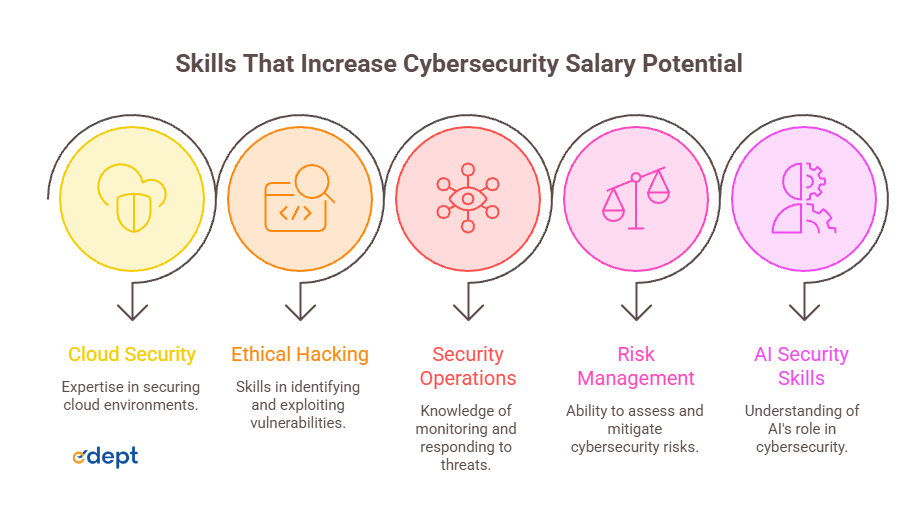
Why Skill-Based Cybersecurity Education Matters
Only theoretical knowledge will not help you to land a job. Skill-based cybersecurity education matters because digital threats are evolving at a much faster rate. The theoretical knowledge will not help you gain any practical experience or exposure to the realities of the job. The employers at every level, from entry-level analyst jobs to senior engineering jobs, value those candidates who can demonstrate practical problem-solving, not just an academic degree. What works is a combination of hands-on lab practice; recognized certifications, which can combat AI-driven attacks, cross-functional business resilience; and real-world project simulations. The best cybersecurity programmes will train you to investigate a phishing incident or help you run a penetration test against a vulnerable web app, work on a cloud environment, and write a clear incident report, because that is exactly what your first day on the job will look like. Certifications and academic degrees can open doors, but what will actually get you hired is how much problem-solving skill you have, how easily you can find a solution for a critical problem, and how you can analyze any problem and give a solution. Skill-based learning makes you employable from day one.
Why Choose edept for Cybersecurity Career Preparation
If you are looking for a learning partner that takes you from beginner to job-ready with the global market in mind, edept is built for exactly that.
Industry-Aligned Learning
The edept cybersecurity curriculum maps directly to roles companies are hiring for in 2026, such as SOC analysts, cloud security engineers, GRC specialists, and ethical hackers, instead of broad, theory-only content.
Practical Security Labs
You learn by doing. edept’s hands-on labs simulate real attack and defence scenarios, so you build the muscle memory required to handle live incidents.
Placement Support
edept provides dedicated placement assistance, resume building, interview preparation, mock technical rounds, and connections to hiring partners, which is often the missing piece for self-taught learners.
Global Career Readiness
The training is designed with international careers in mind. You learn the certifications, frameworks, and tools that are recognised across the US, Canada, and Australia, so the skills travel with you wherever you choose to settle.
Step-by-Step Career Roadmap for Global Cybersecurity Careers
Building a global cybersecurity career requires a progression from foundational IT skills to advanced, specialized defensive or offensive security roles.
Learn Core Security Concepts
You should begin with the fundamentals of cybersecurity, networking and operating systems. Master networking fundamentals (TCP/IP, DNS, routing), operating systems (Windows and Linux CLI), and basic scripting (Python or Bash). You should study the CIA triad (confidentiality, integrity, availability), zero trust models, and common threat vectors (malware, phishing).
Gain Certifications
The next step is to earn certifications. Certifications such as CompTIA Security+ are very important for beginners and provide a strong foundation for job searches. After completing the beginner certifications, you can complete CompTIA CySA+ (for analysts), PenTest+ (for testers), Certified Cloud Security Professional (CCSP), or the highly practical Offensive Security Certified Professional (OSCP).
Build Practical Projects
You should set up a home lab and participate in the Capture the Flag (CTF) challenges, TryHackMe and Hack The Box labs. Contribute to the bug bounty programmes. Then start documenting all your work and projects and build a professional portfolio. Global employers always look for candidates with practical exposure and industry experience.
Apply for Global Roles
You should start targeting the employers in your researched countries and prepare your resume for the country you’re targeting. Use platforms such as LinkedIn, Seek and various job boards to find the right jobs and start applying
Explore International Migration Options
Research the visa and immigration pathways appropriately before applying. Once you have 1–3 years of experience, evaluate Express Entry (Canada), Subclass 189/190 (Australia), or employer-sponsored pathways (US). You should start to plan early, as these processes take months to complete.
Future Scope of Cybersecurity Careers Beyond 2026
Cybersecurity careers are evolving past basic network defence into highly specialized, proactive, and strategic roles.
AI Security Growth
Artificial intelligence is transforming cybersecurity from both sides. Organizations are deploying more sophisticated AI-powered threat detections, while attackers are using ML to make attacks more sophisticated and harder to detect. The professionals who develop expertise at this intersection will find themselves in one of the most in-demand specializations in technology for the future.
Global Skill Shortage
The global cybersecurity workforce gap has reached an estimated 4.8 million unfilled positions. While demand continues to rise, requiring an 87% workforce growth to meet current needs, the industry faces systemic challenges, including broken hiring pipelines, talent burnout, and a lack of entry-level training. Only 34% of university- or master’s-level cybersecurity programmes require internships. This leaves many graduates without practical experience. Companies are moving past strict resume requirements, certifications and academic records and are rather focusing on candidates who can practically demonstrate their capabilities in real-world scenarios.
Increasing Salary Trends
Cybersecurity salaries are experiencing sustained global growth, with average compensation packages rising between 8% and 11%. The finance, technology, healthcare, and energy sectors are paying premium salaries of 20% or more over general market rates due to stricter regulatory and data privacy frameworks.
Conclusion
Cybersecurity has become one of the strongest career paths which is available to technology professionals in 2026. Microsoft estimates there are approximately 600 million cyber attacks globally each day, with over 97 billion exploitation attempts and 36,000 malicious scans per second. The global cybersecurity spending market will reach USD 240 billion in 2026, a 12.5% increase from 2025. Every organization now requires a professional who can protect its computer systems and network. As ransomware, AI-driven threats, and cloud vulnerabilities are continuously growing, companies are ready to pay top salaries for security professionals. This is why hiring for security roles has shot up across the United States, Canada, and Australia – these three countries consistently rank among the best places across the globe to build a cybersecurity career
The United States offers the highest and most attractive salaries, with senior professionals regularly earning $150,000 to $250,000 or more. Canada provides a strong balance of competitive salary, manageable living costs, and one of the most accessible permanent residency pathways in the world. Australia delivers excellent salaries, a growing market, and a quality of life that draws professionals from across the globe. Various Certifications, practical experience, and specialization in high-demand areas like cloud security, ethical hacking, and AI threat management consistently drive salaries above average in all three countries. Regardless of which market you’re targeting, those who invest in skills development, not just academic knowledge and certifications, are the ones who negotiate the strongest offers and are highly valued by employers.
If you are planning for a global cybersecurity career, you should start with a clear picture of where you want to land, understand the immigration pathways, and build the practical skills that employers in that market are actively looking for.
FAQs
Which country pays highest for cybersecurity jobs?
The United States and Switzerland generally pay the highest nominal salaries for cybersecurity jobs globally.
Is Canada good for cybersecurity careers?
Yes, Canada is an excellent market for cybersecurity careers.
Is Australia better than USA for cybersecurity?
Whether Australia or the USA is better for cybersecurity depends entirely on your specific priorities. The USA is the global hub for cybersecurity innovation and venture capital, whereas Australia offers a more streamlined compliance landscape, better work-life balance, and a distinct career paths.
What salary can freshers earn in cybersecurity abroad?
Freshers in cybersecurity can expect entry-level starting salaries ranging from $60,000 to $90,000 (approx. ₹50 Lakh to ₹75 Lakh), depending on the country, city, and specific role.
Which certifications improve salary?
CRISC, OSCP, and cloud security certifications (AWS Security Specialty, Azure SC-100) consistently lead to higher salaries.
Can Indian students get cybersecurity jobs abroad?
Yes, Indian students can absolutely get cybersecurity jobs abroad.
Which country offers the easiest PR?
Express Entry is widely considered the most predictable. Australia’s skilled migration system is also fast and transparent.
Is cybersecurity worth studying in 2026?
Yes, cybersecurity is absolutely worth studying in 2026.