Artificial Intelligence (AI) and Data Analytics have become two of the most sought-after career domains in today’s technology-driven world. From automating business processes to helping organizations make smarter decisions, both fields are transforming industries such as healthcare, finance, manufacturing, retail, education, and e-commerce. As companies continue investing in digital transformation, the demand for professionals in both domains is increasing rapidly. This growing demand has made AI vs. data analytics one of the most-searched career comparisons among students and working professionals. Despite their similarities, choosing between AI vs data analytics is not always easy. Both careers work with data, require analytical thinking, and offer excellent salary packages. However, their objectives, skill requirements, career paths, and long-term opportunities differ significantly. While Artificial Intelligence focuses on developing intelligent systems capable of learning, automating tasks, and making predictions, Data Analytics focuses on collecting, processing, and interpreting data to help businesses make informed decisions. This distinction often creates confusion for students trying to decide between AI and data analytics as a long-term career. According to the World Economic Forum’s Future of Jobs Report 2025, AI, big data, and information processing technologies will be among the biggest drivers of job creation through 2030, creating millions of new employment opportunities worldwide. Organizations across industries are actively recruiting professionals with expertise in both AI and analytics, making AI careers and data analytics careers some of the fastest-growing technology fields. If you’re wondering whether AI vs data analytics is the right career choice for you, this guide will help you make an informed decision. We’ll compare artificial intelligence vs data analytics across job roles, required skills, salaries, industry demand, career growth, and AI future scope to help you choose the path that best aligns with your interests, strengths, and long-term career goals.
What Is Artificial Intelligence?
Before you compare AI vs data analytics, it is very important for you to exactly understand what Artificial intelligence actually is. As both of these fields rely on data, AI is one step ahead as they enable machines to learn from data, recognize patterns, and make intelligent decisions with minimal human intervention. This is the key difference between artificial intelligence vs data analytics, influencing the skills required, career opportunities, and long-term growth in each field.
Understanding AI
Artificial intelligence refers to the simulation of human intelligence in machines that can learn from data, solve problems, make predictions, and improve their performance over time. AI systems continuously adapt using algorithms and large datasets instead of following traditional software that follows fixed rules. AI combines machine learning, learning systems, automation, and predictive capabilities to solve complex real-world problems. Some of the most common AI applications include:
- AI Chatbots for customer support and virtual assistance
- Recommendation engines used by Netflix, Amazon, and Spotify
- Autonomous systems such as self-driving vehicles and smart robotics
- Generative AI tools that create text, images, videos, and code
AI careers are expanding at a very fast rate across every industry, making AI vs data analytics an increasingly important career decision for students.
Why AI is Growing Rapidly
The development of Artificial Intelligence technology has gained momentum like never before, as organizations try to automate their processes, increase productivity, and innovate. Cloud computing, GPU processing power, and the availability of huge language models have made AI much more achievable today than ever before. 78% of organizations, as per the McKinsey State of AI Report (2025), make use of AI in at least one business process. With the increasing number of AI-driven solutions being adopted by businesses, the demand for professionals who can manage AI projects is steadily growing, further boosting the future scope of AI.
What is Data Analytics?
To have a good understanding of AI vs data analytics, it is also very important to know what data analytics is and what it involves. While artificial intelligence focuses more on building intelligent systems, Data Analytics concentrates on collecting, processing, and interpreting data to help organizations make informed business decisions. This distinction is one of the biggest differences in the artificial intelligence vs data analytics comparison.
Understanding Data Analytics
Data Analytics is the process of collecting, cleaning, organizing, and analyzing data to uncover meaningful patterns, trends, and insights. Instead of automating decisions like AI, Data analytics helps organizations understand past performance, identify opportunities, and make data-driven decisions. Key stages of Data Analytics include:
- Data collection from multiple sources
- Data cleaning to improve accuracy and quality
- Data analysis using statistical and analytical techniques
- Insight generation to support business strategies
Some common applications of Data Analytics include:
- Business intelligence and performance tracking
- Sales and demand forecasting
- Business reporting and dashboard creation
- Strategic decision-making across departments
The dependence on data by corporations as the foundation for growth makes data analytics among the most popular technology jobs today, which makes AI vs. Data Analytics an interesting topic for potential employees.
Why Data Analytics Is Critical
Data has emerged as one of the most valuable resources of any business, and businesses rely heavily on analytics to make quick and informed decisions. Whether it be customer experience improvement, operational optimization, or market trend forecasting, Data Analytics provides an edge for businesses to thrive in the dynamic world today. As per IDC, the datasphere is anticipated to grow to 393 zettabytes globally by 2028, which emphasizes the requirement for experts in analytics more than ever before. It underpins the future scope of analytics and guarantees that there will be plenty of opportunities for data analytics careers along with AI careers in the future.
AI vs Data Analytics: Key Differences
When comparing AI vs data analytics, it is very important to understand that both fields do use data but solve different kinds of problems. While artificial intelligence focuses more on building systems that can learn, automate tasks, and make predictions, data analytics focuses more on extracting meaningful insights from data to support business decisions. Both AI and data analytics offer excellent career prospects; the required skills, daily responsibilities, learning curves, and long–term career opportunities are quite different from each other. Having a good understanding of AI vs data analytics will help you choose the right career path based on your interests, technical abilities, and career goals.
AI vs Data Analytics Comparison Table
| Factor | AI | Data Analytics |
| Core Focus | Intelligent Systems | Data Insights |
| Goal | Automation and Prediction | Business Decisions |
| Complexity | High | Moderate |
| Coding Requirement | High | Moderate |
| Math Requirement | High | Moderate |
| Tools | Python, TensorFlow, PyTorch | SQL, Power BI, Tableau, Excel |
| Career Roles | AI Engineer, ML Engineer, NLP Engineer | Data Analyst, BI Analyst, Business Analyst |
Difference in Core Objective
The biggest distinction between AI and Data Analytics lies in their primary objectives. Artificial Intelligence is concerned with creating intelligent algorithms that learn from data, detect patterns, automate processes, and make predictions without any programming involved. AI drives recommendation engines, virtual assistants, autonomous systems, fraud detection services, and Generative AI tools. Data Analytics involves gathering, preparing, processing, and analyzing data in order to draw business insights. In contrast to AI algorithms, analysts help businesses to analyze customers’ behavior, detect trends, improve processes, and inform strategic decisions. It means that artificial intelligence vs data analytics is about creating intelligence vs getting insights. These two domains are complementary, and AI and data analytics are great areas to choose a career in.
Difference in Skills
Skills required for AI vs data analytics differ because each discipline addresses different business challenges. Professionals who are pursuing AI careers require strong technical and mathematical foundations, which include:
- Python programming
- Machine learning
- Deep learning
- Neural networks
- Linear algebra
- Probability and Statistics
- Data Structures and Algorithms
- Model Training and Optimizations
This helps AI professionals create predictive models, automate workflows, and create intelligent software applications. Some core skills required in data analytics careers include:
- SQL
- Microsoft Excel
- Statistics
- Data Visualization
- Power BI
- Tableau
- Business Intelligence
- Data Storytelling
While programming skills apply to both areas, differences arise regarding the technical skills required in the two disciplines. AI needs more programming and mathematics, but data analytics requires more business understanding and visualization.
Difference in Tools
Another important comparison point in AI vs data analytics is the tech stack being used in both fields. AI professionals mainly work with advanced development frameworks and programming environments, including:
- Python
- TensorFlow
- PyTorch
- Scikit-learn
- Jupyter Notebook
- Hugging Face
- OpenCV
These tools are used to build, train, evaluate, and deploy intelligent machine learning models. Data Analytics professionals rely more on business intelligence and reporting platforms, such as:
- SQL
- Microsoft Excel
- Power BI
- Tableau
- Google Looker Studio
- R (optional)
These tools are essential for data analysts to collect data, clean data, and visualize insights from the gathered data for better business decisions. AI or data analytics: your preferred tool can depend on your choice of career. People who like to develop software applications and intelligent systems will like AI, while people who like business analysis will like Data Analytics.
Difference in Complexity
One of the biggest points that arises when deciding between AI vs Data Analytics is the learning curve in their respective fields. Learning in the case of Artificial Intelligence is quite difficult as it involves programming, math, machine learning, deep learning, neural networks, and model optimization. The individuals working on AI spend much time working on model improvements, accuracy, and computational complexity. The learning curve for Data Analytics is comparatively moderate. It is possible to start working on Excel, SQL, and Power BI right away and then move on to Python, Statistics, and Predictive Analytics. That is why Data Analytics is the easiest way to get into the tech industry.
Difference in Work Style
Day-to-day responsibilities of both AI specialists and data analysts differ when we talk about AI vs data analytics.
- AI professionals spend most of their time in:
- Building machine learning models
- Training and testing algorithms
- Improving prediction accuracy
- Developing AI-powered applications
- Experimenting with new models
- Deploying AI solutions
While data analysts focus more on:
- Collecting and cleaning data
- Creating reports and dashboards
- Identifying business trends
- Visualizing data
- Supporting business decisions
- Presenting insights to stakeholders
In conclusion, there is no need to compare artificial intelligence to data analytics since they resolve different problems for companies. The scope of AI in the future looks more promising in comparison with data analytics’ future scope, owing to the development of intelligent automation in many industries, but the prospects for the latter look bright as well since data-driven decision-making grows in significance. Data analytics careers offer more chances to get an entry-level job, but AI occupations will appeal to people who like innovations.
Career Opportunities in AI
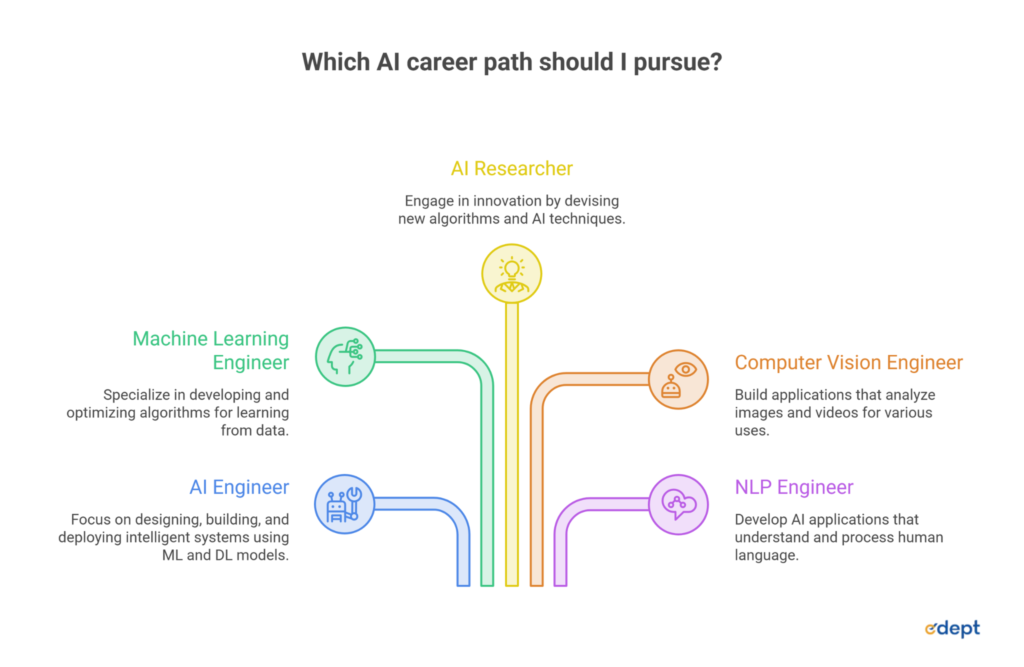
Demand for AI careers is continuing to grow as companies are adopting intelligent automation, Generative AI, and machine learning across industries. When evaluating AI vs data analytics, AI does offer some of the highest-paying and fastest-growing tech roles. According to reports from the World Economic Forum, AI and information technology will be among the biggest drivers of job creation through 2030, showing huge growth in the AI future scope.
AI Engineer
The daily work of AI Engineers involves designing, building, and deploying intelligent systems using machine learning and deep learning models. They mainly develop AI-powered applications like chatbots, recommendation engines, and predictive analytics solutions that automate business processes.
Machine Learning Engineer
Machine Learning Engineers design the algorithms that help machines to learn from data and continuously get better at doing certain tasks. They develop, optimize, and deploy machine learning models for applications like fraud detection, computer vision, and demand forecasting.
AI Researcher
AI Researchers devise new algorithms and AI techniques to solve difficult real-life problems through innovation. They usually operate in research labs, universities, or top technology firms.
Computer Vision Engineer
Computer Vision Engineers build AI applications that analyze images and videos. These engineers are responsible for technologies such as facial recognition, autonomous driving, medical imaging, and surveillance solutions.
NLP Engineer
Computer Vision Engineers build AI applications that analyze images and videos. These engineers are responsible for technologies such as facial recognition, autonomous driving, medical imaging, and surveillance solutions.
Career Opportunities in Data Analytics
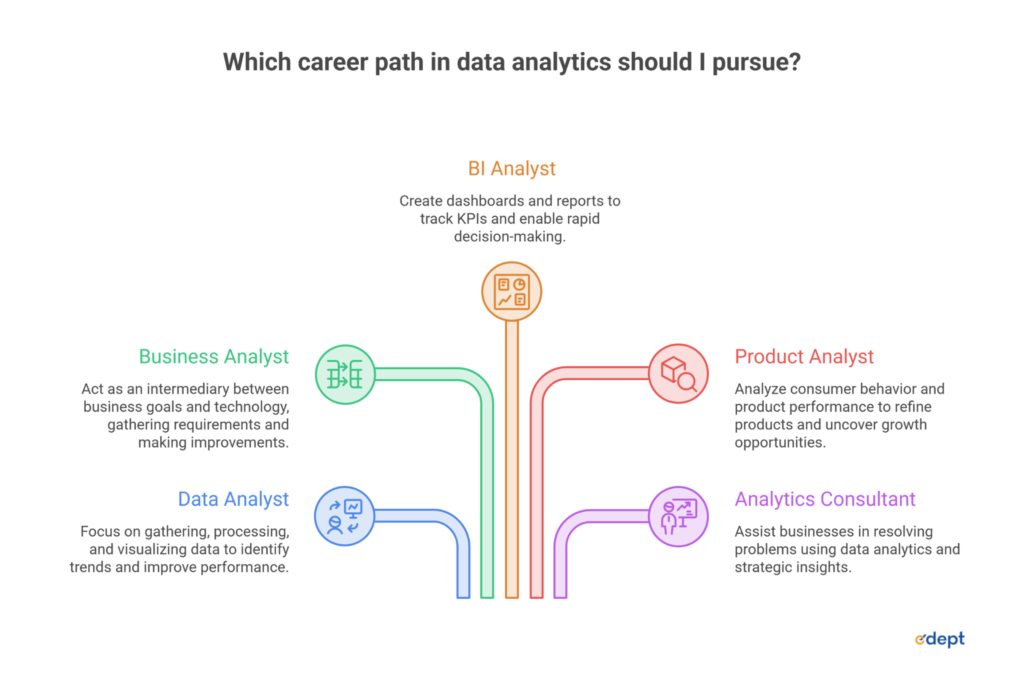
Demand for jobs in the data analytics field continues to grow, as businesses make more data-driven decisions to boost their performance. However, when comparing AI vs. Data Analytics, the latter offers a wider variety of career choices across sectors and easier access to the job market than the former. Analytical thinking is among the most sought-after skills at work, according to the World Economic Forum, thus indicating great prospects for data analytics.
Data Analyst
Data Analysts gather, process, analyze, and visualize the collected data in order to identify the trends that would help businesses make decisions. They use software like SQL, Excel, Power BI, and Tableau to build reports and dashboards, which help improve the company’s performance.
Business Analyst
Business Analysts act as intermediaries between the goals set by the companies and technologies that could achieve them. They gather the requirements and make improvements using data analysis.
BI Analyst
Business Intelligence (BI) Analytics Professionals create dashboards, reports, and data visualization services that allow executives and other stakeholders to track KPIs and make business decisions more rapidly.
Product Analyst
Product Analysts analyze consumer behavior, product performance, and metrics related to user engagement to help firms refine their products, provide better consumer experience, and uncover opportunities for growth through data.
Analytics Consultant
Analytics Consultants assist businesses in resolving problems by applying data analytics, reports, and strategic insights to them. The skills required for being an Analytics Consultant are industry-agnostic, which makes this career one of the most flexible options for professionals considering AI vs data analytics.
Skills Required for AI Careers
Success in a career in artificial intelligence (AI) calls for having a solid technical background and constantly keeping yourself updated. When you have to compare artificial intelligence vs. data analytics, artificial intelligence calls for programming and mathematics knowledge at a higher level. Getting better in these fields can help build an excellent future career in artificial intelligence.
Python
Python is the most commonly used programming language in artificial intelligence, as it is used in creating ML models and AI applications using TensorFlow and PyTorch.
Mathematics
Having a solid understanding of mathematical functions like linear algebra, calculus, probability, and statistics is essential for developing, training, and optimizing AI models.
Machine learning
Machine Learning is the backbone of modern AI. Having a strong base in supervised and unsupervised learning, and reinforcement learning techniques is important to build predictive and intelligent systems.
Deep Learning
Deep Learning essentials are more focused on working with neural networks that power advanced applications such as computer vision, speech recognition, and Generative AI.
Cloud AI
Having a good familiarity with AI services on AWS, Microsoft Azure, and Google Cloud does help professionals deploy scalable AI solutions and makes cloud expertise a valuable skill in today’s AI vs data analytics landscape.
Skills Required for Data Analytics Careers
An effective career in Data Analytics needs analytical skills, knowledge about the business, and technical knowledge. While analyzing AI vs data analytics, Data Analytics has an easy-to-understand learning curve, providing good data analytics career prospects in various sectors. Developing these skills can help you develop a solid base for improving your prospects in analytics.
SQL
SQL is the most important skill for Data Analysts. It is used to retrieve, filter, join, and manage data stored in relational databases for reporting and analysis.
Excel
Microsoft Excel remains a powerful tool for data cleaning, calculations, pivot tables, and basic data analysis, making it an essential skill for beginners.
Statistics
A basic understanding of statistics helps analysts identify trends, interpret data accurately, and make reliable business recommendations based on evidence.
Data Visualization
Presenting data through charts, graphs, and interactive reports enables stakeholders to quickly understand complex information and make informed decisions.
Dashboard Tools
Learning Power BI and Tableau allows professionals to make interactive dashboards and KPI monitoring; hence, they are valuable skills in AI vs data analytics era.
Salary Comparison: AI vs Data Analytics
As far as the comparison between AI vs data analytics is concerned, both fields provide lucrative pay and great prospects. Nevertheless, AI specialists get higher pay because of the high level of specialization and knowledge, while Data Analytics provides high income with easier access.
| Experience | AI Salary (India) | Data Analytics Salary (India) | AI Salary (Global) | Data Analytics Salary (Global) |
| Entry-Level | ₹8–15 LPA | ₹5–10 LPA | $90,000–130,000 | $65,000–95,000 |
| Mid-Level (3–7 Years) | ₹15–30 LPA | ₹10–20 LPA | $130,000–180,000 | $90,000–130,000 |
| Senior-Level (8+ Years) | ₹30–60+ LPA | ₹20–40+ LPA | $180,000–250,000+ | $130,000–180,000+ |
AI professionals, such as AI Architects and Machine Learning Engineers, get highly paid due to the future scope of AI and its increased need in intelligent automation. At the same time, experienced professionals like Data Analysts, Business Intelligence Specialists, and Analytics Consultants get equally competitive data analyst salary packages. Analyzing both AI and Data Analytics careers, one can say that the former provides better earning perspectives while the latter has great potential for career development and is more accessible at an entry level.
Which Career Is Easier for Beginners?
Choosing between AI vs data analytics often comes down to your background, interests, and learning preferences. While both fields offer excellent career opportunities, their learning curves differ significantly. Understanding these differences can help you decide whether AI or data analytics is the right starting point for your career.
AI Learning Curve
AI has a steeper learning curve in that it requires mastery of the Python programming language, mathematics, machine learning, deep learning, and algorithms. Beginners will also have to know linear algebra, probability, and neural networks before designing any intelligent system. Nevertheless, gaining such skills will provide access to lucrative AI jobs and an amazing future in AI.
Data Analytics Curve
As compared to AI, Data Analytics is easier to learn and does not involve many technical skills initially. One can start with learning SQL, Excel, Power BI, Tableau, and statistics, then proceed to learning Python and predictive analytics. Since there is no need for development of any AI model but data analysis, the technical aspects involved are relatively less complicated. This makes data analytics a good entry to the technology field.
Best Starting Point
When considering AI vs Data Analytics, Data Analytics is a better place to start, especially for beginners, owing to ease in learning and huge demand in almost all industries. Nonetheless, if one loves programming and mathematics, AI provides a lucrative future. Ultimately, the decision regarding AI vs Data Analytics lies with the individual concerned.
Which Career Has Better Future Scope?
While evaluating AI vs data analytics, both are highly promising career paths; however, they have different market needs. Although Data Analytics offers more opportunities at an entry level, Artificial Intelligence will grow much faster due to intelligent automation becoming a need for businesses.
AI Growth Outlook
The future of AI is very promising since all businesses are spending billions on Generative AI, machine learning, robotics, and intelligent automation. According to the World Economic Forum, technologies related to AI and information processing will become leading contributors to job creation until 2030. That’s why jobs related to artificial intelligence are considered one of the most promising domains within the technology industry.
Analytics Demand Outlook
Data analytics jobs are still in high demand as data-driven decision-making becomes an integral part of businesses. People with skills in SQL, Power BI, Tableau, and business intelligence are always in high demand in many industries like healthcare, finance, retail, and manufacturing.
Industry Adoption Trends
More and more businesses use a combination of AI and Data Analytics to automate processes, enhance customer experience, and gain actionable insights from data.
Which Has More Long-Term Potential?
When it comes to AI versus Data Analytics, AI is considered the winner because it has more growth potential and better pay due to fast technology. Nevertheless, Data Analytics should be chosen by novices since it will provide you with an easy way in and the basics necessary for entering the world of AI.
Industries Hiring AI and Predictive Professionals
The need for specialists with expertise in artificial intelligence against data analytics is not limited to tech companies. Businesses from all sectors are implementing AI and Data Analytics solutions in order to automate their processes, provide a better experience for customers, optimize their business, and make data-driven decisions. This ongoing process stimulates high demand for AI careers and data analytics careers.
Technology
AI Engineers, Machine Learning Engineers, Data Analysts, and BI Specialists are hired by technology companies to build intelligent solutions, cloud products, and data-based services.
Healthcare
AI and analytics are used by hospitals, pharmaceutical companies, and health-tech businesses for such purposes as disease prediction, medical imaging, optimization of patient care, and healthcare data management.
Finance
AI and Data Analytics are used by banks, insurance companies, and FinTech enterprises for fraud detection, credit risk analysis, algorithmic trading, customer insights, and compliance.
E-Commerce
AI and Data Analytics are used by online retailers to implement recommendation engines and analytics in order to personalize the shopping experience, predict demand, optimize inventory, and digital marketing.
Manufacturing
Manufacturers use AI and analytics for predictive maintenance, quality control, supply chain optimization, robotics, and production planning. As businesses continue embracing intelligent technologies, professionals with expertise in AI vs data analytics will find abundant career opportunities across virtually every major industry.
Common Mistakes Students Make While Choosing Between AI and Data Analytics
Selecting AI vs Data Analytics is not just a matter of comparing salary packages or going with industry trends. Most people opt for one of these options without any awareness of the skill set involved or how difficult each may be to learn and practice.
Choosing Based Only on Salary
Students pick AI vs data analytics jobs depending on salaries. Even though the salary in AI is high, future success will be determined by one’s personal interests, capabilities, and constant learning.
Ignoring Skill Requirements
One needs programming skills, good math skills, and machine learning capabilities for AI jobs, whereas for data analytics, they require SQL, data visualization, statistics, and solving business problems. It is vital to know the requirements before deciding which career path to take.
Underestimating Math in AI
It is a myth that coding alone is sufficient for AI professionals. However, the truth is that one needs strong math skills, such as linear algebra, probability, and calculus, among others, to work on AI algorithms. Therefore, it is important to evaluate one’s mathematical abilities before embarking on the chosen career path.
Avoiding Practical Projects
Certification alone is not sufficient; having practical knowledge through developing projects and doing internships helps one gain employability in AI as well as data analytics.
Why AI+Data Analytics Skills Create Stronger Career Opportunities
Today, in a world of technology, the discussion between AI vs data analytics has moved beyond its traditional boundaries, into how the two fields support each other. Companies require candidates who can create intelligent applications and use data analysis to support business decision-making. The combination of these two skills will give an opportunity to open up AI-related career paths, data analytics-related career paths, and even higher-paid jobs.
AI Needs Quality Data
The success of your AI model depends on the data that it processes. Therefore, clean, structured, and accurate data is crucial for building machine learning algorithms and producing reliable predictions.
Analytics Improves AI Decisions
Data Analytics enables companies to collect, process, and analyze data, which will then be used by AI models. Higher data quality means better models, automation, and, ultimately, successful business results.
Hybrid Professionals Are In High Demand
Candidates with knowledge in both fields of AI and Data Analytics are valuable assets for companies in any industry. They can create intelligent systems, interpret business insights, and solve problems in a complete manner. Thus, if you have to choose between AI vs data analytics, developing skills in both domains will bring you more opportunities and better chances in the future.
Why Choose edept for AI and Data Analytics Career Preparation
As the demand for professionals in AI vs data analytics continues to grow, choosing a training provider that combines academic excellence with industry relevance is essential. edept prepares students for future-ready careers through practical, career-focused learning designed around the latest technology trends. Its Master’s in Data Science & AI programme, delivered in partnership with Steinbeis University (Germany) and Shree L.R. Tiwari School of Business Management (Mumbai), follows a global dual-degree model with a strong focus on employability.
Industry-Aligned Programs
edept’s curriculum encompasses Artificial Intelligence, Data Analytics, Python, SQL, Machine Learning, Business Intelligence tools, Cloud Computing, Data Management, and other new-age technologies. Students get a chance to work on innovative projects in business analytics in line with present-day industry requirements.
Practical Projects
Learning at edept comes in the form of projects that include innovation projects, internships in India, and industry-based company projects in Germany tracks, which enable students to build a portfolio of their own before joining the corporate sector.
Hands-On Learning
Instead of just theoretical learning, students are encouraged to learn by doing in the form of live projects, research work, cloud technology applications, and artificial intelligence-based practical case studies and applications. The students are also trained in German language courses.
Career-Oriented Training
In order to support students in all phases of their learning journey, mentorship, visa services, interview preparations, career guidance, and academic collaboration with international institutions are provided. With the help of these and industry-aligned curriculum, and global exposure, edept helps upcoming professionals build a career in AI, Data Analytics, Cloud Computing, and other technologies.
Step-by-Step Roadmap for Students
If you are still confused about choosing between AI vs Data Analytics, then you should consider a step-by-step process to make sure that you have the right skills and can enter your chosen field without any doubts.
Learn Programming Basics
Begin by learning Python because it is the most popular programming language in both the fields of AI and Data Analytics. Start with the basics of programming and problem-solving.
Build Strong Data Foundations
Be aware of SQL, Excel, Statistics, and Data Visualization. All of these concepts form the foundation for both AI and Data Analytics.
Choose AI or Analytics Path
Choose an area of interest. You can go for AI if you like machine learning and automation, or Data Analytics if you like making business decisions.
Work on Real Projects
Build practical projects such as dashboards, predictive models, or AI-powered applications. A strong portfolio showcases your skills to employers.
Earn Certifications
Complete recognized certifications in AI, Data Analytics, cloud technologies, or Python to strengthen your resume and validate your expertise.
Apply for Internships
Gather practical experience through internships or real-time industrial projects. This experience will not only improve your problem-solving skills but will also increase your chances of getting lucrative jobs.
Future Outlook Beyond 2030
The future of AI vs data analytics is extremely bright because companies will keep making investments in intelligent technologies and innovations based on the analysis of data. Even though AI is anticipated to take a front place in the upcoming wave of automation, Data Analytics will be equally important for turning unstructured data into valuable information for businesses.
AI Adoption Will Accelerate
Firms globally will use AI for automation, predictive modeling, Generative AI, robotics, and intelligent decision-making, which means that there will be high demand for specialists in this area.
Data Volumes Will Continue Growing
With the growing amount of generated data in companies, there will be an increasing need for experts capable of collecting, analyzing, and interpreting information, thus giving additional power to data analytics career paths.
Hybrid AI-Analytics Roles Will Rise
More and more firms are looking for specialists knowledgeable in AI and Data Analytics to develop intelligent solutions on the basis of high-quality data and business insights.
Skill-Based Hiring Will Increase
Academic degrees and certifications are becoming less important for employers in favor of practical skills and projects.
Strong Global Demand Will Continue
According to the World Economic Forum’s Future of Jobs Report, AI, big data, and technological literacy will remain among the fastest-growing skill areas through the coming decade. Whether you choose AI vs data analytics, continuously learning and adapting to emerging technologies will be the key to long-term career success.
Conclusion
In the AI vs data analytics comparison, there is no one answer that fits all because both branches provide great career opportunities and potential for development. Artificial Intelligence is distinguished by high salaries, advanced technologies, and increased AI future scope, which make it a great option for students interested in programming, machine learning, and intelligent systems. At the same time, Data Analytics offers an easier entry into the field, high demand from employers, and a variety of job positions within various industries, including business, healthcare, finance, retail, and technology. Everything comes down to personal preferences, skills, and the career goals of students. Regardless of the chosen branch of technology, the accumulation of experience in AI vs data analytics through projects, internships, certifications, and education will guarantee future success. With growing investments by companies in data-driven technologies, specialists in AI vs data analytics will always stay in high demand.
Related Links:
| Top GenAI Careers to Watch Out | Direct Admission in Data Science |
| Job-Focused Data Science Programs | Data Science Courses for Beginners |