Every year, lakhs of students graduate, but almost everyone makes the same decision. It is not that they particularly want to study more for a postgraduate degree or that it is genuinely required for their career; they want it because they believe that with a master’s degree they can easily have a strong international career opportunity. That story is changing fast. In 2026, global jobs without master’s degree are not just possible; they are increasingly common.
Around 70% to 73% of global employers and hiring managers prioritize demonstrated skills over traditional credentials like a master’s degree. Data shows that skills-based hiring expands talent pools significantly, while nearly 40% of core workplace skills are projected to change by 2030, making continuous upskilling more valuable than static academic degrees. Employers across various sectors, such as cybersecurity, cloud computing, data analytics, data science, healthcare, and digital marketing, are now hiring based on what candidates can actually do, not just what degree they sit on their resume.
Sectors such as AI support, DevOps, and UI/UX design now operate on a skills-first model. A strong portfolio, a relevant certification, or hands-on project experience often opens more doors than a traditional master’s programme. If you are looking for global jobs that don’t require a master’s degree, the market has never been more welcoming. Skill-based hiring is expanding, and international jobs without postgraduate degrees are paying competitive salaries from day one. This guide walks through high-demand global jobs without a master’s that are hiring right now, what they pay, which countries are actively recruiting, and exactly how a student can prepare for one of these roles without waiting for a postgraduate degree.
Why Companies Are Prioritizing Skills Over Degrees
Prioritizing skills over degrees means focusing on what people can actually do, rather than just the formal education they have completed. Employers are rapidly shifting to skills-based hiring, with 70% now using it and 53% eliminating degree requirements, driven by the fast pace of AI. AI competency is increasingly crucial for entry-level roles.
Rapid Technology Changes
In India, approx. 40-67% of young graduates remain unemployed. They have the degree, but it is the skills they lack, which is why the challenges in finding a job remain constant. On the other hand, professionals with updated skills but without any prestigious degree are landing great jobs. Technology is moving faster than a university curriculum can keep up with. AI, data analytics, and automation are the new tools that even traditional sectors like banking, healthcare, and manufacturing are embracing. What you learn in a master’s programme today may be partially outdated by the time you graduate. Employers need people who can adapt to new tools immediately, not candidates who spent years studying theory.
Industry Certifications Becoming More Valuable
The top universities are forming collaborations with global platforms such as Coursera, Microsoft, Google, or AWS to deliver certifications along with degrees. Cloud certifications are proof that you have skills in cloud computing platforms like AWS, Microsoft Azure, and Google Cloud. Cybersecurity certification proves that you can protect networks, data, and computer systems from hackers. Analytics certifications prove that you can collect, clean, and study data to help businesses make important decisions.
Practical Experience Matters More
Practical experience matters more than just theory. It proves your skill set in real-world situations. Internships help you gain real experience in a professional setting. You can learn how teams collaborate & communicate and meet mentors and industry experts who can guide you. Project portfolios showcase your work & give employers proof of what you can actually do. Hands-on experience helps you to practise with the software or tools your field actually uses. You will learn to fix errors & handle daily tasks.
Note: The reality is very simple. Non-master’s career pathways are no longer a second option. They have become a direct, respected route into the global workforce.
Benefits of Starting a Global Career Without a Master’s Degree
To start a global career without a master’s degree is highly achievable and offers significant financial and professional advantages. Some of them are.
Faster Entry Into the Workforce
Skipping a master’s degree helps you to start your global career immediately. You can enter the international job market two to three years ahead of your peers. Instead of draining your savings in higher education, you can start generating steady income immediately.
Lower Education Cost
By entering a global workforce you can completely avoid tuition fees & living expenses. Instead of draining your savings, you can generate a steady income, and you can reinvest in learning certifications and skill building.
Early International Experience
A global career depends on cultural adaptability and market knowledge. Starting early introduces you to diverse multinational teams and global business operations. You learn to understand international cross-cultural communication in real-world scenarios.
Ability to Upskill While Working
The modern global market is rapidly evolving. Working directly in an industry helps you understand the skill gaps, and you have the chance to complete the targeted certifications and upskill yourself while working. This ensures that your professional development is aligned with global industry demands.
Benefits of Starting a Global Career Without a Master’s Degree
To start a global career without a master’s degree is highly achievable and offers significant financial and professional advantages. Some of them are.
Faster Entry Into the Workforce
Skipping a master’s degree helps you to start your global career immediately. You can enter the international job market two to three years ahead of your peers. Instead of draining your savings in higher education, you can start generating steady income immediately.
Lower Education Cost
By entering a global workforce you can completely avoid tuition fees & living expenses. Instead of draining your savings, you can generate a steady income, and you can reinvest in learning certifications and skill building.
Early International Experience
A global career depends on cultural adaptability and market knowledge. Starting early introduces you to diverse multinational teams and global business operations. You learn to understand international cross-cultural communication in real-world scenarios.
Ability to Upskill While Working
The modern global market is rapidly evolving. Working directly in an industry helps you understand the skill gaps, and you have the chance to complete the targeted certifications and upskill yourself while working. This ensures that your professional development is aligned with global industry demands. 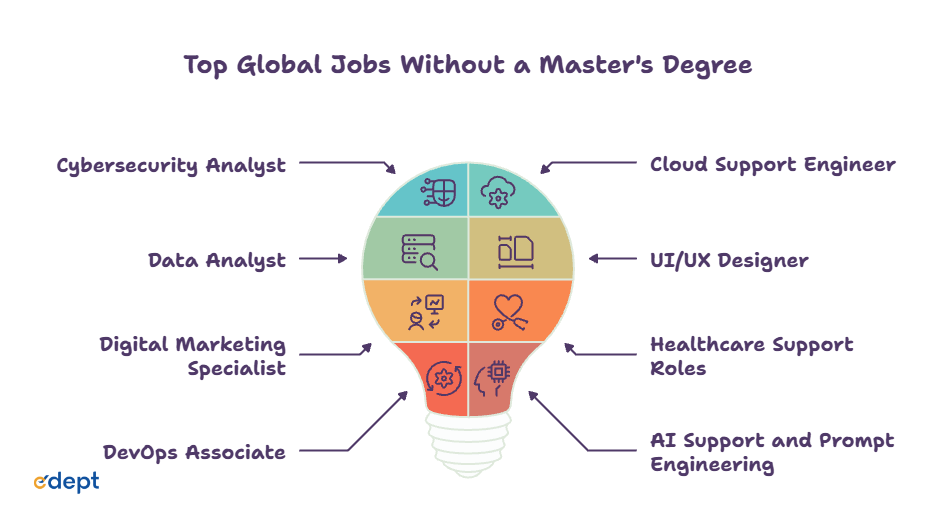
Top Global Jobs That Don’t Require a Master’s Degree
The top global jobs that don’t require a master’s degree are as follows:
Cybersecurity Analyst
Role overview: Cybersecurity analysts help monitor networks for suspicious activity, run threat detection inside a Security Operations Centre (SOC), investigate breaches, and help in building incident-response plans.
Average salary range: The global average salary range for a cybersecurity analyst ranges from $40,000 to $136,000 per year, varying widely by region, experience, and local cost of living. Countries hiring: The top countries actively hiring cybersecurity analysts globally are the United States, Canada, the United Kingdom, Australia, and Germany.
Required skills: SOC operations, SIEM tools, vulnerability assessment, incident response, and foundational networking (TCP/IP, firewalls).
Certifications: CompTIA Security+ and Certified Ethical Hacker (CEH) are the two most widely recognized entry credentials; CISSP and cloud security certifications add further salary premiums as experience grows.
Cloud Support Engineer
Role overview: Cloud support engineers help in managing and troubleshooting cloud infrastructure on platforms like AWS and Microsoft Azure. They handle everything from server administration to cloud operations monitoring. It’s the most common entry point into the broader cloud career track. Average salary range: The average global salary for a cloud support engineer ranges from approximately $90,000 to $130,000 per year.
Countries hiring: Major countries actively hiring cloud support engineers globally include the United States, Germany, Singapore, the United Kingdom, and Australia.
Required skills: AWS or Azure administration, cloud operations monitoring, basic scripting, and networking fundamentals.
Certifications: AWS Certified Cloud Practitioner or Solutions Architect Associate and Microsoft’s AZ-104, each linked to double-digit salary increases, with combined certifications leading to pay 40–50% above non-certified peers.
Data Analyst
Role overview: Data analysts help in interpreting datasets to guide business decisions, a role that covers nearly every industry, from finance to healthcare to retail. A data analyst who is mostly proficient in SQL, Python, Excel and Power BI and who can communicate insights clearly to business stakeholders earns well at every level of their career.
Average salary range: The average global salary range for a data analyst ranges from approximately ₹4.5 Lakhs to ₹10 Lakhs per year in India, $55,000 to $115,000+ per year in the United States, and €35,000 to €80,000 per year across the European Union, heavily influenced by experience and region.
Countries hiring: The top countries actively hiring data analysts globally include the United States, Canada, Germany, Australia, and the United Kingdom.
Required skills: Excel, SQL, and data visualization are the baseline; deeper roles increasingly expect Python or R.
Certifications: Power BI and Tableau certifications, along with Google’s Data Analytics Professional Certificate, are the most commonly requested credentials.
UI/UX Designer
Role overview: UI/UX designers help in shaping how digital products look, feel, and function, and this is probably the only field on this list where a degree does not matter, because hiring managers judge design ability almost entirely by portfolio.
Average salary range: The average global salary for a UI/UX designer ranges from $35,000 to over $115,000 per year.
Countries hiring: The top countries actively hiring UI/UX designers globally include the United States, Germany, the United Kingdom, Canada, and the Netherlands.
Required skills: Figma, wireframing, prototyping, and user research methods.
Certifications: The Google UX Design Professional Certificate remains the most recognized entry credential, alongside Interaction Design Foundation courses.
Digital Marketing Specialist
Role overview: Digital marketing specialists help in running SEO, paid advertising, and social media campaigns, a results-driven field where measurable performance matters more than academic background.
Average salary range: The global average salary for a digital marketing specialist generally ranges from $5,000 to over $88,000 per year.
Countries hiring: The countries with the highest global demand and compensation for digital marketing specialists include the United States, United Kingdom, Canada, Australia, and the UAE Required skills: SEO, paid ads (Google Ads, Meta Ads), social media strategy, and analytics interpretation.
Certifications: Google Analytics, Google Ads, HubSpot, and Meta Blueprint certifications are the standard employer-recognized credentials.
Healthcare Support Roles
Role overview: Elder care workers, nursing assistants, and healthcare technicians form the frontline of ageing-population care systems worldwide; these are roles built on vocational training rather than postgraduate study.
Average salary range: The average median annual wage for healthcare support roles globally spans a wide range, sitting around $38,340 in the United States, while international migration and specialized destination roles can range from ₹5 lakh to over ₹60 lakh ($6,000 to $72,000+ USD) depending on the region.
Countries hiring: Germany, United Kingdom, Australia, UAE, New Zealand & Ireland.
Required skills: Patient care fundamentals, basic clinical support, and communication under pressure.
Certifications: Vocational healthcare assistant training and, where applicable, national nursing assistant licensing.
DevOps Associate
Role overview: DevOps associates help automate software delivery pipelines, manage CI/CD workflows, maintain cloud infrastructure, and help development and operations teams work together efficiently.
Average salary range: The average global salary range for an entry- to mid-level DevOps Associate is $60,000 to $110,000 USD per year, with significant variation by region and company type. Countries hiring: The top countries hiring DevOps associates and engineers globally include the United States, Canada, and Germany.
Required skills: Automation scripting, CI/CD tools (Jenkins, GitLab), containerization (Docker), and cloud infrastructure basics.
Certifications: Certified Kubernetes Administrator (CKA) and AWS Certified DevOps Engineer are the most valued credentials.
AI Support and Prompt Engineering Roles
Role overview: This is the newest category here, non-research operational AI jobs such as AI support specialists and prompt engineers, who help in deploying, tuning, and troubleshooting AI systems inside real products rather than researching new models.
Average salary range: The average global salary range for AI Support and Prompt Engineering roles typically spans from $90,000 to $140,000 per year.
Countries hiring: The top countries actively hiring for AI support, interaction, and prompt engineering roles globally include the United States, United Kingdom, Germany, Singapore, India, and Switzerland.
Required skills: Prompt design, basic Python, and familiarity with LLM tools and evaluation methods.
Certifications: Applied prompt-engineering and generative AI courses from providers like Coursera and NetCom Learning are increasingly recognized.
| Role | Entry-Level Salary (USD/Equivalent) | Top Hiring Countries |
| Cybersecurity Analyst | $55K – $75K | Canada, Germany, Australia |
| Cloud Support Engineer | $75K – $105K | USA, UK, Germany, India |
| Data Analyst | $58K – $75K | USA, Canada, UK, Singapore |
| UI/UX Designer | $60K – $80K | Remote-first (Global) |
| Digital Marketing Specialist | $58K – $70K | USA, UAE, UK, Australia |
| Healthcare Support | $35K – $50K | Germany, Australia, Canada |
| DevOps Associate | $80K – $100K | USA, Germany, Canada |
| AI Support / Prompt Engineer | $95K – $130K | USA, UK, Remote |
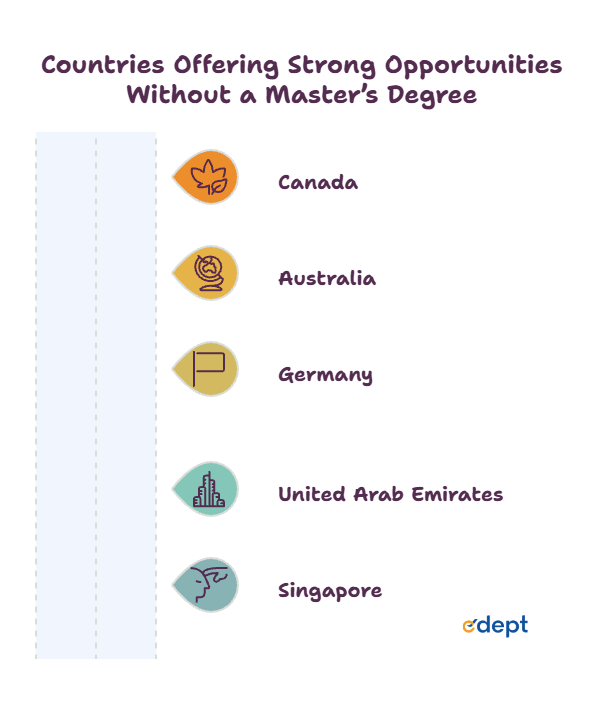
Countries Offering Strong Opportunities Without a Master’s Degree
The place where a student chooses to build a career is equally important as which skill they build. The countries below stand out because their immigration and hiring systems are structured around skills, occupation demand, and practical experience.
Canada
Canada offers strong career prospects for professionals without a master’s degree, relying heavily on practical skills, certifications, and relevant experience.
Hiring culture: Here, employers prioritize hands-on experience, demonstrated portfolios, and industry-recognized certifications over advanced academic degrees. Local networking, cultural fit, and strong English heavily influence hiring success.
Work visa openness: The Comprehensive Ranking System (CRS) awards points for age, language ability, and work experience, and the Express Entry Trades Category accepts candidates with as little as six months of continuous experience in an eligible trade, no degree required. Canada plans to admit 122,000 permanent residents through Express Entry, and skilled workers with strong CRS profiles can move from application to PR in roughly 6–12 months.
Industries hiring: IT, logistics, hospitality.
Australia
Australia offers strong career and earning opportunities without a master’s degree by focusing on practical skills, certifications, and trade qualifications.
Hiring culture: Here, employers prioritize proven ability, certifications, and practical experience over academic credentials.
Work visa openness: The Temporary Graduate Visa (subclass 485) gives 2–4 years of full work rights. Australia’s skilled migration programme prioritizes healthcare support, IT, and engineering professionals. Vocational qualifications like Certificate III in Health Services Assistance are widely accepted.
Industries hiring: IT, civil works, logistics & construction
Germany
Germany offers strong career paths for international professionals who do not hold a master’s degree, and it is heavily driven by severe labour shortages. Germany faces a structural shortage of over 1.7 million unfilled positions, concentrated heavily in engineering, IT, and healthcare.
Hiring culture: Here employers increasingly evaluate candidates by proven track records, technical tests, certifications, and project portfolios. Some broader German job markets expect conversational-to-professional German proficiency.
Work visa openness: The Chancenkarte (Opportunity Card) lets skilled professionals enter Germany for up to 12 months to search for work without a prior job offer, requiring only 6 points on a scale that accepts vocational qualifications alongside degrees. Separately, Germany’s EU Blue Card carves out a specific no-degree exception for IT specialists with three or more years of recent, relevant experience.
Industries hiring: IT, software development, healthcare & nursing, logistics & supply chain.
United Arab Emirates
The United Arab Emirates (UAE) does not require a master’s degree for the vast majority of its workforce; instead, a bachelor’s degree or specialized technical experience is the standard benchmark for professional-tier roles. They heavily prioritizes relevant professional experience and practical skills.
Hiring culture: The UAE has a fast-paced, highly corporate, and multicultural workplace culture. Recruiters screen heavily based on how quickly you can start.The UAE job market heavily prioritizes relevant professional experience, practical skills.
Work visa openness: The UAE Job Seeker Visa and Green Visa give skilled professionals routes to enter without a sponsoring employer already lined up, and standard employer-sponsored work visas typically process within weeks once documentation is complete.
Industries hiring: Sales & Real Estate, Tech & Digital Media, Hospitality & Tourism, Supply Chain & Logistics Administration & Finance
Singapore
Singapore offers strong career opportunities for professionals without a master’s degree, relying heavily on practical skills, certifications, and proven work experience.
Hiring culture: Employers increasingly value certifications, technical proficiency, and portfolio impact over advanced academic degrees. They focus on efficiency, clear hierarchy, and measurable performance targets.
Work visa openness: The Employment Pass requires a minimum monthly salary starting at S$5,600 (rising to S$6,000 from January 2027) and a COMPASS score of at least 40 points, calculated from salary competitiveness, qualifications, workforce diversity, and shortage-occupation bonuses, a structure built to reward in-demand skills, not just degree level alone.
Industries hiring: IT, Logistics & Supply Chain, Digital Commerce & Marketing, Advanced Manufacturing & Healthcare Support.
Skills That Matter More Than a Master’s Degree
Organizations today need professionals who can contribute from the start. They value experience, problem-solving ability, and applied knowledge over theoretical understanding. As a result, hiring decisions increasingly prioritize skills over formal education.
Technical Certifications
A certification tells an employer, in a very practical way, that you already know how to do the job. Cloud certifications like AWS and Microsoft’s AZ-104 can increase your pay by 15–20% on their own, and combining a few relevant certifications together can push salaries 40–50% above what non-certified peers earn. That kind of return, in just a few weeks of focused study, is hard for a two-year degree to match.
Communication Skills
This is the one skill people underestimate the most. In a 2026 survey of over a thousand hiring managers, communication came out as the single most important soft skill of the year, ahead of professionalism, time management, and even technical ability. Nearly all employers, 98% in one recent survey, said strong communication is a must-have for new hires. If you can explain your work clearly, in writing and out loud, you’re already ahead of a large share of applicants.
Problem-Solving Ability
Employers care less about how you learned to think and more about how well you actually think under pressure. Analytical thinking tops the World Economic Forum’s list of core skills for 2026. This is a skill you build by doing real work, not by sitting through more lectures.
Real-World Projects
When you build an actual system, it proves your capability better than any thesis. Portfolios demonstrate how you handle constraints, timelines, and execution. Practical exposure signals job readiness instantly.
Industry Tools Knowledge
If you know how to operate modern software and platforms, it can save your onboarding time. Familiarity and practice with standard workplace tech make you productive from day one. You can build this skill through online resources and self-guided practice. Recent hiring managers place software and tool proficiency as the top hard skill for hiring any candidates.
Certifications That Improve Global Employability
Certifications work because they give an employer proof, not promises. A degree tells someone what you studied years ago; a certification tells them what you can do right now.
Cloud Certifications
Cloud computing certifications prove that you can build and manage scalable infrastructure on the world’s leading platforms. Cloud skills are some of the most rewarded in tech hiring today. Some of the most important cloud certifications include:
- AWS Certified Solutions Architect – Associate
- Microsoft Certified: Azure Administrator Associate (AZ-104)
- Google Cloud Professional Cloud Architect
Cybersecurity Certifications
Cybersecurity certifications are universally recognized because every digital enterprise faces persistent global cyber threats. Security+ and CEH (Certified Ethical Hacker) are the two credentials that consistently open doors in cybersecurity hiring. Some of the most important cloud certifications include:
- CompTIA Security+
- Certified Ethical Hacker (CEH)
- Certified Information Systems Security Professional (CISSP)
Analytics Certifications
- Power BI, Tableau, and Google Analytics certifications prove you can turn raw data into decisions employers can actually use. Since more than half of hiring managers now highly value a candidate’s practical portfolio as heavily as their education, these certifications work best when they are tied to a real project, a dashboard you built, or a report you analysed, rather than just a simple traditional resume. Some of the most important cloud certifications include:
- Tableau
- Power BI
- Google Analytics
Digital Marketing Certifications
Google Ads, Google Analytics, HubSpot, and Meta Blueprint are the most commonly requested marketing certifications in job postings today. Their real value shows up when they’re paired with actual campaign results, click-through rates, conversions, and audience growth that a candidate can point to and explain clearly. Some of the most important cloud certifications include:
- Meta & Google Blueprints
- HubSpot Content Certifications
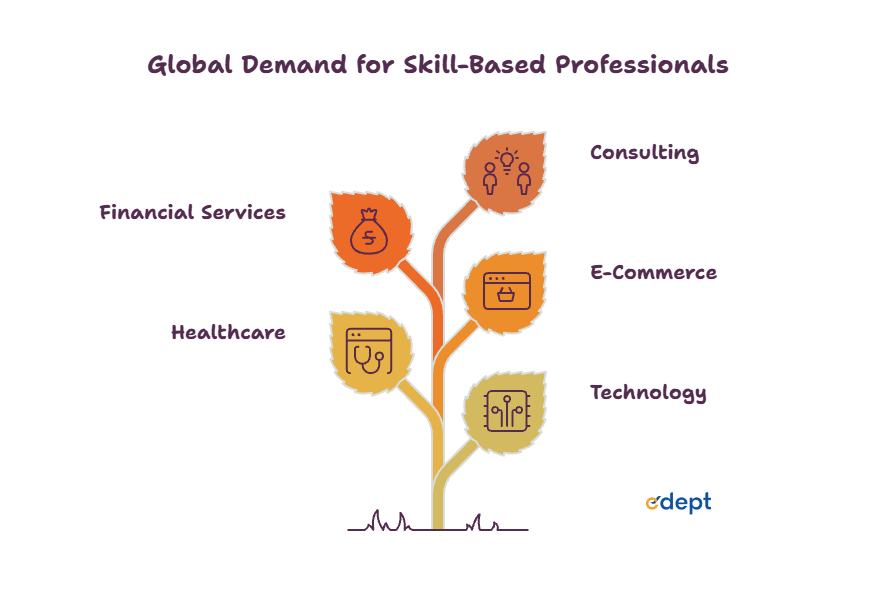
Industries Hiring Skill-Based Professionals Globally
Skill-based hiring isn’t limited to one type of company anymore. Across almost every sector, employers now use skills assessments, project reviews, and portfolios as the primary means of evaluating candidates.
Technology:
Technology remains the clearest example of skills over degrees. Tech hiring in 2026 is being driven by AI adoption, cybersecurity needs, and cloud infrastructure demand. Tech talent shortages are so persistent that unemployment rates for many specialized tech roles remain well below the national average. What’s changed is that this demand isn’t limited to traditional tech companies anymore; nearly every industry now hires for technical skills to support its own digital transformation.
Healthcare:
While regulated roles like physicians and nurses still require traditional degrees, the broader healthcare ecosystem is aggressively shifting toward skill-based hiring for its operational, technological, and supportive roles. The global rapid growth of digital health, telemedicine, and electronic health record management has created a massive demand for technical competencies within clinical environments.
E-Commerce
The e-commerce and retail tech landscape operates at a speed that demands immediate, practical expertise. Online retail continues expanding worldwide. Hiring managers in this sector look for proven execution skills in digital marketing, search engine optimization, conversion rate optimization, and data-driven inventory management.
Financial Services
The financial services industry is experiencing a massive transformation and is driven by fintech innovation and decentralized systems. Digital banking, online payments, and blockchain-based services are pushing fintech firms to hire compliance specialists, data analysts, and cybersecurity professionals, roles that are built on practical, certifiable skills rather than just a postgraduate degree.
Consulting and Outsourcing
The global business process outsourcing market is projected to grow from roughly $353 billion in 2026 to over $740 billion by 2034. Consulting firms and business process outsourcing providers are rapidly transforming their business models to deliver immediate value to clients, making them major supporters of skill-based hiring.
Common Mistakes Students Make While Planning Global Careers
Some of the common mistakes students make while planning their global careers are
Over-Relying on Degrees
Most of the students believe that a degree from a highly ranked university is a golden ticket to a global career, but they forget that employers now value proven skills & capabilities over university degrees. While a degree is important, students still struggle heavily if they lack relevant skills, real-world networks, and role-specific certifications.
Ignoring Certifications
Academic programmes can teach you foundational theoretical knowledge, but they often fail to provide the immediate, job-ready skills that international employers highly value. Many industries, such as finance, cloud computing, data analytics, and healthcare, depend heavily on industry-standard licences and certifications; skipping these certifications can make you look generic in the global talent pool.
Lack of Portfolio Building
When companies hire for abroad and global job roles, a generic resume with only classes and grades mentioned does not give the employer much proof that you are capable of handling the job. The absence of a portfolio can affect your job interview a lot. Employers look for candidates who have practical, hands-on skills and workplace readiness.
Not Researching Visa-Friendly Countries
One of the most serious mistakes is selecting a study destination based purely on university prestige or lifestyle trends, without understanding local immigration pathways. Before you make your decision, do complete research on the country’s work visa policies, post-study work visa durations, and demand lists for critical skills.
Why Skill-Based Education Is Becoming More Important Than Ever
In today’s rapidly evolving job market, academic knowledge alone is no longer enough. Employers are looking for professionals with practical, job-ready skills that can be applied from day one. According to the World Economic Forum’s Future of Jobs Report, over 85 million jobs may be displaced by automation by 2025, while 97 million new roles will emerge requiring distinctly human skills like creativity, empathy, and complex reasoning. That means industry-ready training matters more than ever. Practical exposure to building real systems, analyzing real datasets, and running real campaigns improves employability faster than theory alone, and certifications give employers a fast, trustworthy assurance of readiness.
Why Choose Edept for Global Career Preparation
edept was founded by alumni of INSEAD and IIM with one goal: closing the gap between what universities teach and what global employers actually need. Rather than building programmes around a theory-heavy syllabus, edept partners with universities to design industry-oriented, certification-focused programmes in fields like cybersecurity, data analytics, and cloud computing.
Industry-Aligned Curriculum
edept’s curriculum is designed to meet what the industry actually expects. Every module covers real-world job roles and the specific skills employers ask for, not just theoretical content.
Hands-On Projects & Practical Training
Learning at edept means getting your hands on real environments. You work on projects that simulate actual job scenarios. Instead of just watching videos, you get to build real projects, deploy new applications, configure networks, and take on many other interesting tasks.
Placement Assistance & Career Support
edept provides structured support for your job search, from resume building and mock interviews to job referrals and career guidance. You are not left to figure it out on your own.
Structured Career Roadmap for Students
Whether you are just starting from zero or looking to level up, edept gives you a clear, step-by-step path, from beginner foundations to expert-level skills. No guesswork, just a structured roadmap that takes you where you want to go. 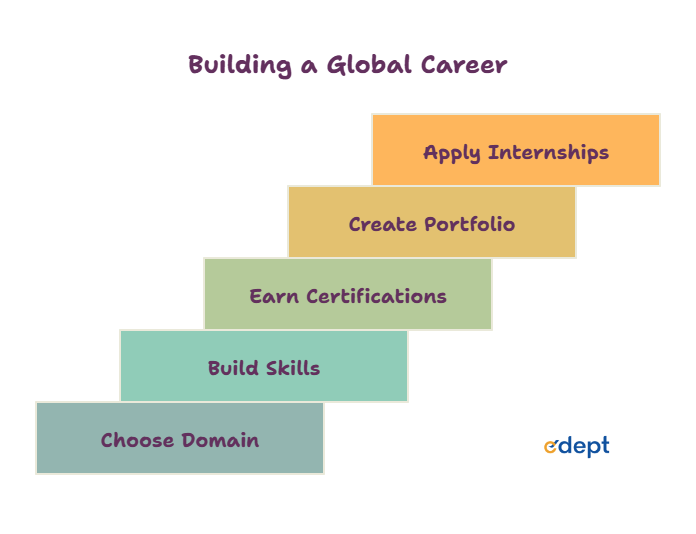
Step-by-Step Roadmap to Build a Global Career Without a Master’s Degree
You can build a successful international career entirely through practical skills, proven results, and strategic networking. Global companies increasingly prioritize what you can execute over the degrees on your resume.
Choose a High-Demand Domain
To compete globally without a Master’s degree, you should focus on domains with acute global talent shortages. Avoid generic fields and choose a technical or business vertical where output is easily measurable. You can choose between cybersecurity, cloud, data analytics, or digital marketing, based on genuine interest and regional hiring demand
Build Technical Skills
Once you decide your domain, start building your technical skills through structured, industry-aligned courses rather than just scattered self-study. You can start with hands-on labs and bootcamps. Start learning core technical skills such as Linux, Docker, Kubernetes, Terraform, CI/CD pipelines, and and Bash/Python.
Earn Certifications
You should start earning a beginner-level certification on your chosen platform. This will help you validate your knowledge for employers and give you a clear pathway to work toward.
Create a Portfolio
Start documenting every project, deploy it, publish it, or present it. Make it presentable and searchable. Your portfolio serves as proof of your skills.
Apply for Global Internships and Jobs
When you are aiming for any global job without a localized advanced degree, your application methodology must be targeted and precise. You can use various job platforms to target companies that hire internationally without requiring immediate physical relocation.
Future Scope of Skill-Based Global Careers Beyond 2026
The future scope of skill-based global careers heavily depends on AI and automation and the demand for people who can operate, secure, and interpret these systems.
AI and Automation Increasing Skill Demand
Artificial intelligence takes over repetitive and manual work. Companies need workers who can build, manage, and fix AI systems.
Remote Work Expanding International Hiring
Approximately 73 million jobs worldwide are now remote-capable, projected to reach 92 million by 2030. Companies are increasingly willing to hire across borders based purely on skill. Companies hire the best person for a job regardless of where they live.
Global Companies Prioritizing Practical Talent
The shift toward skills-based hiring is becoming structural. Employers care more about what you can build or fix rather than only traditional college diplomas. Companies use practical work trials instead of standard interviews to test real abilities.
Conclusion
A master’s degree is no longer a must-have for a successful career. In 2026, a combination of skills, industry certifications and relevant project experience often carries more weight than an advanced degree. Whether you’re aiming to become a cybersecurity specialist in Toronto, a cloud solutions architect in Berlin, or a remote UX designer based out of Bangalore, the path to opportunity is clear: acquire the skill, prove it, and you’ll be able to act on a global career. Data shows that skills-based hiring expands talent pools significantly, while nearly 40% of core workplace skills are projected to change by 2030, making continuous upskilling more valuable than static academic degrees. Your career outside the country can begin today; you do not have to wait two years for that.