In today’s digital world, cloud computing is transforming the way businesses work. It is not just a niche-specific skill reserved for large enterprises; it has become the backbone of how modern businesses operate, storing data, running applications, managing security, and scaling organisations. It has become one of the most transferable digital skills in the world. As businesses invest more in AI-ready infrastructure, hybrid environments, cybersecurity, and platform-led delivery, the need for cloud professionals keeps rising across regions. Hence, cloud jobs abroad from India are spiking every year.
The global cloud computing market is valued at $917.9 billion in 2026, on track to pass $1 trillion this year. Gartner projects public cloud end-user spending at $850 billion in 2026, up 21.3% year over year. Hence, the countries facing technology talent shortages are not waiting for local graduates to catch up. They are actively recruiting international cloud professionals through skilled migration programmes, employer-sponsored work visas, global tech recruitment initiatives, and remote-to-relocation opportunities. For Indian professionals, this is the right time to enter this market. India’s IT talent pool is already recognized globally, cloud certification adoption is accelerating, and employers in markets like Canada, Australia, Germany, and the UK know what Indian engineers are capable of.
This guide breaks down exactly how to get cloud jobs abroad from India. We will cover the skills that actually matter, the countries worth targeting, the visa pathways that work, and the certifications that can get your resume noticed.
Why Cloud Computing Skills Are in High Demand Globally
Cloud computing skills are in high demand globally due to rapid digital transformation, the explosive growth of Artificial Intelligence (AI), and a persistent global talent shortage.
Cloud Adoption Continues to Accelerate
Cloud adoption continues to accelerate & is driven by enterprise digital transformation, cloud-first strategies, and growth in AI infrastructure. The cloud computing market size is expected to grow from USD 0.86 trillion in 2025 to USD 1.04 trillion in 2026 and is forecast to reach USD 2.65 trillion by 2031, at a 20.65% CAGR over 2026-2031.
Global Cloud Talent Shortage
There is a global shortage of certified cloud professionals driven by rapid technological growth, as well as the shortage of skilled talent and the increasing demand across industries. Over 90% of global organizations are encountering IT skill shortages & cloud skill gaps, creating an estimated $5.5 trillion impact in delayed projects and hindered innovation.
Cloud Skills Are Highly Transferable Across Countries
Cloud skills are highly transferable globally because they rely on universal technologies and are backed by global certifications. Amazon Web Services, Microsoft Azure, and Google Cloud use the same core tools, codes, and systems in every country.
Cloud Careers Offer Strong Salary Growth
Cloud computing careers offer exceptional salary growth, with entry-level professionals starting strong and senior experts or architects earning high packages. In the U.S., average base salaries for cloud engineers range from $135,000 to $152,000, with total compensation often exceeding $175,000. Entry-level roles start around $110,000-$130,000.
Why Indian Professionals Are Well Positioned for International Cloud Careers
Indian professionals succeed in international cloud careers due to strong technical education, timely global project delivery, and high rates of professional certifications.
Strong Technical Education Background
Indian professionals have a strong technical background. Millions of engineering graduates enter the workforce annually, establishing deep foundational knowledge in computer science and system architecture. They heavily focus on core mathematics, logic, and coding principles.
Experience With Global IT Projects
The professionals manage the workload of large enterprises for multinational clients. Standard delivery models in major tech hubs build fluency in cross-border team collaboration.
Growing Adoption of Cloud Certifications
Professionals actively pursue certifications like the AWS Certified Solutions Architect, which increases substantial salary growth & global credibility.
High Demand for Indian Tech Talent Worldwide
India is a global powerhouse for tech talent due to massive annual engineering graduation numbers, high proficiency in emerging technologies like AI and cloud computing, and widespread English communication skills. India produces over 1.5 million engineering graduates annually, and a growing percentage are pursuing cloud-specific training. 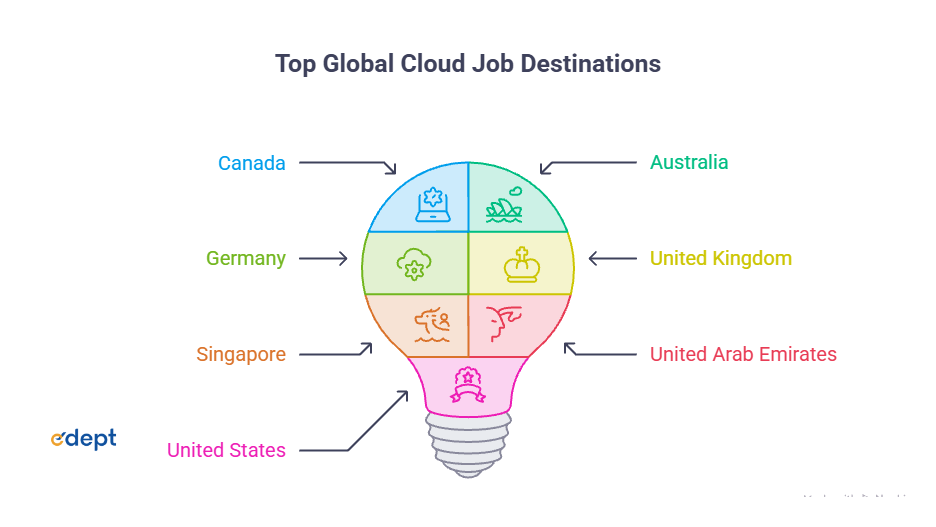
Best Countries for Cloud Jobs in 2026
The top countries for cloud jobs in 2026 are
Canada
Canada is one of the most accessible destinations for Indian cloud professionals. Canada’s cloud computing market is valued at over $64 billion.
Why Cloud Professionals Choose Canada
Cloud professionals choose Canada for its fast-growing tech market, favourable immigration pathways, and robust data infrastructure
Major Hiring Cities
The major hiring cities are Toronto, Vancouver, Calgary, Ottawa, Montreal, and Waterloo
Work Visa and PR Pathways
Express Entry and Provincial Nominee Programs (PNPs) are structured to absorb skilled technology workers. The Global Talent Stream processes work permits in as little as two weeks for in-demand occupations. The Post-Graduation Work Permit (PGWP) allows up to three years of work after studying in Canada.
Salary Expectations
Average annual salary: CAD 90,000–150,000/year (mid-level: CAD 90,000–110,000; senior cloud architect: CAD 130,000–150,000; principal/staff engineer: CAD 150,000+)
Australia
Australian organizations are expected to spend more than A$33.6 billion on public cloud services in 2026, an increase of 17.9% from 2025, according to the latest forecast from Gartner.
Why Demand Is Growing
Demand for cloud professionals in Australia is growing rapidly in 2026 due to increasing AI workloads, stricter data privacy rules, and a heavy focus on cloud cost optimization. Public cloud spending in Australia is projected to reach AUD $33.6 billion this year.
Skilled Migration Opportunities
Australia offers skilled migration opportunities through permanent and provisional visa pathways, primarily focusing on the Skilled Independent (subclass 189), Skilled Nominated (subclass 190), and Skilled Work Regional (subclass 491) visas.
Cloud Talent Shortages
Australia faces a severe cloud talent shortage, with strong demand for cloud engineers, hybrid architects, and AI infrastructure specialists.Sector initiatives report that for every 2.3 specialized cloud and digital infrastructure roles, only one qualified professional is available
Salary Outlook
Average annual salary: AUD 110,000–170,000/year (mid-level: AUD 110,000–130,000; senior cloud/ DevOps engineer: AUD 140,000–170,000; principal/architect: AUD 170,000–200,000+
Major Hiring Cities
The major hiring cities are Sydney, Melbourne, Brisbane, Perth, and Canberra; federal government cloud contracts in Canberra drive additional demand.
Germany
Demand for cloud professionals in Germany is extremely high in 2026, driven by structural talent shortages, upcoming SAP migration deadlines, and a shift toward strict data compliance.
Opportunities in Europe’s Largest Economy
The German cloud computing market size is expected to grow from USD 56.52 billion in 2025 to USD 65.05 billion in 2026, and is forecast to reach USD 131.29 billion by 2031, at a 15.08% CAGR over 2026-2031. Germany offers major opportunities for cloud professionals driven by rapid multi-cloud adoption, strict data privacy laws, and heavy investments from major providers like Amazon Web Services (AWS).
Cloud Adoption Across Industries
Germany’s cloud market is valued at $65.05 billion in 2026 & is driven heavily by manufacturing, healthcare, and hybrid cloud integration. Major industries hiring are manufacturing & automotive, healthcare, and banking & finance.
EU Blue Card and Opportunity Card
The EU Blue Card & Opportunity Card (Chancenkarte) is a distinct German immigration path for non-EU professionals: the EU Blue Card requires a job offer, the Opportunity Card is for job hunting, and both offer unique rules for living and working in Germany. The EU Blue Card is issued for up to 4 years, Opportunity Card is valid for up to 1 year.
Major Hiring Cities
The major hiring cities are Berlin, Munich, Frankfurt, Hamburg, Stuttgart, and Cologne
Salary Outlook
Average annual salary: EUR 65,000–115,000/year (mid-level: EUR 65,000–85,000; senior cloud architect/ DevOps lead: EUR 90,000–115,000; Berlin startup scene: EUR 80,000–120,000+
United Kingdom
Demand for cloud jobs in the UK in 2026 is strong but selective, focusing heavily on multi-cloud architecture, platform engineering/DevOps, and cloud security.
Financial Services and Cloud Demand
UK financial services cloud demand in 2026 centres on operational resilience, AI integration, and regulatory compliance. The major cloud providers (AWS, Google Cloud, Microsoft, and Oracle) face direct regulatory control under UK operational resilience rules.
Skilled Worker Visa Opportunities
UK Skilled Worker Visa opportunities in 2026 require a general minimum salary threshold of £41,700 per year, a confirmed job offer from a licensed sponsor, and an increased B2-level English language requirement.
Major Tech Hubs
The major tech hubs include London, Manchester, Edinburgh, Bristol, Leeds, Birmingham.
Salary Outlook
Average annual salary: GBP 60,000–110,000/year (mid-level: GBP 60,000–80,000; senior cloud engineer/SRE: GBP 80,000–110,000; principal/staff engineer: GBP 100,000–130,000+)
Singapore
The demand for cloud professionals in Singapore is very high & is driven by rapid AI integration, financial sector modernization, and government-backed digital initiatives.
Asia-Pacific Cloud Hub
Singapore serves as the primary Asia-Pacific cloud hub, featuring major investments like the Amazon Web Services (AWS) Asia Pacific Hub and extensive data centre infrastructure. Singapore is the most important cloud engineering market in the Asia-Pacific, & it hosts the regional headquarters of AWS, Google Cloud, Microsoft Azure, and Alibaba Cloud.
Hiring Demand
Hiring demand for cloud professionals in Singapore is extremely strong. Some of the key roles in high demand include cloud engineers, cloud architects, and cloud security experts.
Employment Pass Opportunities
Singapore Employment Pass (EP) opportunities for cloud professionals require a minimum qualifying salary of S$5,620 per month (higher for older candidates and financial sectors) and qualification through the Ministry of Manpower COMPASS framework.
Major Hiring Cities
The major hiring cities are Singapore (city-state); the MNC regional HQ belt in One-North, Changi Business Park, and Marina Bay Financial Centre.
Salary Outlook
Average annual salary: SGD 90,000–180,000/year (mid-level: SGD 90,000–120,000; senior cloud architect/ DevOps lead: SGD 130,000–180,000; principal: SGD 180,000–250,000+
United Arab Emirates
The demand for cloud computing in the UAE is surging rapidly, valued at USD 16.43 billion in 2026 and projected to reach USD 56.26 billion by 2031.
Digital Transformation Projects
Cloud-driven digital transformation projects in the UAE mainly focus on public sector modernization, sovereign cloud deployment, and smart utility scaling.
Tax-Friendly Salary Structure
A UAE salary structure for cloud computing professionals is naturally tax-friendly because the UAE levies 0% personal income tax on employment earnings.
Cloud Infrastructure Expansion
The UAE cloud services market reached USD 6.15 billion in 2026 and USD 5.86 billion in 2025, projected to hit USD 9.34 billion by 2032 at 7.21% CAGR. Cloud infrastructure expansion in the UAE is increasing, driven by massive investments from global tech giants like Microsoft and Amazon Web Services, strict data privacy laws, and a national push toward artificial intelligence.
Major Hiring Cities
The major hiring cities are Dubai (Dubai Internet City, DIFC, Business Bay), Abu Dhabi (Hub71, ADGM, and Masdar City), and Sharjah.
Salary Outlook
Average annual salary: USD 70,000–140,000/year tax-free (mid-level: USD 70,000–100,000; senior cloud architect/ DevOps lead: USD 100,000–140,000; total compensation packages, including housing and benefits, can reach USD 110,000–160,000.
United States
The United States is the world’s largest cloud computing market and the highest-paying destination for cloud and DevOps engineers.
Largest Cloud Market Globally
The United States is the world’s largest national cloud market, generating an estimated $521.84 billion in 2026, driven by major domestic infrastructure leaders, Amazon Web Services (AWS), Microsoft Azure, and Google Cloud. The cloud infrastructure market expands at roughly 37% annually.
Employer Sponsorship Opportunities
Employer sponsorship opportunities in the USA are widely available across top industries like technology, healthcare, and finance, primarily via H-1B, J-1, and EB-3 pathways.
Major Hiring Cities
The major hiring cities are San Francisco, Seattle, New York, Austin, Boston, Chicago, and Washington, DC.
Salary Outlook
Average annual salary: USD 120,000–200,000/year (mid-level: USD 120,000–150,000; senior cloud architect: USD 160,000–200,000; FAANG roles with equity: USD 200,000–400,000+)
Most In-Demand Cloud Job Roles Abroad
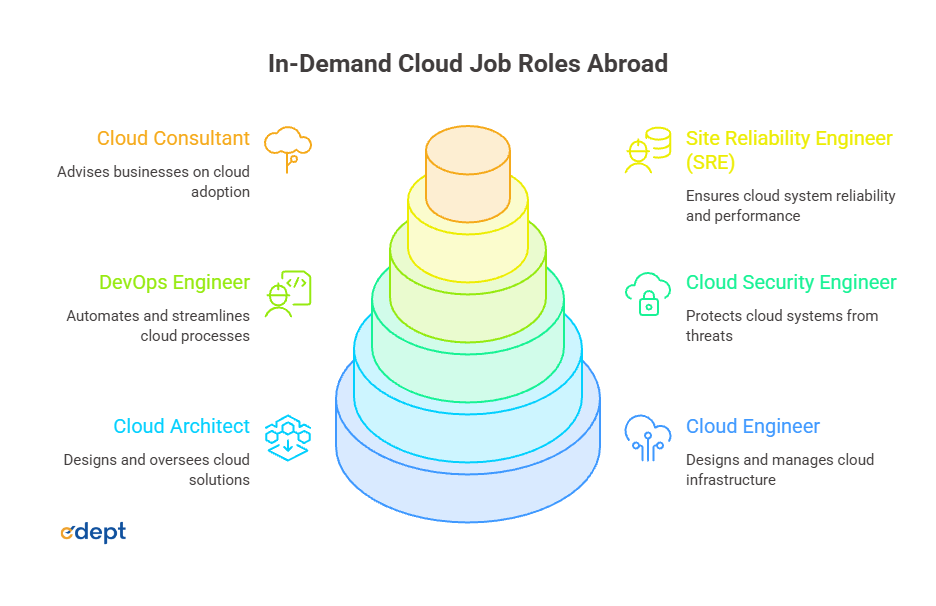
The top in-demand global cloud job roles are Cloud Engineer, Cloud Architect, and DevOps Engineer, alongside specialized paths like Cloud Security Engineer, Site Reliability Engineer (SRE), and Cloud Consultant.
Cloud Engineer
They build & maintain cloud infrastructure and manage virtual machines, storage, and networking. Skills required: Core familiarity with AWS, Azure, or GCP; basic Linux and computer networking. Career Growth: High entry-level volume; pathways to progress into advanced DevOps, architecture, or specialized platform roles.
Cloud Architect
Design large-scale, enterprise-grade, and secure cloud frameworks that align multi-cloud strategies with business goals. Skills required: Deep multi-platform cloud mastery (AWS, Azure, GCP) Career Growth: Excellent top-tier earning potential
Cloud Security Engineer
Protects cloud environments from threats, manages identity and access, and ensures compliance. Skills required: Cloud security hubs (AWS Security Hub, Azure Security Centre), Splunk, Sentinel, and DevSecOps integration. Career Growth: Rapid growth in demand due to strict corporate compliance frameworks.
DevOps Engineer
Automates software deployment processes, manages CI/CD, and bridges development and operations. Skills required: Python, Bash, Go, Docker, Kubernetes, Terraform, Ansible Career Growth: High global market demand.
Site Reliability Engineer
Apply software engineering practices to infrastructure problem management, system maintenance, responsiveness, and performance metrics. Skills required: Prometheus, Grafana, Python, Go Career Growth: Highly valued prestigious technical track; moves into Principal Engineer or VP roles.
Cloud Consultant
Advise client organizations on cloud strategy, migration planning, and vendor selection. Skills required: Strong consulting and communication skills along with financial & operational understanding. Career Growth: High-paying advisory role, promotion to senior partner, enterprise solutions director, or independent technology consultant.
Skills Required to Get Cloud Jobs Abroad
The skills required to get cloud jobs abroad are
Cloud Platform Expertise
You need deep knowledge of at least one major platform. AWS holds 32% global market share, Azure holds 21-23%, and Google Cloud holds 12%. AWS is the safest starting point for the widest job availability, but Azure dominates enterprise environments, and GCP leads in AI/ML workloads.
Networking Fundamentals
It includes VPC, subnets, firewalls, DNS & connectivity. Every cloud architecture sits on top of networking.
Linux Administration
It includes CLI proficiency, file permissions, shell scripting, process management, and log analysis. Most cloud servers run Linux. Comfort with the command line, shell scripting, and system management is expected.
Cloud Security Concepts
It includes IAM, least privilege, encryption, compliance, & vulnerability scanning. Security is no longer a separate team; it is built into every role.
Containers and Kubernetes
It includes Docker/Kubernetes (K8S)-managed K8S service mesh & CI/CD integration. They are now standard requirements for cloud and DevOps roles.
Automation and Infrastructure as Code
It includes Terraform, cloud-native IaC, configuration management, CI/CD tools, and GitOps.
Communication and Collaboration Skills
It includes English proficiency, cross-cultural teamwork, technical writing & stakeholder management.
Certifications That Improve International Employability
These are the top global cloud and infrastructure credentials, including AWS Certified Solutions Architect, Microsoft Azure Administrator, and Google Associate Cloud Engineer.
AWS Certified Solutions Architect
Premier, globally recognised certification. Appears in up to 40% of cloud engineering job descriptions. It validates your ability to design distributed systems on AWS.
Microsoft Azure Administrator
It validates your hands-on ability to manage cloud services, security, and hybrid enterprise environments. It is favoured by large traditional corporations, banks, and governments.
Google Associate Cloud Engineer
Responsible for core competencies in deploying applications, monitoring operations, and managing enterprise projects on Google Cloud. Strong for data and AI-focused careers.
Kubernetes Certifications
It is essential for modern Site Reliability Engineering (SRE) and DevOps positions globally.
Terraform Certifications
The HashiCorp Infrastructure Automation credential validates infrastructure-as-code skills that employers actively seek. Crucial for multi-cloud automation and scaling efficiency.
Cloud Security Certifications
The vendor-neutral designations like CCSP or platform-specific security specialities confirm data protection and compliance expertise. Premium global salaries are achievable.
Note: You should start with AWS Cloud Practitioner, Azure Fundamentals (AZ-900), or Google Cloud Digital Leader. These foundational certifications cost under $100, require 30-60 hours of study, and open entry-level positions paying $80,000-$110,000 internationally.
Salary Comparison for Cloud Professionals by Country
Cloud computing remains one of the highest-paying and fastest-growing tech careers in 2026, but “how much do cloud professionals earn” has no single answer; it depends heavily on where you work. A senior cloud architect in San Francisco and one in Bengaluru may have identical skill sets yet earn different figures once you factor in currency, taxes, and everyday cost of living.
| Country | Entry-Level (0–2 years) | Mid-Level (3–5 years) | Senior-Level (6+ years) |
| USA | USD 85,000–110,000 | USD 120,000–145,000 | USD 160,000–190,000+ |
| UK | GBP 47,000–67,000 | GBP 69,000–99,000 | GBP 95,000–137,000+ |
| Canada | CAD 79,000–120,000 | CAD 100,000–135,000 | CAD 109,000–150,000+ |
| Germany | EUR 61,500–88,700 | EUR 90,500–130,000 | EUR 125,000–180,000+ |
| Australia | AUD 130,000 | AUD 150,000 | AUD 180,000+ |
| Singapore | SGD 76,000–95,000 | SGD 110,000–145,000 | SGD 150,000–182,000+ |
| UAE | AED 108,000–180,000 | AED 192,000–336,000 | AED 336,000–540,000+ |
| India | INR 600,000–1,200,000 | INR 1,400,000–2,400,000 | INR 2,600,000–4,200,000+ |
Work Visa Pathways for Cloud Professionals
Getting a job abroad depends on work visa pathways. Every country has its own visa timeline, requirements and pricing. Now let us look at a few of the visa pathway requirement for cloud professionals
Canada Express Entry
They manage permanent residency applications for skilled professionals through economic programs like the Federal Skilled Worker (FSW) and Canadian Experience Class (CEC). The Federal Skilled Worker Program uses a points-based system that rewards age, education, language proficiency, and work experience. Cloud professionals score well due to high demand in the National Occupational Classification (NOC) system.
Australia Skilled Migration
Australia provides employer-sponsored and independent points-tested visa pathways for cloud professionals, led by the Skills in Demand Visa (Subclass 482) and permanent options like the Skilled Independent Visa (Subclass 189).
Germany EU Blue Card
The Germany EU Blue Card for cloud and IT professionals requires a job offer, a minimum gross annual salary of €45,934.20 (as of 2026) for shortage/IT occupations, and either a recognized university degree or 3+ years of documented IT experience.
UK Skilled Worker Visa
The UK Skilled Worker Visa requires a confirmed job offer from an A-licensed sponsor, a graduate-level role, and an annual salary of at least £41,700 or the occupation’s going rate (whichever is higher).
Singapore Employment Pass
Cloud professionals requires to earn a minimum qualifying salary of S$5,600 per month (higher for financial sectors and older applicants) and score at least 40 points on the COMPASS points-based framework.
UAE Employer-Sponsored Visa
It is a two-year, renewable residency pathway managed via the Ministry of Human Resources and Emiratisation (MOHRE) and local immigration authorities like GDRFA Dubai. It requires a formal job offer from a UAE-registered mainland or free-zone company.
How to Build an Internationally Competitive Cloud Resume
To build an internationally competitive cloud resume, you need to follow the below steps.
Highlight Certifications
Put your certifications high on the first page so recruiters see them. List top certifications like AWS Certified Solutions Architect, Microsoft Azure Solutions Architect Expert, or Google Cloud Professional Cloud Architect. Highlight the date when you earned them.
Showcase Cloud Projects
You build 3-5 projects that demonstrate real deployment, monitoring, and troubleshooting. Host them on GitHub with clear documentation.
Quantify Technical Achievements
Write down how much faster your pipelines or database queries run now. Use strong words such as ‘architected’, ‘migrated’, or ‘optimised’ for every bullet point.
Demonstrate Multi-Cloud Experience
You should highlight knowledge in at least two major platforms, such as AWS and Azure or GCP.
Optimize LinkedIn Profile
You should ensure your job titles, skills, and dates match word-for-word between LinkedIn and your CV. Write a clear summary explaining your core cloud skills.
Best Job Portals for Finding Cloud Jobs Abroad
Finding international cloud engineering roles requires targeting global platforms and specialized local boards.
It is best for networking, direct recruiter outreach, and mid-to-senior cloud architect/DevOps roles.
Indeed
It is best for high-volume searches and wide global coverage of international corporate openings.
Glassdoor
It is best for researching company culture, compensation packages, and verifying if an overseas company actually sponsors visas.
Wellfound
It is best for finding fast-growing international tech startups and scale-ups.
Country-Specific Tech Job Boards
It is best for niche regional markets with high demand for localised engineering compliance.
Recruitment Agencies
It is best for high-touch, unlisted, or executive international matching.
Common Mistakes Indian Professionals Make When Applying Abroad
Some of the common mistakes Indian professionals make when applying abroad are
Applying Without Certifications
Forgetting to add globally recognized certifications, where certified professionals earn 25-40% more, skipping certifications puts you at a disadvantage.
Ignoring Visa Eligibility
Applying to jobs without checking if the company actually sponsors work visas. Research whether you qualify for skilled migration programs before applying.
Lack of Hands-On Projects
Showing only degrees or book knowledge; employers want evidence that you have actually built something in a cloud environment.
Weak LinkedIn Presence
International recruiters use LinkedIn as their primary sourcing tool. An incomplete profile is a missed opportunity.
Applying to Every Role Without Targeting
Sending the same resume to vastly different job descriptions will not help you land a job. Customise your resume for each role, emphasizing the specific cloud platforms and tools mentioned in the job description.
Why Multi-Cloud Skills Increase Global Employability
92% of enterprises worldwide now use a multi-cloud strategy. The average organisation uses 3.4 different cloud providers. 68% of IT leaders say multi-cloud improves risk resilience. 47% of companies say a lack of cloud expertise is a top challenge when implementing multi-cloud strategies.
AWS Alone Is No Longer Enough
AWS is no longer enough, as it leaves you unprepared for companies using other systems. Businesses prefer tools from Google, Microsoft, and AWS together.
Enterprises Use Hybrid Environments
Companies need experts who can move data safely between different systems. Multi-cloud skills help build stronger and safer IT infrastructures.
Cloud Security Is Becoming Essential
Every platform has unique safety tools and rules. The experts who understand all major clouds are hard to find
Cross-Platform Expertise Commands Higher Salaries
Few employers can master more than one cloud platform well. Companies pay extra money for multi-cloud skills.
Why Choose Edept for a Global Cloud Career
If you are planning to build a career in cloud computing, the quality of your training matters. Edept’s cloud computing programmes are built around one goal: making you job-ready.
Industry-Aligned Cloud Programs
Edept’s curriculum is designed to meet what the industry actually expects. Every module covers real-world cloud job roles and the specific skills employers ask for, not just theoretical content.
Exposure to AWS, Azure, and Google Cloud
Instead of limiting you to one platform, edept gives you practical experience across multiple ecosystems. You also cover DevOps pipelines, containerization, and security hardening.
Hands-On Projects and Labs
Learning at edept means getting your hands on real cloud environments. You work on projects that simulate actual job scenarios. Instead of just watching videos, you get to build real projects, deploy new applications, configure networks, and take on many other interesting tasks.
To Know More, Click Here
Career and Placement Support
edept provides structured support for your job search, from resume building and mock interviews to job referrals and career guidance. You are not left to figure it out on your own. What sets the programme apart is its industry integration. Through edept’s partnerships with Deloitte, students access the Deloitte Learning Academy and can earn a Deloitte-issued certification alongside their degree. Through IBM, B.Tech students get structured internships and mentored live projects using IBM Watson and IBM Cloud, with a joint IBM–NASSCOM certification and a national stipend opportunity for top performers. Global industry immersion projects with Practera and HEX. A 300+ recruiter network, career support, mock interviews, and resume-building assistance. 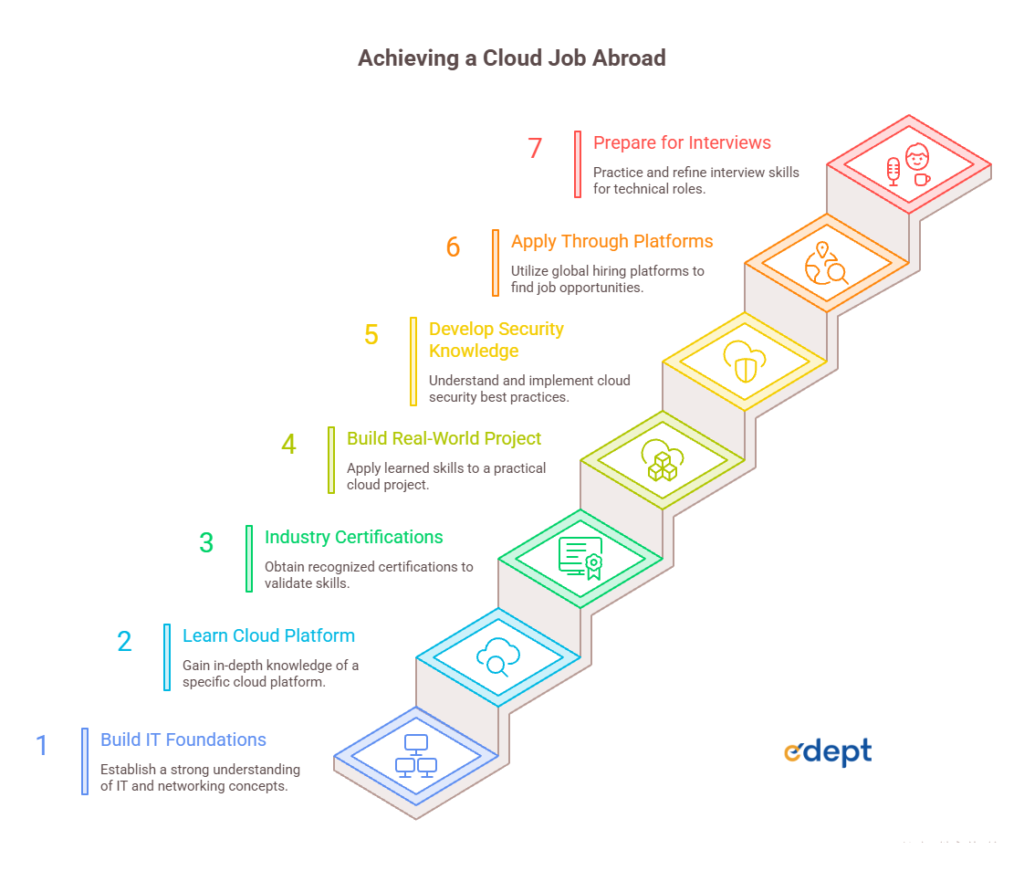
Step-by-Step Roadmap to Get a Cloud Job Abroad From India
To get a cloud job abroad from India, you must build core IT skills, master a major cloud platform, and apply through global channels.
Build IT and Networking Foundations
You should first start with the basics and understand how cloud computing actually works. Start getting familiar with Linux, basic networking (TCP/IP, DNS, HTTP), and a programming language like Python.
Learn One Cloud Platform Deeply
Pick a platform. Choose either Amazon Web Services (AWS), Microsoft Azure, or Google Cloud Platform (GCP). AWS is the most versatile starting point for most students.
Earn Industry Certifications
You should start earning a beginner-level certification on your chosen platform. This will help you validate your knowledge for employers and give you a clear pathway to work toward.
Build Real-World Projects
You should start applying what you are learning each day. Start by deploying a simple application. You can also set up an automated backup system. You can create a virtual network. Each project teaches you something new every day.
Develop Cloud Security Knowledge
You should learn how to control user access and set up secure passwords. Start studying standard safety rules used by global companies.
Apply Through Global Hiring Platforms
You should update your LinkedIn profile to show you want to work abroad. Start searching for international jobs on global sites like LinkedIn, Indeed, and Glassdoor.
Prepare for Technical Interviews
Start practising coding tests and system design questions. Practice speaking English clearly for video interviews with foreign interviewers.
Future Outlook for Cloud Careers Beyond 2026
Cloud careers beyond 2026 will grow rapidly, driven by artificial intelligence, multi-cloud setups, and severe talent gaps.
Growth of AI Infrastructure
Artificial intelligence will handle routine daily tasks and fix system errors automatically. Engineers will start managing AI tools to keep the cloud system fast.
Expansion of Multi-Cloud Environments
Many organizations are moving away from just a single-cloud setup toward multi-cloud strategies, using AWS, Azure, and GCP together. This creates demand for professionals who can work across various platforms and can manage complex, distributed infrastructure.
Rising Cloud Security Demand
Cyber threats will grow as more data moves online. Advanced protection methods and constant network monitoring will protect critical data.
Continued Global Talent Shortages
The demand for certified cloud experts grows faster than the number of trained workers. Companies offer better salaries and benefits to attract top cloud talent.
More International Remote Opportunities
Companies hire cloud workers from anywhere in the world. Workers collaborate across different time zones using modern digital tools.
Conclusion
Cloud computing is one of the best career paths that you can choose in 2026. It has great salary potential and offers strong career opportunities and growth. It remains one of the strongest pathways to international technology careers. Countries such as Canada, Australia, Germany, the UK, Singapore, the UAE, and the USA continue investing heavily in cloud talent and have structured visa pathways for skilled professionals.
For Indian professionals, the combination of strong technical foundations, globally recognized certifications, and hands-on project experience creates a genuine competitive advantage. The global cloud computing market is valued at $917.9 billion in 2026, on track to pass $1 trillion this year. The talent shortage is acute. And the skills you build today are transferable to virtually any country or industry. Start with one platform. Get certified, build projects and apply strategically.