Many young data scientists feel that learning programming languages like Python and SQL, along with machine learning and statistics, is sufficient to pursue a career as a data scientist. This may be true in some cases, but this is just one part of the story. Modern companies do not hire data scientists just to make models or reports; they hire them to solve their actual business problems.
This is where Business Analytics Skills become indispensable. They help data scientists understand business objectives, interpret data in the right context, and transform analytical findings into actionable recommendations. Rather than confining their focus to algorithms alone, individuals who possess Business Analytics Skills will be able to uncover potential, mitigate risk, enhance efficiency, and make decisions based on the data. From increasing sales to running more effective marketing campaigns or providing an enhanced customer experience to streamlining the supply chain, companies appreciate data scientists who can bridge the two worlds.
In this guide, we will explore how these skills make data scientists more valuable, employable, and capable of creating lasting business impact.
What Is Business Analytics?
Understanding Business Analytics
Business Analytics involves the process of acquiring, studying, and analysing data to aid in making better managerial decisions. Instead of making decisions based on gut feeling, companies make use of analytics to identify patterns, quantify results, recognise opportunities, and prevent business-related problems. It generally includes three types of analytics:
- Descriptive Analytics – Examines historical data to understand what has already happened.
- Predictive Analytics – Uses statistical models and machine learning techniques to forecast future outcomes.
- Prescriptive Analytics – Recommends the best actions based on available data and business objectives.
The Master’s in Data Science & AI develops these capabilities through modules such as Business Statistics, Marketing & Consumer Analytics, Applied Econometrics for Business Analytics, Python Programming for Analytics, Data Visualization & BI Tools (Tableau/Power BI), Introduction to Data Management (SQL & Databases), and Supervised and Unsupervised Machine Learning.
Business Analytics vs Traditional Data Analysis
Although both disciplines work with data, their purpose and business value differ significantly.
| Business Analytics | Traditional Data Analysis |
| Focuses on solving business problems and improving decision-making | Focuses primarily on collecting, cleaning, and analysing data |
| Converts insights into actionable business recommendations | Primarily identifies patterns and reports findings |
| Converts insights into actionable business recommendations | Often concentrates on descriptive analysis of historical data |
| Directly contributes to business growth, operational efficiency, and competitive advantage | Primarily supports reporting and performance measurement |
The India track introduces students to business-focused subjects such as Business Economics, Financial Reporting & Analysis, Marketing &Consumer Analytics, Business Statistics, and Applied Econometrics for Business Analytics, while technical modules like Python Programming for Analytics, Data Visualization & BI Tools (Tableau/Power BI), SQL & Databases, and Machine Learning strengthen analytical capabilities. Students progressing to the Germany track further study Data Strategy & Governance, Data Driven Business Models & Products, Artificial Intelligence, and Data Exploration & Analytics, helping them connect data analysis with real-world business strategy
Why Business Analytics Is Essential for Every Data Scientist
Data Alone Doesn’t Solve Business Problems
Data scientists only partially fulfill their responsibilities with gathering and analysing data. Businesses require people who can interpret the findings, provide recommendations, and make informed decisions. A graph showing reduced sales or increased operational cost is of no practical use unless decision-makers can figure out the reasons for such an outcome. Business Analytics enables data scientists to connect technical analysis with business objectives across different functions, such as:
- Sales: Identify revenue trends, forecast demand, and improve sales performance.
- Marketing: Analyse customer behaviour and evaluate campaign effectiveness.
- Finance: Monitor financial performance, identify risks, and support budgeting decisions.
- Supply Chain: Optimise inventory, demand planning, and operational processes.
- Customer Experience: Understand customer preferences, improve retention, and enhance service quality.
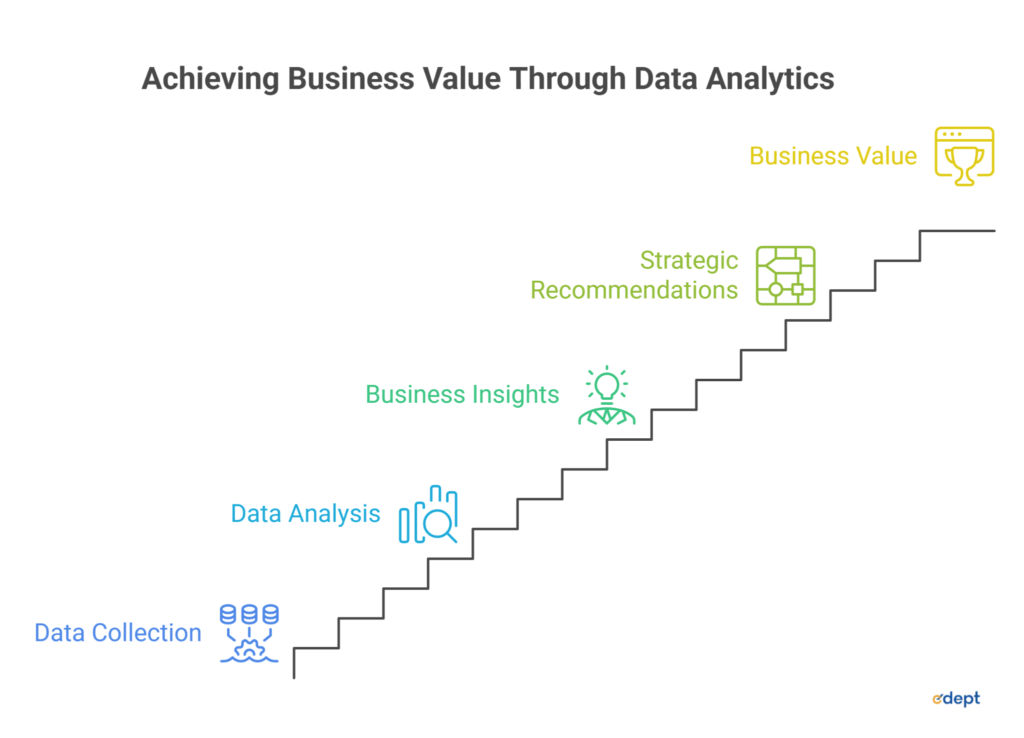
Turning Data Into Business Value
The true value of Business Analytics lies in its ability to convert analytical findings into measurable business outcomes. Instead of stopping at data interpretation, it helps organisations make informed, evidence-based decisions that support long-term growth. The programme strengthens these capabilities through advanced modules such as Data Strategy & Governance, Data-Driven Business Models & Products, Artificial Intelligence, and Data Exploration & Analytics during the Germany track. Students also gain practical exposure through internships in India and company projects in Germany, enabling them to apply Business Analytics concepts in real-world business environments.
Business Analytical Skills That Strengthen a Data Scientist’s Career
Technical expertise alone is not enough to succeed as a data scientist. Employers increasingly seek professionals who can understand business goals, interpret data correctly, and communicate recommendations that create measurable business value.
Business Problem Solving
Every analytics project begins with understanding the business challenge rather than the data itself. Before selecting models or analysing datasets, data scientists must identify what the organisation wants to achieve and how success will be measured. The programme builds this foundation through subjects such as Business Economics, Financial Reporting & Analysis, Marketing & Consumer Analytics, and Applied Econometrics for Business Analytics.
Data Interpretation
Generating results is only valuable when those results are interpreted accurately. Data scientists must distinguish meaningful trends from random patterns and avoid conclusions that could lead to poor business decisions. Modules such as Business Statistics, Python Programming for Analytics, Introduction to Data Management (SQL & Databases), and Supervised and Unsupervised Machine Learning provide the analytical foundation required for accurate data interpretation.
Decision-Making Skills
Business Analytics enables data scientists to support decisions with evidence rather than assumptions. Instead of simply reporting findings, professionals evaluate different options and recommend actions that align with business objectives. The Germany track strengthens these capabilities through modules including Data Strategy & Governance, Data-Driven Business Models & Products, Artificial Intelligence, and Data Exploration & Analytics.
Data Storytelling
A successful analysis has little impact if stakeholders cannot understand it. Data storytelling combines analytics, visualization, and business context to communicate insights clearly and encourage informed decision-making. To develop these skills, the programme includes Data Visualization & BI Tools (Tableau/Power BI) alongside opportunities for internships in India and company projects in Germany, allowing students to communicate analytical insights in practical business environments.
Technical Skills That Complement Business Analytics
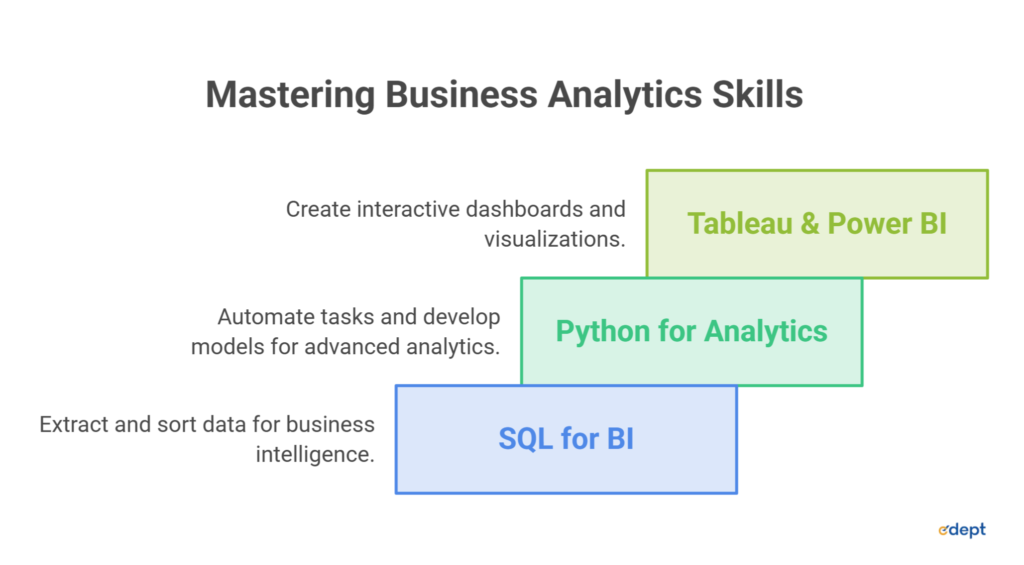
The image below shows a detailed illustration of the technical skills that constitute the business analytics field.
SQL for Business Intelligence
SQL is one of the most critical technical skills which is associated with Business Analytics Skills. This is because SQL helps data experts to extract and sort huge amounts of data relating to business operations. From analyzing customer transactions and assessing sales performance to creating various reports, all can be done easily using SQL. Beyond data retrieval, SQL is widely used for reporting and KPI tracking. Organizations rely on SQL queries to monitor key business metrics such as revenue growth, customer acquisition, inventory levels, and operational efficiency. When combined with strong Business Analytics Skills, SQL helps professionals move beyond data extraction to uncover insights that guide business strategy.
Python for Advanced Analytics
Python is essential in advanced analytics, as it enables data scientists to automate their work and develop models by processing datasets. This is possible due to the availability of a wide range of libraries in Python, which makes the process easier for professionals when handling large datasets. Machine learning is another popular use case of Python where organizations benefit from forecasting needs, detecting anomalies, making recommendations, and optimizing operations, among others. Nevertheless, technical models cannot be sufficient by themselves. When Python is combined with Business Analytics Skills, data scientists can provide actionable insights from model outputs.
Tableau and Power BI
Tableau and Power BI are leading Business Analytics tools used to create interactive dashboards, executive reports, and data visualizations that simplify complex information. These platforms allow organizations to monitor performance, track KPIs, and explore trends through intuitive visual interfaces. While dashboards present valuable information, their true impact depends on business interpretation. Professionals with strong Business Analytics Skills understand which metrics matter, how they align with organizational goals, and what actions should follow. By combining technical expertise in Tableau and Power BI with business thinking, data scientists can transform raw data into actionable insights that support faster, smarter, and more strategic decision-making.
Real-World Applications of Business Analytics in Data Science
Business Analytics helps organisations transform data into actionable business decisions across multiple industries. By combining statistical analysis, data visualization, machine learning, and business knowledge, data scientists can solve real-world challenges that improve operational efficiency and business performance.
Marketing Analytics
Marketing teams rely on Business Analytics to understand customer behaviour and improve campaign performance. Instead of making assumptions, organisations use data to make informed marketing decisions. Common applications include:
- Customer segmentation to identify different audience groups based on behaviour and preferences.
- Campaign optimisation by measuring marketing performance and improving future campaigns.
- ROI analysis to evaluate whether marketing investments are generating expected business results.
Financial Analytics
Financial institutions and businesses use analytics to monitor financial performance, manage risks, and improve planning. Business Analytics enables organisations to make faster and more accurate financial decisions using data. Students develop relevant analytical skills through Financial Reporting & Analysis, Business Statistics, and Applied Econometrics for Business Analytics.
Supply Chain Analytics
Supply chain operations generate large volumes of operational data. Business Analytics helps organisations optimise resources, reduce delays, and improve overall efficiency. Some common use cases are:
- Inventory optimisation to maintain appropriate stock levels.
- Demand forecasting using historical and predictive data.
- Logistics planning to improve transportation and distribution efficiency.
These business applications are supported by the programme’s combination of Business Statistics, Python Programming for Analytics, SQL & Databases, and Machine Learning, which prepare students to analyse operational data effectively.
Healthcare Analytics
Healthcare organisations increasingly use Business Analytics to improve patient care while optimising hospital operations and resource allocation. Key applications include:
- Patient outcome analysis to support better clinical decisions.
- Resource planning for hospitals, staff, and medical facilities.
- Predictive healthcare to identify health risks and improve preventive care.
The programme also prepares students for careers in HealthTech, one of the hiring industries highlighted in the brochure, while strengthening analytical capabilities through Artificial Intelligence and Data Exploration & Analytics in the Germany track.
Why Employers Prefer Data Scientists with Business Analytics Skills
Modern organisations expect data scientists to contribute to business growth, not just build models or analyse datasets. Employers increasingly value professionals who can combine technical expertise with business understanding to solve real-world challenges, support strategic initiatives, and communicate insights that influence decision-making. This is why programmes that integrate both analytics and business concepts are becoming increasingly relevant for today’s data-driven industries.
What Recruiters Look For
Recruiters today look beyond programming languages and machine learning knowledge. They seek candidates who can translate technical analysis into business value and collaborate effectively across different teams. Some of the most valued skills include:
- Business understanding to align analytical solutions with organisational objectives.
- Communication skills to explain technical findings clearly to business stakeholders.
- Cross-functional collaboration with teams such as marketing, finance, operations, and product management.
The Master’s in Data Science & AI reflects these industry expectations by combining business-focused modules such as Business Economics, Marketing & Consumer Analytics, Financial Reporting & Analysis, and Applied Econometrics for Business Analytics with technical subjects including Python Programming for Analytics, Data Visualization & BI Tools, Machine Learning, Artificial Intelligence, and Data Strategy & Governance. This balanced curriculum helps students develop the business and technical competencies employers seek across roles such as Data Scientist, Data Analyst, BI & Analytics Consultant, Machine Learning Engineer, and AI Specialist.
How a Master’s in Data Science Builds Business Analytical Skills
A well-structured Master’s programme is essential for helping students gain not just technical skills but also the Business Analytics Skills needed for solving actual business challenges. Instead of limiting itself to programming and machine learning techniques, it merges business know-how with analysis. The Master’s in Data Science & AI begins with a strong business-focused foundation during the India track. Students study subjects such as Business Economics, Business Statistics, Applied Econometrics for Business Analytics, and Research Methodology, which help them understand business performance, market trends, statistical analysis, and evidence-based decision-making.
Alongside these subjects, they build technical expertise through Python Programming for Analytics, SQL & Databases, Data Visualization & BI Tools (Tableau and Power BI), Machine Learning, and Cloud Computing, creating a balanced skill set that connects analytics with business strategy. Innovation projects, internships in India, and company projects in Germany are additional highlights in the programme, where the students have an opportunity to apply their Business Analytics Skills to solve actual business problems. While on the track in Germany, the participants get the chance to familiarize themselves with such advanced courses as Data Strategy & Governance, Data-Driven Business Models & Products, Artificial Intelligence, and research projects.
In combination with the dual degree of the programme and global industry exposure, the graduates are fully equipped for a career in data science.
Conclusion
The role of data scientist calls for far more than simply being a skilled professional in this field. Even though programming, machine learning, and data analytics are vital, the true skill lies in knowing the company’s priorities and transforming data into actions. Strong Business Analytics Skills enable data scientists to connect analytical findings with real business outcomes, helping organizations improve efficiency, reduce costs, increase revenue, and make smarter strategic decisions.
As the reliance on evidence-based decision-making grows, people who blend their business acumen with technical skills will be much sought after in different industries. Developing Business Analytics Skills alongside expertise in Python, SQL, data visualization, and artificial intelligence creates a well-rounded skill set that delivers measurable value. Combining these skills will enable budding data scientists to lay a solid foundation for future career success in the field of data science.
Related Links:
| Soft skills for Data Analytics | Artificial Intelligence vs Data Analytics |
| Skill-based vs Traditional Data Analytics Programs | Complete Guide to Data Analytics Salary |