The development of generative AI technologies is progressing incredibly fast and has already become one of the major forces driving change in the global workforce. These days, thanks to advanced AI technologies, people can produce content, code, generate images and videos, perform data analysis, and even help companies in decision-making within seconds through Generative AI Job Market. It makes organizations more efficient and affects expectations from their workforce. For that reason, the generative AI job market has expanded dramatically and brought about new career opportunities and changes in the world of work. AI technologies affect employment both in the area of technology and non-tech industries. In healthcare organizations, AI helps to improve diagnoses; in banks, AI performs risk assessment automatically; in marketing departments, AI helps to personalize marketing campaigns; producers implement AI to make their production process better; teachers use AI to create adaptive learning scenarios; and finally, IT specialists use AI assistants to become more productive. In this guide, we will talk about generative AI changes in jobs, industries impacted the most by AI, jobs that will be changed by AI, new job opportunities due to AI, and the skills necessary to become successful in an AI career.
What is Generative AI?
Understanding Generative AI is essential to understanding the generative AI job market. Unlike traditional AI, which analyzes existing data to make predictions, Generative AI creates entirely new content. As organizations rapidly adopt AI across departments, understanding this technology has become a valuable skill for anyone preparing for the future of work.
Understanding Generative AI
Generative AI refers to artificial intelligence systems that can generate new content by learning patterns from massive datasets. These systems can create text, images, code, audio, videos, and even business insights with minimal human input. Some of the most common examples include:
- AI chatbots like ChatGPT and Claude
- Content generation tools for writing blogs, emails, and marketing copy
- AI code assistants such as GitHub Copilot
- AI design tools that generate images, graphics, and presentations
These technologies are transforming the generative AI job market by helping professionals automate repetitive work while improving creativity and productivity.
Why Generative AI Is Growing Rapidly
Generative AI has witnessed unprecedented growth due to three major factors: rapid enterprise adoption, powerful cloud computing infrastructure, and advances in large language models (LLMs). Organizations can now automate repetitive tasks, improve decision-making, and increase operational efficiency at scale. According to McKinsey & Company (2025), 78% of organizations now use AI in at least one business function, highlighting how quickly AI adoption is accelerating across industries. This rapid growth is creating new AI job opportunities, reshaping AI careers, and significantly influencing the AI impact on jobs across the global economy.
How Generative AI Is Transforming the Job Market
The generative AI jobs market is revolutionizing the way organizations recruit, run operations, and innovate. Unlike other emerging technologies that simply replace humans in the workforce, Generative AI is revolutionizing the way we work through automation, increased efficiency, and new careers. The effect of AI on the workforce can be seen in almost all sectors, including technology, healthcare, finance, education, manufacturing, retail, and others. Workers who learn to collaborate with AI will definitely be the beneficiaries as more firms continue to invest in AI transformation. As per the Future of Jobs Report 2025 by the World Economic Forum, about 86% of employers anticipate AI and information processing technologies transforming their businesses by 2030, thus making AI one of the major catalysts of employment trends globally. This goes on to show why it has become crucial to understand how generative AI is transforming jobs.
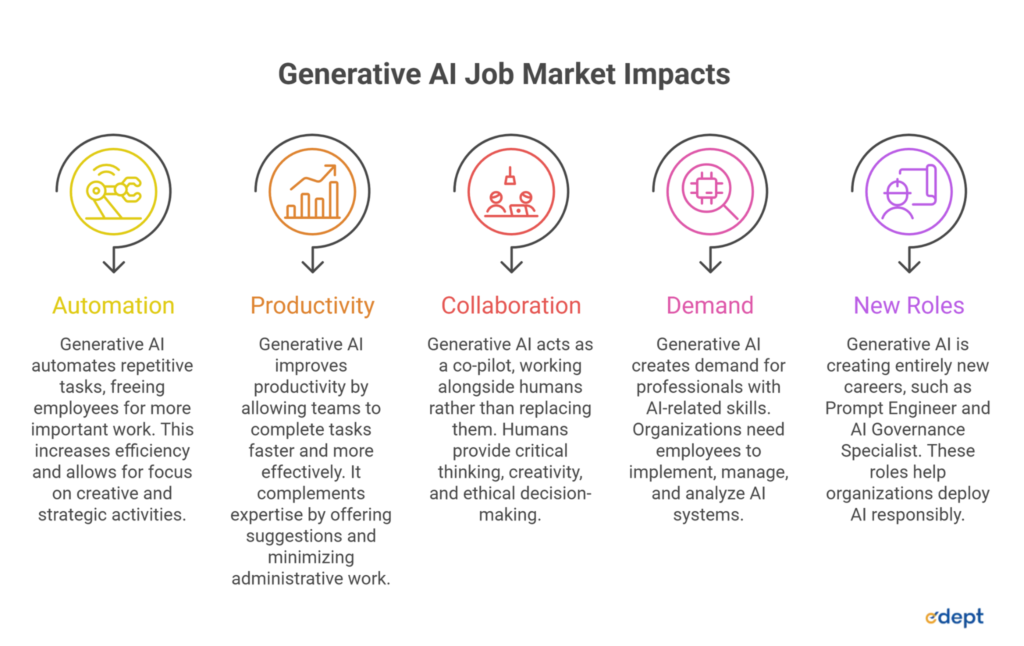
Automation of Repetitive Tasks
The major way through which the generative AI job market has changed is by automating tedious and time-consuming activities. Rather than wasting many hours doing repetitive activities, employees can use generative AI to undertake those activities faster and thus concentrate on other important tasks. Common examples include:
- Drafting emails, blogs, and marketing content
- Generating business reports and documentation
- Assisting with basic coding and debugging
- Automating customer support through AI chatbots
- Creating meeting summaries and project documentation
This does not mean that jobs are being destroyed, but rather that workload will be lessened and employees will be able to engage in creative, strategic, and customer-related activities. In this case, software engineers utilize AI coding to come up with boilerplate code fast, whereas marketers utilize AI to come up with marketing ideas. According to Microsoft’s 2024 Work Trend Index, 75% of knowledge workers already use AI at work, with many reporting that AI helps them save time and focus on more meaningful responsibilities. This demonstrates that the AI impact on jobs is largely about transforming workflows rather than replacing entire professions.
Increased Productivity Across Teams
Productivity at work has improved tremendously due to generative AI, as it allows teams to do tasks more quickly and more effectively. Rather than eliminating expertise, AI complements it by offering suggestions instantly, automating repetitive tasks, and minimizing administrative work. Some of the key productivity benefits include:
- Faster content creation and editing
- Quicker software development using AI coding assistants
- Automated data analysis and report generation
- Improved customer response times
- Better project planning and documentation
These advancements mean cost savings for companies in terms of reduced expenses, shorter time-to-market, and increased efficiency. The employees will have more time to tackle complicated issues, work together with their co-workers, and innovate rather than engage in mundane activities. The increased productivity of the workforce is among the major factors that drive the growth of the generative AI labor market. Companies are not only acquiring advanced technologies but also hiring skilled workers who know how to leverage them.
Shift Toward Human-AI Collaboration
One of the misconceptions about AI is that AI will replace all human jobs. However, many companies have opted for a collaborative approach in which AI serves as a co-pilot instead of replacing humans altogether. Human professionals still provide:
- Critical thinking
- Business judgment
- Creativity
- Ethical decision-making
- Emotional intelligence
- Relationship management
AI, however, can be very efficient in terms of working with huge amounts of data, producing content, recognizing patterns, and automating routines. For instance, AI is used by designers to produce rough drafts of designs that need to be improved manually. AI allows data analysts to work with large datasets but make business decisions personally. Programmers utilize AI coding helpers to speed up the process but then review, improve, and secure the final product. The move towards Human-AI collaboration is one of the most significant features of how generative AI affects the world of work.
Rising Demand for AI-Skilled Professionals
While AI automates certain activities, it is simultaneously creating enormous demand for professionals with AI-related skills. Organizations need employees who can implement AI tools, manage AI systems, analyze AI-generated insights, and integrate AI into everyday business processes. The most sought-after AI skills include:
- Prompt engineering
- AI literacy
- Data analytics
- Machine Learning fundamentals
- Cloud Computing
- Cybersecurity
- AI governance
- Business process automation
According to LinkedIn’s 2025 Work Change Report, AI-related skills are among the fastest-growing capabilities employers seek when hiring across technology and business roles. This trend is creating significant AI job opportunities not only for software engineers but also for marketers, analysts, consultants, project managers, cybersecurity professionals, and product specialists. As a result, students entering the workforce should view AI as a career accelerator rather than a threat. Building AI literacy alongside technical and communication skills can significantly improve employability in the evolving generative AI job market.
New Job Roles Are Emerging
Perhaps the most exciting aspect of the generative AI job market is the creation of entirely new careers. Just a few years ago, roles such as Prompt Engineer or AI Governance Specialist barely existed. Today, organizations worldwide are actively recruiting professionals for AI-focused positions. Some of the fastest-growing AI careers include:
- AI Engineer
- Prompt Engineer
- AI Product Manager
- AI Data Specialist
- AI Governance Specialist
- AI Security Specialist
- AI Solutions Consultant
- AI Integration Specialist
These professionals help organizations deploy AI responsibly, build AI-powered products, manage training data, protect AI systems, and optimize business workflows. Rather than reducing employment opportunities, Generative AI is reshaping the workforce by shifting demand toward higher-value, skill-based roles. Professionals who combine AI expertise with Cloud Computing, Cybersecurity, Data Analytics, and strong problem-solving abilities will have access to some of the best future jobs with AI. This is why the AI future scope remains exceptionally strong, making now the ideal time for students and professionals to prepare for an AI-driven career.
Read more: Top Gen-AI Careers to Watch Out
Jobs Most Impacted by Generative AI Job Market
The generative AI job market is transforming nearly every profession, but the impact varies across industries and roles. Rather than replacing entire jobs, AI is automating repetitive tasks while allowing professionals to focus on creativity, strategic thinking, and decision-making. The AI impact on jobs is best viewed as job evolution rather than job elimination.
Content and Marketing Roles
Now, the job of creating blogs, creating content for social media, writing emails, and marketing collateral has become the work of AI tools in the hands of content creators, copywriters, SEO experts, and digital marketers. However, although AI helps in quick generation of content, human intelligence is necessary too. What’s Changing: AI-generated content and AI-assisted marketing campaigns Risk Level: Medium Future Outlook: Strong demand for professionals who combine marketing expertise with AI tools and content strategy.
Customer Support
It is becoming more frequent for customer support teams to use AI-based chatbots and virtual assistants to provide responses to customers’ most frequently asked questions and solve simple problems, while complex queries remain under the purview of human agents. What’s Changing: AI chatbots and automated ticket handling Risk Level: Medium Future Outlook: Support professionals with AI literacy and customer relationship skills will remain highly valuable.
Software Development
With AI coding assistants like GitHub Copilot, software developers can speed up their coding process, detect errors, produce documents, and automate monotonous programming tasks. Software developers have been rendered more productive rather than obsolete. What’s Changing: AI-assisted coding and faster software development Risk Level: Low Future Outlook: Demand for developers continues to grow, especially those skilled in AI integration, cloud technologies, and software architecture.
Design Roles
Graphic designers, UI/UX designers, and creative professionals now use AI to generate concepts, mockups, illustrations, and prototypes in minutes. Human designers remain responsible for creative direction, user experience, branding, and final design decisions. What’s Changing: AI-generated designs and rapid prototyping Risk Level: Medium Future Outlook: Designers who use AI as a creative partner will gain a competitive advantage in the evolving future of work.
Data and Analytics Roles
Automating reporting, summarizing datasets, creating dashboards, and discovering patterns in information is easier using generative AI than traditional approaches. Nevertheless, interpreting the outcomes and suggesting business decisions requires human intervention. What’s Changing: Automated reporting and faster business insights Risk Level: Low Future Outlook: AI job opportunities in analytics continue to grow as organizations seek professionals who can combine AI tools with business intelligence and data-driven decision-making.
New Career Opportunities Created by Generative AI
While the employment of AI technology in work has resulted in automation of some activities, it has equally created new jobs that never existed just a few years ago. With firms continuing to adopt AI in their operations, the future of the AI job market looks promising both for individuals with technical skills and knowledge of how to solve business problems.
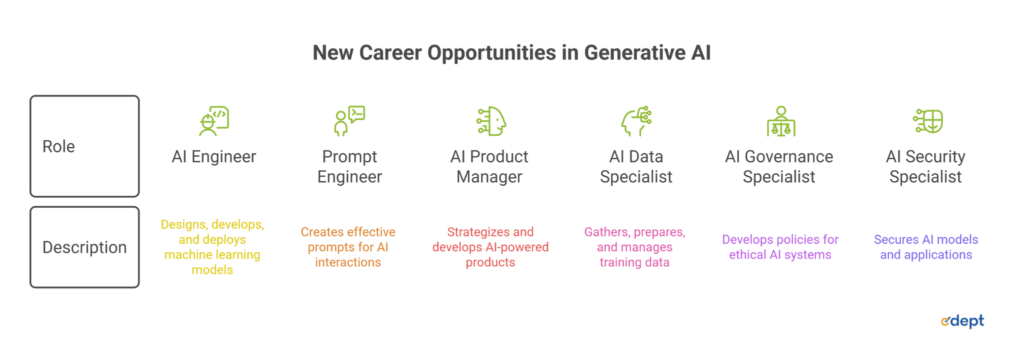
AI Engineer
An AI Engineer builds AI-powered applications by designing, developing, and deploying machine learning models, LLMs, and cloud platforms. An AI Engineer creates intelligent systems to automate business processes and aid in decision-making.
Prompt Engineer
A Prompt Engineer creates effective prompts, workflows, and AI interactions that allow ChatGPT, Claude, etc., to generate reliable and high-quality outputs. This has turned out to be one of the most rapidly growing AI jobs in recent times.
AI Product Manager
An AI Product Manager strategizes, plans, and develops AI-powered products. They work closely with engineering, design, and business teams to ensure that AI solutions solve customers’ problems effectively.
AI Data Specialist
An AI Data Specialist is responsible for gathering, preparing, labeling, and managing the training data utilized by the machine learning models. The AI systems need to have good-quality data.
AI Governance Specialist
An AI Governance Specialist develops policies to ensure that the AI systems are ethically sound, transparent, secure, and comply with regulatory requirements. With growing AI adoption, this job is becoming more relevant in different industries.
AI Security Specialist
An AI Security Specialist secures AI models, training data, and AI-powered applications from cyberattacks and other threats. With AI becoming a fundamental business technology, this position offers incredible future scope in AI.
Industries Seeing Major AI Job Growth
Job opportunities related to the generative AI market are growing rapidly in almost all industries. Companies have been implementing AI to increase their efficiency, automate their processes, and make intelligent decisions; hence, creating more job openings for professionals skilled in this area.
Technology
Technology companies are at the forefront of developing and implementing AI technologies such as cloud services and automation through AI applications. There is an increase in demand for professionals who can do AI engineering, machine learning engineering, prompt engineering, and AI product management.
Healthcare
There are applications of AI in imaging, drug discovery, diagnostics, and treatment by hospitals, pharmaceutical firms, and health-tech companies, thereby generating AI job openings in health care analytics, research and development, and decision-making tools.
Finance
The banking and finance industry uses AI in fraud detection, credit risk, algorithmic trading, and personalizing financial services, thus creating a need for AI specialists and data professionals.
Education
Educational establishments have been employing AI technologies in learning applications, intelligent tutoring, and assessments, thus the creation of opportunities in AI in educational technology.
Manufacturing
The manufacturing industry applies AI in predictive maintenance, quality control, robots, and logistics. This creates career opportunities in industrial AI and smart manufacturing.
E-Commerce
Companies in retail and e-commerce use AI in recommending products, demand forecasting, inventory management, customer service, and marketing. These industries will continue to shape the future of AI and jobs in the coming years.
Skills Becoming More Valuable in the AI Era
Success in the generative AI job market is no longer determined by technical expertise alone. Employers increasingly seek professionals who can combine AI skills with analytical thinking, creativity, and effective communication. Developing these future-ready capabilities will help students and professionals stay competitive as the AI impact on jobs continues to reshape industries.
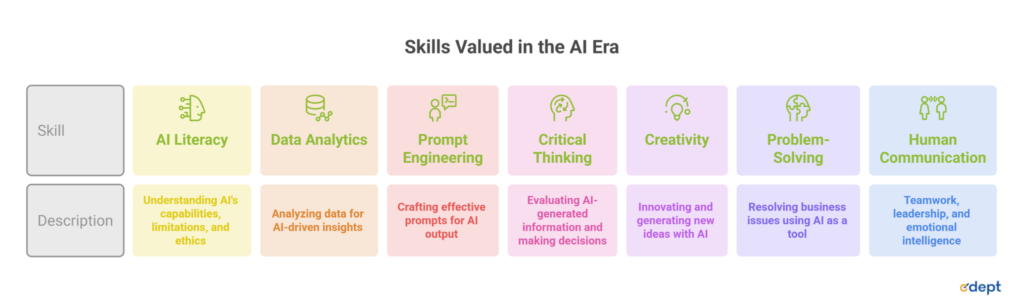
AI Literacy
Knowledge of Generative AI, its powers, limitations, and ethical concerns is becoming an important skill set. Those professionals who will be confident about utilizing these tools will have an edge over others in the future of work.
Data Analytics
Data collection, analysis, and visualization skills become increasingly crucial for professionals who can make better business decisions through the help of AI-driven insights.
Prompt Engineering
Effective writing of prompts allows getting more accurate output from AI. The art of prompt engineering is quickly gaining popularity as one of the most needed AI skills.
Critical Thinking
AI can provide us with the necessary information instantly; however, it is people who need to check the accuracy of the data, detect any biases, and make the right decisions. Critical thinking becomes an important skill that cannot be automated by AI completely.
Creativity
AI helps in faster content generation and idea creation. However, it is human creativity that helps innovate, tell stories, design, and strategize.
Problem-Solving
Employers appreciate professionals who can resolve difficult business problems using AI as a productivity tool. Problem-solving skills will be one of the most critical competencies required for any career related to AI.
Human Communication
As AI takes over many routine jobs, communication, teamwork, leadership, and emotional intelligence will become even more significant. Professionals who have excellent communication skills and can develop relationships will do well regardless of the increasing influence of AI on jobs.
Jobs With Strong Growth Despite AI Automation
While AI impact on jobs is automating repetitive tasks, many professions are becoming even more valuable because they require human expertise, strategic thinking, and advanced technical skills. The generative AI job market is creating strong demand for professionals who can build, secure, and manage AI-powered technologies rather than compete with them.
Cloud Computing Roles
Cloud engineers, cloud architects, and cloud operations specialists are still in great demand since AI solutions depend heavily on scalable cloud infrastructures. Therefore, the development of AI solutions will not decrease job opportunities in cloud computing but increase them even further.
Cybersecurity Roles
With AI working with confidential corporate and customer data, there will be a growing demand for cybersecurity professionals capable of protecting AI algorithms, cloud platforms, and other assets from cyberattacks. It makes cybersecurity one of the most rapidly developing AI career paths.
Healthcare Roles
Medical experts will remain an integral part of healthcare along with AI. With AI assisting in diagnostics, medical imaging, and handling administrative procedures, physicians, nurses, scientists, and healthcare professionals will stay vital for medical practices.
Product Management Roles
Human judgement and decision-making skills required to define product strategy and analyze customer needs make the position of AI product manager hard-to-automate.
AI Engineering Roles
Among the most rapidly developing AI career opportunities are AI engineers, machine learning engineers, prompt engineers, and AI solutions architects. Since AI adoption is constantly increasing, specialists able to work with AI-powered systems have bright prospects ahead.
Highest-Paying AI-Driven Careers through Generative AI Job Market
The rapid growth of the generative AI job market has created several high-paying career paths across technology, cloud computing, and cybersecurity. Professionals who combine strong AI skills with hands-on experience and industry certifications can expect excellent salary growth and global career opportunities.
| AI Career | Average Salary (India) | Average Salary (Global) |
| AI Engineer | ₹10–25 LPA | $120,000–180,000/year |
| Machine Learning Engineer | ₹12–28 LPA | $130,000–190,000/year |
| AI Product Manager | ₹18–40 LPA | $140,000–220,000/year |
| AI Security Specialist | ₹15–35 LPA | $130,000–210,000/year |
| Cloud AI Engineer | ₹12–30 LPA | $125,000–200,000/year |
AI Engineer
The AI Engineer is responsible for building, training, and deploying AI-based applications. This profession is among the most in-demand professions in current AI career opportunities.
Machine Learning Engineer
The Machine Learning Engineer creates predictive models, optimizes the algorithm, and develops intelligent systems that help to power modern-day AI applications.
AI Product Manager
The AI Product Manager is responsible for the creation of AI-based products by linking business objectives with technical progress. It is one of the best-paid AI job opportunities.
AI Security Specialist
The AI Security Specialist ensures the security of AI models, their training datasets, and enterprise AI systems from all kinds of cyber threats.
Cloud AI Engineer
Cloud AI Engineers design and implement AI solutions on cloud platforms like AWS, Azure, and Google Cloud. With the growth in AI use, there is good AI future scope in this field.
Also read: Best Countries for AI Jobs
Common Myths About AI and Jobs
As the generative AI job market continues to evolve, several misconceptions have emerged about the AI impact on jobs. Understanding the facts can help students and professionals make informed career decisions and prepare for the future of work with confidence.
AI Will Replace All Jobs
AI is automating repetitive jobs but not entire professions. The majority of jobs are being transformed into something better through the help of AI, while people keep doing creative work and decision-making.
Only Tech Professionals Need AI Skills
AI is revolutionizing not only the tech industry but also other sectors such as healthcare, finance, marketing, education, manufacturing, and human resources, which means that AI skills are becoming important for any profession.
AI Eliminates Creativity
Generative AI creates different content, images, and ideas, but the human approach is required for creative activities such as storytelling, innovation, branding, and dealing with specific issues of businesses.
AI Career Require Advanced Coding
Many jobs related to AI do not need programming skills because professions like an AI Engineer require coding, whereas the jobs of Prompt Engineer, AI Product Manager, AI Governance Specialist, AI Trainer, and AI Consultant require much more communication, business acumen, problem-solving, and working with AI applications.
How Students Can Prepare for the Generative AI Job Market
Preparing for the generative AI job market requires more than simply learning how to use AI tools. Students should focus on building a combination of technical expertise, practical experience, and human-centric skills. Those who continuously develop their AI skills will be better positioned to take advantage of emerging AI job opportunities and thrive in the evolving future of work.
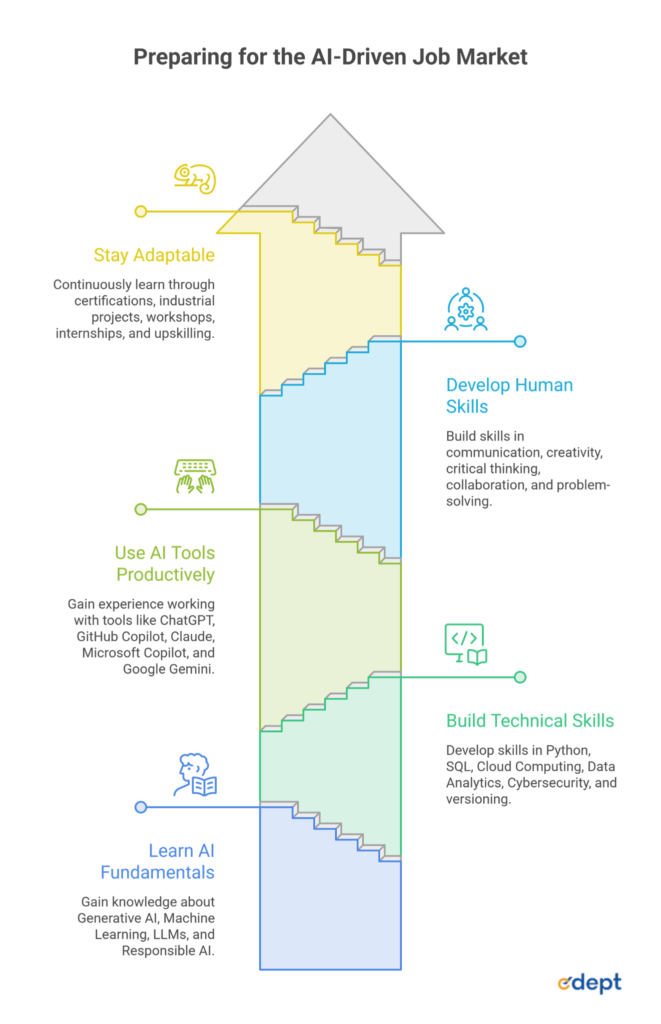
Learn AI Fundamentals
Begin by getting knowledge about Generative AI, Machine Learning, Large Language Models (LLMs), and Responsible AI. Good knowledge will help you adapt easily in view of the increasing AI effects on jobs.
Build Technical Skills
Build skills in areas like Python, SQL, Cloud Computing, Data Analytics, Cybersecurity, and version control. These skills complement each other and make you better off in the future for careers in the AI domain.
Use AI Tools Productively
Gain experience in working with tools like ChatGPT, GitHub Copilot, Claude, Microsoft Copilot, and Google Gemini. Learn how to be productive with AI instead of depending on it completely.
Develop Human Skills
Build skills in communication, creativity, critical thinking, collaboration, and problem-solving. They are uniquely human skills that are going to remain important in the future despite developments in AI.
Stay Adaptable
Technology is advancing rapidly in the area of AI. Continuous learning can be achieved through certifications, industrial projects, workshops, internships, and upskilling.
Why AI + Cloud + Cybersecurity Skills Will Be Most Valuable
The future of the generative AI job market lies at the intersection of Artificial Intelligence, Cloud Computing, and Cybersecurity. Modern AI applications depend on cloud platforms for computing power and secure infrastructure to protect sensitive data. Professionals who combine expertise in these three domains will be among the most sought-after in the evolving future of work.
AI Runs on Cloud Infrastructure
Generative AI applications need a scalable cloud infrastructure such as Amazon Web Services (AWS), Microsoft Azure, and Google Cloud for training, deployment, and management of these AI applications. The increasing need for cloud technology for AI development is creating a high demand for AI specialists with cloud computing skills.
AI Systems Need Security
Artificial Intelligence applications deal with huge amounts of sensitive business and customer data. Therefore, there is an urgent need for cybersecurity experts to protect AI applications, secure cloud infrastructure, identify any threats, and deploy AI applications responsibly. It is one of the highest-growth AI jobs.
Hybrid Skills Command Premium Salaries
The combination of AI skills with Cloud Computing and Cybersecurity provides job seekers with more employment options and better paychecks. Job positions like AI Engineer, Cloud AI Engineer, AI Security Engineer, and AI Architect are becoming highly paid jobs.
Why Choose edept for Future-Ready Careers
Rapid development of the Generative AI jobs market requires experts who can offer much more than just theoretical skills. At edept, students are trained to become part of the changing world of work thanks to the industry-specific curriculum, hands-on training, internationally approved certifications, and project practice. By merging Artificial Intelligence with Cloud Computing, Cybersecurity, and Data Analytics, edept helps students acquire skills that are in demand in today’s AI-powered labor market.
Industry-Aligned Programs
Learning extends beyond classrooms through industry workshops, guest lectures, global immersion projects, AI-powered learning experiences, and hands-on labs that expose students to real business challenges. This practical approach prepares graduates for emerging AI careers and modern technology roles.
Practical Learning
The learning experience is not confined to the classroom since the program offers industry workshops, guest lectures, global immersion projects, AI-based learning, and hands-on labs that allow learners to face the challenges of the business world. It provides graduates with preparation for emerging AI careers and technology professions.
Hands-On Projects
Students work on live projects mentored by IBM, capstone projects, and international client projects via collaboration with companies like Practera and HEX. All these contribute to building a good portfolio and developing problem-solving skills of problem solving.
Career-Focused Education
edept has over 300 recruiting partners, resume-building sessions, LinkedIn profiling, mock interviews, internships, and placement assistance. It gives graduates a career-first advantage to prepare them for jobs in AI.
Read more: Top AI Jobs that Sponsor Work Visa
Future Outlook Beyond 2030
The job opportunities in generative AI are anticipated to expand immensely after the year 2030 as artificial intelligence technology becomes increasingly embedded in the functioning of industries, government agencies, health care, education, and manufacturing. In the World Economic Forum’s Future of Jobs Report 2025, it is estimated that AI and associated technologies will continue to drive job creation in the coming decade. Workers who are dedicated to enhancing their AI expertise and pursuing lifelong learning will thrive in the future of work.
Human-AI Collaboration Will Expand
AI will become a co-pilot in the workplace environment, assisting employees with automating repetitive processes while the human element concentrates on creativity, strategy development, leadership, and difficult decision-making.
More AI-Powered Industries
Outside technology itself, fields including health care, finance, retail, manufacturing, logistics, education, and even government services will continue integrating AI into their operations, leading to varied AI career options.
New Roles Will Continue Emerging
With increasing capabilities of AI, there will be an emergence of careers in the fields of AI governance, AI security, prompt engineering, AI ethics, AI consulting, and intelligent automation.
Skill-Based Hiring Will Increase
Hands-on experience, professional certifications from the relevant field, and project work in addition to theoretical knowledge and qualifications will become increasingly important for securing good AI jobs.
Adaptability Will Become Critical
With the rapid pace of innovations in the realm of artificial intelligence, the process of continuous learning and acquisition of versatile skills will remain crucial. AI professionals combining their skills with Cloud Computing, Cybersecurity, and Data Analytics will have the best career perspectives.
Conclusion
The generative AI job market is changing how people work, study, and develop their careers. Although Generative AI is performing tasks that involve writing, coding, and data analytics automatically, it also opens up many amazing new possibilities within the sectors of technology, medicine, finance, education, and more. To benefit from the future of work, students and professionals have to concentrate on developing the necessary skills in AI, getting some hands-on experience, and constantly improving themselves in additional fields like Cloud Computing, Cybersecurity, and Data Analytics. Those who embrace AI and learn to collaborate with advanced technologies will be prepared for the future and able to use new job opportunities in the future.
Related Links:
| Digital First Job Market India | Top Gen AI Careers to Watch |
| Best Countries For AI Jobs | AI in Forensic Science |