The tech world is evolving with each passing decade, beyond just software development; yet there are many students who still think coding is the only career path for jobs after BSc IT. Yes, programming is an essential skill in today’s world in the software development domain, but there are many organizations that offer numerous jobs after a B.Sc IT degree that focus less on coding and more on other domains like cloud, cybersecurity, analytics, and business technology. Recruiters target professionals who can actually solve business problems from day one, instead of just writing lines of code. If you’re exploring career opportunities after BSc IT beyond coding, this guide will help you understand the best jobs after BSc IT, the skills employers expect, salary potential, certifications that boost employability, and the future scope of BSc IT careers Here, you’ll learn how an industry-oriented approach in B.Sc IT courses, along with certifications and internships, is useful in building lucrative non-programming tech jobs in the present-day environment of IT. Students who have studied in industry-oriented B.Sc IT courses, which include academic courses, certifications, and AI tools, among others, are usually well-equipped for emerging job opportunities.
Why B.Sc IT Offers More Than Coding Careers
There is a misconception that BSc IT leads one to either the software development profession or programming positions. However, today’s IT industry offers a wide range of career opportunities after BSc IT beyond coding, including cloud careers, cybersecurity careers, data analyst jobs, and IT support jobs. The B. Sc IT provides one with a solid technical base that prepares them for various non-programming tech jobs.
Strong Technical Foundation
The BSc IT course helps one develop an understanding of computer science, database management, operating systems, networking, cybersecurity, software basics, and more. This makes one eligible to apply for many jobs after BSc IT, including those that don’t involve coding.
Exposure to Networking and Systems
Through a BSc IT course, one gains hands-on experience with networking, Linux, cloud computing, system administration, and IT infrastructure. These skills are highly valued in cloud careers, technical support, and infrastructure management, making them ideal for those exploring non-coding jobs after BSc IT.
Growing Demand for Non-Coding Tech Roles
As companies fast-track their digital transformations, the demand for workers specializing in cloud services, cyber security, IT Infrastructure, business analysis, and technical support is on the rise. However, the emerging career options for a BSc IT graduate are not all about programming anymore but also involve problem-solving and business operations.
Diverse Career Pathways in IT
The jobs that one can do after a BSc IT include Cloud Computing, Cyber Security, Data Analytics, Network Administration, IT Support, Business Analysis, Product Operations, and Project Coordination. These expanding BSc IT careers offer excellent salary potential, global opportunities, and long-term growth without requiring advanced coding expertise.
Read more: Coding Essentials for Cybersecurity
Why Non-Coding Tech Careers Are Growing Rapidly
There have been rapid developments in the technology sector, leading to the creation of employment opportunities following the completion of a BSc in IT that involve much more than just programming. Companies are increasingly adopting cloud computing technologies, cyber security, and data analysis as part of their operations. As a result, non-coding jobs after a BSc IT are becoming some of the fastest-growing career options in today’s IT landscape.
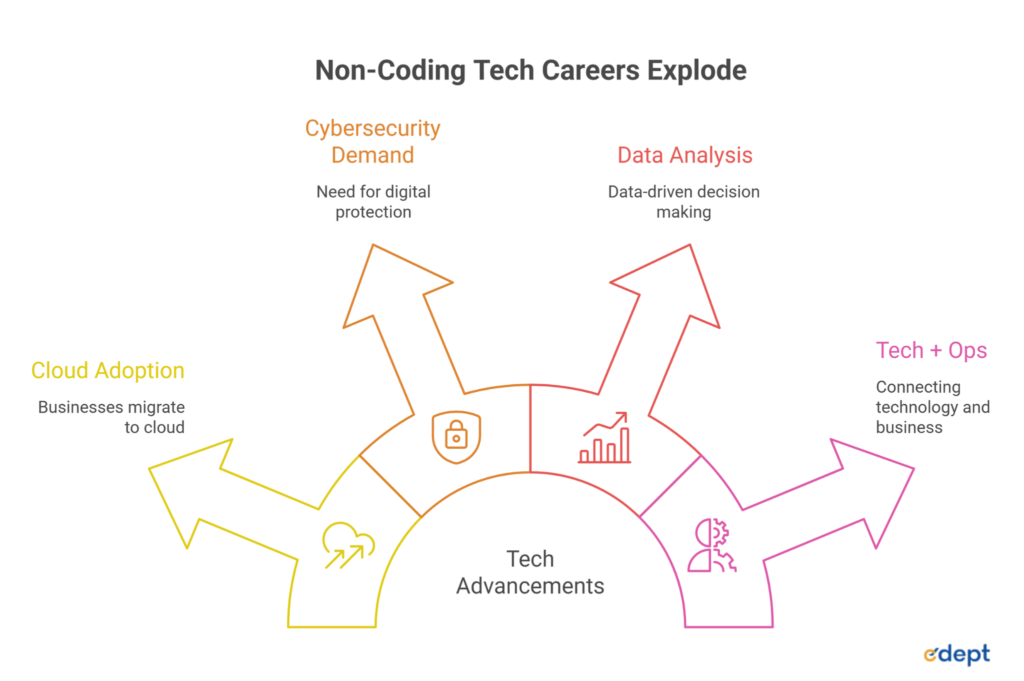
Cloud Adoption Is Increasing
Businesses of all sizes are migrating their applications and data to cloud platforms such as AWS, Microsoft Azure, and Google Cloud. This shift is creating thousands of jobs after BSc IT in cloud operations, cloud support, infrastructure management, and cloud careers, even for candidates with minimal programming experience.
Cybersecurity Demand Is Rising
With an increase in cyber threats, there is a need for organizations to enhance their security infrastructure and hire experts to protect their digital assets. This is leading to more cybersecurity job opportunities for B.Sc IT graduates in the fields of security operations, risk management, compliance, and incident response.
Data-Driven Decision Making Is Expanding
Companies need data for improving customer experience, operational efficiency, and growth of the business. This has caused an increase in demand for the role of data analysts, where analysts use various analytical tools to analyze data from the business.
Business Needs Tech + Operations Professionals.
Modern companies require experts who can connect technology with business operations. Roles in IT support, cloud operations, project coordination, business analysis, and product operations continue to create excellent jobs after BSc IT, making non-coding tech jobs an attractive career choice for graduates seeking long-term growth.
Best Career Opportunities After B.Sc IT Beyond Coding
The biggest misconception among students is that the only jobs after BSc IT are software development roles. In reality, organizations are hiring graduates for cloud infrastructure, cybersecurity, analytics, IT operations, business technology, and technical support. According to the NASSCOM and Naukri.com (2026) data highlighted in the edept B.Sc IT brochure, India is expected to have a 7.5 million IT workforce by 2030, with 126,000+ new IT jobs by 2026 and over 144,000 active IT job openings. This rapid growth is creating numerous career opportunities after BSc IT beyond coding across multiple technology domains. The table below highlights some of the best non-coding jobs after BSc IT and how they compare.
| Job Role | Primary Responsibilities | Key Skills | Average Fresher Salary | Future Scope |
| Cloud Support Engineer | Cloud monitoring, deployment support | Cloud, Linux, Networking | ₹4–7 LPA | Excellent |
| Cybersecurity Analyst | Threat detection, incident response | Security, Risk Analysis | ₹4–8 LPA | Excellent |
| Data Analyst | Reporting, business insights | SQL, Excel, Power BI | ₹4–7 LPA | Excellent |
| System Administrator | Server & infrastructure management | Linux, Networking | ₹3.5–6 LPA | High |
| Cloud Operations Associate | Cloud operations & monitoring | AWS/Azure, Linux | ₹4–7 LPA | Excellent |
| Network Administrator | Network monitoring & security | Networking, Troubleshooting | ₹3.5–6 LPA | High |
Cloud Support Engineer
The Cloud Support Engineer is another rapidly-growing job after BSc IT, but for those students who are interested in cloud technologies, not programming. Cloud support engineers manage cloud computing resources, monitor the virtual infrastructure, resolve any deployment issues, and ensure that cloud applications are up and running.
Key Responsibilities:
- Manage cloud services and virtual infrastructure
- Monitor cloud resources and performance
- Support application deployments
- Resolve cloud-related technical issues
Required Skills:
- Cloud Computing fundamentals (AWS, Azure, GCP)
- Linux Administration
- Networking concepts
- Basic troubleshooting
Salary Potential: ₹4-7 LPA (Freshers) Future Scope: As organizations continue migrating to cloud platforms, cloud careers are expected to remain among the highest-demand technology careers through 2026 and beyond.
Cybersecurity Analyst
Cybersecurity has become an indispensable part of modern business due to the growing number of cyberattacks worldwide. A Cybersecurity Analyst works at the prevention stage, protecting an organization’s infrastructure, networks, and sensitive information from various threats. One of the most interesting non-programming positions after BSc IT.
Key Responsibilities:
- Monitor security threats
- Conduct security assessments
- Respond to cybersecurity incidents
- Support compliance and risk management
Required Skills:
- Cybersecurity fundamentals
- Risk analysis
- Security tools
- Network security concepts
Salary Potential: ₹4-8 LPA (Freshers) Future Scope: Growing cyber threats continue to drive strong demand for cybersecurity careers across banking, healthcare, government, e-commerce, and technology companies.
Data Analyst
For those who like playing with numbers and solving business issues, a career as a Data Analyst will suit them perfectly well. Data analysts collect, clean, analyze, and visualize data in order to help organizations with their business decision-making.
Key Responsibilities:
- Analyze business data
- Prepare reports and dashboards
- Generate actionable insights
- Support business decision-making
Required Skills:
- SQL
- Microsoft Excel
- Power BI or Tableau
- Data visualization
Salary Potential: ₹4-7 LPA (Freshers) Future Scope: As businesses increasingly rely on data-driven decisions, data analyst jobs continue to grow rapidly across finance, healthcare, retail, manufacturing, and consulting.
System Administrator
System Administrators are responsible for the efficient functioning of an organization’s infrastructure, including managing servers, operating systems, and enterprise networks. This position suits those students who prefer infrastructure management to software development; therefore, it is one of the most stable positions after BSc IT.
Key Responsibilities:
- Manage servers and operating systems
- Monitor infrastructure performance
- Perform system maintenance
- Troubleshoot hardware and software issues
Required Skills:
- Linux Administration
- Networking
- Server management
- Troubleshooting
Salary Potential: ₹3.5-6 LPA (Freshers) Future Scope: Organizations across every industry require skilled system administrators to maintain business continuity and IT operations.
Network Administrator
Network administrators build, maintain, oversee, and secure the computer networks of their organizations. They work to provide seamless connectivity, improve network efficiency, and safeguard enterprise resources from potential security risks. It is one of the most dependable non-coding technical careers for B.Sc IT graduates.
Key Responsibilities:
- Configure and maintain computer networks
- Monitor network performance
- Optimize connectivity
- Implement network security
Required Skills:
- Computer Networking
- Infrastructure management
- Network security
- Problem-solving
Salary Potential: ₹3.5-6 LPA (Freshers) Future Scope: With expanding enterprise networks, cloud adoption, and hybrid work environments, Network Administrators will continue to play a vital role in modern IT infrastructure, creating steady jobs after BSc IT for skilled professionals.
IT Support Specialist
The job of an IT Support Specialist entails providing support in resolving computer-related issues, software troubles, network troubles, and problems with operating systems for employees and customers. It is one of the easiest entry-level positions to get after obtaining a degree in BSc IT, with ample room to develop your technical skills.
Key Responsibilities:
- Troubleshoot hardware and software issues
- Provide technical support to users
- Install and configure systems
- Resolve network and connectivity problems
Required Skills:
- Windows and Linux fundamentals
- Basic networking
- Problem-solving
- Customer communication
Salary Potential: ₹3-5 LPA (Freshers) Future Scope: As businesses continue adopting digital technologies, IT support jobs remain essential across every industry and often serve as a gateway to cloud, cybersecurity, and system administration careers.
Cloud Operations Associate
The job of a Cloud Operations Associate consists of managing the cloud environment’s daily operations and maintaining its security, availability, and optimization. The emerging profession is considered to be one of the fast-growing jobs after BSc IT, especially for companies that shift their applications to the cloud platform.
Key Responsibilities:
- Monitor cloud infrastructure
- Support cloud operations
- Troubleshoot cloud services
- Assist with deployments and backups
Required Skills:
- AWS, Microsoft Azure, or Google Cloud fundamentals
- Linux
- Networking
- Monitoring tools
Salary Potential: ₹4-7 LPA (Freshers) Future Scope: With cloud adoption accelerating worldwide, cloud careers continue to expand rapidly, creating long-term opportunities for graduates with cloud operations skills.
Business Analyst
Business Analysts connect the business side of an organization with the technical side by analyzing the requirements of businesses in terms of technologies to implement them. It is one of the best non-programming jobs after BSc IT that students with good communication and problem-solving skills can undertake.
Key Responsibilities:
- Gather business requirements
- Prepare functional documentation
- Support decision-making
- Coordinate with technical teams
Required Skills:
- Business analysis
- Communication
- Data interpretation
- Documentation
Salary Potential: ₹5-9 LPA (Freshers) Future Scope: As organizations become more data-driven, Business Analysts play a critical role in digital transformation projects across banking, healthcare, retail, and IT consulting.
Technical Project Coordinator
Technical Project Coordinator is a job that requires candidates with leadership and organizational skills to coordinate project timelines, development team management, and project progress for successful delivery. It is considered to be one of the fastest-growing jobs after BSc IT.
Key Responsibilities:
- Coordinate project activities
- Track timelines and deliverables
- Communicate with stakeholders
- Support Agile project execution
Required Skills:
- Project coordination
- Communication
- Agile fundamentals
- Time management
Salary Potential: ₹5-8 LPA (Freshers) Future Scope: As organizations manage increasingly complex digital projects, Technical Project Coordinators continue to enjoy strong career growth and opportunities to progress into Project Management roles.
Product Operations Specialist
The role of a Product Operations Specialist involves helping product teams through operational optimization, product analysis, and cross-functional coordination. This is an evolving tech job that does not involve coding and involves a blend of technology, operations, and business.
Key Responsibilities:
- Improve product workflows
- Support product and operations teams
- Analyze operational performance
- Coordinate cross-functional activities
Required Skills:
- Analytical thinking
- Product management fundamentals
- Communication
- Process improvement
Salary Potential: ₹5-9 LPA (Freshers) Future Scope: Product Operations is rapidly becoming a high-demand function in SaaS companies, startups, and technology enterprises. As businesses focus on improving customer experience and operational efficiency, this role offers excellent long-term career opportunities after BSc IT beyond coding.
Highest-Paying Non-Coding Careers After B.Sc IT
Many of the highest-paying jobs after BSc IT no longer require advanced programming skills. As businesses invest in cloud infrastructure, cybersecurity, analytics, and digital transformation, non-coding jobs after BSc IT are offering attractive salaries and excellent long-term career growth.
Cloud Roles
Cloud Engineer, Cloud Support Engineer, and Cloud Operations Associate are amongst the most lucrative jobs with starting pay of ₹4-7 LPA, which can go up to ₹20+ LPA with experience and certifications.
Cybersecurity Roles
Cybersecurity analysts and security consultants can earn ₹4-8 LPA on an entry-level basis, whereas professionals with experience can earn ₹25+ LPA due to increasing popularity of careers in cybersecurity.
Analytics Roles
The starting salary of Data Analyst Jobs ranges from ₹4-7 LPA, whereas data analysts and business intelligence professionals with experience can earn up to ₹18-25 LPA.
Management Roles
Business Analyst, Product Operations Specialist, and Technical Project Coordinator are some of the fastest-growing jobs after BSc IT with a starting salary of ₹5-9 LPA and salaries reaching ₹20-30+ LPA with experience.
Also read: Role of Technology in Modern Higher Education
Skills Needed for Non-Coding IT Careers
Building a successful career in non-coding jobs after BSc IT requires a strong mix of technical knowledge and workplace skills. Students who develop these competencies can access a wide range of jobs after BSc IT in cloud, cybersecurity, analytics, and IT operations.
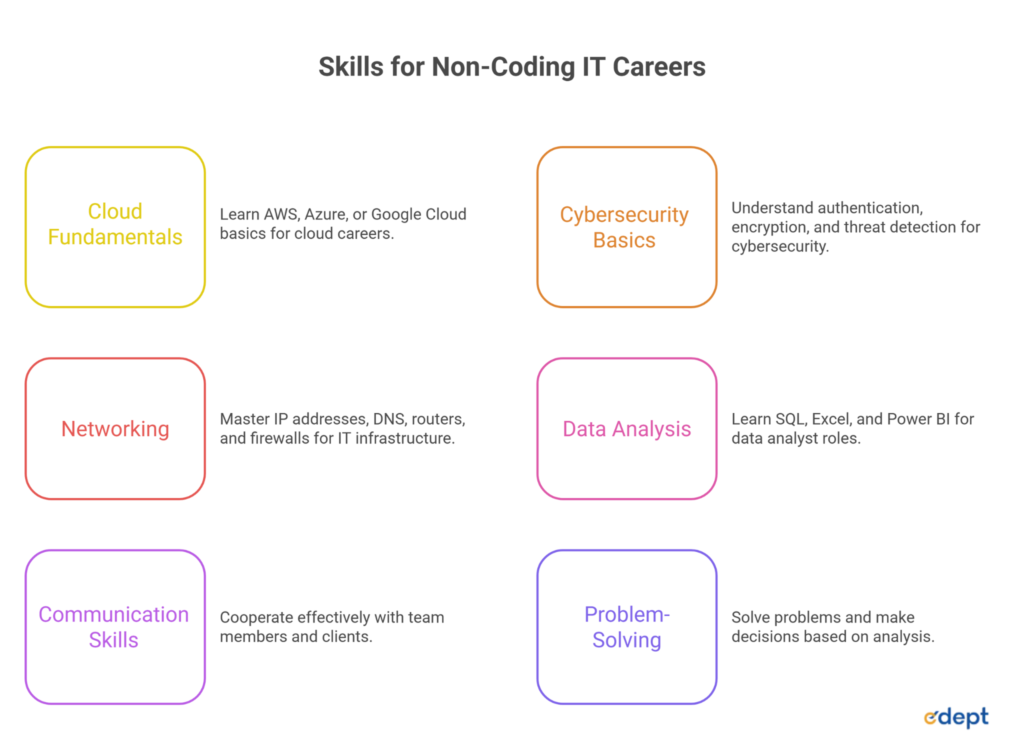
Cloud Fundamentals
Learn the basics of AWS, Microsoft Azure, or Google Cloud, including cloud services, virtual machines, storage, and deployment models to prepare for cloud careers.
Cybersecurity Basics
Learn about basic cybersecurity aspects like authentication, encryption, risk assessment, network security, and threat detection that will form the basis of your future cybersecurity career.
Networking
Be skilled in networking basics such as IP addresses, DNS, routers, switches, firewalls, and VPNs, since this knowledge is crucial for various IT infrastructure positions.
Data Analysis
Learn how to work with SQL, Microsoft Excel, Power BI, and data visualization to be qualified for data analyst or business intelligence jobs.
Communication Skills
Good communication skills allow you to cooperate with other members of the team and clients.
Problem-Solving
Problem-solving is one of the most valuable skills today because employers need candidates who can solve problems and make decisions based on their analysis.
Industries Hiring B.Sc IT Graduates for Non-Coding Roles
Job opportunities for BSc IT students are not only confined to one particular industry but many more due to the adoption of digital transformation, cloud computing, and data-based operations. The scope is not limited to just software development for the graduates.
IT Services
IT service companies hire graduates for IT support jobs, system administration, technical consulting, and cloud operations.
Cloud Companies
Cloud service providers and tech companies employ cloud specialists for various job positions such as cloud support, cloud operations, and infrastructure managers.
Banking and Fintech
Banks and FinTech companies employ B.Sc. IT graduates as cybersecurity officers, business analysts, risk officers, and digital banking operators.
Healthcare Technology
Healthcare organizations require IT professionals for digital systems operation, patient data security, application development in healthcare, and secure infrastructure management.
E-Commerce
E-commerce companies employ graduates in the fields of data analytics, IT support, cloud operations, and product operations to enhance their performance.
SaaS Companies
SaaS companies have great employment opportunities for non-coders after BSc IT in product operations, customer success, technical support, cloud management, and business analysis.
Salary Potential After B.Sc IT in Non-Coding Roles
The salary package for IT jobs after an undergraduate degree in IT varies depending on factors such as job profile, technical expertise, certification, and experience. Individuals in the fields of cloud, cybersecurity, data analytics, and IT operations earn lucrative pay packages in India and abroad.
| Experience Level | India Salary | Global Salary |
| Entry Level (0-2 Years) | ₹3–7 LPA | $50,000–75,000/year |
| Mid-Level (3–6 Years) | ₹7–15 LPA | $75,000–110,000/year |
| Senior-Level (7+ Years) | ₹15–30+ LPA | $110,000–160,000+/year |
There is often rapid salary progression among cloud, cybersecurity, and analytics experts due to rising demand within the industry. Skill development, obtaining certifications within the industry, and work experience can greatly benefit salary opportunities for BSc IT professionals, enabling high-salary positions without coding after BSc IT.
Certifications That Improve Career Opportunities
Earning industry-recognized certifications can significantly improve your chances of securing jobs after BSc IT. Certifications validate your practical skills, strengthen your resume, and help you stand out when applying for non-coding jobs after BSc IT.
Cloud Certifications
To begin a career in the cloud, start with AWS Certified Cloud Practitioner, Microsoft Azure Fundamentals (AZ-900), or Google Associate Cloud Engineer.
Cybersecurity Certifications
For a career in cybersecurity, pursue CompTIA Security+ or Certified in Cybersecurity (CC) from ISC² or EC-Council Certified Ethical Hacker (CEH) certification.
Data Analytics Certifications
For eligibility in data analyst positions, get yourself certified with the Google Data Analytics Professional Certificate, Microsoft Power BI Data Analyst Associate (PL-300), or Tableau Desktop Specialist certification.
IT Support Certifications
To begin an IT support career, start with the Google IT Support Professional Certificate, CompTIA A+, or ITIL Foundation certification.
Common Mistakes B.Sc IT Students Make
Many students limit their career growth by making avoidable mistakes during their degree. Understanding these challenges early can help you secure better jobs after BSc IT and build a successful career in emerging technology domains.
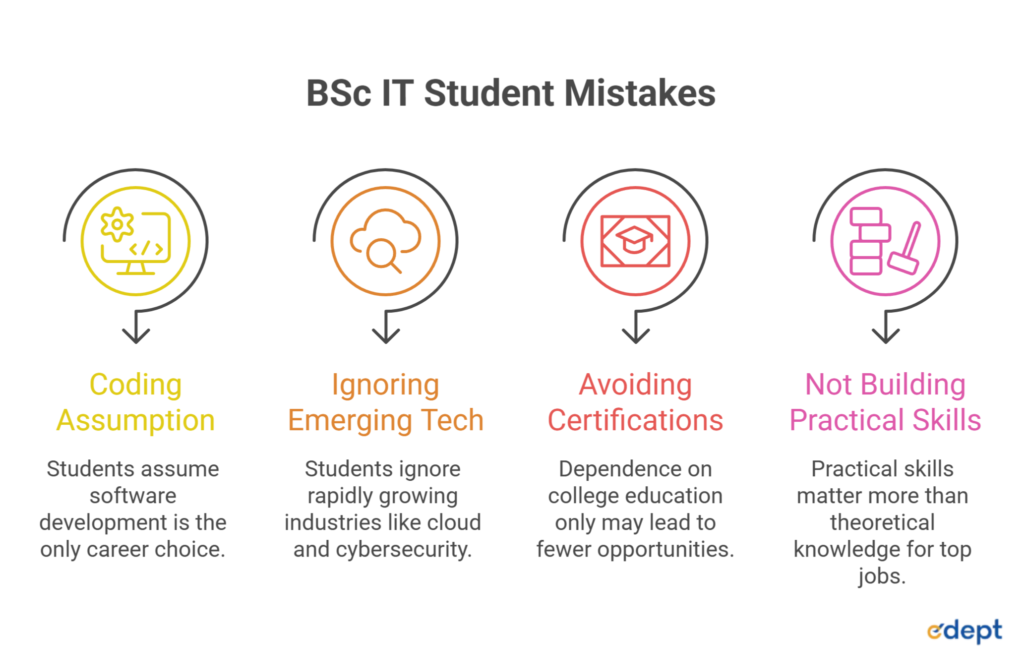
Assuming Coding Is the Only Option
One of the major misunderstandings is to think that software development is the only choice in terms of career. At present, there are many non-coding career options after BSc IT like cloud computing, cybersecurity, data analysis, IT support, and business operations.
Ignoring Emerging Tech Careers
The majority of students ignore rapidly growing industries like cloud careers, cybersecurity careers, and data analyst careers despite high demand and salary prospects.
Avoiding Certifications
Dependence on college education only may lead to fewer employment opportunities. Certifications in the industry prove real competence and increase job prospects.
Not Building Practical Skills
Practical skills matter more than theoretical knowledge. Project work, experience with cloud, internship programs, and problem-solving will be of great help for getting top jobs after BSc IT.
Why Skill-Based Education Improves Career Outcomes
Securing the best jobs after BSc IT requires more than academic knowledge. Employers increasingly prefer candidates who can apply their skills in real-world environments. Skill-based education combines practical learning, industry exposure, and hands-on experience, helping students become job-ready from day one.
Practical Learning
Learning through real-world scenarios helps students understand how cloud computing, cybersecurity, data analytics, and IT systems work in professional environments instead of relying only on theory.
Industry Projects
Involvement in live industry projects helps students tackle practical problems, build up a portfolio, and get the practical experience needed in jobs not requiring programming skills post BSc IT.
Hands-On Labs
Practical labs provide opportunities for students to work on cloud computing platforms, networking applications, cybersecurity environments, and analytics software.
Better Job Readiness
The combination of classroom study along with industry certifications, projects, internships, and practical training is what prepares students for jobs in the current market post BSc IT. Programs such as the B.Sc IT program of edept incorporate all of these elements into its curriculum.
Why Choose edept for Career Growth After B.Sc IT
Landing the best jobs after BSc IT requires more than a university degree—it demands practical skills, industry exposure, and recognized credentials. edept’s industry-led B.Sc IT program is designed to prepare students for emerging non-coding jobs after BSc IT through real-world learning, live projects, global collaborations, and placement-focused training. The curriculum combines academic foundations with hands-on experience, helping students build successful careers in Cloud Computing, Cybersecurity, Data Analytics, AI, and other high-growth technology domains.
Industry-Aligned Programs
The curriculum consists of highly-demanded subjects like Cloud Computing, Cybersecurity, Data Analytics, Artificial Intelligence, Networking, and other latest information technologies. In addition to that, students obtain globally recognized certifications from Deloitte Learning Academy and IBM + NASSCOM.
Practical Labs and Projects
Hands-on training is provided via live projects mentored by IBM, global immersion projects at companies like Practera and HEX, capstone projects, and real-life assignments that help to master practical problem-solving skills.
Career-Oriented Learning
In addition to academic learning, edept offers guest lectures, workshops, industrial visits, AI-enabled learning, and practical exposure to business problems, thus preparing its students to enter the job market.
Placement Support
edept has 300+ recruiting partners, resume preparation sessions, LinkedIn profiling, mock interviews, career assistance, and IBM internship programs, helping students to secure desirable jobs after their BSc in Information Technology.
Step-by-Step Roadmap to Build a Non-Coding Tech Career
Building a successful career doesn’t require becoming a software developer. By following a structured learning path, students can secure rewarding jobs after BSc IT in cloud computing, cybersecurity, data analytics, and IT operations.
Identify Career Interest
Choose a specialization according to your strengths from cloud jobs, cybersecurity, data analytics, IT support, or business analysis.
Build Core Technical Skills
Develop a strong understanding of concepts like networking, Linux, operating systems, databases, and the basics of cloud to be ready for coding-free jobs after BSc IT.
Learn Industry Tools
Build practical skills using tools like AWS, Microsoft Azure, Power BI, SQL, Wireshark, ServiceNow, Microsoft 365, etc., based on your specialization.
Earn Certifications
Add value to your resume through certificates like AWS Certified Cloud Practitioner, CompTIA Security+, Google Data Analytics, or Google IT Support Professional Certificate.
Build Projects
Work on your practical projects, cloud labs, dashboards, and cybersecurity labs to prove your skills through your strong portfolio.
Apply for Entry-Level Roles
Make an effective resume, make your LinkedIn profile perfect, apply for internships, and get into entry-level positions after BSc IT.
Future Outlook for Non-Coding IT Careers Beyond 2026
BSc IT graduates can look forward to promising prospects in the future owing to cloud computing, cyber security, artificial intelligence, and digital transformation initiatives being invested in by organizations. BSc IT graduates who acquire practical knowledge and industrial certification will be able to secure long-lasting non-coding positions.
Cloud Jobs Will Continue Growing
As organizations continue to move their processes to AWS, Microsoft Azure, and Google Cloud, the demand for professionals in cloud careers, such as Cloud Support Engineers and Cloud Operations Associates, is expected to increase.
Cybersecurity Demand Will Rise
The threat of cyberattacks and new regulations for data protection will provide more job prospects in the field of cybersecurity, including security analysis, risk management, and incident response.
Analytics Will Expand Across Industries
Organizations are becoming data-driven, and there is an increased need for data analyst positions that help organizations make sense of business data.
Tech Operations Roles Will Increase
Businesses require professionals who can help organizations manage their IT infrastructure, cloud services, technical support, and operations, thus making technology operations one of the fastest-growing sectors for jobs after BSc IT.
Hybrid Tech + Business Roles Will Grow.
In the future, employers will be looking for professionals with both technical skills and business knowledge. Positions such as Business Analyst, Product Operations Specialist, and Technical Project Coordinator will provide career growth in the convergence of technology and business.
Conclusion
Considering career options in the field of BSc IT besides coding will allow us to see that in today’s world, the IT industry offers many other job opportunities besides being a software developer. Cloud career, cybersecurity career, data analyst position, IT operations, business management – all these jobs after BSc IT give you ample opportunities for growth, good salary, and even work globally. In order to be successful in such positions, one needs to develop the necessary skills and get certified as well as gain practical experience through projects and internships. Thus, with a combination of theoretical knowledge and practical experience, you will definitely be able to choose among many other non-coding jobs after BSc IT. Whether your interest lies in cloud computing, cybersecurity, analytics, or technology management, the future for BSc IT careers is brighter than ever beyond 2026.
Related Links:
| Prepare for a Digital-First Job Market in India | Coding essentials for Cybersecurity |
| How to get Non-Coding IT jobs in 2026 | Role of Technology in Modern Education |