When you start planning to settle or move abroad for higher education or work purposes, the first thing most people look at is the amount of salary they are going to receive or the scholarship amount. Moving abroad in 2026 is an exciting journey but also a significant financial commitment. What will actually help you determine your quality of life abroad is how much your money stretches once your rent, groceries, transport, healthcare and everyday expenses are taken care of. The cost of living in Canada vs UK vs Australia is one of the most significant comparisons made by international students and career-driven professionals.
Choosing the right destination is one of the most important decisions for any student or professional who is planning to pursue higher education or a career switch abroad. Among the most popular destinations, Canada, the United Kingdom, and Australia consistently attract thousands of international students and professionals every year. However, deciding between these countries can be challenging. The cost of living in Canada vs Australia vs the United Kingdom is one of the most significant comparisons made by international students and career-driven professionals.
They are the top three destinations for professionals and students. They help in offering a strong education system, world-class universities, a post-study work visa, and genuine migration pathways. Their living costs are quite different, and they differ sharply based on rent, groceries, transport, and taxes. For example, a student paying around CAD 1,800 a month in Toronto may spend close to AUD 2,300 in Sydney for a similar lifestyle or roughly £1,500 in London for something a little similar.
This guide will give you a complete idea about the cost of living in these countries in 2026. Throughout this guide, we will look at the actual monthly costs city by city, compare salary versus expenses along with rent, food, transport, and healthcare, talk about the hidden charges nobody warns you about, and help you plan your finances. Whether you are a student who wants to pursue higher education abroad or a professional who wants to build a career abroad, this blog will give you the actual numbers, which will help you make an informed decision.
Why Cost of Living Matters Before Moving Abroad
Understanding the cost of living before you plan to move forward helps you ensure financial stability. A lot of students plan their dream destination abroad, but they fail to budget for daily living expenses. This is where things go wrong. The living expenses abroad are not only a one-time thing; they will repeat every single month, and they will only decide whether you can save or you are struggling financially.
Salary Does Not Equal Savings
A high salary in your letter can sometimes deceive you. The entry-level salaries in Toronto or Sydney may sound impressive in the beginning, but as soon as you deduct the rent, transport, healthcare, and grocery expenses, you hardly have any savings left. A £35,000 salary in London sounds wonderful until rent deducts half of your salary. This is why the salary-to-expenses ratio matters. A job paying CAD 55,000 in Calgary may leave you with more savings than a salary of GBP 38,000 in London, simply because in Calgary the fixed cost is comparatively lower. What truly matters is disposable income, the amount left after rent, taxes, transport, and groceries
Students Need Financial Planning
For international students, financial pressure is very acute. The international students usually live on a fixed budget made up of savings, family support, and part-time work. You have to pay tuition fees and manage daily expenses. In Australia, students can work up to 48 hours per fortnight during their study periods. In Canada, the limitation is 20 hours per week off campus. UK also holds 20 hours per week for students. None of these part-time jobs can completely meet your daily expenses. You need to plan everything and come up with a clear financial plan.
Lifestyle and Career Stability Depend on Affordability
Long-term financial pressure is the main reason why many students and professionals return. If you are consistently running short on money, it affects your academic performance, social life, mental health and your ability to build a career. Affordable living means you can focus on studies, build a network, and take internships that pay less but teach more. Choosing a destination where your income can genuinely cover your lifestyle is not just about making a financial decision; it is a decision that affects the quality of your life abroad.
Major Factors Included in Cost of Living
The cost of living represents the total amount of money required to cover basic, everyday expenses to sustain a certain standard of living. It is not just about rent; it gives a full picture of what it takes to live a normal, comfortable life every month.
Accommodation Costs
This is typically the most expensive cost for both the students and working professionals. It varies enormously, depending on which city you live in and how you live: in shared accommodation, university halls, or a private apartment. Understanding which cities are affordable within each country helps you decide where you should live and how much you can save.
Monthly Accommodation Cost Comparison
| Type | Canada | Australia | United Kingdom |
| Most Expensive City | Toronto / Vancouver | Sydney / Melbourne | London |
| Shared Room (Most Expensive City) | CAD 900 – CAD 1,500 | AUD 1,000 – AUD 1,600 | GBP 800 – GBP 1,400 |
| Shared Room (Mid-Tier City) | CAD 600 – CAD 950 (Montreal) | AUD 700 – AUD 1,100 (Adelaide) | GBP 420 – GBP 700 (Manchester / Birmingham) |
| 1-Bedroom Apartment (City Centre, Expensive City) | CAD 2,200 – CAD 2,800 | AUD 2,400 – AUD 3,200 | GBP 1,800 – GBP 2,800 |
| Cost Level (Major City) | HIGH | HIGH | HIGH (London) / MEDIUM (Outside London) |
| Cost Level (Mid-Tier City) | MEDIUM | MEDIUM | LOW–MEDIUM |
| Affordable Alternatives | Calgary, Edmonton, Halifax | Brisbane, Adelaide, Perth | Manchester, Sheffield, Leeds, Belfast |
Food and Groceries
It normally includes the cost of daily meals, both for home-cooked groceries and dining out. Grocery prices typically reflect local supply chains, import costs, and consumption habits. Among the UK, Australia, and Canada, the UK generally offers the lowest grocery costs, while Canada has the highest; Australia tends to sit somewhere in between. Cooking at home versus eating out can make a very significant difference in your budget.
Monthly Food and Grocery Cost Comparison
| Category | Canada | Australia | United Kingdom |
| Average Monthly Grocery Spend (Single Person) | CAD 310 – CAD 445 | AUD 300 – AUD 450 | GBP 150 – GBP 250 |
| Inexpensive Meal (Restaurant) | CAD 18 – CAD 22 | AUD 22 – AUD 28 | GBP 12 – GBP 18 |
| Monthly Dining-Out Budget (Moderate) | CAD 150 – CAD 250 | AUD 200 – AUD 300 | GBP 150 – GBP 250 (higher in London) |
| Grocery Price vs 3-Country Average | Higher than UK; broadly similar to Australia | Slightly lower than Canada; 10–15% above UK | Lowest of the three countries |
| Budget Supermarket Options | No Frills, FreshCo, Walmart | Aldi, Woolworths, IGA | Aldi, Lidl, Tesco, Asda |
| Cost Level | HIGH | MEDIUM–HIGH | LOW–MEDIUM |
Public Transport
All of these countries have public transport systems in major cities, but their monthly cost and reliability vary. Most major cities offer student concessions on monthly passes. The United Kingdom provides the highest quality and coverage of public transport among the three. Canada and Australia fall into the lower tier, generally offering good public transport within dense city centres but severely lacking connectivity and frequency in suburban and rural regions. Canada’s transport cost is the lowest among the three; Australia has the highest transport cost, and the UK falls in between.
Monthly Public Transport Cost Comparison
| Category | Canada | Australia | United Kingdom |
| Monthly Transit Pass (Major City) | CAD 100 – CAD 180 (Toronto: ~CAD 156; Vancouver: ~CAD 100–115) | AUD 100 – AUD 200 (Sydney Opal card; daily fare caps apply) | GBP 80 – GBP 180 (London Oyster: up to GBP 180; Manchester/Birmingham: GBP 70–100) |
| Student / Concession Discount | U-Pass (some cities): 20–25% off; varies by university | Concession card: approx. 50% off full fare in most states | 18+ Student Oyster Card: 30% off adult Travelcard; 16–25 Railcard: ⅓ off national rail |
| Single Trip (Typical) | CAD 3.00 – CAD 4.00 | AUD 2.50 – AUD 5.00 (capped daily) | GBP 1.75 – GBP 3.50 (London single bus: capped at £1.75) |
| Cost Level | MEDIUM | MEDIUM | MEDIUM (London: HIGH) |
| Walkability / Cycle-Friendly | Moderate (weather-dependent) | Moderate | High (many university towns are walkable) |
Healthcare and Insurance
Healthcare varies significantly in these 3 countries. The UK provides the most comprehensive public coverage with the lowest private insurance reliance, while Australia and Canada rely more heavily on supplementary private insurance to cover gaps. Canada provides provincial public healthcare to residents. Australia requires all international students to hold overseas student health cover. The UK provides the National Health Service (NHS), which is primarily funded by general taxation and provides free medical care at the point of delivery for all residents.
Healthcare and Insurance Cost Comparison
| Category | Canada | Australia | United Kingdom |
| Public Healthcare System | Provincial Medicare (eligibility for international students varies by province) | Medicare (for residents/citizens); NOT available to international students on student visas | NHS (National Health Service)-available to student visa holders after paying IHS |
| Mandatory Health Cover for Students | Required in most provinces if provincial coverage unavailable; private insurance CAD 50–100/month | Overseas Student Health Cover (OSHC) is mandatory for all student visa holders | Immigration Health Surcharge (IHS)-paid upfront with visa application |
| Estimated Annual Cost | CAD 600 – CAD 1,200/year (private insurance, varies by province) | AUD 600 – AUD 700/year (OSHC, single student policy, 2025–26 rates) | GBP 776/year per student (IHS 2026 rate), paid upfront as part of visa |
| Monthly Equivalent | CAD 50 – CAD 100/month | AUD 50 – AUD 60/month | GBP 65/month (amortised) |
| What’s Covered | Doctor visits, hospital (varies by province and policy); dental and vision are usually extra | Doctor visits, hospital, emergency care (through OSHC); dental extra | GP visits, hospital, emergency care via NHS; prescriptions £9.90/item in England; free in Scotland/Wales/NI |
| Cost Level | MEDIUM (varies significantly by province) | LOW–MEDIUM (mandatory but affordable) | LOW (once IHS is paid, no ongoing monthly premium) |
Utilities and Internet
Canada typically offers the most affordable utilities due to abundant hydroelectricity, while the UK provides the cheapest standard internet plans. Australia generally has the highest costs for both utilities and internet.
Monthly Utilities and Internet Cost Comparison
| Category | Canada | Australia | United Kingdom |
| Electricity (Monthly, Single Person or Shared) | CAD 60 – CAD 120 (higher in winter due to heating) | AUD 80 – AUD 150 (spikes in summer: air conditioning) | GBP 40 – GBP 80 (Ofgem-regulated; avg. annual energy bill ~£1,738 for a household) |
| Gas / Heating (Monthly) | CAD 50 – CAD 100 (particularly high in Ontario and BC in winter) | AUD 30 – AUD 60 (warmer climate; less heating needed) | GBP 30 – GBP 70 (included in Ofgem cap; higher in winter) |
| Water (Monthly) | CAD 30 – CAD 50 | AUD 30 – AUD 50 | GBP 25 – GBP 45 (often included in rent for student accommodation) |
| Internet (Monthly Broadband) | CAD 60 – CAD 90 | AUD 60 – AUD 90 | GBP 25 – GBP 45 |
| Total Monthly Utilities + Internet | CAD 150 – CAD 250 | AUD 150 – AUD 250 | GBP 80 – GBP 150 |
| Key Seasonal Driver | Winter heating (Nov–Mar: highest bills) | Summer cooling (Dec–Feb: highest bills) | Winter heating (Nov–Feb) |
| Cost Level | MEDIUM–HIGH (winter months) | MEDIUM | LOW–MEDIUM |
Taxes and Miscellaneous Expenses
Taxes quietly shape your take-home pay. Australia tends to offer the highest take-home pay. Canada offers a dual-level system with both federal and provincial taxes. United Kingdom have a high overall tax burden, with the basic income tax rate at 20% and the higher rate at 40%.
Tax and Miscellaneous Expense Comparison
| Category | Canada | Australia | United Kingdom |
| Income Tax Structure | Federal + Provincial (two layers). Federal lowest rate: 14% (2026) on first CAD 58,523. Provincial rates add 5.05%–17.5%, depending on the province. | Federal only. Tax-free threshold: AUD 18,200. Rates: 19% up to AUD 45,000; 32.5% up to AUD 120,000. | PAYE system. Personal Allowance: GBP 12,570 (0%). Basic rate: 20% up to GBP 50,270; Higher rate: 40% above that. |
| Effective Tax Rate (Entry-Level ~CAD/AUD/GBP 40,000) | Approx. 20–25% combined (federal + provincial; Ontario/BC higher end). | Approx. 19–22% (lower bracket; no provincial tax). | Approx. 16–18% (personal allowance provides meaningful relief at this income level). |
| Superannuation / Pension Contribution | CPP: Employee contributes approximately 5.95% of earnings (2026). | Superannuation: Employer contributes 11% on top of salary (does not reduce take-home pay; considered a benefit). | National Insurance: Employee pays 8% on earnings between £12,570 and £50,270. |
| GST / VAT on Purchases | GST: 5% federal + provincial sales tax (PST/HST varies by province; Ontario HST: 13%). | GST: 10% on most goods and services. | VAT: 20% on most goods and services (food staples are generally zero-rated). |
| Miscellaneous Student Costs (Annual) | CAD 200–400 (student ID, campus fees, administration fees). | AUD 200–400 | GBP 150–350 |
| Cost Level (Tax Burden for Students / Entry Workers) | Medium (lower federal rate in 2026, but provincial taxes add to the burden). | Low–Medium (tax-free threshold benefits low earners; superannuation is employer-funded). | Low–Medium (GBP 12,570 personal allowance shelters a significant portion of entry-level earnings). |
Summary
| Cost Factor | Canada | Australia | United Kingdom | Affordable Option |
| Accommodation | High | High | Medium (outside London) | United Kingdom (mid-tier cities) |
| Food & Groceries | High | Medium–High | Low–Medium | United Kingdom |
| Public Transport | Medium | Medium | Medium | United Kingdom (student discounts strongest) |
| Healthcare / Insurance | Medium | Low–Medium | Low (once IHS paid) | Australia / UK (Tie) |
| Utilities & Internet | Medium–High | Medium | Low–Medium | United Kingdom |
| Taxes (Entry Level) | Medium | Low–Medium | Low–Medium | Australia / UK (Tie) |
| Overall Monthly Cost (Student, Major City) | CAD 1,800 – 2,800 | AUD 1,800 – 3,000 | GBP 900 – 2,200 | UK (outside London) |
| Overall Monthly Cost (Student, Mid-Tier City) | CAD 1,500 – 2,000 | AUD 1,500 – 2,000 | GBP 850 – 1,300 | UK / Canada (Tie) |
Cost of Living in Canada
If you are planning to study in Canada in 2026 or looking for a career change, then the first step is to understand the cost of living. The cost of living in Canada is moderately high, with a single person spending CAD 1,400–1,500 per month (INR 94.8K–1.01L), excluding rent, and driven by groceries, utilities, and transport.
Average Monthly Living Cost
The average monthly cost of living in Canada ranges from $3,000 to $4,000 CAD for a single person and $5,900 to $6,400 CAD for a family of four. Your expenses depend on the city you are living in and your lifestyle. For Indian students who are planning to study in Canada, the highest monthly costs usually include accommodation, food, transportation, and health insurance. On average, students spend around CAD 1,500 to CAD 2,500 per month. Major cities like Toronto and Vancouver tend to be more expensive than smaller cities.
Rent in Major Cities
In 2026, the average monthly rent for a 1-bedroom apartment in major Canadian cities varies significantly. Vancouver is the most expensive city and commands approximately $2,400 to $2,500 CAD; Toronto averages $2,100 to $2,587 CAD, and Calgary offers more affordable options at roughly $1,500 to $1,600 CAD.
| City | 1BHK (City Centre) | 1BHK (Outside City Centre) |
| Toronto | CAD 2,439 (INR 1.65L) | CAD 1,900 (INR 1.28L) |
| Vancouver | CAD 2,491 (INR 1.69L) | CAD 2,050 (INR 1.38L) |
| Calgary | CAD 1,559 (INR 1.05L) | CAD 1,200 (INR 81.3K) |
| Ottawa | CAD 1,767 (INR 1.19L) | CAD 1,400 (INR 94.8K) |
| Montreal | CAD 1,433 (INR 97.1K) | CAD 1,050 (INR 71.2K) |
Student Expenses in Canada
Student expenses in Canada generally require a monthly budget of CAD $1,500 to $2,500, with transport, groceries, and healthcare being major components. The grocery budget in Canada on a monthly basis is normally CAD 350–550 (INR 23.7K–37.3K). Major Canadian cities offer extensive, student-friendly transit systems (buses, subways, and trains). A single ride typically costs between CAD $3 and $4. Health insurance is mandatory for all international students. The costs generally range from CAD $600 to $1,100 annually, and this fee is usually automatically added to your university tuition bill.
Salary vs Living Cost
Canada usually offers a high quality of life, but the rising living cost requires proper financial planning. The average national income is roughly $67,500. The federal minimum wage is CAD 17.5/hour as of 2026. Your living depends on your location, the number of members in your family and your lifestyle. The international students who are working for 20 hours per week can earn approximately CAD 1400 to CAD 1500/month before tax.
For graduates and working professionals, the average salary is CAD 64,487, and for entry-level professionals, it is near CAD 51,886. Canada’s Express Entry immigration pathway provides points for Canadian work experience, making it an easily accessible country for international students in the long run. Vancouver and Toronto are very expensive, & renting a one-bedroom apartment often exceeds $2,500 CAD monthly, whereas cities such as Calgary, Edmonton, Halifax, or Montréal are significantly more affordable and less costly.
Cost of Living in Australia
The average monthly cost of living in Australia ranges from AUD 1,600 to AUD 3,500 for a single person and AUD 5,600 to AUD 7,500+ for a family of four, depending on the city you are living in and your lifestyle. The cost of living in Australia is the highest in the Asia-Pacific region.
Average Monthly Living Cost
In 2026, the average monthly living cost in Australia ranges from AUD 1,600 to AUD 3,500 for a single individual and AUD 4,500 to AUD 7,500+ for a family of four, depending on the city you are living in and your lifestyle. Sydney, Melbourne, and Canberra are the most expensive, with rent being the biggest expense. For students who are planning to study in Australia, monthly expenses range between AUD 1,500 and 2,500 (₹83,000–1.38 lakh), making budgeting an important factor to live in Australia.
You can also check: Best Countries for Fastest Work Permit Approvals in 2026
Cost of Living in Major Australian Cities
| City | Approximate Monthly Expenses (AUD) | Approximate Monthly Expenses (INR) |
| Sydney | AUD 3,000–3,800 | ₹1.62–2.05 lakh |
| Melbourne | AUD 2,800–3,600 | ₹1.51–1.94 lakh |
| Canberra | AUD 2,700–3,500 | ₹1.46–1.89 lakh |
| Brisbane | AUD 2,400–3,200 | ₹1.29–1.73 lakh |
| Adelaide | AUD 2,200–3,000 | ₹1.18–1.62 lakh |
| Perth | AUD 2,300–3,100 | ₹1.24–1.67 lakh |
Rent in Major Cities
The rental price in Australia has increased more than 12 per cent since 2023, making it one of the most expensive countries in the world. Sydney is the most expensive city, whereas Melbourne remains slightly more affordable alongside Brisbane. Families renting larger apartments can expect costs of AUD 2,700–3,700 (₹1.50–2.05 lakh), making housing the biggest monthly expense
| City | Housing Type | Monthly Rent Range (AUD / INR) |
| Sydney | 1BR City Centre | AUD 2,100–2,500 (₹1.16–1.38 lakh) |
| Melbourne | 1BR Outside Centre | AUD 1,600–2,000 (₹88,000–1.10 lakh) |
| Canberra | 3BR City Centre | AUD 3,000–3,700 (₹1.65–2.05 lakh) |
| Brisbane | 3BR Outside Centre | AUD 2,400–3,000 (₹1.32–1.65 lakh) |
| Adelaide | 1BR City Centre | AUD 1,700–2,200 (₹94,000–1.22 lakh) |
| Perth | 3BR Outside Centre | AUD 2,500–3,200 (₹1.38–1.77 lakh) |
Student Expenses in Australia
Students who are planning to study in Australia should budget an average of AUD 300 to AUD 500 per month for food, AUD 60 to AUD 220 per month for transport, and AUD 140 to AUD 560 per month for utilities, depending on lifestyle, city, and housing arrangements. Food and grocery costs in Australia are moderate, but still, they form a significant part of monthly expenses. Groceries for a single person average AUD 400–600 (₹22,000–33,000) per month. Most Australian states offer public transport discounts for full-time international students.
A monthly public transport pass typically costs around AUD 130 (₹7,200). The health insurance premium, on average, ranges between AUD 150 and 300 (₹8,200 and 16,500) per person. Medicare covers basic healthcare for citizens and permanent residents, but international students must purchase Overseas Student Health Cover (OSHC). The utilities and internet charges range between AUD 150 and AUD 250 per month.
Salary vs Living Cost
Australia generally offers a high quality of life with strong average salaries (around AUD $92,000 a year). However, this depends on the high cost of living. A single person typically needs AUD $2,000 to $2,500/month, while families require AUD $120,000 to $180,000/year. The minimum wage is AUD $24.95 per hour. A student working for 48 hours per fortnight earns AUD1500 per fortnight. Expenses differ significantly depending on where you stay. Sydney and Melbourne are the most expensive cities, with premium real estate. Cities like Brisbane, Adelaide, and Perth offer more affordable housing and a lower overall cost of living.
Cost of Living in the United Kingdom
The cost of living in the United Kingdom averages roughly £1,200 to £1,800 per month for a single person, excluding tuition or major housing expenses. Monthly costs are significantly higher in London, demanding £1,800 to £2,500+, whereas cities like Belfast, Newcastle, or Manchester offer more affordable living.
Average Monthly Living Cost
The average monthly cost of living in the United Kingdom ranges from £1,500 to £2,500 for a single person and £4,000 to £6,000 for a family. The cost of living depends on the city you are living in, the number of members in your family, and your lifestyle. London remains the most expensive city, while regions like Northern Ireland and Northeast England are more affordable.
| City | Approximate Monthly Expenses (GBP) | Approximate Monthly Expenses (INR) |
| London | £2,000–£2,800 | ₹210,000–₹294,000 |
| Cambridge | £1,600–£2,200 | ₹168,000–₹231,000 |
| Bristol | £1,400–£1,900 | ₹147,000–₹199,000 |
| Manchester | £1,300–£1,800 | ₹136,000–₹189,000 |
| Belfast | £1,100–£1,600 | ₹115,000–₹168,000 |
Rent in Major Cities
The rental expense in major UK cities varies drastically, with London remaining the most expensive, while cities like Manchester and Birmingham offer significantly more affordable options. London is consistently the highest-priced rental city in the UK, followed by Manchester, which offers a strong alternative to the capital, featuring high rental demand driven by its growing business and creative sectors. Birmingham is generally more affordable than Manchester and provides excellent value for money
| City | Housing Type | Monthly Rent Range (GBP / INR) |
| London | 1-BR City Centre | £1,600–£2,500 (₹168,000–₹262,500) |
| Cambridge | 1-BR Outside Centre | £950–£1,400 (₹99,700–₹147,000) |
| Bristol | 3-BR City Centre | £1,500–£2,200 (₹157,500–₹231,000) |
| Manchester | 3-BR Outside Centre | £1,200–£1,700 (₹126,000–₹178,500) |
| Belfast | 1-BR Outside Centre | £700–£1,000 (₹73,500–₹105,000) |
Student Expenses in the UK
Managing student living expenses in the UK requires proper budgeting and financial planning. Food and grocery costs form a significant part of the cost of living in the UK. Groceries for a single person average around £250–£400 (₹26,300–₹42,000) per month. Students aged 16–25 can purchase a 16-25 Railcard, which provides a ⅓ discount on rail travel across the UK. Transport costs typically range between £40 in smaller university towns and up to £150 in major cities like London. If you are an international student, you are required to pay the Immigration Health Surcharge (IHS) as a mandatory part of your visa application. The average basic utilities expense averages around £100 to £200+ per month, alongside additional costs for mobile phones and broadband.
Salary vs Living Cost
In UK, the monthly budget is heavily dependent on location and lifestyle. The average annual salary is around £35,000 to £45,000, whereas average monthly living expenses range from £1,800 to £2,500 for single individuals. The minimum wage for those whose age is 21 and over is £12.71 per hour. The students who are working 20 hours per week can approximately earn £1120 per month. Food and grocery costs form a significant part of the cost of living in the UK. Groceries for a single person average £250–£400 per month. The monthly public transport cost usually costs £75, and the utility and council tax can typically charge £300 to £500 per month. The rent expenses usually range from £800 to £1,100 per month for a 1-bedroom flat outside London. and inside the city centre, it ranges between £1,800 and £2,300.
Canada vs Australia vs United Kingdom: Detailed Cost Comparison
Most Affordable Country
When comparing the expenses, the UK outside London is the most affordable out of the three, particularly in cities such as Sheffield, Belfast, Leeds, Nottingham, and Glasgow. Canda is next, but if you start comparing Toronto and London, then costs are mostly similar. Canadian cities such as Montreal, Calgary, Halifax and Quebec City are more affordable. Australia is the most expensive, but Brisbane, Adelaide and Perth are still affordable.
Best Country for Students
Canada’s smaller cities, such as Sherbrooke, Trois-Rivières, and Moncton, offer total monthly costs, including rent and living expenses, ranging from CAD 1,100 to 1,400, making them more affordable than UK cities. In Australia, Adelaide and Brisbane are popular among students for their lower rent and affordable food options, with shared housing from AUD 700–900/month. Canada and Australia both offer clear migration pathways and more structured post-study work options.
Best Salary-to-Expense Ratio
Australia stands strong in this category. Students in Australia generally earn AUD 20–30 per hour depending on job type and city; by working 12–18 hours weekly, students can earn approximately AUD 1,200–1,800 per month, covering a significant share of their living expenses.
Best Country for Long-Term Savings
Canada stands out ahead for long-term savings potential, particularly for professionals settling in mid-sized cities. Montreal and Calgary have lower rents compared to Toronto and Vancouver, and sharing accommodation cuts housing costs by 30–40%. Combined with Canada’s Express Entry PR pathway, which benefits local work experience, the long-term financial growth and savings for Canada are strong for career-focused migrants who choose cities wisely.
Which Country Is Better for International Students?
There is no universally best country; the best actually depends on your career goals. Each country has a unique personality and benefits.
Canada
Canada is considered better for international students who want affordability, a strong PR pathway, and a multicultural lifestyle. Canada leads for long-term settlement. The Post-Graduation Work Permit (PGWP) allows you to stay and work for up to three years. The Express Entry system provides a structured, points-based route to permanent residency. Generally, the most affordable option for both tuition and living expenses, particularly outside major hubs like Toronto and Calgary, includes Montreal and Calgary.
Australia
Australia offers one of the best combinations for students’ work rights and post-study opportunities. Australia mandates a strong minimum wage (A$24.95 per hour). This earning potential helps easily face the higher overall cost of living. They give graduates genuine time to settle and establish themselves professionally. Although living costs are a bit high, there is high pay, generous work hours, and a steady job market, which makes it a better place for both students and professionals.
United Kingdom
The UK’s biggest advantages are the well-reputed universities, the globally recognised degrees and the shorter programme duration. Master’s degrees generally take only 1 year, and undergraduate programmes typically take 3 years, saving you a year of tuition and living costs. The Graduate Route visa allows you to work for 2 years after graduation, making it a great country for building a global career.
Cost of Living vs Salary Comparison
A higher salary in an expensive city is not always better than a modest and average salary in an affordable one. For instance, a graduate in Melbourne might earn more than one in Toronto, but rent and groceries in Melbourne are more expensive than in Toronto. In the same way, a UK graduate working in Manchester or Birmingham often saves more than one who is working in London, despite getting a modest salary.
| Country | Avg Annual Salary | Avg Monthly Expense | Estimated Monthly Savings |
| Canada | CAD 64,487 | CAD 1,800 – 2,500 | CAD 1,500 – 2,500 (varies by city) |
| Australia | AUD 68,000 – 75,000 | AUD 1,800 – 2,800 | AUD 1,500 – 3,000 (varies by city) |
| United Kingdom | GBP 28,000 – 38,000 | GBP 1,000 – 2,000 | GBP 500 – 2,000 (varies by city) |
Hidden Costs Students Often Ignore
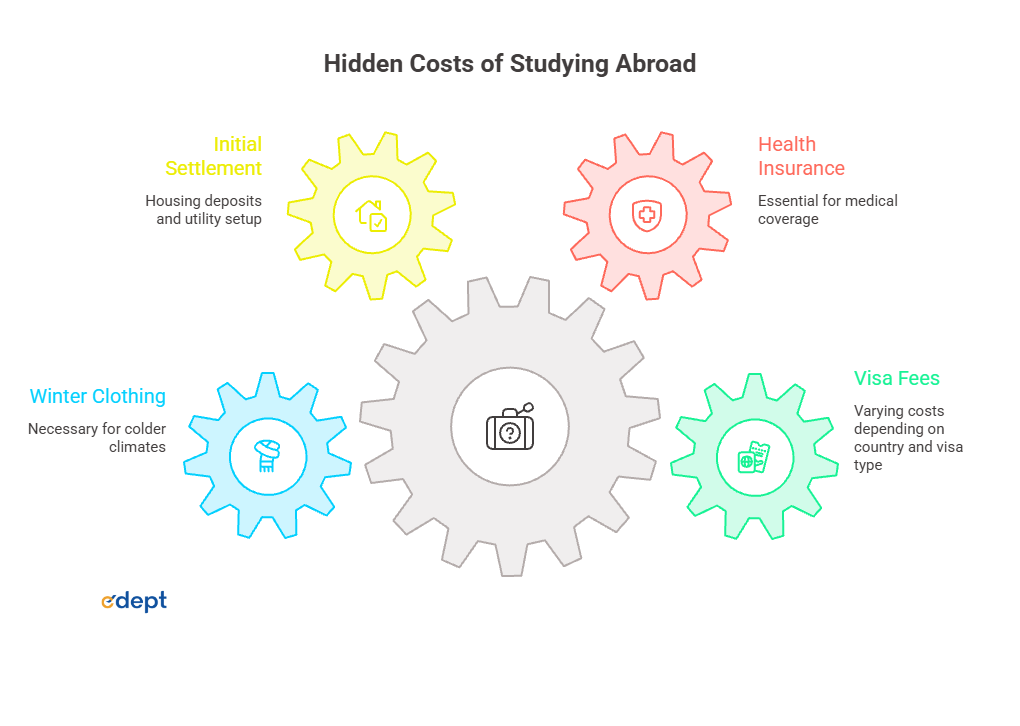 Most financial and budgeting guides only talk about daily expenses and the cost of living, but there are several other hidden costs, which often go unnoticed by students.
Visa Fees
The visa application costs are the real hidden costs, which most of the students fail to calculate. The Canadian study permit application cost CAD 150. Australian student visas typically cost AUD 1600. Some of the additional costs also include biometrics, medical exams, and mandatory Overseas Student Health Cover (OSHC). The visa application fees in the UK are £558. For a 1-year master’s programme, you usually pay for about 16–18 months, which adds up to roughly £1,164 – £1,552.
Health Insurance
Health insurance policies for international students vary significantly. The health insurance charges in Canada typically range between CAD $600 and $900 per year. Some provinces (like Alberta, British Columbia, Manitoba, Newfoundland and Labrador, and Saskatchewan) provide full provincial healthcare for international students, though there may be a 3-month waiting period upon arrival. The IHS is required at the time of your student visa and charges £776 per year for students. For a 3-year degree, this amounts to £2,328 upfront. In Australia, the health insurance charges range between AUD $500 and $700 per year for a single student.
Winter Clothing and Travel
Canada is consistently the coldest among the three. Now, if you arrive from a tropical or subtropical climate, you will need a serious wardrobe change. You need winter jackets, coats, and boots. This can cost CAD 500 to CAD 1000. Also, the flight and travel expenses from Canada, Australia or UK are usually very high, and these also add up as additional expenses.
How Skill-Based Education Improves ROI Abroad
Skill-based education helps in maximising your return on investment by aligning your degree with global in-demand industries and job roles, which results in getting higher starting salaries, faster promotion and job growth. The key drivers for higher studies, which can give you a better ROI, include specialised job-ready skills and knowledge, internships and live projects, soft skill development, and global networking. The students who graduate with industry-relevant skills and knowledge are recognized more by employers and get a chance to negotiate higher starting salaries. In 2026, employers in Canada, Australia, and the UK are hiring not only based on degrees, but they are looking for candidates with job-ready, skill-based capabilities. Certifications in areas such as data analytics, cloud computing, project management, and digital marketing are highly valued by employers. For the highest financial and professional returns, you should start focusing on sectors with global talent shortages, such as technology, business, finance and healthcare.
Why Choose Edept for Global Career Preparation
edept is built around one core belief: that skill development and career readiness are inseparable from the quality of an international student’s experience abroad. The institution offers a range of programmes specifically designed to close the gap between academic qualifications and what employers in Canada, Australia, and the UK actually expect from entry-level candidates.
Industry-Focused Programs
edept programs are developed in consultation with industry partners, ensuring that what you study reflects current workplace needs rather than outdated curricula. Whether you are entering technology, business, or healthcare, your learning is anchored to real-world application.
Practical Learning and Certifications
Alongside academic content, edept integrates professional certifications that hold weight with employers. These credentials shorten your job search timeline and give you a concrete advantage in competitive graduate hiring processes.
Career-Oriented Skill Development
From interview preparation and resume building to LinkedIn optimization and industry networking, edept supports the full career development journey, not just the classroom experience.
Guidance for International Opportunities
Navigating study options, visa pathways, and employment regulations in a foreign country is complex. edept provides clear, experience-backed guidance to help students make informed decisions about destinations, programmes, and career pathways before they ever board a flight.
Step-by-Step Financial Planning Guide for Students Moving Abroad
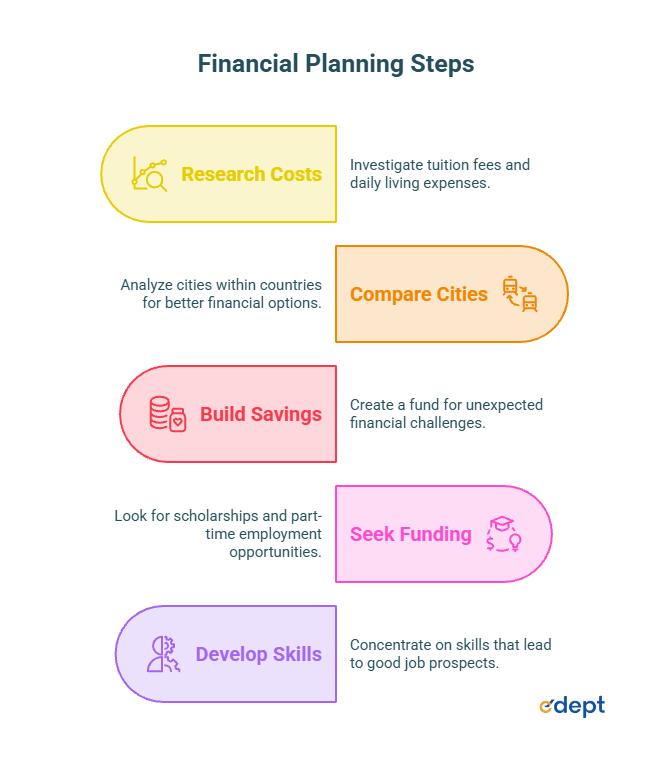 Moving abroad for studies is a very crucial decision for every student. It requires strict financial planning so that you can manage your budget effectively.
Research Tuition and Living Costs
Before moving, you should start doing detailed research on various fixed and variable expenses such as tuition fees, mandatory health insurance, visa/immigration processing fees, rent/utilities, groceries, transportation, and books. You can build a 12th projection plan, not just for a single month
Compare Cities Instead of Countries Only
Toronto is not Canada. London is not the UK. Sydney is not Australia. There is a huge difference in living in various cities. A city-level comparison will actually give you the real picture of affordability. You should always compare the city-level costs, not just national averages
Build Emergency Savings
Always have a safety fund for unforeseen emergencies, such as unexpected travel home or a medical issue not covered by insurance. You should have a minimum of three months of living expenses saved as an emergency fund, separately from your regular budget.
Explore Scholarships and Part-Time Jobs
More than 1000 scholarships are available in Australia for international students, many of which cover not only tuition fees but also accommodation and living expenses. Canada also offers partially as well as fully covered scholarships, both at the undergraduate and postgraduate levels. UK also has several universities, which provide scholarships. You should first research this before you commit to a full-time course.
Focus on High-Employability Skills
The fastest way to improve your financial position is to focus on high-employability skills. Skill-based education helps in maximising your return on investment by aligning your degree with global in-demand industries and job roles, which results in getting higher starting salaries, faster promotion and job growth. In 2026, employers in Canada, Australia, and the UK are hiring not only based on degrees, but they are also looking for candidates with job-ready, skill-based capabilities.
Future Cost of Living Trends Beyond 2026
Some of the future cost of living trends include:
Rising Urban Rent
Toronto, Sydney, and London continue to see steady rent growth driven by housing shortages and rising migration. The students who are planning beyond 2026 should plan very carefully and build conservative estimates.
Remote Work Influencing City Choices
More students are choosing smaller cities like Halifax, Adelaide, and Manchester because remote work makes location less important. The increase and normalisation of remote work is slowly making regional cities more attractive. Professionals now do not have to live in Toronto or London to secure good job roles. This trend is slowly reducing the demand pressure in capital cities and bringing more opportunities around regional cities.
Growth of Regional Migration Programs
Canada and Australia are both expanding regional immigration programmes that reward students who study and work outside major cities. Through the Provincial Nominee Program (PNP), individual provinces (like Alberta, Saskatchewan, and Nova Scotia) nominate migrants based on localised labour shortages. In the UK, migrants utilise the Skilled Worker Visa or the Health and Care Worker Visa, which require a job offer from an approved sponsor and meeting specific salary needs. In Australia, the Skilled Work Regional (Provisional) Visa (Subclass 491) allows professionals to live, work, and study in designated regional areas for 5 years.
Conclusion
There is no single answer that can justify which country is best for you. It completely depends on your priorities, your field of study, and your dream career path. Now, if your goal is opportunities, affordability, and permanent residency, then Canada is best for you. If you prioritize prestigious universities and shorter academic programmes, then the UK may be the ideal choice for you. If you want a high quality of life, a good salary, an excellent lifestyle, and strong graduate employment prospects, Australia is the perfect option for you.
This debate has no universal winner. It depends on your academic goals, financial situation, career aspirations, and long-term plans. What matters most is, regardless of whichever country you choose, the crucial step is how well you are prepared before you arrive in that country. Your financial planning, skill development, and career readiness help in determining whether your investment in international education actually pays off. Choose your destination very wisely.