One of the biggest challenges faced by many international students and working professionals while moving abroad is not finding a job opportunity but waiting for visa approval. There are many reasons why people look for a work visa today, be it to take up a new job, pursue further education, transfer internally or work legally in a country they already call home. The urge to work abroad and have a global career is very high these days, but navigating the various complexities of work visas can sometimes feel overwhelming. You have a good job offer in your hand; you have made all your relocation plans and career decisions, but you cannot move forward unless a government authority approves your documents. A delay, even for a few weeks, can cost you the job opportunity because the job market is very competitive; no one will wait for you. Now let us understand the best countries for fastest work permit approvals in 2026.
The lengthy processing times, unclear requirements, strict laws and regulations can derail an entire career plan. But the good news is that certain countries have recognized the value of attracting global talent, and the global immigration landscape is shifting dramatically. The countries that had previously been slow have started investing significantly in digital immigration systems, a smooth, skilled visa pathway, and a dedicated fast-track route for highly competitive occupations. In 2026, the global countries are competing more actively with each other to attract skilled professionals in sectors such as healthcare, cybersecurity, cloud computing, AI, data analytics and engineering. That said, not all countries have uniform processing times; it depends on the type of visa you are applying for, your occupation, whether your employer is an approved sponsor, and how complete your documentation is from day one.
This guide will help you compare the countries with the fastest work permit approval in 2026, as well as the easiest work permit countries, and highlight which destinations are strongest for job seekers who want both speed and long-term career growth. It also helps you understand the difference between work permit speed and PR friendliness, which is important before making a decision.
Why Work Permit Processing Time Matters
Work permit processing time acts as a critical bridge between securing a job offer and physically starting a new job in a new country. It directly influences how quickly a person with a job offer can start working, relocate properly and settle in his role without any uncertainty
Faster Job Joining and Career Stability
When a company offers you a job role, they have a fixed date for your start. If you have a long delay in your visa application, then that affects your starting date. If the wait time is unpredictable, you risk losing your current salary before your new one begins. Your offer can expire or the project can move on without you. Employers value candidates who can honour their start date and protect their professional credibility.
Reduced Financial and Visa Uncertainty
The immigration effects and long waits have a direct financial consequence. Many applicants take their unpaid leave, burn their savings, or leave other opportunities. The countries which have digitised and streamlined their immigration systems reduce this window of financial exposure significantly. A predictable timeline can help you budget properly, reduce financial pressure and make decisions with confidence.
Better Planning for International Relocation
Moving internationally requires months of preparation. Relocation involves housing, shipping, transportation, banking and finance, family arrangements and tax planning. A faster and more predictable timeline can help the professionals to plan with confidence, whereas a delay in work permits can cause emotional burdens and stress. The countries with a transparent, digitally managed immigration system can give applicants real-time updates and clearer timelines.
Competitive Advantage for Skilled Professionals
In a competitive job environment, where global companies are continuously searching for skilled professionals, the work permit visa acts as a differentiator. Employers sometimes receive multiple strong candidates’ profiles for the same position, and if one candidate can start in three weeks while another requires three months of immigration processing, the choice becomes practical rather than just merit-based.
Factors That Affect Work Permit Approval Speed
There are various factors that affect work permit approval speed. Let us understand the following. 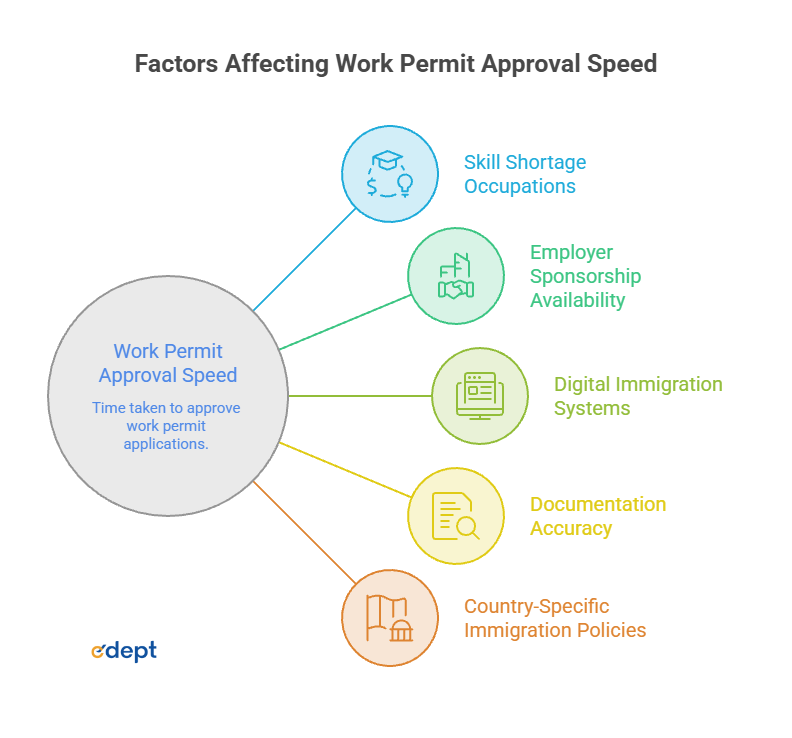
Skill Shortage Occupations
The first thing is whether your occupation falls under a shortage list category or a high-demand job category. If your role appears on that list, whether you are a registered nurse, a cybersecurity engineer, or a cloud architect, your application is often given priority processing.
Employer Sponsorship Availability
Employer sponsorship is another important factor. Most of the fast-track work permit pathways require an employer who is confirmed and who is either registered as a sponsor or licensed to hire international professionals. If an employer is already trusted by the immigration authority, the verification stage is faster, and the applicant benefits directly. Several countries, such as Canada, the UK, Australia, and Singapore, have employer sponsorship frameworks, which significantly accelerate approvals.
Digital Immigration Systems
The countries that have moved their system entirely online, where all the documents are submitted digitally and verification is done electronically. They are consistently faster than those that rely only on paper-based manual systems. Countries such as Singapore, Canada, and the UAE have heavily invested in infrastructure now.
Documentation Accuracy
Documenation quality is another important factor. This depends on us, and it is fully under our control. An application that is clean, complete, accurate, and properly organized will almost always move through the system faster than one that is returned for corrections. A single error such as a mismatched name, a missing certificate, or an unsigned form can reset the processing clock entirely.
Country-Specific Immigration Policies
Each country has its own set of processing priorities, which is based on certain economic needs, market conditions, and bilateral agreements. Policies are not fixed; they change, and what was right in 2024 might not be the same in 2026. You need to stay current with the policy updates.
Countries With Fastest Work Permit Approvals in 2026
For international professionals, the countries offering the fastest work permit approvals in 2026 include the UAE, Singapore, Canada, and Germany. The countries below are among the strongest options for applicants who want faster approvals, active hiring, and clear career pathways. Approval time always depends on the visa type, employer, job category, and completeness of the file. 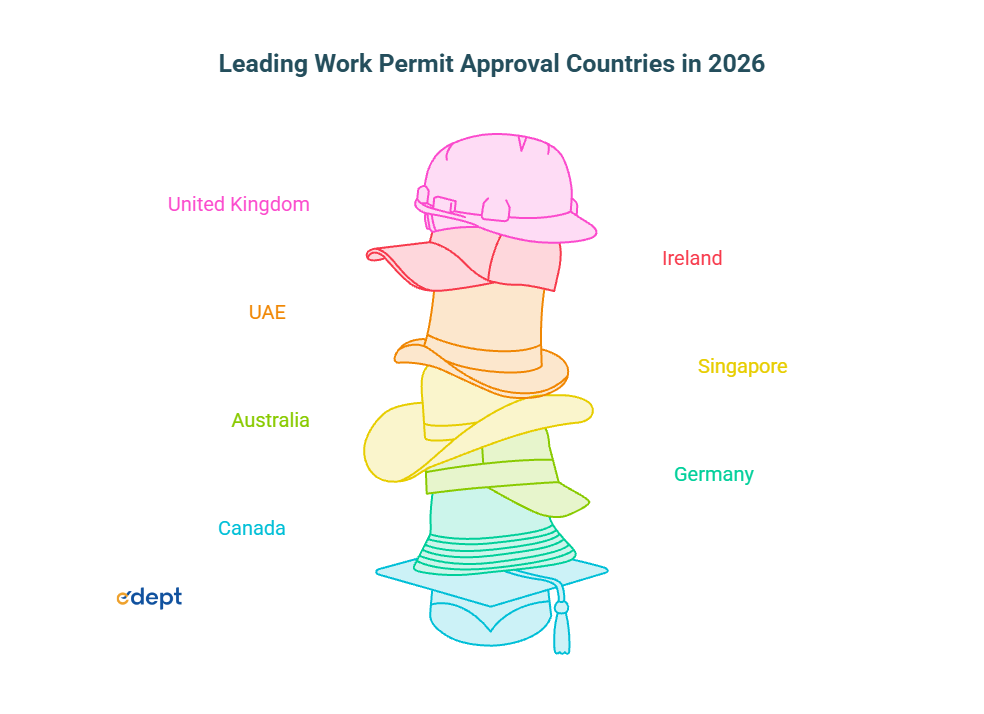
Canada
Canada is famous and the most popular, fastest work-permit country for skilled professionals, especially for applicants in tech and healthcare. The government actively invites skilled workers through a points-based immigration system. The key visa programs include the Express Entry Program, the Global Talent Stream and the Temporary Foreign Worker Program (TFWP). Some of the visa requirements include a valid job offer from a Canadian employer. Proof of qualifications (diploma, degree, or certification); English/French language proficiency (CLB Level 5+ typically required); medical examination; police certificate; and proof of financial stability.
Some of the key industries hiring are information technology, healthcare, construction, engineering, skilled trades, and finance. The PR timeline is usually 8-18 months. The processing time is generally 6-8 months for Express Entry and 2 weeks for the Global Talent Stream.
Advantages:
- Fast PR processing
- PR holders get universal healthcare coverage
- A very strong multicultural environment
- Post-Graduation Work Permit (PGWP) for international graduates, valid for up to 3 years
- Easy pathway to Canadian citizenship
- High salaries & job opportunities
Challenges:
- The cost of living in Toronto and Vancouver is relatively high
- Some smaller provinces offer easier PNP access, but require commitment to living in that region
- The Comprehensive Ranking System (CRS) general pool requires exceedingly high scores (often reaching the 530+ range).
- Fluency in French has become one of the most reliable and highly prioritized pathways.
Germany
Germany has become one of the most attractive and easiest destinations in Europe due to the high demand for skilled workers and its Skilled Immigration Act. Germany introduced the Opportunity Card to allow skilled workers to enter the country and search for employment. Some of the key visa options include the EU Blue Card, Opportunity Card, and Skilled Worker Visa. The PR timeline is 2–4 years of employment in Germany, depending on the visa category and language proficiency. The German Blue Card typically takes 8–12 weeks to process in 2026, with applications submitted from within Germany often processing faster than those submitted from abroad.
The Opportunity Card (Chancenkarte) is a newer, points-based route that allows job seekers to enter Germany and find employment locally. Opportunity card processing times usually range from 4 to 12 weeks, depending on the embassy and application volume. Some of the major industries hiring are healthcare and social assistance, IT & cybersecurity, construction & engineering, education & training, and renewable energy and resources.
Advantages:
- They are transparent point-based systems with clear eligibility benchmarks
- Regional migration options normally lower the range significantly for those willing to move outside major cities
- High quality of life and competitive salaries
- Strong job market and clear PR pathways
Challenges:
- General Skilled Migration (GSM) visas (like Subclass 189 and 190) face severe backlogs.
- There is intense competition for general skilled migration.
- There is a huge reliance on employer sponsorship
- The revised skilled points system heavily penalizes generic degrees and rewards professionals who already have local Australian work experience and English proficiency.
Australia
Australia offers one of the most systematic immigration frameworks for skilled professionals. The Australian Temporary Skill Shortage Visa (Subclass 482) is the primary route for sponsored workers in designated in-demand fields. The Australian SkillSelect programme manages points-based and employer-sponsored PR pathways, which typically take 2 to 3 years of work and residency to achieve. Some of the key visa options include the Skilled Independent Visa (Subclass 189), Skilled Nominated Visa (Subclass 190), Skilled Work Regional Visa (Subclass 491), and Temporary Skill Shortage Visa. The PR timeline is usually 8-18 months. Some of the major industries hiring are healthcare and social assistance, IT & cybersecurity, construction & engineering, education & training, and renewable energy and resources.
Advantages:
- They are transparent point-based systems with clear eligibility benchmarks
- Regional migration options normally lower the range significantly for those willing to move outside major cities
- High quality of life and competitive salaries
- Strong job market and clear PR pathways
Challenges:
- General Skilled Migration (GSM) visas (like Subclass 189 and 190) face severe backlogs.
- There is an intense competition for general skilled migration.
- There is a huge reliance on employer sponsorship
- The revised skilled points system heavily penalizes generic degrees and rewards professionals who already have local Australian work experience and English proficiency.
United Arab Emirates
The UAE operates an employer-driven immigration system that, for standard cases, is relatively fast by global standards. It operates on one of the fastest processing of work visas. It offers fast-tracked work permits under its prestigious Golden Visa programme, the Work Bundle / Green Visa and standard employment visas with minimal processing delays. The UAE work visa processing time in 2026 commonly ranges from about 8 to 32 working days, depending on appointment availability and document accuracy. The PR pathways for long-term Golden Visas (5–10 years) provide significant stability. Some of the major industries hiring are hospitality, construction, healthcare, information technology, finance, retail, and transportation.
Advantages:
- No income tax
- High and attractive salaries
- Faster employer-driven onboarding process
- Multicultural workforce
- Modern infrastructure and job security
Challenges:
- No traditional PR route
- Mandatory sponsorship tied to a specific employer
- The UAE requires a mandatory medical screening covering infectious diseases like HIV and tuberculosis (TB)
- Your academic and official documents must be attested by the UAE Embassy in your home country and the UAE Ministry of Foreign Affairs (MoFA).
Singapore
Singapore has become one of the most digitally efficient immigration systems in the Asia-Pacific region. It provides competitive and attractive salaries along with a great working job environment. It has a very efficient immigration policy. Some of the key visa options include Employment Pass (EP), S Pass, and Tech. Pass. For professionals who are targeting a permanent resident (PR) career in Singapore, the process typically takes 2.5 to 3.5 years. You must first secure an Employment Pass (EP), then work locally for 12–24 months, and finally wait 4 to 6 months for the Immigration & Checkpoints Authority (ICA) to process your PR application. Some of the major industries hiring are IT & communication, financial services & fintech, advanced manufacturing & engineering, healthcare, and logistics & supply chain.
Advantages:
- Global financial hub
- Tax-friendly environment
- High and attractive salaries
- Strong demand for fintech, AI, and data professionals
Challenges:
- Strict visa criteria
- Low PR approval rates
- High cost of living, particularly housing
Ireland
Ireland has established itself as Europe’s technology employment hub, and it has become the European headquarters of companies like Google, Meta, Apple, and Pfizer. The Critical Skills Employment Permit is the fastest and most accessible route for skilled professionals. Critical Skills Employment Permits tend to move quickly, often taking just 4 to 6 weeks, especially if all documents are in order and the permit is given priority status. After 5 years of legal residence in Ireland, professionals can apply for long-term residency. Some of the in-demand sectors are information technology (especially software development), pharmaceutical sciences, engineering, healthcare (nursing, medical specialists), finance, and education.
Advantages:
- Holders of the Critical Skills Employment Permit (CSEP) can transition to a Stamp 4, which allows them to work for any employer without a permit after just 21 months.
- Critical Skills permit holders can bring their family members immediately to Ireland, who may also be eligible to work without needing their own work permits.
- Equal employment protection and opportunities
Challenges:
- A strict labour market needs testing
- The Critical Skills Employment Permit (CSEP) provides a streamlined, fast-track 4-year pathway to residency but is strictly limited to specific high-demand roles
- Certain administrative and systemic backlogs
United Kingdom
The United Kingdom has been one of the world’s most desirable destinations for international professionals. They offer access to global financial services, world-class universities and a great job market. After working in the UK for five years, individuals can apply for permanent residency. Some of the key visa options include the Skilled Worker Visa, Health and Care Worker Visa, High Potential Individual (HPI) Visa, and Global Talent Visa. For professionals looking to build a career in the UK, permanent residency (officially called ‘Indefinite Leave to Remain’ or ‘ILR’) is typically achieved after 5 years of continuous, lawful employment. Some of the major industries hiring are healthcare & life sciences, IT, engineering & infrastructure, business, finance & management.
Advantages:
- Global career exposure
- Competitive salaries
- Pathway to British citizenship
- London is a global career hub; the exposure and experience are unmatched
Challenges:
- The standard qualifying period for Indefinite Leave to Remain (ILR) has been extended from 5 years to 10 years for most sponsored work visas.
- The minimum salary range for the Skilled Worker route is now at £41,700, making it challenging to secure sponsorship for entry to mid-level professional roles.
- English proficiency requirements for Skilled Worker, Scale-up, and High Potential Individual (HPI) visas are very strict.
Countries Offering Fast Work Permits for Tech Professionals
Tech professionals often receive fast work permits because many countries are facing a shortage of skilled tech professionals in digital and technical roles. Singapore, Germany, Canada, Ireland, and the UK are among the strongest options for tech talent. Most employers in these countries value job-ready candidates with proper practical skills and knowledge. They value experience and real industry exposure more than some traditional degrees.
Best for Cybersecurity Jobs
The best countries for cybersecurity professionals with competitive salaries and fast-track work permits include Canada, Germany, Australia, Singapore, and the United Arab Emirates. Canada is the most accessible destination for cyber professionals. The Global Talent Stream (GTS) processes highly skilled IT and cybersecurity work permits in as little as 2 weeks. Germany actively recruits foreign cybersecurity experts under the EU Blue Card scheme, making it one of the easiest entry points to the European Union. Australia has listed cybersecurity specialists on its Skilled Occupation List, actively hiring global talent for major tech hubs such as Sydney, Melbourne, and Canberra. Singapore has been the undisputed cybersecurity and banking hub of Asia, offering fast-tracked passes for skilled tech talent. Finally, the UAE has created a significant government-led cybersecurity market, particularly in Dubai and Abu Dhabi.
Best for Cloud Computing Careers
The best countries for cloud computing careers offering fast-tracked work permits are Canada, Germany, and the United Arab Emirates (UAE). Germany’s shortage occupation list includes cloud architects and DevOps engineers, and EU Blue Card holders in tech are among the most in-demand profiles. In Canada, the Global Talent Stream (GTS) processes highly qualified tech professionals in under 2 weeks. The UAE Golden Visa and fast-track Green Visas are granted to skilled professionals, offering processing times as low as 5 to 30 days.
Best for AI & Data Analytics
For AI and data analytics careers, the top destinations with massive job demand, high salaries, and smooth work permits include Canada, Germany, the UAE, and Singapore. Canada has smooth immigration options, a world-class AI ecosystem, and massive tech talent shortages. Germany is Europe’s leader in industrial AI, offering high job security, strong purchasing power, and a great work-life balance. The UAE has zero personal income tax; it has become a regional AI hub and has a rising corporate data analytics sector. Singapore has a high-paying financial and tech hub with strong government-backed AI initiatives.
Best for Software Engineers
For software engineers seeking fast-tracked work permits, the best destinations include Canada, Germany, Singapore, and Ireland. Canada offers a dedicated Global Talent Stream for high-demand tech professionals, allowing foreign nationals to receive work permits and visa approvals in just 14 days. Germany’s EU Blue Card is highly favourable for software engineers. Singapore has a thriving tech hub with an online Employment Pass processing system. Ireland’s CSEP specifically targets software engineers and provides a rapid path to residency. Australia has a highly digitized processing pathway and is looking for tech talent, specifically through its Global Talent Independent (GTI) programme for top-tier engineers.
Countries Offering Fast Work Permits for Healthcare Professionals
Healthcare workers are often prioritized because many countries are facing shortages in nurses, elder care workers, and allied health roles. This makes healthcare one of the fastest-moving categories in international hiring. The UK, Canada, Germany, Australia, the UAE and New Zealand are some of the countries that offer fast work permits for healthcare professionals.
Nurses
The global healthcare system is having a rising demand for nurses due to technological progress, modern infrastructure, and an ageing population. Countries like Germany, Canada, the UK, and Australia are actively recruiting foreign nurses to address growing healthcare demand and labour shortages.
Elder Care Professionals
The countries offering faster elder care visas include the UK, Canada, Germany, Australia, Ireland and Spain.
Allied Healthcare Workers
The countries offering faster allied healthcare workers include Canada, the UK, Australia, the UAE, and Ireland.
Fastest Work Permit vs Easiest PR: Key Difference
A work permit is an official document that allows an individual to work in a foreign country for a fixed period of time. It is temporary and often valid for a specific period. It is usually linked to a specific employer, a specific job role or for a specific duration. It provides temporary, employer-specific authorization to work in a foreign country. Permanent residency gives you the right to work and live in a country for a long period of time without being tied and dependent on a single employer. It is a direct pathway to permanent citizenship. Here, an individual can settle in the country for an indefinite period of time without needing to renew any right to remain.
You can also read: Work Visa vs PR Pathways: Which Countries Are Easier?
Countries with Fast Approvals but Tough PR
The countries such as the UAE, Portugal, Germany, Singapore and Greece provide fast work permits but take time to transition into permanent residency.
Countries with Balanced Work Visa + PR
The most balanced countries combine a very clear, points-based work visa with straightforward PR pathways. Top destinations for highly skilled professionals, such as those in STEM, healthcare, and IT, include Canada, Australia, Germany, and New Zealand.
Long-Term Settlement Considerations
Before you decide on a destination purely based on processing speed, you should consider whether that specific country’s immigration pathway aligns with your long-term life goals. If you want to build a permanent career and family life in one place, choose a country where the visa system supports long-term settlement. If you prioritize a fast career entry and flexibility, countries like Singapore and the UAE may serve your immediate goals while you keep longer-term options open. If your goal is settlement and citizenship, Canada and Australia will be the best options for you.
Common Reasons for Work Permit Delays
Even if the country has a very efficient immigration system, the application process gets delayed. Below are some of the important reasons for such work permit delays.
Incomplete Documentation
This is the most common and most avoidable cause of delay. A missing certificate, a document not signed, providing the document in the wrong language, or not providing correct police clearances are capable of returning the application to the start of the queue. You should check all the document checklists before finalising the documents.
Employer Verification Delays
In some countries with sponsor licence frameworks such as Canada, the UK, and Australia, the employer must be registered and in a good position before your application proceeds. If there is any issue with the employer’s licence, your application will be delayed regardless of how strong your personal profile is.
Security Checks
The applicants from certain countries, or those who have lived in multiple countries, may be subject to additional security or background checks. These checks are non-negotiable in nature and add variable amounts of time to the process. They cannot be removed, but they can be predicted. Knowing that you may face additional scrutiny allows you to apply earlier.
Incorrect Visa Category Selection
Applying under the wrong category is a costly mistake. If you are in a shortage occupation but apply under a general stream, you miss out on priority processing. If your employer is eligible for an employer-of-record arrangement but applies under a standard sponsorship route, the same principle applies. Taking professional immigration advice before submitting can save months of delay.
Skills That Improve International Hiring Chances
To drastically improve your chances of getting hired internationally, you need to combine highly transferable hard skills and adaptable human (soft) skills. The strength of your application for any international work permit is directly connected to the skills you bring to the table. In 2026, the following profiles are most in demand globally. 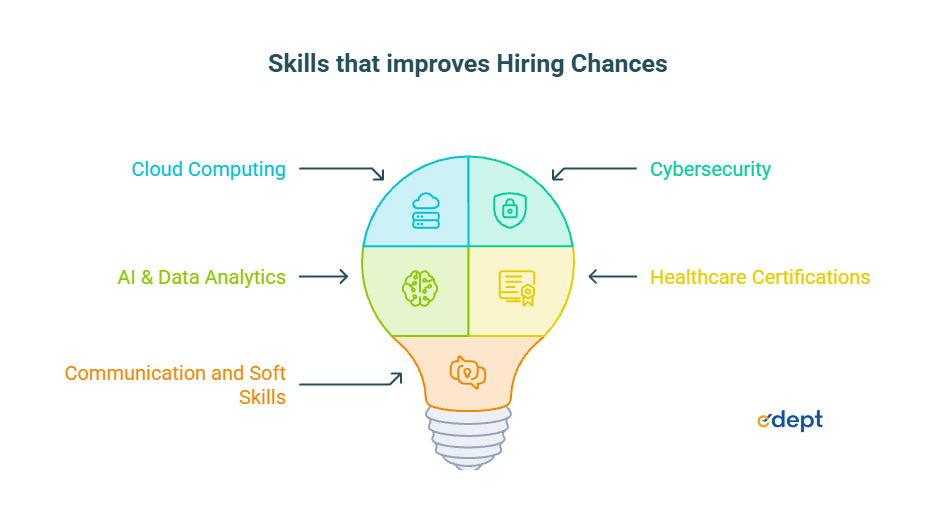
Cloud Computing
AWS, Azure, and Google Cloud certifications are well recognized globally across all seven countries mentioned in this blog. Certain job roles such as cloud architects, cloud engineers, and DevOps professionals appear on shortage occupation lists in Germany, Canada, Ireland, and Australia. These certifications highlight and improve both hiring and visa sponsorships.
Cybersecurity
Candidates with various certifications such as CISSP, CEH, or CompTIA Security+ are among the highly demanded professionals. Protecting various digital assets is a rapidly growing necessity in every global industry. Governments and enterprises alike are expanding their cybersecurity headcount, and immigration authorities in the UK, Canada, and Germany have responded by ensuring these roles qualify for fast-track processing.
AI & Data Analytics
Data scientists, machine learning engineers, and AI researchers are in high demand across all major economies. Proficiency in Python, TensorFlow, data analysis, data visualization, generative AI and SQL combined with real-world project experience significantly improves both employability and the strength of employer sponsorship applications.
Healthcare Certifications
Internationally recognized nursing and allied health qualifications, with credential verification from the relevant regulatory body in the destination country, are important for most healthcare work permits. NCLEX for nurses, PLAB for UK doctors, and recognition of prior learning for allied health workers can cut months off your licensing timeline.
Communication and Soft Skills
While English serves as the international business standard, fluency in secondary regional languages (like Spanish, German, or Arabic) provides a massive competitive advantage. In English-speaking destinations like Canada, the UK, Australia, and Ireland, language proficiency tests (IELTS, OET, and PTE) are a hard requirement. Not only language, employers across these markets value cross-cultural communication, teamwork, and adaptability as key hiring factors for international candidates.
How Skill-Based Education Improves Global Mobility
Skill-based education is becoming more important because employers want candidates who can contribute from day one. Practical learning, certifications, and project experience help build trust with international employers. For an international career path, a degree alone is not enough. One of the most common patterns in international hiring is that employers are looking for applied and practical skills and demonstrations, not just your academic degree. A candidate who holds a relevant degree and can show hands-on experience through projects, certifications, and real-world tools is significantly more attractive than one who holds a degree alone.
This shift gradually affects your global mobility because your visa sponsorships depend on this. Various industry-recognised certifications, such as AWS, Azure, Google Cloud, CompTIA Security+, CISSP, PMP, CFA, and data science, help you in directly mapping your roles to the most skilled occupational lists. International graduates who combine their degree with these certifications consistently have better employer responsiveness and faster job offer timelines. Capstone projects, internships, freelance work, and your GitHub portfolio are all important for landing your first international job. Practical, industry-aligned skills education is not just good for your career. For your global career path, it is one of the most strategic investments you can make.
Why Choose Edept for Global Career Preparation
For students and professionals preparing for an international career, the quality of your skill preparation makes a direct difference in how quickly you move from aspiration to employment abroad.
Industry-Aligned Programs
edept’s programmes are designed around actual market demand, not theoretical curriculum. Courses are built in consultation with industry professionals and updated to reflect what employers in Canada, Australia, Germany, and the UK are actively hiring for.
International Career-Oriented Learning
edept prepares students not just with technical skills but also with the professional context that international employers expect. This includes understanding how global workplaces function, how to present skills and experience on an internationally competitive resume, and how to approach job applications in target markets.
Skill Development for Global Roles
From cloud computing and cybersecurity to AI, data analytics, and engineering support, edept’s programs target the exact skill domains that appear on shortage occupation lists across the UK Canada, Australia, and Germany. This alignment is intentional and directly improves visa sponsorship prospects.
Career Guidance and Placement Support
edept provides dedicated support for students navigating the career aspects of international migration, from resume preparation and interview coaching to job-search strategies for specific markets. The goal is not just skill development in isolation but also a clear bridge from learning to landing an international role.
Preparation for Global Opportunities
Whether you are a student exploring a first international career move or a working professional looking to transition to a higher-demand occupation, edept’s programmes are structured to improve both your employability and your immigration outcomes. A stronger professional profile means stronger employer interest, and stronger employer interest means faster sponsorship, which means faster work permit approvals.
Step-by-Step Guide to Applying for International Work Permits
To build an international career, you need well-defined planning and strategy. 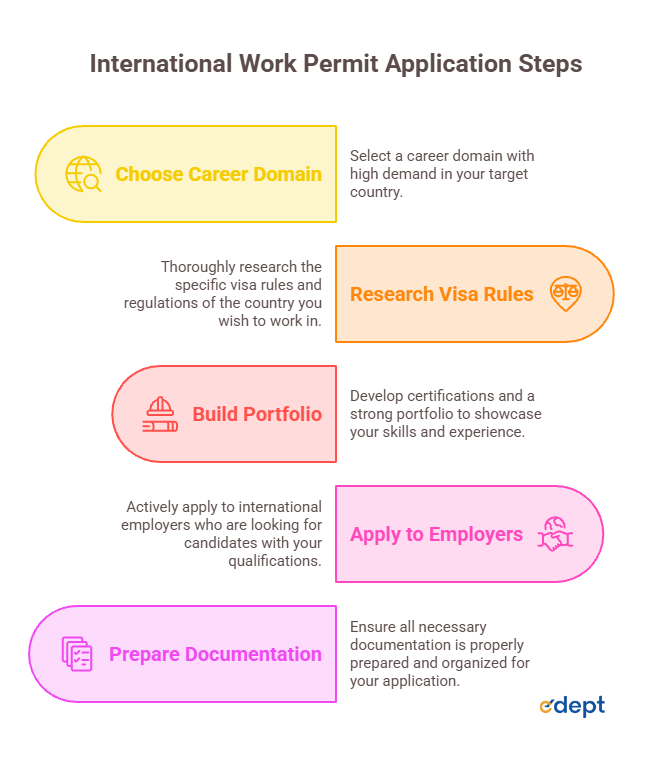
Choose a High-Demand Career Domain
You should start by researching which careers are in huge demand with skill shortages in your target countries. Various domains such as healthcare, cybersecurity, cloud computing, engineering, and AI are in huge demand across major destinations. You should choose a domain with genuine and high market demand, along with various job opportunities.
Research Country-Specific Visa Rules
Each country has its own eligibility criteria, salary limits, documentation requirements, and employer registration systems. Some of the examples are that Germany’s Blue Card requires a recognized degree and a qualifying salary. Canada’s GTS requires an employer referral or an occupation listed on the Global Talent Occupations List. Singapore’s EP requires an employer application, not a self-application.
Build Certifications and Portfolio
Along with your degree, you should start gaining hands-on practical experience, work on capstone projects, use GitHub and Kaggle and build a strong portfolio. Employers across global markets are looking for candidates who can demonstrate real capability, not just academic degrees. Build projects, practice with real tools, and document your work. Earn recognized industry certifications in your domain. AWS certification for cloud, CompTIA Security+ or CISSP for cybersecurity, and Google Professional certificates for data. These certifications increase your credibility
Apply to International Employers
You should start targeting employers who are registered sponsors or have hired international candidates before. In the UK, you should check the Home Office publisher’s register of licensed sponsors. In Canada, job boards targeting GTS-eligible roles are a useful starting point. In Ireland, tech sector employers in Dublin regularly post roles specifically open to critical skills permit holders.
Prepare Documentation Properly
Once you have a job offer, the next step is to start preparing for documentation. This typically includes academic certificates with official translations where required, employment history records, reference letters, police clearance certificates, health checks, and proof of finances. Starting this process early, before you even have an offer in hand, helps in reducing the total timeline significantly.
Future Immigration Trends Beyond 2026
Beyond 2026, global talent competition is likely to increase further. Countries will continue using faster digital systems and skill-based immigration pathways to attract the workers they need.
Increasing Global Talent Competition
The competition for skilled professionals, particularly in technology, healthcare, and engineering, will dramatically increase over the coming years. Countries are already adjusting their immigration frameworks, rules and policies to attract and retain talent, and the gap between nations with modern digital systems and those still relying on paper-based processes will grow wider.
Faster Digital Visa Processing Systems
Paper-based applications are disappearing; AI-assisted application review, biometric pre-clearance, and real-time document verification are all being introduced in 2026. Australia’s new automated visa system, Canada’s IRCC digital updates, and the UAE’s expanding e-government services are early signs of what will become standard practice, which will be followed across most major immigration systems.
More Skill-Based Immigration Pathways
Countries are progressively moving away from entirely employer-dependent immigration and toward independent skilled migrant programmes that give qualified professionals more opportunities to grow. This reflects a global policy shift among developed nations toward targeted, highly specialized immigration to deal with global talent shortages. Germany’s Opportunity Card, Canada’s Express Entry, and Australia’s regional migration options all reflect this trend. Points-based systems that use occupation, certification, language proficiency, age, and professional experience are already mature in Canada and Australia and are being adopted or adapted in Germany, Ireland, and the UK. The international candidates should start investing in skills before they make their immigration move.
Conclusion
The world’s fastest work permit countries have one thing in common: they have deliberately started simplifying their immigration systems to attract skilled professionals in sectors facing genuine labour shortages. In 2026, the global landscape for work visas and PR pathways will offer real opportunities for skilled professionals, but the outcomes depend on where you want to go and how well you are prepared to achieve that career goal. Every country has its own policies, visa pathways and regulations. Canada, Germany, Singapore, Ireland, the UK, Australia, and the UAE all offer structured pathways for international candidates, and in several cases, processing times have dropped to weeks rather than months for qualified applicants.
Choosing the right destination requires more than just comparing processing timelines. It means you have to understand the PR landscape, the cost of living, the strength of the job market in your field, and the practical realities of relocation. Countries are now looking for skilled professionals; employers are looking for candidates with job-ready skills, industry-relevant experience and problem-solving capacity. The best choice depends on your field, your qualifications, and your long-term goals. With the right preparation and the right learning partner like edept, you can have a very smooth and fast global career move .