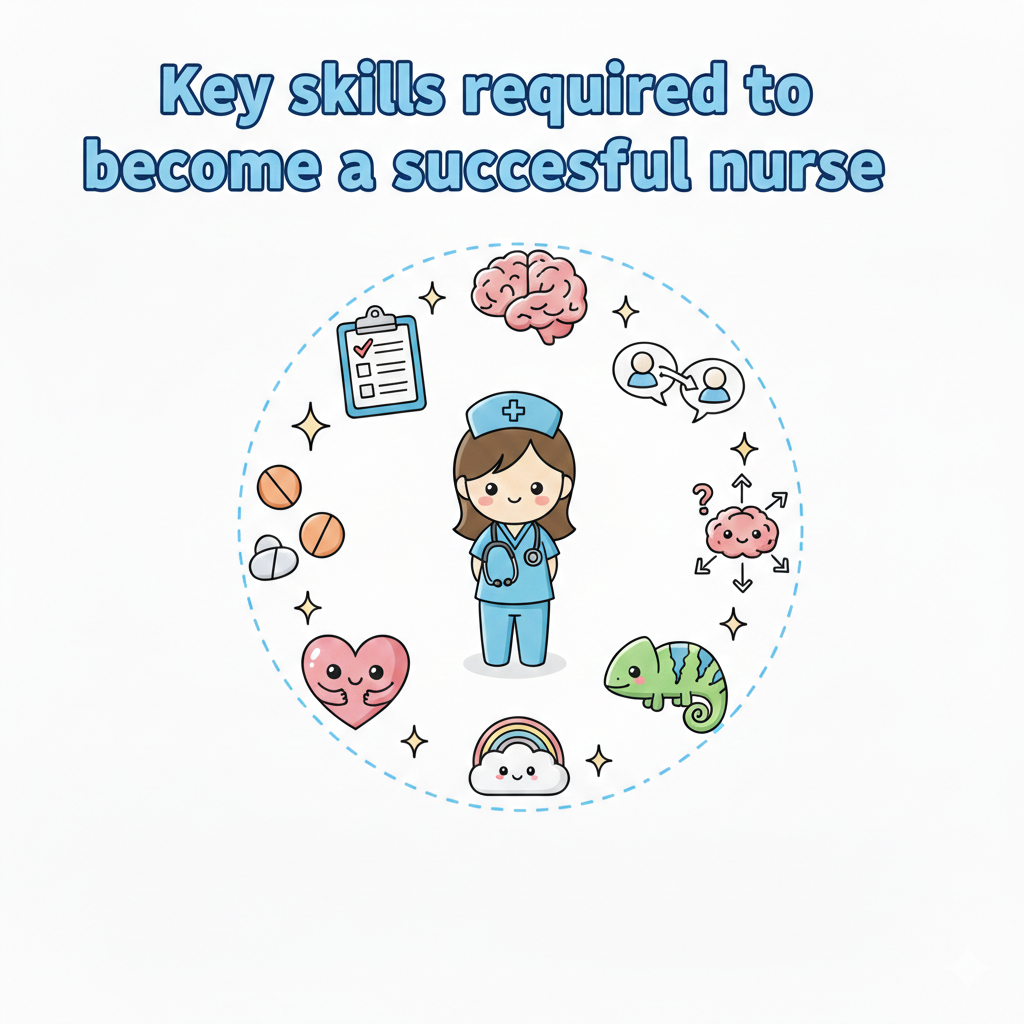
Nursing now is one of the most skill-oriented professions in healthcare, requiring a balance of knowledge, precision, and compassion. The key skills required to become a successful nurse are more than just academic qualifications. Each day, nurses depend on a combined clinical expertise, emotional intelligence, communication, and the quick decision-making process to deliver safe and effective care for patients. In a rapidly evolving medical environment, a nurse requires both technical and soft skills. While clinical nursing skills ensure treatment accuracy, with soft skills, nurses build trust, patient support, and gain knowledge on how to manage stress. As a healthcare system is dynamic, mastering the required nursing skills is important not only for patients but also for successful outcomes. This builds career growth.
Why skills matter in the nursing profession
Skills are the start of nursing practice. Essential nursing skills directly affect patient security by lessening mistakes and by making sure if accuracy in treatment. Moreover, essential nursing skills help you with specialization, leadership roles, and the environment of your career. In short, we can say that soft skills are more inclined to define professional credibility and patient trust.
Clinical and technical nursing skills
The core of daily nursing responsibilities is all about clinical nursing skills. These skills ensure the patient’s safety, timelines, and provide accurate care.
| Skills | Usage |
| Patient assessment | Taking vitals, health history, and doing physical examinations. |
| Medication | Understanding dosages, side effects, and potential allergies. |
| Use of medical tools | Knowledge of IV pumps and having technical confidence. |
| Infection control | Maintaining hygiene, sterilization, dressing, wound care, and bowel care. |
| Documentation | Accurate records for legal security. |
Communication skills
Communicating effectively is one of the most important elements in nursing career skills. Nurses come across various interactions daily, such as talking to the family, patient, or doctors. Patient interaction requires giving a clear explanation so there is no tension for both the patient and the nurse. Then comes team coordination, where you have to inform accurately to avoid mistakes. Clear reporting through real-time updates is necessary for critical medical decisions. Last but not least, listen to the patient’s concern actively, as this improves care quality. With these communication skills, a nurse can be successful in building trust and teamwork in a professional environment.
Critical thinking and decision making
It is common for nurses to come across daily unexpected situations where judgment needs to be given fast. So in this case, assessment of the situation has to be quick, and the nurse should be able to give an emergency response. It is also necessary to identify issues and solve problems effectively. While managing multiple patients, a nurse should also be able to understand which patient needs more prioritization.
Emotional intelligence and empathy
A key soft skill for nurses is emotional intelligence. It also helps in supporting patients and managing personal stress. A skill in emotional intelligence helps to build a patient’s trust with comfort and confidence. If emotions are controlled, it prevents burnout. A nurse should be compassionate enough to understand a patient’s emotional needs. Emotional intelligence makes human connections stronger and helps with good-quality healthcare.
Time management and organizational skills
Nursing shifts are time-sensitive and very demanding as shifts change. By planning tasks, you can work smoothly without errors. Then there’s multitasking, as you have to handle various tasks at the same time without any mistakes. There should be a work-life balance as well. Since it reduces fatigue for an organization and improves performance. Time management helps in long-term career growth.
Leadership and teamwork
Leadership doesn’t always mean it has to be related to a senior position. Any nurse can show leadership through their actions. Collaboration and teamwork help improve the outcomes. Even while handling conflicts, nurses should be calm and maintain unity. As a nurse, always share knowledge with your juniors to maintain a better healthcare system. We can say that leadership significantly contributes to a nursing career.
Adaptability and continuous learning
Healthcare is a dynamic profession where there is rapid growth in changes. It makes adaptability necessary. Like any new technological adoption, you gain the knowledge on how to use it and work with it so there are no errors with patient care. Then there are medical protocols that constantly keep updating, so to keep up with that continuous education is important. Adaptability helps nurses stay relevant in the modern healthcare system.
| Nursing skill | Facts |
| Clinical nursing skill | Nurses are responsible for 50% of the global healthcare workforce and provide care for patients. |
| Communication skill | Poor communication is related to over 60% of medical errors that could be prevented. |
| Critical thinking | Nurses have to make hundreds of clinical decisions per day, according to what research shows. |
| Emotional intelligence | This provides chances of lower bunouts and higher professional satisfaction. |
| Time management | It can be 4-8 patients per shift for a nurse, and it even depends. |
| Leadership roles | It creates better patient outcomes. |
| adaptability | Medications or treatments get updated multiple times per year. |
| Continuous learning | Having an ongoing education process is necessary to stay updated with new technologies and medications. |
Final Call on Top Nursing Skills 2026
The key skills required to become a successful nurse help build professional expertise and patient trust. It can be clinical nursing skills or soft nursing skills. Every ability plays an important role in conducting secure, compassionate, yet effective care. Emotional intelligence, communication, critical thinking, leadership, and adaptability all together define nursing skills. Nursing means providing the patient with care while handling multiple tasks effectively to prevent errors. Even when there is an emergency or a shortage of medications. A nurse always knows how to distribute them among patients so there’s no risk for the patient. Nursing is not only about professionalism but also about providing service, dedication, and working with skills so that a patient feels safe around a nurse.