In the management sphere, an MBA continues to be one of the most sought-after postgraduate qualifications for professionals looking to upgrade their career in management, leadership, and marketing. There are many entrance exams that students opt for in India, like CAT, XAT, MAT, and CMAT, to secure admissions in top business schools. While there are also options to secure MBA admission without an entrance exam in top universities, which sounds too good to be true, a good number of students opt for the same. This trend has made post-graduation in management more accessible for all kinds of students who may not be able to appear for entrance exams, either due to time constraints or monetary issues, and want to start their MBA journey faster. Though going for an MBA without CAT or other entrance exams does sound very appealing, everything boils down to one thing: how can it provide the same or better benefits than pursuing the traditional MBA pathway through entrance exams, both in career aspects and return on investment? In this guide, we will cover every aspect you need to know as a student regarding MBA admission without entrance exam programs. You will get to know its advantages, disadvantages, career prospects, costs, and placements with long-term outcomes so you can make the right decision.
What is MBA Admission Without an Entrance Exam?
Unlike traditional MBA Programs with entrance exams, MBA admission without an entrance exam is referred to as the process of enrolling in an MBA program without actually appearing for competitive tests like CAT, XAT, CMAT, or SNAP. Candidates can actually opt for direct admissions, considering the business schools are open for so with their own internal selection, instead of waiting and preparing for entrance exams for months, maybe even a year.
Direct Admission Explained
Direct MBA admission is carried out in universities either using merit-based selection or some institution-level admission processes. They don’t need any national-level entrance exam results for you to secure your seats. They usually assess your academic background, overall profile, and suitability for management studies before granting admission.
Types of Colleges Offering It
Most MBAs without CAT admissions are run by private and deemed-to-be universities, autonomous institutions, and a few state-owned private colleges. These places have their own ways of admitting students, often including their own screening methods.
Admission Criteria Used Instead
Instead of relying on entrance exams, business schools consider other factors when deciding which candidates are suitable for their MBA programs. They usually check your graduate grades, overall academic record, and results from personal interviews. Some colleges also consider your statement of purpose and any relevant work experience you might have. Just keep in mind that eligibility criteria can differ between schools and across program types.
Why Do Colleges Offer MBA Without Entrance Exams?
The rise in management education’s popularity has led many schools to admit MBA students without entrance exams. This lets colleges draw in more candidates and make business training easier to get for those looking to boost their careers.
Increasing Demand for MBA Seats
More graduates wanting management degrees to jumpstart their careers means a higher demand for MBA seats in business schools and deemed universities. To handle this, many institutions provide other options besides relying solely on entrance exam test scores.
Flexibility in Private Institutions
Private universities and deemed institutions usually have more flexibility in setting up their admissions. Instead of just using CAT, MAT, or XAT scores, they look at a student’s academic grades, interview performances, aptitude tests, and overall profile.
Focus on Accessibility
Not all students can take those big entrance exams. So, direct MBA admission paths help fresh grads, working professionals, and professionals changing careers get into management programs if they meet the criteria, but want another way in MBA programs besides the traditional entrance exam gateway.
Also read: How to Get Admission in MBA 2026–27
Advantages of an MBA Without an Entrance Exam
MBA admission without entrance exams feels too good to be true for many students. While it may not be suitable for everyone, it does offer several benefits of its own for candidates who want to avoid lengthy entrance exam schedules and immediately want to purse MBA after graduation.
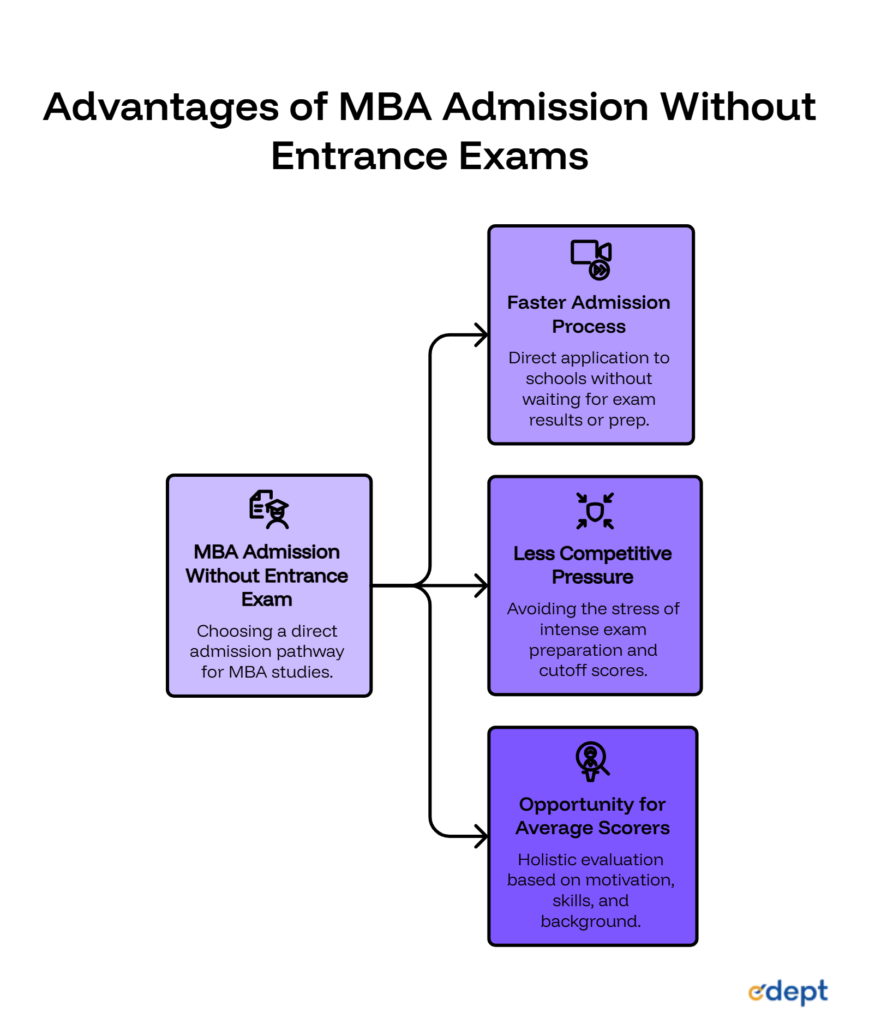
Faster Admission Process
One huge advantage of MBA admissions without an entrance exam is how much faster the overall process proceeds in comparison to traditional MBA programs. Students can apply straight up to the schools that fit them and start their programs right away, no months of prep for entrance exams like CAT, XAT, or MAT needed. This cuts down on all that waiting around for exam results and lets candidates jump into their studies quicker.
Less Competitive Pressure
Entrance exams are highly competitive, with thousands of candidates competing for limited seats in top institutions. If students go for direct admission, they skip that whole stressful process of preparing for intense exam preparation, possibly retaking them, and dealing with changing cutoff scores. This way, the path to getting admitted is way easier and less stressful.
Opportunity for Average Scorers
Not everyone performs well in standardized entrance tests, even when they’ve got solid grades or real career potential. MBA admission without an entrance exam creates opportunities for candidates who may not achieve competitive exam scores but possess the motivation, communication skills, and commitment needed to succeed in management careers. Schools take a holistic look at those applicants through interviews and examining their whole academic background, rather than being fixated on one test score.
Disadvantages You Must Consider
Going for an MBA without entrance exams is easy and convenient, but you should think about the downsides too. An MBA’s worth comes from the degree, school reputation, job placement help, and how the biz world sees the college.
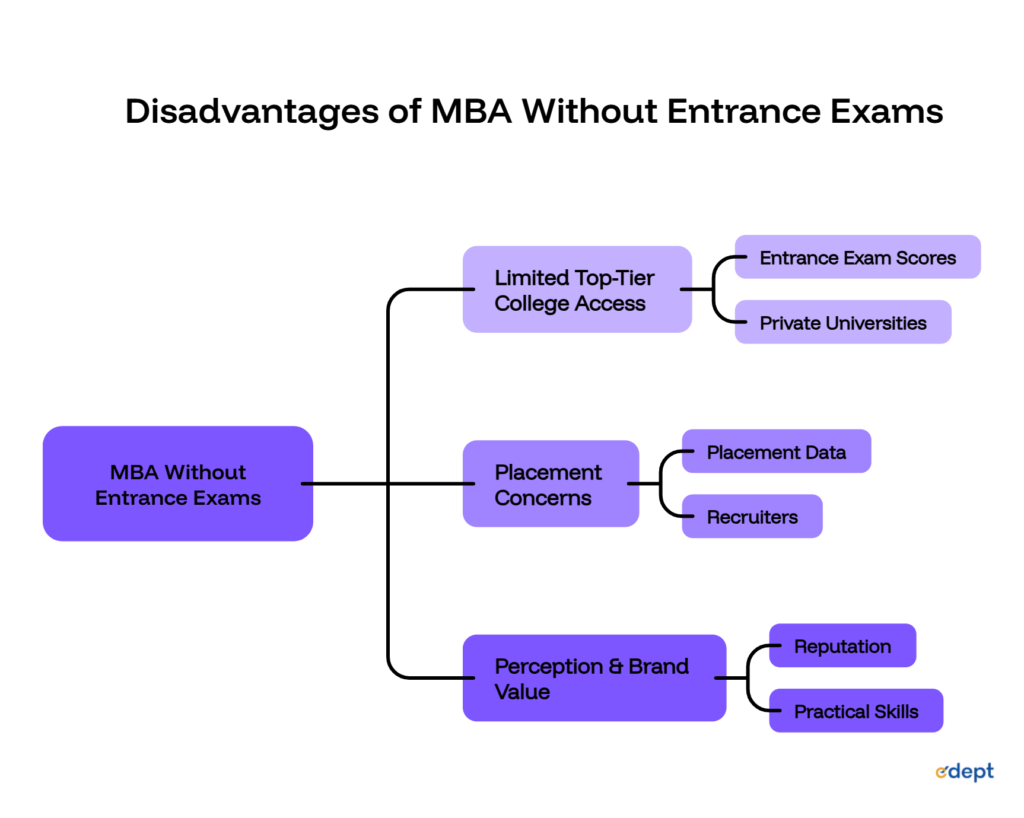
Limited Top-Tier College Access
Big-name biz schools, like IIMs and other top picks, usually need entrance exam scores. So, if you skip the tests, you might not get into those highly ranked places. Many private universities do have good programs, yet it’s crucial to look at their creds, where they rank, their teachers, and how well students get exposed to real-world biz before signing up..
Placement Concerns
Placement outcomes differ a lot depending on which college gives direct MBA admission. Some schools have solid links with big companies, leading to better placements, but others don’t offer that much help finding jobs. Prospective students really need to check out placement data, the list of recruiters, internships, and pay scales to figure out what they might expect in terms of returns on their investment.
Perception & Brand Value
The school’s reputation does matter when it comes to hiring, especially for some sectors and firms. They might favour candidates who graduated from top-ranked programs with tougher entry criteria. Yet, eventually, how well you perform depends more on your practical skills, work experience, and overall professionalism, not just the type of MBA program you went through. It’s way more about choosing a reputable college than rushing into one because you avoided a CAT or similar exam.
Cost vs ROI Analysis
When you talk about MBA admission without an entrance exam, it is very important to check whether the program has the potential for good returns on investment (ROI). Having an easier admission criterion does not directly mean the program will have guaranteed placements. Students should compare basic amenities like tuition fees, placement outcomes, industry exposure, and long-term earning potential before making any decision.
Fee Structure
Unlike traditional MBA programs, universities that follow MBA admission without an entrance exam may charge higher tuition fees in comparison to government-funded institutions. In addition to tuition fees, students also have to bear hostel fees, study material expenses, and certifications. Keeping in mind, the international exposure programs should also be considered when calculating the total investment.
Placement Outcomes
Placement outcomes are a big deal when it comes to an MBA’s worth. Based on what Indian business schools report, new grads can expect salaries ranging from ₹4 to 12 LPA, but that varies based on their school, major, and job sector. For a good sense of a program’s clout, candidates should look into the average pay, the kinds of companies that recruit there, internships offered, and overall placement rates—not just which schools are easiest to get into.
Return on Investment
When thinking about doing an MBA, the return on investment is key. If a program lines up solid placements, brings industry contacts, and focuses on real-world experience, the time it takes for you to see a profit can be quicker, even if it costs more upfront during the admissions process. So, before enrolling in an MBA program that doesn’t require an entrance exam, compare the program’s costs against expected salary growth and long-term career opportunities.
Career Scope After MBA Without an Entrance Exam
Students often ask if getting into an MBA program without an entrance exam can still lead to good career opportunities. It mainly depends on how good the school is, what skills you pick up in the program, and how well you can use management ideas in the real world. Nowadays, companies care a lot about practical skills, leadership potential, and business smarts, not just grades.
Job Roles Available
Without an entrance exam, grads can still land jobs in many areas. Typical roles after an MBA without entrance exams are Marketing Executive, HR Executive, Financial Analyst, Ops Executive, Biz Dev Associate, Sales Manager, and Management Trainee. These roles are commonly seen in banking, consulting, retail, health care, manufacturing, tech, and e-commerce.
Salary Expectations
The salary after completing an MBA without an entrance exam differs from one school to another, specializations and service. The salary for Entry-Level positions ranges from ₹4 to ₹8 LPA, but that of graduates from well-known institutions may be higher because of their institution’s support. Experience and special skills can also help to increase wages in the long term.
Growth Opportunities
Long-term career success depends on your skill set, performance during the set of course, and the extra training you gain along the way. As you gather experience, you will get a chance to lead teams, departments, or even become a manager. Go for industry certifications because they usually count more than how you got into college in the first place.
Also read: Differences Between Online MBA, Distance MBA, and Regular MBA
Key Factors to Evaluate Before Choosing
Before opting for MBA admission without an entrance exam, it is important to evaluate the institution beyond its admission process. The quality of education, placement outcomes, industry exposure, and overall reputation of the college will have a much greater impact on your career than the admission route itself. Conducting thorough research can help you make a more informed decision and maximize your return on investment.
College Accreditation & Ranking
When thinking about MBA admissions without an entrance exam, check whether the institution is approved by recognized regulatory bodies such as UGC or AICTE. Their seal of approval means the program hits good academic standards. Also, look at rankings, the industry’s take on the program, how skilled the faculty are, and what alumni have achieved.
Placement Records
Placements matter a whole lot. It’s wise to dig into placement stats like percentages, salary averages, main recruiting firms, internships, and where past students end up. Since schools might spin things their way, focus on clear facts and figures.
Industry Exposure & Internships
In real life, the opportunities to get a better job increase significantly after your MBA. So, look for a program with internships, hands-on projects, firm visits, mentorship programs, and networking opportunities. Loads of industry interaction can give you practical skills, and companies often love that in candidates.
Who Should Consider MBA Without Entrance Exam?
While MBA admission without an entrance exam may not be the ideal choice for every student, it can be a suitable option for candidates with specific career goals and circumstances. The key is to evaluate whether the institution, curriculum, and career outcomes align with your professional aspirations rather than focusing solely on the admission route.
Students with Time Constraints
Students who can’t commit several months to prep for exams like CAT, XAT, or MAT might prefer MBAs that don’t need entrance tests. This lets them start their management studies earlier and avoid holding up their academic or career plans.
Working Professionals
A lot of working pros choose these no-exam MBA paths because they’re flexible and quick ways to get management training. It lets folks keep building their leadership, managerial, and biz skills without putting their jobs on pause for test prep.
Students Focused on Skills Over Brand
Some students care more about hands-on learning, real-world exposure, and career advancement than getting into super competitive schools. For them, skipping the entrance exam leads to more immediate educational and internship opportunities. Still, picking a reputable college with solid job placement and industry links is key here, too.
Alternatives to Consider
Before you opt for MBA admission without an entrance exam, it is always suggested to explore other pathways that may offer better career advantages. Keep your academic background, career goals, and available time, as alternative options can provide access to reputed institutions and stronger industry recognition.
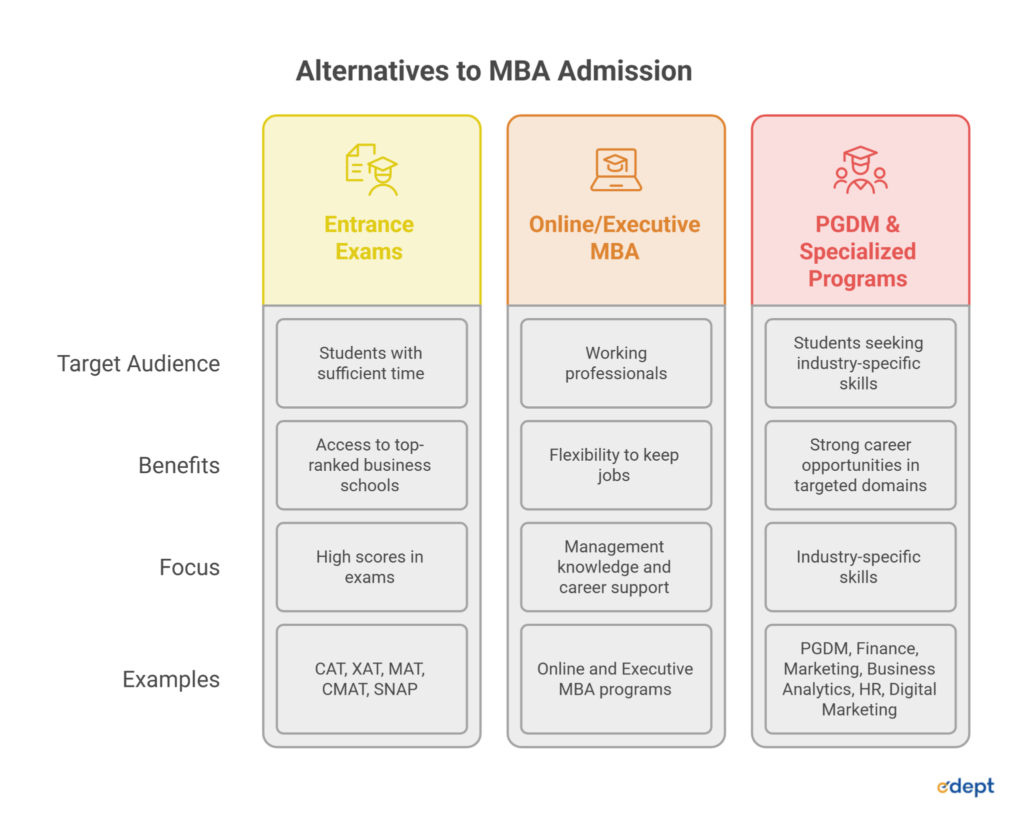
Preparing for Entrance Exams
If you have sufficient time, preparing for exams such as CAT, XAT, MAT, CMAT, or SNAP can expand your options for admission into top-ranked business schools. Scoring good marks in either of these exams, you might land admissions to those highly ranked business schools with fantastic alumni networks and amazing placement offers.
Online/Executive MBA Programs
More and more folks who are already in the workforce are signing up for Online and Executive MBA programs. These give students the freedom to keep their jobs while they gain valuable management knowledge. Lots of respected colleges now offer MBAs online, complete with career support and up-to-date coursework that really helps in the real world.
PGDM & Specialized Programs
Besides applying to traditional MBA programs, you could look into PGDM programs or specializations like Finance, Marketing, Business Analytics, HR, and Digital Marketing. These programs often focus on industry-specific skills and can provide strong career opportunities in targeted domains.
Conclusion
There is no one-size-fits-all answer to whether MBA admission without an entrance exam is worth it. What works best varies based on your career goals, how you learn best, your budget, and the school you consider. Some students appreciate the quicker route that direct admission provides, while others see value in getting ready for entrance exams as a way to join top business school MBA programs. That said, what’s more important is the program’s overall quality for your long-term career growth. Think about accreditation, teacher experience, industry involvement, internship options, job placement help, and how successful past graduates have been. These factors tend to affect long-term career growth more than the type of admission process. When choosing an MBA program, spend time comparing different colleges. Look at job placement rates, evaluate the return on investment, and check out industry recognition. A well-informed decision today can help you build a stronger and more rewarding management career in the future.
Related Links:
| Get direct admission in MBA | Top Colleges Offering MBA in Business Analytics |
| Everything about Online MBA | Everything about MBA Business Analytics Program |