Most people researching a data analytics career abroad focus on the salary number. Fewer think about what actually stays in their pocket after tax, or how far that money goes where they are living. This data analyst salary comparison across the USA, Canada, and Germany cuts through the noise and gets to what actually matters for your career decision in 2026.
Picking the right country for a data analytics career is one of those decisions that feels straightforward until you actually sit down and run the numbers. The salary gap between these three markets is real, and in some cases it is dramatic. What is less obvious is how much of that gap disappears once you factor in taxes, housing, and the cost of everyday life in each location.
The demand side of the picture is worth understanding first. AI and machine learning skills now carry a 28% salary premium of nearly $18,000 more per year in the US compared to general analytics roles, according to Lightcast’s Beyond the Buzz report from July 2025. That premium exists because demand has outrun supply in a very specific way. The USA accounts for over 30% of global analytics roles. This proves more than 1 million openings projected by 2030. Germany is sitting on over 300,000 unfilled data vacancies. Canada has passed 200,000 openings across tech, banking, and public sector analytics. All three markets are genuinely short of qualified people, which is what keeps salaries competitive across the board.
So what does data analyst salary USA vs Canada vs Germany actually look like in 2026, broken down by experience level, take-home pay, and cost of living? Simply put, the US offers the highest absolute numbers, Canada offers the clearest immigration pathway, and Germany offers a quality of work-life balance that neither of the other two can match.
This blog gives you the full data analyst salary comparison with tax-adjusted figures, cost of living context, and a clear decision framework for choosing the right destination based on what you actually care about most.
Why Data Analyst Salaries Differ Across Countries
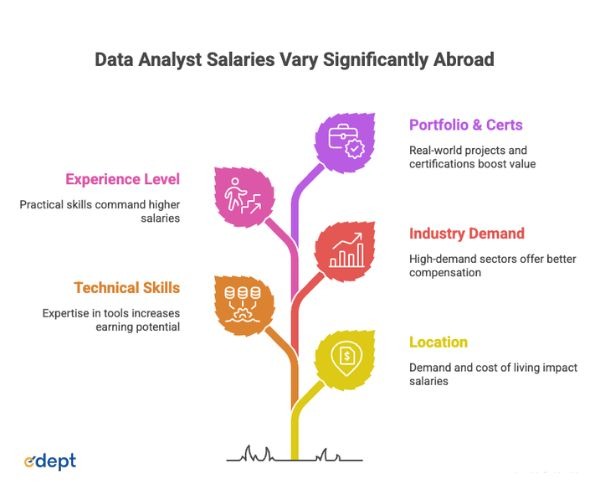
Salary numbers alone do not tell the full story. The reasons behind the differences between the data analyst salary USA vs Canada vs Germany comparison matter as much as the figures themselves, because they shape what you actually keep and how long the numbers last.
Demand vs Talent Gap
Where demand for analytics skills outpaces the available talent pool, salaries climb. The US technology sector, which is based in cities such as San Francisco, Seattle, and New York, has always been characterised by an insufficient number of skilled analysts compared to the job opportunities offered. The move towards digital transformation within the German automotive, manufacturing, and financial services sectors has resulted in a high demand for analytics jobs that cannot be filled by the country’s current workforce pool. All three markets are in genuine shortage, which is why the analytics jobs abroad salary picture is strong across the board in 2026.
Cost of Living Adjustments
A salary of $100,000 in San Francisco and a salary of $100,000 in Austin represent completely different financial realities. The same logic applies internationally. German salaries expressed in euros translate to figures that look lower than US equivalents in USD, but the cost of housing, healthcare, and daily living in cities like Berlin or Munich is considerably lower than comparable tech hubs in America. Any honest data analyst salary comparison has to account for purchasing power, not just the number on an offer letter.
Tax Structures
Tax structures vary dramatically between the three countries. It can directly affect take-home pay. The US applies federal income tax with additional state taxes. It varies from zero to over 13% depending on location. Canada has a federal and provincial structure with higher overall rates but correspondingly broader social benefits. Germany’s progressive taxation is among the highest in the developed world, but universal healthcare, generous social insurance, and lower out-of-pocket costs for services that American and Canadian workers pay for directly need to be factored into any realistic analytics jobs abroad salary comparison.
Data Analyst Salary in United States
The US remains the benchmark that every other data analytics market gets measured against. The scale of the tech industry, the concentration of high-paying employers, and the premium on specialised skills all combine to produce salary figures that no other country in this comparison consistently matches.
Entry-Level Salary
Entry-level data analysts in the USA typically earn between $65,000 and $80,000 per year. At top companies in tech hubs like San Francisco and Seattle, starting salaries can reach $90,000 to $100,000. Monthly, that translates to roughly $5,400 to $6,700 before tax at the lower end, and $7,500 to $8,300 at premium employers.
Mid-Level Salary
In Seattle, the median salary for a mid-level data analyst is $81,600, roughly 29% above the national midpoint. Other top-paying metro areas include New York at 36.5% above national figures, San Francisco at 35% above, Denver at 20%, and Philadelphia at 16.5% above national benchmarks. A mid-level analyst with three to five years of experience and a strong technical stack can reasonably expect $85,000 to $110,000 nationally, with tech hubs pushing that to $130,000 or beyond.
Senior-Level Salary
In the technology sector, the national midpoint data analyst salary sits at $117,250, with a full range of $96,250 to $138,500. Senior analysts at major technology companies in high-demand markets can push well above that range, particularly those with AI and machine learning capabilities layered on top of core analytics skills.
Key Benefits
The US offers the highest absolute data analyst salary comparison figures globally. The tech ecosystem provides unmatched career growth opportunities and access to the most advanced tools and methodologies. The challenge is that H-1B visa uncertainty creates real immigration risk for international candidates, and state income taxes combined with high housing costs in premium cities can significantly reduce effective take-home pay below what the gross salary number suggests.
Data Analyst Salary in Canada
Canada is not the highest-paying market in the data analyst salary USA vs Canada vs Germany comparison, but it offers something the US cannot match on its own: a relatively transparent and achievable pathway to permanent residency that makes the long-term career calculation genuinely different.
Entry-Level Salary
The Canadian market pays well and is highly competitive in the international market, where there is an average salary for data analyst in Canada of around CAD $65,000-$75,000. Entry-level analysts working in large cities such as Toronto and Vancouver will get paid on the high end of the pay scale, while others might be paid on the low end of the pay scale in other provinces.
Mid-Level Salary
Mid-level data analysts in Canada with three to five years of experience and strong SQL, Python, and visualisation tool skills typically earn between CAD $80,000 and $100,000 annually. Financial services, tech firms, and healthcare analytics roles in Ontario and British Columbia tend to sit at the upper end. Monthly, that is approximately CAD $6,700 to $8,300 before provincial and federal tax.
Senior-Level Salary
Senior data analysts and those moving into analytics lead or data engineering roles in Canada can expect CAD $110,000 to $140,000 annually, with senior positions at major banks, tech companies, and consulting firms sometimes exceeding that range. The analytics jobs abroad salary ceiling in Canada is lower than in the US in absolute terms, but the immigration stability and social benefits change the effective value of the compensation package significantly.
Key Benefits
Canada offers the fastest PR through Express Entry, achievable in one to two years after an Invitation to Apply. Data analysts and BI analysts are among the in-demand occupations in Canada with PR-linked visa pathways, and Ontario, British Columbia, and Alberta run dedicated tech streams for international IT professionals. The stable job market, universal healthcare, and relatively lower housing costs outside Toronto and Vancouver all improve the real value of a Canadian analytics salary compared to US equivalent numbers at face value.
Data Analyst Salary in Germany
Germany sits in a different position in the data analyst salary comparison than most people expect. The numbers expressed in euros look lower than US or Canadian figures, but the combination of employment protections, social benefits, and quality of life that comes with a German analytics role changes the effective value considerably.
Entry-Level Salary
Career starters in Germany can expect an annual salary of around €40,000 gross, with those holding a Master’s degree starting at approximately €46,000. In USD terms at current exchange rates, that is roughly $43,000 to $50,000 annually. The lower starting point compared to the US reflects both lower average living costs and Germany’s progressive tax system. This delivers more in social benefits than either the US or Canadian systems at comparable income levels.
Mid-Level Salary
The median salary for a data analyst position in Germany is €63,000 per annum, while the median salary range varies from €51,025 to €72,102 annually, as stated by Glassdoor data collected in April 2026 among 972 salary submissions. In Munich and Frankfurt, data analysts are paid 10-15% more than the country’s average salaries. Monthly, a mid-level German analytics salary translates to approximately €4,250 to €6,000 gross.
Senior-Level Salary
Data analysts with 10 or more years of professional experience in Germany can expect double the career-starter gross salary, which puts senior compensation in the €80,000 to €95,000 range. Top earners have reported making up to €90,900 at the 90th percentile. Senior analysts in automotive, pharmaceutical, and financial sector roles in Munich and Frankfurt regularly reach and exceed this range.
Key Benefits
Germany’s EU Blue Card visa provides a structured path to permanent residency in as little as 21 months with B1 German language proficiency. Germany’s data analytics sector is projected to grow by 36% as industries from automotive to healthcare digitalise, with the Work and Stay Agency launched in 2026 specifically targeting international data talent. Work-life balance, 25 to 30 days of statutory annual leave, universal healthcare, and strong employment protections make the analytics jobs abroad salary in Germany more competitive in practice than the gross figures alone suggest.
Read More: Data Analytics Study Guide in Canada, UK, and Australia: A Complete Pathway 2026
Salary Comparison Table (USA vs Canada vs Germany)
Numbers tell the story more clearly than general claims do. Here is how data analyst salaries stack up across three of the most active hiring markets for internationally mobile professionals considering where to take their careers.
| Level |
USA (Annual, USD) | USA (Monthly, USD) | Canada (Annual, CAD) | Canada (Monthly, CAD) | Germany (Annual, EUR) | Germany (Monthly, EUR) |
| Entry-Level | $65,000–$100,000 | $5,400–$8,300 | $65,000–$75,000 | $5,400–$6,250 | €40,000–€46,000 | €3,333–€3,833 |
| Mid-Level | $85,000–$130,000 | $7,083–$10,833 | $80,000–$100,000 | $6,667–$8,333 | €51,000–€72,000 | €4,250–€6,000 |
| Senior-Level | $96,250–$138,500+ | $8,021–$11,542+ | $110,000–$140,000 | $9,167–$11,667 | €80,000–€95,000 | €6,667–€7,917 |
Entry-Level Comparison
The US leads at the entry level in absolute terms, particularly at tech company employers in premium cities. Canada sits meaningfully below the US in USD equivalent terms but delivers a comparable quality-of-life outcome in cities outside Toronto, given lower housing and healthcare costs. Germany’s entry-level figures look lowest in this data analyst salary comparison, but the universal healthcare and employment stability that come with the package change the effective value for international candidates.
Mid-Level Comparison
The US advantage widens at the mid-level. It is particularly for analysts in tech hubs with strong Python, SQL, and AI skills. Canada’s mid-level salaries are competitive within the North American context and come with immigration advantages that the US cannot offer with the same reliability. Germany’s mid-level figures in Munich and Frankfurt close the gap with Canada in USD terms and deliver significantly better work-life outcomes than either the North American market typically provides.
Senior-Level Comparison
At the senior level, the US gap is at its most pronounced. Senior US analysts in major tech cities earn more than double their German counterparts in absolute terms. Canada closes some of that gap in purchasing power terms, given the lower cost of living in many provinces. Germany’s senior compensation, while lower in absolute terms, comes with the security of the EU, statutory leave entitlements, and pension benefits that make direct salary comparison genuinely incomplete without accounting for total compensation value.
Tax Comparison: Which Country Offers Better Take-Home Salary?
Tax is where the data analyst salary comparison gets complicated. Understanding what stays in your pocket after tax is more useful than comparing gross figures alone.
1. USA Tax Overview
The US applies federal income tax on a progressive scale, plus state income taxes that range from zero in states like Texas, Florida, and Nevada to 13.3% in California. A data analyst earning $100,000 in a no-income-tax state might take home around $72,000 to $75,000 after federal tax. The same salary in California drops to approximately $67,000 to $70,000 after combined federal and state taxes. Social security and Medicare contributions add approximately 7.65% on top of income tax.
2. Canada Tax Overview
Canada operates a federal and provincial tax system. In Ontario, the largest province of Canada, a data analyst with an annual salary of CAD $85,000 will be subject to both federal and provincial taxes at a level such that he or she ends up keeping about CAD $62,000-$65,000. Even though taxes are higher than in many US states, there is no need for private health insurance due to universal healthcare.
3. Germany Tax Overview
Germany’s progressive tax system applies rates from 14% to 45% on income, plus solidarity surcharge and social insurance contributions, including health, pension, unemployment, and care insurance. A data analyst earning €63,000 gross in Germany might take home approximately €38,000 to €42,000 net annually. It totally depends on individual circumstances. That looks considerably lower in isolation, but universal healthcare, comprehensive pension contributions, and employment protections all represent real value that the net figure does not fully reflect in any direct data analyst salary comparison.
Cost of Living Comparison
Salary figures only make sense when placed against what life actually costs in each location. The analytics jobs abroad salary picture changes significantly once housing, transport, and daily expenses are taken into account.
Housing Costs
San Francisco and New York, the highest-paying US markets, are also two of the most expensive housing markets in the world. A one-bedroom apartment in San Francisco averages $3,000 to $3,500 per month. The same in Toronto runs CAD $2,400 to $2,800. Berlin, Germany’s primary tech hub, offers comparable one-bedroom apartments at €1,200 to €1,800 per month, making the German capital one of the more affordable technology hubs among the three countries in this data analyst salary comparison, particularly compared to its salary levels.
Transportation and Utilities
Germany’s public transport infrastructure is extensive and relatively affordable compared to US equivalents, where car ownership is often necessary. Monthly public transport passes in major German cities run approximately €80 to €100. In most major US cities outside New York, car ownership represents a significant additional monthly expense. Canadian cities fall somewhere between the two, with Toronto and Vancouver having reasonable transit systems and Montreal being particularly accessible.
Lifestyle Expenses
Day-to-day living expenses, including food, entertainment, and clothing, are broadly comparable between Germany and Canada, with both being notably lower than equivalent costs in major US tech hubs. Dining out, gym memberships, and cultural activities in Berlin cost meaningfully less than comparable experiences in San Francisco or New York, which affects the real quality of life that any given analytics jobs abroad salary delivers in practice.
Job Demand for Data Analysts
The job market context behind a salary number matters as much as the number itself. A high salary in a market with weak demand is a less stable career proposition than a slightly lower salary in a market with structural, sustained demand.
1. USA Demand Trends
The USA hosts over 30% of global analytics roles, with more than 1 million openings projected by 2030. Demand is strongest in tech, finance, healthcare, and consulting sectors. These vacancies are with AI-integrated analytics roles commanding the highest premiums. The data analyst salary USA vs Canada vs Germany comparison consistently shows the US as the highest absolute compensation market, and the demand data explains why that premium has been maintained over time.
2. Canada Demand Trends
Canada has over 200,000 openings across tech, banking, and public sector analytics. Ontario, British Columbia, and Alberta are running dedicated tech immigration streams for international professionals, reflecting genuine labour market needs rather than simply a policy aspiration. The Canadian analytics ecosystem is growing particularly strongly in financial data roles, e-commerce analytics, and public health data analysis.
3. Germany Demand Trends
Germany has over 300,000 data vacancies. These vacancies are concentrated in the automotive, manufacturing, pharmaceutical, and financial services sectors. These sectors tend to form the backbone of the German economy. The country’s digital transformation agenda across traditional industries is creating demand for data analysts that has outpaced the domestic talent supply, which is why the EU Blue Card and the 2026 Work and Stay Agency launch are specifically targeting international analytics talent.
Best Cities for Data Analyst Jobs
Where within each country you work matters as much as which country you choose in any data analyst salary comparison.
New York and San Francisco (USA)
New York offers data analyst salaries 36.5% higher than the national midpoint, and San Francisco sits 35% above national benchmarks. Both cities represent the premium end of the US analytics job market, with the highest absolute salaries but also the highest housing costs and tax burdens in the country. Seattle and Denver offer strong salaries with somewhat lower living costs, making them increasingly popular as alternatives among analytically skilled professionals doing the net income calculation carefully.
Toronto and Vancouver (Canada)
Toronto anchors Canada’s financial and technology analytics sector, with the highest concentration of data analyst roles and the strongest salary levels in the country. Vancouver has a growing technology sector. It is particularly in gaming, software, and e-commerce analytics that makes it the second most active Canadian market for analytics professionals. Both cities have high housing costs by Canadian standards, and Montreal increasingly offers competitive salaries with substantially lower housing costs for analysts willing to consider Quebec.
Berlin and Munich (Germany)
Berlin is Germany’s technology hub, attracting a growing number of international tech companies and startups that create analytics demand with somewhat more flexible language requirements than traditional German industrial employers. Munich and Frankfurt offer 10 to 15% above national salary averages for specialised analytics roles, driven by the concentration of automotive, financial, and pharmaceutical sector employers in both cities. Munich in particular combines some of the highest German analytics salaries with a quality of life that attracts significant international talent.
Skills That Impact Data Analyst Salary
No salary comparison is complete without understanding what drives individual variation within a market. The skill set a candidate brings to an employer shapes where, within any given salary band, they will actually land.
1. SQL, Python, and R
These three remain the foundation of analytics compensation globally. The technical stack you bring to an interview directly affects where your salary lands within a range. SQL is table stakes across all three markets in this data analyst salary comparison. Analytical professionals who possess excellent abilities in Python programming generally enjoy higher compensation levels. The reason for this is that such individuals possess experience in data handling, modeling, and automation. Unlike other employees who tend to remain within average salary levels, such individuals can earn much higher. R tells a slightly different story. It is less universally demanded but carries real weight in research-heavy environments and pharmaceutical analytics, particularly in markets like Germany and Canada, where those sectors run significant analytical operations.
2. Data Visualisation Tools (Power BI and Tableau)
Power BI and Tableau proficiency are standard requirements across enterprise analytics roles in all three countries. Analysts who can build functional, well-designed dashboards that business stakeholders can actually use without technical support command consistent premiums in the analytics jobs abroad salary market. Power BI is more prevalent in Microsoft-heavy enterprise environments, while Tableau is more common in independent and consulting contexts.
3. Business Understanding
Raw technical ability only gets you so far when it comes to analytics salary outcomes. Analysts who can take what the data is saying and turn it into something a business can actually act on, who can hold a room of non-technical stakeholders, and who genuinely understand the commercial context they are working within, consistently out-earn technically equivalent peers who never step outside the data layer. That pattern holds across the data analyst salary USA vs Canada vs Germany comparison consistently.
Also Read: Is Direct Admission in Data Analytics Courses Worth It in 2026?
Certifications That Increase Salary Potential
The right certification added to a strong technical base can make a measurable difference to where within a salary range an analyst lands, particularly in competitive markets.
Google Data Analytics Certificate
Google’s professional certificate program is one of the most widely recognised entry-level credentials for analysts transitioning into the field or validating foundational skills. It carries more weight in Canadian and US markets than in Germany, where academic qualifications tend to carry greater formal weight in hiring decisions.
Microsoft Power BI Certification
The Microsoft Power BI certification is directly relevant to the dashboard and reporting responsibilities that form a significant portion of most analytics roles across all three countries in this data analyst salary comparison. It demonstrates tool proficiency in a format that enterprise employers recognise and often specifically require, and it can move a candidate from the lower to the upper portion of an entry or mid-level salary range.
AWS Data Analytics Certification
Cloud platform proficiency is increasingly expected rather than exceptional in analytics hiring. AWS data analytics certification signals the ability to work with cloud-scale data infrastructure, which is relevant across all three markets but particularly valuable in the US tech sector, where AWS dominates enterprise cloud infrastructure. The certification can produce meaningful salary premiums in roles with significant data engineering overlap.
Which Country Is Best for Data Analysts? (Decision Guide)
This is the question the data analyst salary comparison is ultimately building toward. The answer depends entirely on what matters most to the individual making the decision.
Best for Highest Salary: USA
If maximising absolute salary is the primary objective, the US is the clear answer in the data analyst salary USA vs Canada vs Germany comparison. The tech ecosystem, the concentration of high-paying employers, and the premium on specialised skills all combine to produce earnings that neither Canada nor Germany consistently matches. The trade-off is immigration uncertainty, high living costs in premium cities, and the absence of universal healthcare.
Best for Immigration and Stability: Canada
If building long-term settlement with a clear and relatively predictable immigration pathway is the priority, Canada is the strongest choice. Canada offers the fastest PR through Express Entry, achievable in one to two years after an Invitation to Apply. The analytics job market is strong and growing, salaries are competitive within a lower cost of living context outside the major cities, and the social benefits package improves the effective value of the compensation compared to US equivalent numbers.
Best for Work-Life Balance: Germany
If work-life balance, employment security, and quality of daily life matter as much as the salary number, Germany is the most compelling choice in this data analyst salary comparison. Statutory annual leave of 25 to 30 days, universal healthcare, strong employment protections, and the EU Blue Card pathway to permanent residency all combine to create a work environment that many analysts who have worked in all three markets consistently rate as superior for long-term sustainable career building, even accepting the lower absolute salary figures.
Why Choose edept for Data Analytics Career Preparation
Knowing the salary landscape across these three markets is useful. Having the right preparation to access the roles that pay at the top of those ranges is what turns knowledge into career outcomes.
Industry-Aligned Curriculum
edept’s data analytics programs are built around the technical stack that employers in the US, Canada, and Germany are actively hiring for right now. SQL, Python, Power BI, Tableau, and the statistical foundations that underpin serious analytics work are all central to the curriculum rather than peripheral additions. The program is updated to reflect current market demand rather than what was relevant several years ago.
Hands-On Projects and Tools
The most consistently valued differentiator in analytics hiring is a portfolio of real projects that demonstrates capability beyond certification. edept’s programs include project-based learning components that give students documented analytical work to present in applications and interviews, directly addressing the gap between completing a course and being genuinely competitive for mid-market analytics roles in any of the three countries covered in this data analyst salary comparison.
Placement Support
Understanding which roles to target, how to position an analytics profile for different markets, and how to navigate the application process in the US, Canada, or Germany requires specific knowledge that generic career advice rarely provides. edept’s placement support is grounded in real market knowledge. It is oriented toward concrete outcomes rather than general career guidance.
Global Career-Focused Programs
edept’s programs are designed with international analytics careers in mind from the start, which means the curriculum, the certification alignment, and the placement support all reflect the actual requirements of analytics jobs abroad salary markets rather than a purely domestic focus.
Build high-paying data analytics skills with edept’s industry-focused programs.
edept offers structured pathways designed to prepare analysts for the roles that pay at the top of the data analyst salary USA vs Canada vs Germany.
Connect with an edept’s counsellor to explore programs built around where the analytics market is actually heading.
Step-by-Step Plan to Get High-Paying Data Analyst Jobs Abroad
Landing a high-paying data analyst role abroad is not purely about having the right skills on paper. It comes down to how strategically you approach the job search, and most people underestimate how much that strategy actually matters.
1. Learn Core Analytics Skills
SQL and Python are non-negotiable starting points for any serious data analyst salary comparison ambition. Build these first, comprehensively, before adding additional tools or pursuing certification. The foundational technical stack is what determines which salary bands are accessible, and gaps in the foundations show up in technical assessments regardless of the seniority level being targeted.
2. Build Portfolio Projects
A portfolio of three to five well-documented analytics projects in different domains, built using the tools employers actually use, does more for salary outcomes in competitive markets than most certifications on their own. The project work should include data from messy, real-world sources, produce a clear analytical finding, and be documented clearly enough that an interviewer can follow the thinking without the candidate present to explain it.
3. Get Certified
Once the foundational technical skills and portfolio work are in place, targeted certifications add formal credibility. Google Data Analytics, Microsoft Power BI, and AWS data analytics certifications all carry recognition in the markets covered by this data analyst salary comparison, and combining two of them with a strong portfolio typically produces noticeably better application response rates than either element alone.
4. Apply for Global Jobs
Applying for foreign analytics positions in salary roles demands a certain level of adaptation based on the requirements of each individual market. Applications to the United States will need to demonstrate measurable contributions and technical details. Applications to Canada will be improved by a clear immigration status. Also, correlation to occupations that are currently in demand. Applications to Germany will value credentials and presentation more highly.
Future Salary Trends for Data Analysts (2026–2030)
Salaries in data analytics have been climbing steadily, but where they are heading over the next four years is what should shape the decisions you make about skills and specialisation today rather than later.
AI and Data Analytics Integration
Roles requiring AI and machine learning skills carry a 28% salary premium of nearly $18,000 more per year compared to roles without those capabilities. That premium will grow as AI integration deepens across analytics workflows in all three markets. Analysts who develop genuine AI and machine learning capability alongside core analytics skills are positioning themselves for the top end of future salary bands in the data analyst salary USA vs Canada vs Germany comparison.
Increased Demand Across Industries
The healthcare, automotive, financial services, and public sector analytics markets in all three countries are all at earlier stages of data maturity than the technology sector, which means the demand curve for analysts in these industries has further to run. The data analyst salary comparison across sectors will likely compress upward over the next four years as non-tech industries compete more aggressively for analytics talent that currently flows disproportionately toward technology employers.
Rise of Remote Global Jobs
Remote analytics roles are creating a fourth option in the data analyst salary comparison that did not meaningfully exist five years ago. Analysts in lower-cost locations taking US-equivalent remote salaries represent a genuine arbitrage opportunity that is reshaping how international analytics compensation is understood. This trend is likely to continue and may eventually soften the sharp geographic salary differentials that currently define the analytics jobs abroad salary landscape.
Conclusion
The data analyst salary USA vs Canada vs Germany comparison in 2026 points clearly in three different directions, depending on what matters most. Germany’s data analytics sector is projected to grow by 36% as industries from automotive to healthcare digitalise, with the Work and Stay Agency launched specifically in 2026 to attract international data talent with structured EU Blue Card pathways to permanent residency. That growth trajectory, combined with the stable work environment and social infrastructure Germany provides, makes it a genuinely compelling choice for analysts prioritising long-term security over maximum short-term income.
For maximum absolute salary, the US leads and will continue to lead in this data analyst salary comparison for the foreseeable future. For the clearest immigration pathway at competitive analytics salaries, Canada delivers a more reliable outcome than either alternative. For the strongest work-life balance alongside a growing and in-demand analytics job market, Germany offers something neither the North American market can match. The right answer in this data analyst salary comparison depends entirely on what you are optimising for, and knowing clearly what that is before making the decision is what separates career moves that work out from ones that do not.
Related Links: