Remote data analyst roles are in high demand in 2026, with approximately 60% of postings in markets like India offering remote or hybrid options and platforms like Indeed listing hundreds of global vacancies. These positions offer significant flexibility, allowing professionals to work for international companies without relocation, particularly in IT, fintech, SaaS, and consulting sectors.
In today’s world, the whole technology sphere revolves around data implementation and insights. This trend has helped to create more remote data analyst jobs in every industry, from startups to large companies. Reports from LinkedIn suggest that data analytics will continue to be the fastest-growing career path, with the rapid growth of raw data to generate valuable insights across sectors like SaaS and fintech.
Organizations generate huge heaps of data every day from their customer behavior and business insights, making it crucial for them to depend on professionals who can actually generate valuable patterns and insights from that raw data to improve operational efficiency and forecast future trends. For this, businesses look for skilled professionals, but traditional in-office roles have a small search circle, making them miss out on candidates residing outside that sphere. Companies want to hire analysts globally instead of just hiring from one location.
With options to work remotely, recruiters can actually go for candidates who have a valuable and work-relevant skill set in SQL, Power BI, and Python, alongside professional certificates with a working hands-on portfolio showing off their projects. Remote collaborative experience also gives a clear advantage to the organization, making its team more diverse and operationally global.
In this guide, we will explore every aspect you need to know about remote data analyst jobs globally, ranging from salary trends across countries, relevant technical and non-technical skills, certifications, and best hiring platforms to build a successful remote analytics career in 2026 and beyond.
Why Remote Data Analyst Jobs Are Growing Rapidly
The rapid growth in remote data analyst careers stems from the businesses running on cloud-based systems and real-time analytics. Businesses are not just relying on analysts exclusively from their respective areas. Rather, companies are establishing overseas remote work groups to recruit highly trained talent at affordable expenses, and to keep their staff busy around the clock. Gartner and LinkedIn reports suggest Business Intelligence Analytics and AI Reporting jobs will continue to be in the top digital hiring categories until 2030. This change in strides has created strong hiring demand across industries like SaaS, fintech, and consulting.
Rise of Remote Work Culture
Before 2020, many companies used to prefer in-office analysts as there was no need to rely on outside reporting systems or databases. Hiring anyone in the world is much easier today for organizations thanks to cloud infrastructure and secure remote access tools. The industry leaders like Shopify, Spotify, HubSpot, Airbnb, and GitLab actively seek remote analysts so that they are not only present in their home country but also in various other countries.
Cost efficiency and a larger pool of talent are the primary added value for companies. By hiring foreign analysts from abroad, they can cut down on costs and get analysts with specific analytical skills. This transformation can offer job opportunities to professionals to work for international companies without having to move.
Data-Driven Decision Making Across Industries
In today’s business environment, data runs the entire tech ecosystem. However, companies don’t base their decisions upon assumptions or past experiences anymore. Instead, organisations use analytics dashboards, forecasting tools, tracking customer activity, and gaining insights from AI to optimize performance and profitability.
This has driven a rise in the demand for analytics professionals in every industry, but the nature of the analytics roles is different for each. The primary roles of the SaaS companies are to monitor the metrics related to user engagement, subscription growth, and customer churn. The healthcare industry, however, leverages analytics for enhancing patient management and operational efficiency. Every industry now depends on data-driven strategies, and remote analytics professionals with specialization are becoming more in demand globally.
Cloud-Based Collaboration Tools
Cloud collaboration platforms have been facilitating remote analytics, making things smoother and more scalable. Some tools that allow distributed analytics teams to collaborate in real-time across different countries and time zones are Microsoft Teams, Slack, Zoom, Google Workspace, Notion, and Jira.
Cloud-based data platforms have also revolutionized how analysts access and process data remotely, such as Snowflake, BigQuery, Amazon Web Services, and Microsoft Azure. Analysts need not rely on servers in their local offices for enterprise-level data, but can work with it safely from any location on Earth. This transformation in infrastructure has greatly expanded the available positions for data analysts to work remotely across the world.
What Does a Remote Data Analyst Do?
A remote data analyst works much like a traditional data analyst, but with greater use of cloud-based systems, remote collaboration, and virtual reporting systems. They are primarily responsible for gathering, analyzing, processing, and visualizing data for businesses to make informed decisions. Analysts are in high demand among companies across industries like fintech, SaaS, health care, consulting, and e-commerce to keep tabs on key performance indicators, detect trends, manage operational risks, and boost profitability. Employers are looking for professionals who are proficient with SQL databases, cloud analytics, automation platforms, and interactive dashboards, as well as able to clearly articulate insights to distributed teams.
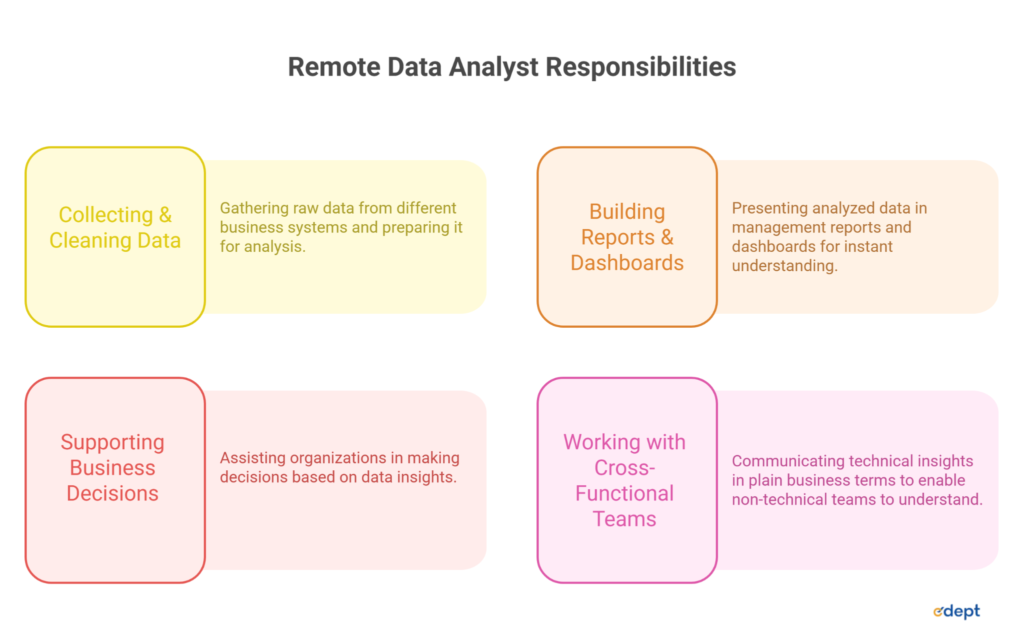
Collecting & Cleaning Data
One of the most important responsibilities of a remote data analyst is gathering raw data from different business systems and preparing it for analysis. It involves eliminating duplicate data, correcting incomplete data, arranging data sets, and ensuring the accuracy of data prior to reporting. Businesses value data cleaning skills as the quality of data can have a direct impact on making business decisions.
Typically, this process is performed by most analysts through SQL, Excel, Python, and cloud databases. In sectors such as fintech and healthcare, data cleansing becomes more significant due to the potential impact of erroneous reports on financial transactions or customer information.
Building Reports & Dashboards
Once the data is analyzed, it is presented in management reports and dashboards for instant understanding by professionals. Common tools utilized for building interactive dashboards include Power BI, Tableau, Looker Studio, and Excel—all of which monitor KPIs, customer behavior, sales performance, and operational trends.
Different industries have different levels of complexity in their dashboards. SaaS companies tend to need product analytics dashboards that provide real-time data insights, while e-commerce businesses may prioritize customer acquisition and conversion reporting. Generally, dashboard-building analysts earn more than those who are not as skilled with visualization because it has a direct impact on strategic business decisions.
Supporting Business Decisions
Instead of making assumptions, remote data analysts assist organizations in making decisions based on data insights. Their findings have a bearing on various aspects of business like marketing strategy, price model, operational efficiency, customer retention, stock management, and revenue prediction. An e-commerce business could then leverage this data to determine the most popular products, for instance, while a fintech firm might use it to enhance fraud prevention protocols.
Working with Cross-Functional Teams
Communication with teams in marketing, finance, operations, sales, and product development is common among remote analysts. With remote collaboration, having good communication and project management is crucial. Technical insights need to be presented in plain business terms to enable the non-technical teams to understand and take action on the data. Analysts with technical skills and communication abilities are highly sought after as they are able to coordinate effectively with colleagues in other departments and time zones in remote working environments.
Types of Remote Data Analyst Jobs Available Globally
The size of the data analytics and cloud computing sphere is growing, and so is the use of remote data analytics, which is not restricted to a particular industry or sector. Data Analysts are becoming a hot commodity in the current job market, especially within specializations globally. Workforce Insights by LinkedIn indicates that, typically, analytics professionals who have domain-specific knowledge see 15-30% higher compensation than those who lack domain-specific knowledge. Let’s take a look at some of the prominent jobs of remote data analysts that are available in the reputed company across the globe.
Business Data Analyst
The main focus of a business data analyst revolves around improving organizational performance through strategic reporting. Key skills they should possess include knowing how to track KPIs, analyze customer retention metrics, and help leadership teams make important decisions. The average salary of a business data analyst ranges between $70,000 to $120,000 annually, considering their work experience, organization, and country they reside in.
Financial Data Analyst
A financial data analyst’s main specialization lies in analyzing future revenues through patterns, understanding the financial risks, and profitability forecasts. Big industries that are relevant to hiring a financial data analyst include banking and investment firms. The average salary of a financial data analyst falls around $90,000 to $140,000 annually, considering they are paid more in comparison to general analytical roles.
Marketing Data Analyst
The main work of a marketing data analyst is to help businesses measure campaign performance, customer engagement, and digital growth strategies. Organizations are actively looking for analysts who can actually work with Google Analytics and CRM platforms. The average salary of a remote marketing analyst earns between $65,000 and $115,000 annually, depending on work experience and organization.
Healthcare Data Analyst
A healthcare data analyst should be proficient in managing patient data, hospital operations, and insurance analytics. With the rise in digital healthcare systems and telemedicine platforms, healthcare analytics is becoming one of the fastest-growing remote analytics sectors globally. The average salary of a healthcare data analyst is between $75,000 and $125,000 annually, considering the organization and country.
Product Data Analyst
The daily work of a product data analyst revolves around working with software developers and product management teams. They are proficient in improving digital products using customer behavior insights. The average salary of a product data analyst is between $54,000 to $176,000 annually, depending on the sector they are working in, like SaaS companies or mobile application startups, alongside the working country. They are one of the highest-paid analytics professionals globally.
Freelance & Contract-Based Analytics Roles
Freelancing roles are also expanding at a high rate due to the rise of remote hiring and project-based work culture. Professionals, instead of going for traditional in-office profiles and working under a professional contract, can now work independently, having a flexible timeline and work-life balance, along with good pay. Beginner freelancers generally earn around $20-40 per hour, while experienced freelancing analysts charge $80-$150+ per hour, depending on the work and experience.
Industries Hiring Remote Data Analysts
Remote data analytics jobs are some of the fastest-growing career paths in the technology sphere across multiple industries and businesses. Reports from LinkedIn and Gartner say likewise, industries investing heavily in AI-driven decision-making and customer analytics are expecting to increase the hiring of analytics professionals between 2026 and 2030. The salary trends and demand, alongside the type of analytical work, do differ across different sectors and industries. SaaS companies prefer professionals who can prioritize customer retention and subscription analytics, while healthcare-based organizations rely heavily on operational and patient analytics. Having a good understanding of these differences will massively help the candidates who want to enter the remote data analytics sphere.
| Industry | Main Analytics Focus | Average Remote Salary | Hiring Demand |
| IT & SaaS | Product analytics | $85K – $140K | Very High |
| Banking and Fintech | Risk analysis and Fraud detection | $95K – $150K | Very High |
| E-Commerce and Retail | Customer behavior analytics | $75K – $125K | High |
| Healthcare & Insurance | Patient and operational analytics | $80K – $130K | Growing Rapidly |
| Consulting and Research | Business Intelligence Reporting | $70K – $120K | Stable |
IT and SaaS Companies
IT and SaaS based organizations are among the top recruiters hiring remote data analysts globally. They rely heavily on data-based insights to run their business growth and increase user engagement. Companies like HubSpot and Atlassian are among the top SaaS organizations that are continuously hiring analysts to optimize digital product performance and improve customer retention strategies. In comparison to other sectors, SaaS offers better demand and faster career growth alongside higher salaries for remote data analysts, especially those who are skilled in a relevant skillset like SQL, Power BI, and Tableau.
Banking and Fintech
When we talk about the highest-paying industries, banking and fintech stay at the top of the list. Financial institutions use analysts to analyze raw data and generate valuable insights that can be used for fraud detection, customer risk analysis, and transaction monitoring. Fintech companies are rapidly hiring remote data analysts who specialize in working on AI-driven reporting systems. Compared to e-commerce and consulting roles, fintech analytics jobs do require strong statistical and forecasting skills.
E-Commerce and Retail
One of the most important things that e-commerce companies must do is to understand how customers behave, enhance conversion rates, maximize advertising effort, and boost repeat purchases with the help of analytics. The remote analysts in this field collaborate with marketing and sales to monitor customer journeys and assess the impact of marketing campaigns. Retail analytics is more concerned with consumer behaviour and growth measurements as opposed to risk forecasting, unlike fintech analytics. Amazon, Shopify merchants, Walmart, and international D2C brands actively seek out analysts who can provide actionable insights on the customer by using either Google Analytics, SQL, or Power BI.
Healthcare and Insurance
Healthcare and insurance firms are quickly increasing their analytics teams, considering that systems that rely on data are vital to their operations and patient management. The analysts in this sector are involved in patient data reporting, analysis of insurance claims, operational forecasting, and analysis of healthcare performance metrics. Reporting accuracy, data privacy, and compliance are higher priorities in healthcare analytics than in retail or SaaS analytics. The rise in the use of telemedicine platforms, healthcare apps, and AI-powered healthcare systems has further fueled the demand for remote healthcare analysts worldwide.
Consulting and Market Research
Analytics helps consulting firms and market research organizations address business challenges, uncover market opportunities, and make better business decisions. In this field, analysts typically juggle several projects in different sectors, which can make consulting one of the most varied and versatile career paths in analytics, with remote work. Consulting may not always be the highest-paying position compared to fintech, but it offers a great opportunity to gain business intelligence, executive reporting, and cross-industry analytics experience. Analysts who build expertise in reporting automation and business forecasting often transition into senior strategy or analytics leadership roles later in their careers.
Skills Required to Get Remote Data Analyst Jobs
Considering organizations are looking for skilled remote analysts, which makes professionals need to be proficient in relevant skills like technical expertise and good analytical thinking. Also, since remote roles involve collaboration with diverse teams globally, having good communication skills becomes essential too to stand out as the best employee. Employers prioritize candidates who can actually manage the data insights while communicating them well with other teams and clients.
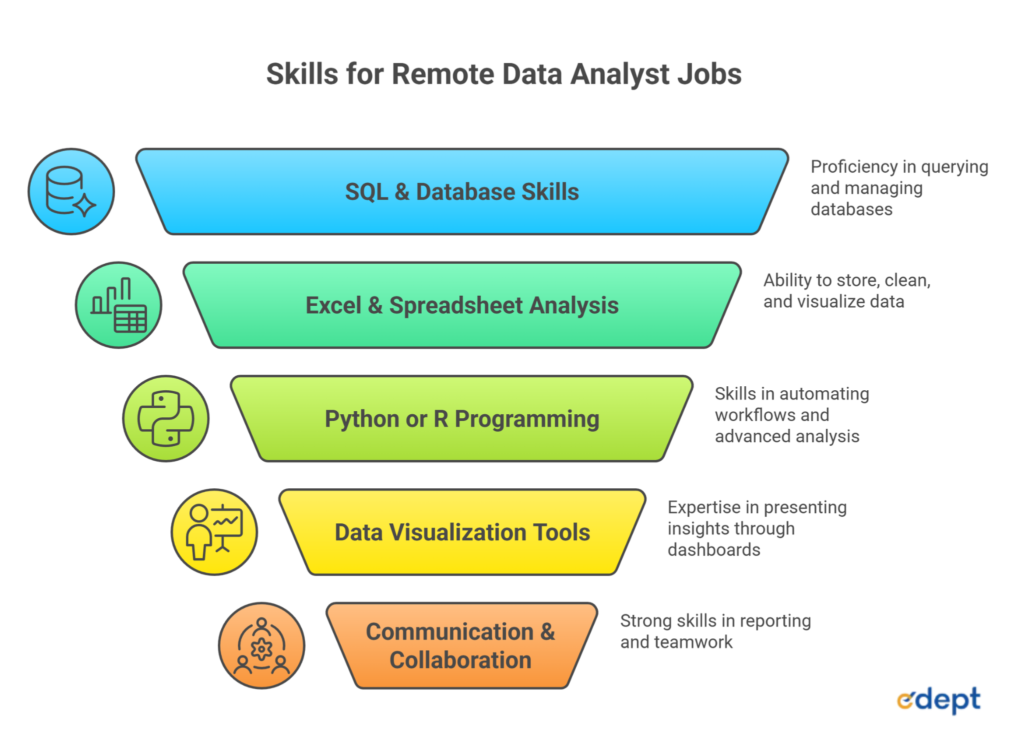
SQL & Database Skills
Considering all the key tech skills that a data analyst should master, SQL and the relevant database skill set top the list. SQL is one of the must-have skills to perform important operations like querying databases, extracting and filtering data, and performing data analysis tasks. Remote data analysts should possess strong SQL fundamentals, as businesses today store large amounts of data in relational databases.
Excel & Spreadsheet Analysis
Another must-have skill or tool for data analysts is Excel, and having a good idea to operate on spreadsheets. Excel is mainly used to store reports, calculations, and for quick analysis. Remote data analysts use spreadsheets for data cleaning and basic visualization. Employers highly value good Excel skills in an analytics career.
Python or R Programming
Alongside using SQL and Excel for analytical operations on numbers, in remote data analyst jobs, analysts benefit from having strong programming skills in their portfolio. Programming languages like Python and R are widely used to automate workflows and perform advanced analysis. Having good knowledge, specifically of Python, is vital, considering it is widely used for automation and machine learning, too, in modern data analytics.
Data Visualization Tools (Power BI/Tableau)
Data visualization tools are essential for data analysts to present their valuable insights generated from raw data through interactive dashboards. There are multiple data visualization tools available in the market, but these three top the list among the most widely used: Microsoft Power BI, Tableau, and Google Data Studio. Having good visualization skills ultimately helps the candidates to show off their decision-making skillset in front of employers, which is very much essential in remote data analyst jobs.
Communication & Remote Collaboration Skills
When we talk about remote work, professionals are bound to work with diverse teams and clients from around the world. If they lack strong collaboration and communication skills, it effectively reduces their chances of getting hired. Having relevant expertise in clear reporting and presentation, with team collaboration, are key skills that employers seek in remote data analyst jobs.
Certifications That Improve Remote Data Analyst Jobs Opportunities
To stay relevant in the global hiring market among other data analysts, you might get outplaced by another individual who has better skills than you. Recruiters also hire those professionals who can actually validate their mentioned skills instead of just filling out their resume. This is where certifications come into the picture, as it is becoming a filtering factor, especially for remote roles where companies focus more on what you can work on instead of just your theoretical knowledge. According to hiring trends from LinkedIn and Coursera, remote data analytics professionals who are actually certified with relevant certificates receive 15-30% higher interview selection rates in comparison to those who are not verified.
| Certification | Approx Cost | Best For | Skills Covered | Estimated Salary Impact |
| Google Data Analytics Certificate | $49/month (Coursera) | Beginners | SQL, Excel, Tableau, data cleaning | +10-15% |
| Microsoft Power BI PL-300 | ~$165 exam free | Dashboard and BI roles | Power BI, data modeling, DAX | +15-20% |
| IBM Data Anlyst Certification | $49/month | Python and SQL learners | Python, SQL, visualization | +10-18% |
| AWS Data Analytics Certification | ~$300 exam fee | Cloud analytics professionals | AWS analytics, cloud data systems | +20-30% |
Google Data Analytics Certificate
The Google data analytics certificate is one of the most popular analytics certifications, specifically for being beginner-friendly. Can be availed through Coursera, the program typically costs around $49 per month, with an average time of 4-6 months taken by learners to complete. Key skills that you can learn through this certification include SQL, working on spreadsheets, Tableau, data cleaning, and reporting. Candidates who are proficient in these key skills, alongside being certified, are qualified for entry-level analytics roles with an average salary of around $55K and $80K annually.
Microsoft Power BI Certification
Microsoft Power BI PL-300 certification is one of the most famous and valuable certifications available online for business intelligence and dashboard-focused analytics roles. The exam fee for this certification is generally around $165, making it relatively affordable in comparison to advanced enterprise certifications. Power BI is the key skill that you will master throughout the certification modules, going from basics to advanced topics like KPI reporting systems. In the data analytics industry, having a specialization in Power BI significantly increases salary potential by 15-20% globally for professionals.
IBM Data Analyst Certification
IBM Data Analyst Certification is well known for its diverse learning modules and technical exposure. Candidates who enrol in this certification are taught key skills like SQL, Python, Excel, and visualization tools. This program is available for around $49 per month, making it accessible for students and working professionals. IBM pays more attention towards practical analytics workflows and teaching programming fundamentals instead of just giving students theoretical knowledge. IBM also provides skill labs after completion of each module, providing students to test their skills and improve to master key skills.
AWS Data Analytics Certification
For anyone interested in cloud analytics and enterprise-scale data systems, the AWS Data Analytics Certification is one of the most beneficial certifications to pursue. Preparation cost is approximately $300, with an additional cost for the certification exam, depending on training materials and practice settings. AWS certification is more technical than beginner-level analytics certifications and is primarily geared towards those who are using cloud infrastructure, large data systems, and AI-powered analytics environments. Cloud analytics skills are well sought after across the world, and certified professionals often find themselves in a position to offer higher compensation from $110K to $150K and above per year, particularly in SaaS, fintech and enterprise technology companies.
Salary of Remote Data Analyst Jobs Globally
Data analyst job roles are known to have good pay across global markets, as companies are hiring internationally for remote analytics roles. The salary of a remote analyst depends entirely on the skills they possess and their experience. Also, the company hiring and the country they reside in also play a key role in deciding their salary range.
According to reports from LinkedIn Salary Insights (2025-26), remote analysts are paid strong compensation due to an increase in global demand.
Entry-Level Salary Range
The daily work of an entry-level remote data analyst involves working on dashboard creation, spreadsheet reporting, KPI tracking, and SQL querying. Recruiters prefer candidates with relevant certifications and portfolio projects over someone with just theoretical knowledge. The average salary of an entry-level analyst in countries like USA and Canada is around $55,000 and $85,000 annually, depending entirely on their expertise and the organization.
Mid-Level Salary Range
Mid-Level remote data analysts have experience working on analytics tools like SQL, Python, and Power BI. Their daily responsibilities involve working on automation workflows, predictive reporting, and stakeholder communication. Having a bigger skill set enables them to have a high-paying salary range, ranging from $85,000 to $120,000 annually.
Senior-Level Salary Range
Senior-Level data analysts and analytical managers are experienced professionals who have expertise in decision-making and advanced analytics projects. They are responsible for leading reporting systems, managing analytics teams, and supporting executive-level decision-making. Their salary range generally is between $140,000 and $200,000 annually, depending on years of experience, company, and expertise.
Freelance vs Full-Time Salary Comparison
Freelance remote analysts are the ones who are best in terms of flexibility in terms of work and salary. They follow a completely different earning structure in comparison to a full-time analyst. They usually charge hourly or project-based. Usually, they have higher short-term income, they salaries can fluctuate depending on client availability.
| Country | Entry-Level Salary | Mid-Level Salary | Senior-Level Salary |
| USA | $55K – $80K | $85K – $120K | $130K+ |
| Canada | CAD 55K – 75K | CAD 80K – 110K | CAD 120K+ |
| UK | £28K – £40K | £45K – £65K | £70K+ |
Best Countries Hiring Remote Data Analysts Jobs
Remote working options have opened the gates for data analysts to work globally with international companies from anywhere in the world. There are some big countries that are leading in hiring skilled professionals for remote data analyst jobs. They have leading tech hubs known for technology ecosystems, digital transformation, and data-driven decision-making. With major benefits running from strong job opportunities to high salary packages, these countries are perfect for you to work as a remote data analyst. For example, the United States offers the highest salaries globally in the data analytics field, while Canada offers better immigration pathways for a better work-life balance. Understanding these differences is very important before targeting remote jobs internationally.
| Country | Avg Remote Salary | Main Hiring Industries | Hiring Competition | Best For |
| United States | $90K-$150K+ | SaaS, AI, fintech | Very High | Highest salaries |
| Canada | CAD 75K-120K | Cloud, SaaS | Moderate | Stability and immigration |
| United Kingdom | £45K–£75K | Banking and Consulting | Moderate | European analytics market |
| Germany | €60K–€95K | Manufacturing and enterprise BI | Moderate | Industrial analytics |
| Singapore | SGD 70K-130K | Fintech, AI, BI | High | Asia-Pacific opportunities |
United States
USA tops the list when we talk about countries with advancements in digital transformation. They remain the largest market for remote data analyst jobs. Top reputed US firms hire remote analysts for multiple roles, like Fintech, AI, and cloud analytics. USA is known to offer the highest salary packages, making it the perfect option for remote data analysts. Companies like Amazon, Google, Meta, Microsoft, and Stripe do offer better salaries in comparison to global averages.
Canada
Canada is known to have a fast-growing tech ecosystem with various tech hubs in top Canadian cities like Toronto and Vancouver. With high demand and less supply for professionals, Canada is a perfect choice to target for remote data analyst jobs. Canada is also known to have a good work-life balance, making it the perfect country for data analyst aspirants. Canada is specifically attractive for professionals who are looking for long-term career stability and easier pathways to permanent residency.
United Kingdom
Apart from USA and Canada, in Europe, the United Kingdom is becoming a key hub for remote data analytics jobs. London remains a major global hub for fintech and business intelligence operations, creating strong demand for skilled remote analysts. Organizations here hire analysts for industries like Fintech, Consulting, and Financial Services.
Germany
Germany is rapidly growing to become one of the biggest hubs for digital transformation and technology growth. With increased demand for remote data analysts, businesses are rapidly hiring skilled professionals. Some key operations for which German companies hire data analysts include enterprise analytics and manufacturing intelligence.
Singapore
In the Asian subcontinent, Singapore is the leading technological hub for fintech firms. Companies in Singapore are hiring remote data analysts for both the regional and international projects. Though the competition is high, if you have a good skill set with specializations in AI-driven analytics and business intelligence, Singapore can be the best country for you. Singapore is particularly attractive for analysts aiming to work with international fintech firms and APAC-focused technology companies.
Read more: Best Countries to study data analytics
Best Platforms to Find Remote Data Analyst Jobs
The platform you are using plays a crucial role in finding high-paying remote data analyst positions. Various platforms target different types of employers, salary ranges, and experience levels. For instance, LinkedIn and Indeed are primarily geared towards full-time corporate recruiting, whereas Upwork and Toptal are better suited for freelance and contract-based analytics jobs. A lot of job seekers apply for jobs on random sites, unaware of the fact that premium jobs are available only at certain sites. In 2026, recruiters are more likely to leverage specialized remote hiring platforms and AI applicant screening tools, which means you need to find the right platform depending on your career objectives, portfolio, and experience.
| Platform | Type of Roles | Average Salary/Earnings | Best For |
| LinkedIn Jobs | Full-time remote analytics roles | $80k – $15k/year | Experienced professionals |
| Indeed | Entry to mid-level analytics jobs | $65K-$120K/year | High-volume applications |
| Upwork | Freelance analytics projects | $20-$120/hour | Freelancers and beginners |
| Toptal | Premium freelance consulting | $80-$200/hour | Senior specialists |
| We Work Remotely | Startups and SaaS remote jobs | $70K-$130K/year | Global remote roles |
| Remote OK | International remote tech jobs | $75K-$140k/year | Remote-first companies |
LinkedIn Jobs
LinkedIn is considered the largest platform when we talk about job portals specifically for remote data analyst jobs. The majority of recruiters actively use LinkedIn to hire candidates by looking through their LinkedIn profiles. Recruiters from top companies like Amazon, Deloitte, Stripe, and Accenture frequently use LinkedIn to hire candidates across different analyst roles. By having an optimized profile showcasing your certifications and projects, candidates can get hired through LinkedIn while having a salary of around $80K to $150K annually.
Indeed
Another famous job portal after LinkedIn is Indeed. It is known to have a large number of recruiter spheres with thousands of remote analytics listings across industries. Many startups use Indeed to hire candidates for remote data analytics jobs. Remote analysts applying through Indeed usually find salary ranges between $65K and $120K annually, depending entirely on their specialization and location.
Upwork and Freelancer
Apart from traditional in-office and remote workers in top organizations, for freelancers and contract-based analysts, Upwork and Freelancer are the best platforms to get clients. These portals are ideal for building experience and having a well-defined remote work portfolio. Beginner freelancers often start at rates around $20-$40 per hour, while those skilled in SQL, Power BI, Python, and cloud analytics can earn in the higher range of $ 80-$150+ per hour. Though freelancing is flexible, providing global exposure, income consistency is hard to achieve, considering it depends entirely on client acquisition and portfolio strength.
Remote Job Boards
Remote job sites are solely designed to offer remote work opportunities among various multinational corporations. These job sites are different from conventional job sites in that they specifically concentrate on remote-first businesses and globally distributed teams.
Websites such as We Work Remotely, Remote OK, FlexJobs, and Remotive often advertise analytics and business intelligence positions among SaaS firms, start-ups, AI companies, and cloud tech companies. Compared to freelance websites, such positions often guarantee an annual salary that ranges from $70K to $140K per year.
How to Build a Strong Remote Data Analyst Portfolio
As a remote data analyst, a strong portfolio is your biggest asset for showcasing your skills and projects alongside certifications. Reputed employers give priority to the work you show on your resume instead of just degrees and theoretical learning. Your portfolio should show that you have the ability to analyze data and solve crucial business problems, as these are key aspects recruiters look for when hiring analysts.
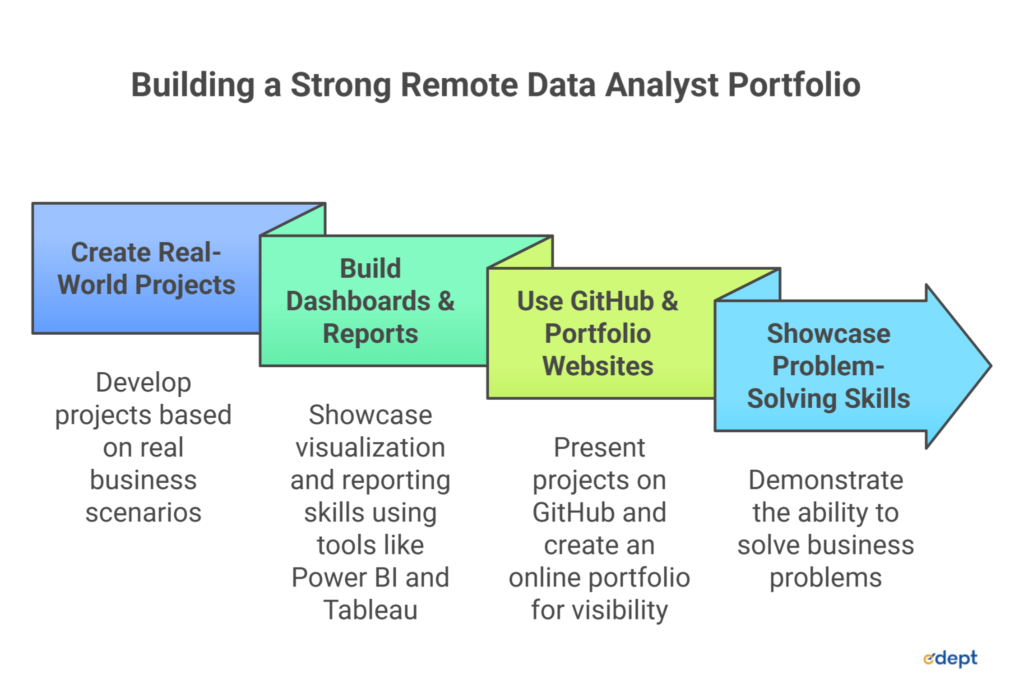
Create Real-World Projects
Your projects should show that you can work on real business scenarios instead of just academic assignments. Hands-on projects are key when it comes to standing out in the competition. Projects like Sales analysis dashboards and Marketing campaign performance reports are some go-to options for data analyst candidates.
Build Dashboards & Reports
Data analysts are known to master the creation of interactive dashboards, and showcasing them shows your visualization and reporting skills. Some famous tools to create dashboards and reports include Power BI and Tableau. Try to create clean and easy-to-understand dashboards with actionable insights.
Use GitHub & Portfolio Websites
Alongside portfolios and dashboards, recruiters also look for your GitHub profile, where you can show off your uploaded projects to professionally present your work. A well-organized online portfolio, on the other hand, improves your recruiter visibility.
Showcase Problem-Solving Skills
Employers value analysts who can solve business problems, not just create charts. You should showcase your problem-solving skills, as it is the most important asset a data analyst must possess.
Challenges in Remote Data Analyst Careers
Remote career options in data analytics come with many benefits, like having flexibility and getting a chance to work with global clients. But not everything is white and black; there is a grey area, which you should learn, like certain challenges to manage effectively. Having a successful career in remote data analytics roles requires more than just technical expertise. Companies seek a candidate with good communication, discipline, and adaptability.
High Competition
Remote data analytics jobs sound great cause of all the benefits it brings on the table. Remote options let companies hire employees from throughout the world based on their skills. Now, standing out in these long queues to even get a chance to be interviewed is tough, especially for remote roles.
Time Zone Differences
Remote analysts get the opportunity to work with foreign clients and under diverse teams. This may cause time zone differences, which create uneven time differences, causing hampered work-life balance. Remote analysts must learn how to manage time well beforehand while being productive.
Self-Discipline & Productivity
When working in the office, you work in a work-driven environment, which gives you no time for slack and helps you meet your deadlines. Now, when you work remote at comfort of your home, chances are some days you will feel off and can get used to pushing the deadlines, wasting time watching movies or anything else other than work. A successful remote data analyst must have self-discipline to complete their work during office hours, as this productivity will help them advance through the promotion ladder.
Why Skill-Based Learning Matters More Than Degrees
Traditionally, recruiters used to hire candidates based on the degrees they possess. Those with tech degrees were always ahead in comparison to professionals with a non-tech background entering the field of data analytics. As the remote working culture came into the picture, recruiters have shifted towards recruiting professionals based on the skills they possess through certifications and the hands-on projects they have in their portfolio.
Employers Prioritize Practical Skills
Recruiters in top companies hire professionals who have expertise in practical skills and tools like SQL, Python, and Excel. For employers, the skills you have under your belt matter more than your academic qualifications.
Portfolio > Resume in Many Remote Roles
Recruiters know there are many candidates who mention a good number of skills in their resume, but when hired, they fail to show off the same in the job. This is the reason they now check the portfolio of the candidates, as a strong portfolio has more impact than a traditional resume. Through a portfolio, you can show off your hands-on projects, dashboards, and certifications, which become essential for recruiters to shortlist candidates.
Certification Increases Credibility
Certifications are key when recruiters look to validate the skills you mention on your resume. Through certifications, a recruiter knows that the candidate can actually work with them in their daily operations since day one. Some popular data analytics certifications include the Google Data Analytics Certificate and the AWS Data Analytics Certificate.
Why Choose Edept for Data Analytics Career Preparation
Students who are starting their career in data analytics and working professionals shifting their career from non-tech to the data analytics industry, building a strong remote data analytics career requires more than just theoretical knowledge. The data analytics program at Edept focuses on this key aspect of helping you start your career in data analytics and get hired. Our career-focused programs help you become job-ready for global analytics opportunities. Edept’s data analytics programs are designed around current industry hiring trends and global remote job requirements.
| Edept Training Focus | Industry Relevance | Career Impact |
| SQL, Excel, Power BI, and Python | Core hiring skills for analytics jobs | Strong interview selection chances |
| Hands-on Projects | Real business case studies | Better Portfolio Strength |
| Resume & LinkedIn Oprtimization | Reruiter-focused branding | Higher visibility to employers |
| Mock Interviews & Placement Support | Hiring preparation | Improved placement readiness |
| Remote Workflow Training | Global remote job environment | Better remote work adaptability |
Industry-Aligned Curriculum
Programs at edept are designed by industry experts to provide students with a structured guide to have a smooth career pathway in remote data analytics roles. Students are taught industry-aligned skills and tools relevant to current trends, keeping them ahead in the competition for remote data analyst jobs.
Hands-On Analytics Projects
Having practical experience is key to showing recruiters and stand ahead in the long queues of submitted resumes. Hands-on analytics projects help recruiters identify that a candidate can actually work on real-world projects rather than just having theoretical knowledge.
Placement & Career Guidance
There are many programs that just focus on theoretical learning, but fail to provide support for key placement aspects. We at edept help students in resume building and interview preparation with career guidance for analytics roles. This helps students prepare for both domestic and international jobs. Career support is essential for students to transition more effectively in the job market.
Focus on Global Readiness
Technical skills, communication skills, and problem-solving capabilities are emphasized to prepare students for remote and global analytics careers.
The course is centered on the tools and workflows that are in use in international companies and distributed teams.
Step-by-Step Plan to Get a Remote Data Analyst Jobs
To become a remote data analyst, having a structured roadmap with a step-by-step plan will help you get your first remote data analytics job. With the rise in competition for remote roles, it becomes crucial to have a smart plan to stand out in the competition.
Step 1: Learn Core Analytics Skills
Start by learning core analytical skills like SQL and Excel. Focus on learning programming languages like Python to enhance your resume. Also, having a good understanding of visualization tools like Power BI and Tableau will help you create a strong base.
Step 2: Build Portfolio Projects
After building a strong base by mastering core skills, building industry-relevant projects is key to showing off your skill set. Create a hands-on project that aligns with current industry trends like Sales dashboards and Financial forecasting models, and upload it to GitHub and your portfolio website so recruiters can access it and hire you.
Step 3: Gain Certifications
Certifications are the core must-have amenities when applying for remote data analytics roles. Go for popular certifications like the Google Data Analytics Certificate and the AWS Data Analytics Certification.
Step 4: Optimize LinkedIn & Resume
Your LinkedIn profile and resume should highlight all the skills you possess and the projects you have worked on. It should have all your qualifications and certifications mentioned specifically that are relevant to data analytics roles.
Step 5: Apply to Remote Job Platforms
After having a good skills base, having created good industry-relevant projects and a portfolio, and optimizing LinkedIn and Resume, now apply for jobs through job portals. Remember, competition is high, so apply for large chunks of job openings. Dedication and self-discipline are key when applying for remote data analytics roles.
Future Scope of Remote Data Analytics Careers (2026-2030)
The future of data analytics looks bright, considering the advancements in analytics tools and skill sets. Between 2026 and 2030, remote analytics roles are bound to bloom on the global stage with the increasing number of data-driven operations. Organizations today are heavily investing in analytics and the cloud computing industry, creating a long-term demand for data analysts.
Expansion of Global Remote Hiring
With the expanding sphere of data analysis, organizations are building diverse teams consisting of professionals from around the world. Going remote is becoming a long-term strategy for many businesses across sectors like tech, finance, and healthcare. Global remote hiring creates more opportunities for data analysts to work with international clients; on the other hand, making organizations have a bigger pool of professionals to hire from.
AI-driven Analytics Growth
Growth in AI and machine learning is another factor that decides the overall future scope of remote data analytics jobs. Use of AI-powered analytics tools is increasing the demand for professionals who have expertise to actually work on them and create valuable insights using dashboards and manage AI-driven analytics systems.
Increase in Freeland Analytics Opportunities
Bloom in freelance work is evident across sectors, and data analytics is not lagging behind in that. Freelancing and contract-based analytics work have grown rapidly in the past few years, making companies hire specialists for short-term projects. Freelancers use various platforms like Upwork and Toptal to connect with relevant clients and get projects to work on.
Conclusion
The digital sphere changes with technological advancements happening every few months. With tonnes of raw data available to analyze, remote data analyst jobs are becoming one of the most in-demand roles globally. Organizations are shifting towards using a remote model to hire candidates outside of their hiring circle, which in turn is giving the candidates opportunities to work on international projects with diverse teams.
Certifications are another key factor when employers want to validate your skills. Having a strong portfolio is important to stand out from others. For students and working professionals willing to transform their careers continuously, remote data analytics is the perfect option, offering great salary options and flexibility to work with international clients.
Related Links:
| Data Analytics as a career choice for Arts and Commerce Students | Top 10 data analytics tools for Beginners |
| Data Science Courses after 12th and Graduation | Data analytics courses: A complete Guide |