Data privacy laws in India 2025 define how personal data is collected, processed, stored, and protected, outlining individual rights and organizational responsibilities under the DPDP framework.
Data privacy laws in India in 2026 are no longer abstract legal concepts. They directly affect how students learn, how professionals work, and how organizations operate. Every digital interaction now leaves a data trail, including admissions forms, online exams, internships, job portals, workplace tools, and cloud platforms.
India has over 900 million active internet users in 2026. Students and young professionals form the largest share. At the same time, reported data breaches in India have grown by over 35% year-on-year since 2023. Most incidents do not begin with hackers. They begin with simple mistakes, weak passwords, oversharing, unsecured devices, and unclear consent.
This is why understanding data privacy laws in India in 2026 is no longer optional. It is a survival skill in a digital economy. It protects individuals. It protects careers. It protects organizations from irreversible damage.
Start Your Data Analytics Journey with edept – Explore Courses Now
What Data Privacy Laws in India Mean?
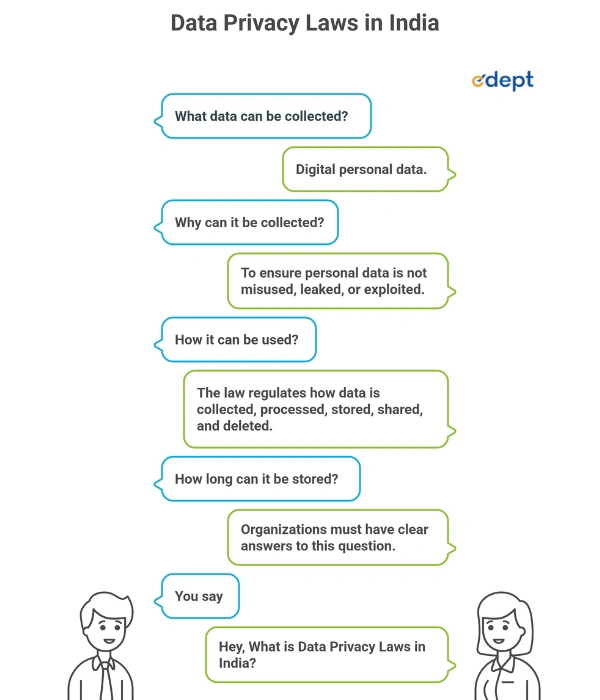
Data privacy laws in India in 2026 regulate how digital personal data is collected, processed, stored, shared, and deleted. These laws are designed to ensure that personal data is not misused, leaked, or exploited.
In simple terms, the law answers five basic questions:
- What data can be collected
- Why can it be collected
- How it can be used
- How long can it be stored
- How must it be protected
Any organization or individual handling personal data must have clear answers to these questions. If not, they are already at risk of non-compliance.
More details on B.Tech in Business Analytics & Computer Science by Rishihood University. Check Now!
Why Students Are Directly Affected By Data Privacy Laws?
Students often assume privacy laws apply only after employment. That assumption is wrong. Students share sensitive personal data constantly:
- Identity documents
- Contact details
- Academic records
- Health information
- Financial data
This data is shared with:
- Colleges and universities
- Edtech platforms
- Scholarship portals
- Internship platforms
- Placement cells
In 2026, educational institutions are legally required to justify data collection, limit access, and protect student data. At the same time, students are expected to understand their rights and act responsibly. Blind consent is no longer safe.
The Core Idea Behind India’s Data Privacy Framework
India’s data privacy laws in 2026 are built on a simple principle:
Personal data belongs to the individual, not the organization collecting it.
Organizations are custodians, not owners.
This shifts power back to users and places responsibility on institutions, employers, startups, and professionals who handle data.
Consent: The Most Misunderstood Concept
Consent is the foundation of data privacy laws in India in 2026. Yet, it is also the most misunderstood.
Consent must be:
- Clear and specific
- Given after understanding the purpose
- Limited to what is necessary
- Easy to withdraw
What consent is NOT:
- Long, unreadable terms
- Pre-ticked checkboxes
- Forced agreement to access basic services
Students often give consent without reading. Early professionals often assume consent is already handled by the company. Both assumptions are risky. If you do not understand why your data is being collected, consent is invalid in spirit, even if legally recorded.
Build Job-Ready Data Skills and Become Data Analyst – Get Personalized Course Recommendations
Rights Every Individual Has in 2026
Under data privacy laws in India in 2026, individuals are legally empowered.
Every data principal has the right to:
- Know what personal data is collected
- Request correction of incorrect data
- Withdraw consent at any time
- Ask for deletion when data is no longer required
These rights apply across sectors:
- Education
- Employment
- Healthcare
- Finance
- Digital platforms
Awareness of these rights helps individuals protect themselves from misuse and manipulation.
Early Professionals and Hidden Responsibility
Many early professionals handle data without realizing the risk.
Examples include:
- Downloading customer spreadsheets
- Sharing internal files on messaging apps
- Using personal laptops for office work
- Storing data on personal cloud accounts
In India, studies show that over 60% of workplace data breaches involve entry-level or junior employees, usually due to lack of awareness, not malicious intent.
In 2026, ignorance is not a defense. Responsibility begins on the first day of work.
Data Privacy in Internships and Entry-Level Roles
Interns and freshers often receive broad access to systems. This is done for learning purposes, but it increases exposure.
Common mistakes include:
- Oversharing access links
- Using weak passwords
- Leaving systems logged in
- Copying data for convenience
Data privacy laws in India in 2026 require organizations to train even temporary staff. At the same time, individuals must follow internal data handling policies strictly.
One careless action can cause a serious breach.
Penalties and Consequences Are Real
Data privacy violations carry real consequences.
For organizations:
- Heavy financial penalties
- Regulatory scrutiny
- Loss of customer trust
- Long-term reputational damage
For professionals:
- Disciplinary action
- Loss of credibility
- Career stagnation
- Legal implications in severe cases
In regulated industries like healthcare, fintech, analytics, and IT, even minor violations are taken seriously.
Data Privacy in the Education Ecosystem
Educational institutions hold some of the most sensitive data. Academic history. Identification records. Health information. Attendance logs.
Data privacy laws in India in 2026 require institutions to:
- Collect only necessary data
- Restrict access to authorized staff
- Define retention timelines
- Secure digital storage systems
Students should be aware of how their data is stored and who has access. Transparency is now a legal requirement, not a courtesy.
Why Data Privacy Is a Career Skill in 2026
Data privacy awareness is now part of professional competence.
Employers expect entry-level professionals to:
- Understand basic privacy principles
- Follow data handling protocols
- Recognize risks
- Report issues early
This is especially critical in careers related to:
- Data analytics
- Cybersecurity
- Management
- Healthcare
- IT and cloud operations
Candidates who understand data privacy laws in India in 2026 stand out in interviews and workplace evaluations.
The Link Between Cybersecurity and Data Privacy
Data privacy cannot exist without cybersecurity.
Most privacy violations happen due to:
- Weak passwords
- Unsecured devices
- Phishing attacks
- Poor access control
That is why organizations now assess cybersecurity awareness alongside privacy understanding. Both are interconnected. A secure system protects privacy. A careless user destroys it.
Read Latest Blogs,
| Data Analytics Course Syllabus 2025 | What is Data Analytics? |
| How to Learn Data Analytics? | What Does a Data Analyst Do? |
Practical Habits Students and Professionals Must Build
Good data habits are simple but powerful. Essential practices include:
- Reading privacy notices before agreeing
- Limiting app permissions
- Using strong, unique passwords
- Avoiding public Wi-Fi for sensitive work
- Separating personal and professional data
These habits align personal behavior with legal expectations.
Why India Strengthened Data Privacy Laws
India’s digital economy is growing rapidly. Digital payments. Online education. Health tech. AI-driven services. With growth comes risk:
- Data misuse
- Identity theft
- Surveillance concerns
Data privacy laws in India in 2026 aim to ensure that innovation does not come at the cost of individual rights. Trust is the foundation of digital growth.
The Bigger Picture for Students and Young Professionals
Understanding data privacy laws early builds long-term resilience. It helps individuals:
- Protect their personal information
- Avoid legal trouble
- Build professional credibility
- Adapt to regulated work environments
In 2026, privacy awareness is not a niche skill. It is basic literacy.
Learning Data Privacy the Right Way with edept
edept integrates data privacy laws in India in 2026 into career-focused programs. Not as a theory. As practical knowledge. Students learn:
- How data is handled in real workplaces
- Where risks occur
- How to stay compliant
- How to think responsibly in digital roles
This prepares learners for real-world expectations, not just exams.
Final Thought
Data privacy laws in India in 2026 are about responsibility.
- Responsibility to users.
- Responsibility to organizations.
- Responsibility to your own career.
The earlier you understand them, the safer your future becomes.