Many students overlook critical prerequisites, entrance exam preparation, and application deadlines when applying to nursing courses, leading to rejected applications despite strong potential. Success requires early planning, healthcare experience, and a polished, error-free application that demonstrates both academic readiness and genuine commitment to patient care.
When we talk about the Indian healthcare industry or abroad, nursing courses are becoming one of the most in-demand career paths. According to reports from the World Health Organization (WHO), there is a projected shortage of over 10 million nurses worldwide by 2030. This trend justifies the growing need in the demand for trained nurses in India and globally.
However, students aspiring to be nurses make a rookie mistake by getting admission into nursing courses without having a clear picture of what comes after the course. From eligibility confusion to lack of awareness about career scope, these gaps can lead to poor decision-making, which, on the other hand, impacts long-term growth.
In this guide, we will talk about everything you need to know about admissions in nursing courses. We will see how applying for nursing courses is not just about meeting eligibility criteria, but it also involves understanding course types (ANM, GNM, BSc Nursing), required skills, costs, clinical exposure, and career opportunities.
Eligibility Criteria Confusion
This is the biggest mistake that students make: misunderstanding the eligibility criteria. This confusion can lead to applying to the wrong colleges or missing important opportunities.
Academic Requirements
The majority of nursing courses require candidates to have completed 10+2 with PCB(Physics, Chemistry, and Maths) as core subjects.
- Have a minimum mark between 40% to 50%, depending entirely on the course and institution.
- Government colleges have higher cut-offs
- Private institutions may also offer more flexibility
Entrance Exams vs Merit-Based Admission
Nursing course admissions generally are of two types: either entrance-based or merit-based.
- Some colleges require exams like NEET or state-level entrance tests
- Others have a direct admission process based on 12th marks
- Government colleges mostly follow an entrance-based system
Age and Medical Fitness Criteria
Age and Medical fitness requirements also fall in the key selection criteria.
- Having a minimum age of 17 years at the time of admission
- Some courses also have upper age limits
- A medical fitness certificate is mandatory
Lack of Understanding of Nursing Course Types
Many aspiring nursing students apply for courses without having a clear understanding of the different course types. Choosing the wrong course among ANM, GNM, or BSc Nursing can backfire, affecting your whole career growth, salary potential, and future opportunities.
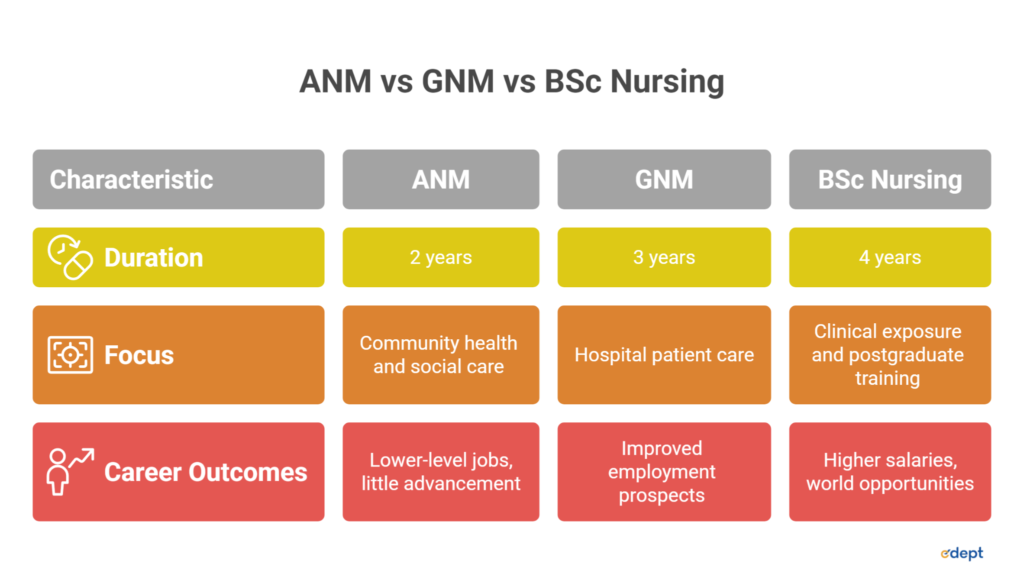
ANM vs GNM vs BSc Nursing
These three are the main courses when we talk about the nursing domain. Each of them offers different durations and career outcomes.
ANM (Auxiliary Nurse Midwifery):
Duration: 2 years
Provides foundational health and social care support to the community
Lower-level jobs that offer little advancement.
General Nursing and Midwifery (GNM):
Duration: 3 years
Provides nursing and patient care in a hospital setting
Improved employment prospects than ANM
B.Sc Nursing:
Duration: 4 years
Postgraduate training in excellent clinical exposure
Better opportunities for higher salaries and world opportunities.
Course Duration & Structure
Nursing courses are a mixture of both theory and practical training.
- Around 40-50% focus is on practical training
- It includes hospital postings and lab sessions
- Internships are also a part of most programs
Available Specializations
After basic nursing education or during higher studies, specialization comes into the picture.
Popular fields include:
- ICU and critical care
- Pediatric nursing
- Psychiatric nursing
- Oncology nursing
Ignoring Essential Skills Required
Many students have the idea that getting into nursing courses is enough, but the real success in this field entirely depends on the skills you master. Nursing is not just about academic learning, but it also requires a strong combination of clinical ability, communication, and emotional strength.
Technical/Clinical Skills
Nurses should be proficient in working on basic medical and clinical tasks.
- Patient care and monitoring
- Handling medical equipment
- Administering medication
- Maintaining accurate patient records
Soft Skills & Personality Traits
Apart from having good technical knowledge, nurses should be proficient in soft skills too.
- Clear communication with patients and doctors
- Teamwork and coordination in the hospital
- Attention to detail and responsibility
Emotional Readiness
Emotions are tough to handle in the nursing sector when there is an emergency case at hand. Students must be prepared to:
- Handle critical and emergency situations
- Deal with patient suffering and loss
- Work under pressure in real hospital environments
Read more: Key Skills Required to Become a Successful Nurse
Overlooking Cost & Financial Planning
Students often enrol in courses without being aware of the complete cost of their education and may have a financial burden later on. By earlier planning, you get to choose a college, and you will not have to wait for a surprise bill.
Tuition Fee Variations
The fee for nursing courses also differs among different institutions.
- Government colleges: ₹10,000 – ₹50,000 per year (approx.)
- Government colleges: ₹15,000 – ₹3 lakh per year
- Adherence to the budget constraint: Government colleges are cheaper, but very competitive
Additional Expenses
In addition to tuition costs, there are several hidden costs:
- Hostel and accommodation
- Uniforms and books
- The clinical tools and study materials are excellent.
- Tuition + Living Expenses + Academic Expenses = Total cost
Scholarships & Financial Aid Options
A student may lower the financial burden of his/her education by:
- Government scholarships
- Merit-based financial aid
- Study loans / EMI facility
Not Checking College Accreditation & Recognition
College accreditation and recognition are two of the most important, yet unnoticed, points when it comes to choosing nursing courses. Attending a non-accredited school can directly affect your career and job prospects.
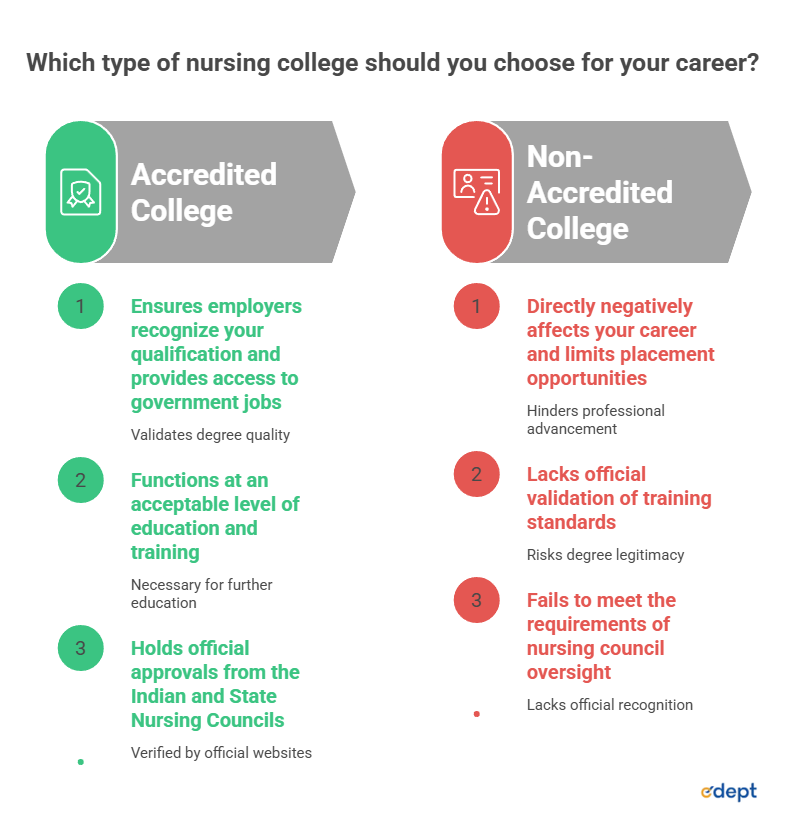
Importance of Accreditation
Accreditation is a way of assuring that the college functions at a level that is acceptable in terms of education and training.
- Validates the quality of your degree
- Ensures employers will recognize your qualification
- Necessary for further education
Affiliation with Nursing Councils
A good nursing college should be recognised by:
- The Indian Nursing Council (INC) was formed in 1956
- State Nursing Council
Students should always verify their approvals on official websites before applying.
Impact on Career Opportunities
College recognition directly affects:
- Placement opportunities
- Eligibility for government jobs
- Admission to higher education
Underestimating Clinical Training & Exposure
When applying for nursing courses, a lot of students just think of theoretical learning, and the strength of a nursing career is in the clinical training. It’s hard to feel confident in performing in a real hospital environment if you are not given enough hands-on experience.
Importance of Practical Learning
- Nursing is a very hands-on profession in which a considerable amount of the education is done in the clinic.
- The practical training is 50% or more of the course.
- Aids in the development of real patient-handling skills.
- Provides a connection from theoretical to practical applications
Hospital Tie-Ups
The quality of the training is dependent on the hospital college which is linked to.
- Multi-speciality hospitals offer more exposure
- Government hospitals give high interaction time to patients.
- Good partnership working = good learning opportunities
Internship Opportunities
Internships are a crucial part of nursing courses.
- Generally, a part of the last year
- May be paid or unpaid in accordance with the institution.
- Provide hands-on experience with real patients
Limited Awareness of Career Scope
Numerous students opt for the nursing courses, as they do so without knowing what career opportunities they will have after completing their courses. This ignorance can result in confusion and lost growth opportunities in the future.
Job Roles After Nursing
Once you have studied nursing courses, you can pursue a variety of healthcare careers:
- Staff Nurse
- ICU / Critical Care Nurse
- Community Health Officer
- Nursing Supervisor
There are opportunities in the government and private hospitals, clinics and health institutions.
Salary Expectations
The salary is dependent on qualifications and experience:
- Entry-level: ₹2.5 LPA – ₹4 LPA (India)
- Experienced professionals: ₹5 LPA – ₹8 LPA+
- Internationally, opportunities pay much more
Businesses with diverse skill sets offer higher salaries: Insight – Higher qualifications and experience, higher paying potential.
Global Career Opportunities
The nursing industry is one of the few industries that has an international demand.
- In countries such as Germany, UK, Canada and Australia, high demand occurs.
- Available chances via a licensing exam or migration program
- Improved wages and employment opportunities overseas.
- Enhanced earnings and career prospects overseas.
Ignoring Work Environment Realities
Students entering nursing programs don’t always understand or have a real understanding of the working environment of nursing. This difference between expectation and reality may cause stress and dissatisfaction at a later stage.
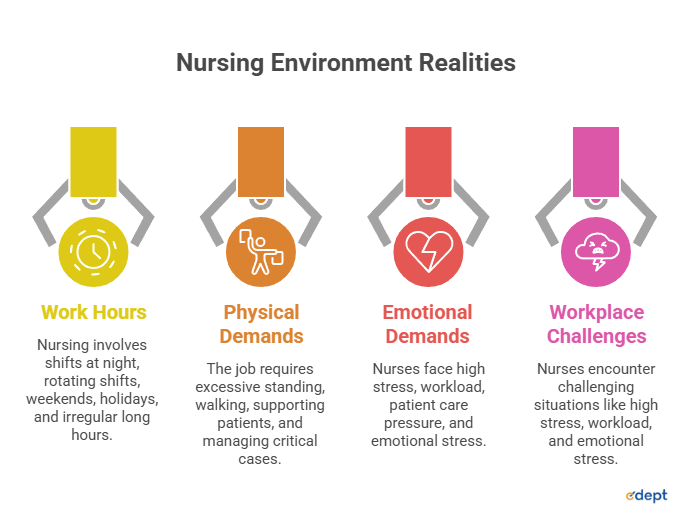
Work Hours and Shift System
Nursing doesn’t work in a 9-to-5 routine. It involves:
- Taking shifts at night or rotating shifts.
- The work hours during the weekends and holidays.
- Irregular work hours that last for long periods of time.
Physical & Emotional Demands
This job is physically and mentally challenging:
- Excessive time spent standing and walking.
- Supporting patients in their mobility
- Managing critical and emergency cases
Workplace Challenges
Nurses often face challenging situations such as:
- High stress and workload.
- Pressure of patient care, emotional stress
The duties, obligations and liabilities of the person who ensures that a patient is treated safely.
Missing Licensing & Certification Requirements
One of the crucial mistakes students make during their course tenure is that they focus more on completing the nursing courses but overlook the mandatory licensing and certification requirements needed to practice professionally. Without proper registration and certifications, you cannot legally work as a nurse, either in India or abroad.
National Registration Requirements
Once you have finished your training as a nurse, you need to register with the State Nursing Council.
- Submit academic documents and proof of internship
- Follow the registration procedure as outlined by the state.
- Get a license to become a Registered Nurse.
- Registration is compulsory to start your nursing career
International Licensing Exams
To work overseas, nurses have to pass country-specific exams, including:
- NCLEX (USA, Canada)
- CBT (Computer-Based Test) for UK
These exams involve preparation for clinical knowledge, language skills, and exam patterns. The following information is for those who wish to pursue careers in foreign countries. Global opportunities require extra certifications.
Continuous Certifications
Nursing is a profession where students are required to keep learning and upgrading their skills over time. If they slack off and stop from keeping themselves updated on new nursing methods, it will be tough to be employed after the course completion.
- Short-term certifications (ICU, emergency care, etc.)
- Advanced training programs
- Skill-based workshops
Continuous learning is very important as it improves career growth and salary potential.
No Long-Term Career Planning
There are many students who apply for nursing courses without considering what they’re going to do after the course completion. This includes a lack of long-term planning, which can restrict career advancement and income. There are several career paths available within the nursing profession, but you must have a clear path to take advantage of them.
Higher Education Options
After the completion of the course, many nursing students opt for higher education, ranging from:
- MSc Nursing for advanced clinical and academic roles
- Post-basic programs and advanced diplomas
Going for higher education opens new pathways for nursing candidates into senior roles with better salaries.
Specialization Pathways
Instead of going for higher studies like MSc degrees and post-basic programs, nursing students can go for specialization in a specific field, which will significantly boost their career.
- Specialization in critical care, oncology, pediatric, and psychiatric nursing
- Specialized roles offer higher responsibility and pay
- Demand varies based on healthcare trends
Alternative Career Options
Beyond roles in hospitals, nursing also offers other career paths. Some of them include:
- Teaching in nursing colleges
- Hospital administration
- Healthcare management
Nursing is not just limited to bedside care; it’s more than that, offering multiple career options for students.
Final Verdict: Taking the right steps paves the way for nursing students’ success
When going for admissions in nursing courses, it involves more than just meeting the eligibility requirements and securing admission. Most of the students overlook key factors like course selection, skills required, cost planning, accreditation, and long-term career scope. Ignoring these aspects will impact both your learning experience and future career growth.
The healthcare sector is a very demanding sector, with nursing being the most rewarding profession that requires the right combination of theoretical knowledge and practical skills. Making the right decision at the start of your career will help you avoid common mistakes later as you build the foundation of your nursing career.
The key is to take your time in researching the courses thoroughly, understanding the options, and choosing the right path before applying for nursing courses to ensure stable career growth.
Related Links: