Singapore has rapidly established itself as one of Asia’s most advanced digital economies, making it a data analytics hub and a major destination for students and professionals seeking global career opportunities. With strong government support, world-class technology infrastructure, and the presence of multinational companies, Singapore continues to invest heavily in artificial intelligence (AI), Big Data, cloud computing, and digital transformation.
As organizations generate massive volumes of data, the need for skilled analytics professionals has grown significantly. From finance and healthcare to logistics, e-commerce, and manufacturing, businesses increasingly rely on data-driven insights to improve decision-making, automate operations, and drive innovation. This has created a steady rise in data analytics jobs in Singapore, offering competitive salaries and long-term career growth. For international students, Singapore also provides several advantages, including globally recognized universities, an English-speaking environment, excellent networking opportunities, and proximity to major Asian markets. These factors make it an attractive destination for those planning to study analytics in Singapore and build a successful international career.
In this guide, we’ll explore why Singapore is becoming a leading Singapore data analytics hub, the industries driving demand, top universities, salaries, living costs, visa options, and the skills needed to build a successful analytics career in Singapore.
Singapore’s Rise as a Global Technology & Innovation Hub
Singapore has established itself as one of Asia’s leading technology destinations, making Singapore data analytics hub and one of the fastest-growing ecosystems for data professionals. Backed by government investment, world-class infrastructure, and a thriving business environment, the country attracts multinational corporations, startups, and skilled professionals from around the world. This combination of innovation and business growth has significantly increased the demand for data analytics talent.
Strong Digital Economy Growth
Singapore’s government has invested heavily in digital transformation through initiatives that encourage businesses to adopt cloud computing, artificial intelligence (AI), and advanced analytics. These programs have accelerated the country’s digital economy and created thousands of opportunities for professionals pursuing an analytics career in Singapore. Organizations increasingly rely on data-driven insights to improve decision-making, optimize operations, and deliver better customer experiences.
Presence of Global Tech Companies
Global technology leaders such as Google, Amazon, Microsoft, Meta, and Grab have established major regional offices in Singapore. Their presence fuels continuous hiring for data analysts, data engineers, business intelligence specialists, and AI professionals. As a result, data analytics jobs in Singapore continue to grow across both multinational corporations and innovative startups.
Smart Nation Initiative
Singapore’s Smart Nation initiative uses data to improve transportation, healthcare, public services, and urban planning. By integrating analytics into governance and infrastructure, the initiative further strengthens Singapore’s position as a global leader in data-driven innovation and reinforces its reputation as a premier Singapore data analytics hub.
Why Data Analytics Is Growing Rapidly in Singapore
Singapore has become one of the most technologically advanced economies in Asia, making Singapore data analytics hub that is growing very quickly. Due to an ever-growing amount of data and digitalization, there is an increasing need for experts in data analytics in all fields. There are plenty of opportunities for learning analytics in Singapore and getting a great job in the future.
Explosion of Business Data
There are tons of data generated by firms in areas such as customers, finances, operational issues, marketing, and so forth. Using data analytics, businesses turn this data into meaningful insights to make decisions, create better customer experiences, and drive business success. Thus, data analytics careers in Singapore are much sought after.
AI & Automation Adoption
AI and automation have changed the way firms conduct business. Firms apply analytics along with AI to enable them to do accurate forecasting, automate processes, find patterns, and even make business decisions in real time. Therefore, there has been growing adoption of AI that has reinforced Singapore’s standing as a top Singapore data analytics center.
Growth Across Multiple Industries
Data analysts are not only required in tech firms but across sectors like finance, health care, logistics, e-commerce, manufacturing, telecommunications, and many others that depend significantly on analytics to be competitive. Therefore, a career in data analytics is very lucrative and ranks highly among the best data analyst career options in Singapore.
Also read: AI vs Data Analytics
Industries Driving Data Analytics Demand in Singapore
The success of the Singapore data analytics hub is fueled by strong demand across multiple industries that rely on data to improve efficiency, reduce costs, and make informed business decisions. As digital transformation accelerates, these sectors continue to create new data analytics jobs in Singapore for skilled professionals.
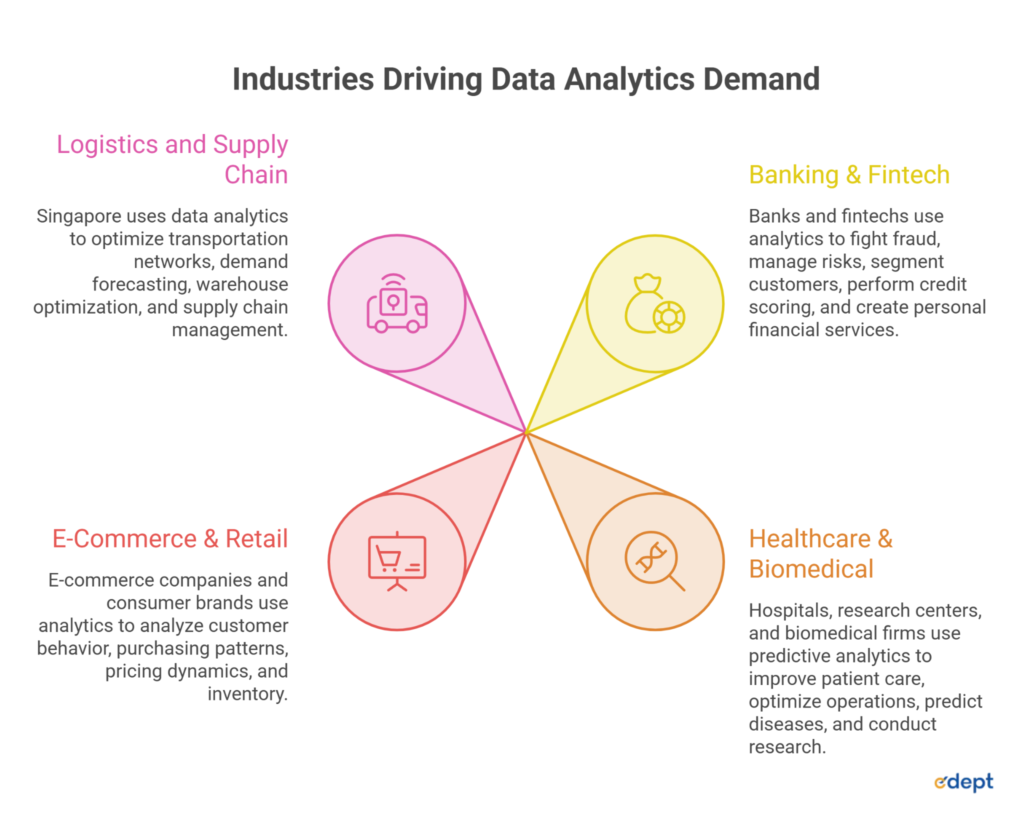
Banking & Fintech
Singapore is among the leading financial centers in Asia. In this case, banks and fintech are among the key employers of analysts. They apply analytics to fight fraud, manage risks, segment customers, perform credit scoring, and create personal financial services that will help them to improve customer experience and security.
Healthcare & Biomedical Sector
Hospitals, research centers, and biomedical firms take advantage of predictive analytics to improve patient care, optimize operations in hospitals, predict diseases and conduct research. The growing importance of data analysis within the healthcare sphere leads to an increase in the demand for analysts.
E-Commerce & Retail
E-commerce companies and consumer brands apply analytics to analyze customer behavior, purchasing patterns, and pricing dynamics, and to manage inventory to create personalized shopping experiences and improve their sales. In such a way, the demand for analytics positions in Singapore increases significantly.
Logistics and Supply Chain
As one of the busiest logistics centers in the world, Singapore uses data analytics to optimize transportation networks, demand forecasting, warehouse optimization, and supply chain management. Such development strengthens the position of Singapore as one of the leading Singapore data analytics hubs.
Why International Students Prefer Singapore for Analytics Career
Nowadays, Singapore has gained much popularity among students who choose to study in order to get an international education and develop a successful career as a data professional. This country has a well-developed technology sector, prestigious universities, and good employment possibilities, which makes Singapore a data analytics hub attractive for future analysts.
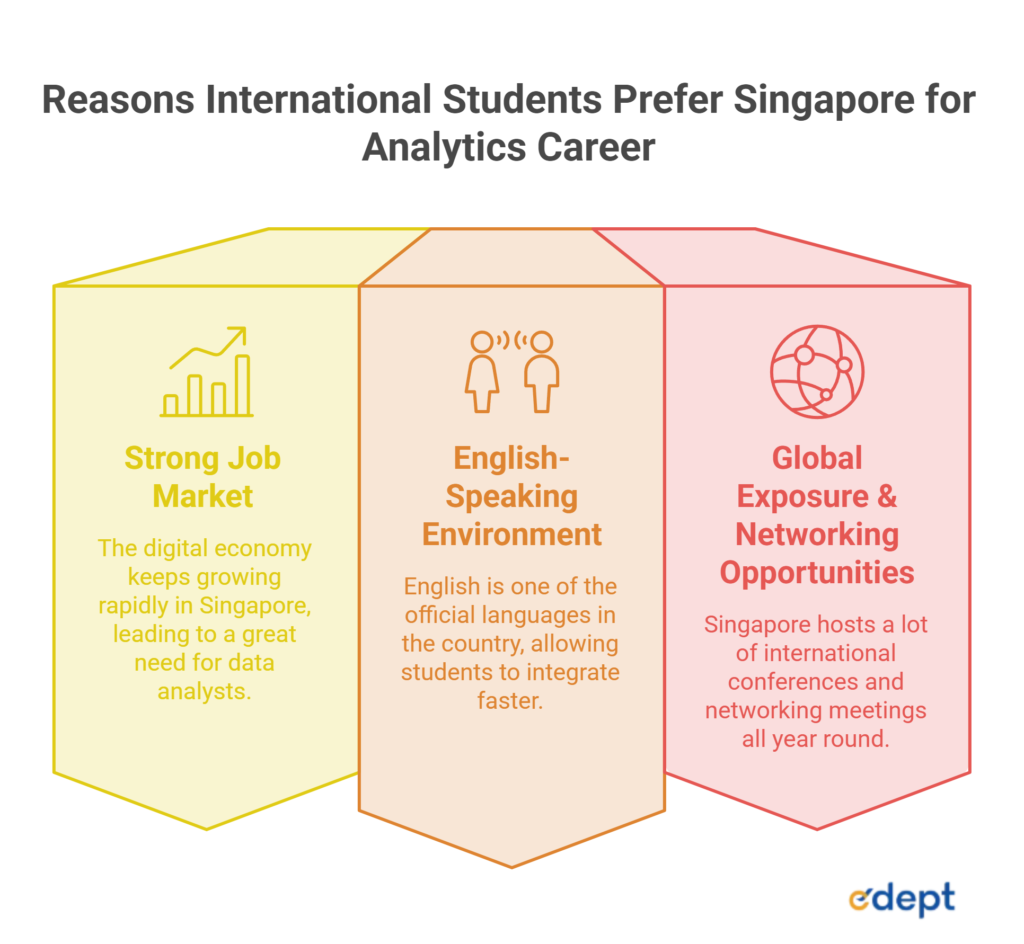
Strong Job Market
The digital economy keeps growing rapidly in Singapore, and it leads to a great need for data analysts working in sectors such as technology, finance, health care, logistics, and e-commerce. The presence of international companies and startups allows graduates to have different high-paying data analytics jobs in Singapore. English-Speaking Environment English is one of the official languages in the country and the main language in education and business. It allows students to integrate faster into new surroundings and not experience any problems related to communication.
Global Exposure & Networking Opportunities
Being a business center in Asia, Singapore hosts a lot of international conferences, technology, career fairs, and networking meetings all year round.
Best Universities & Institutes for Data Analytics in Singapore
Those who wish to pursue their studies in analytics in Singapore have various highly reputed universities and institutes to choose from. They have courses in analytics, data analytics, artificial intelligence, and business analytics, which make them suitable for aspiring students. With these institutions, one can easily succeed in their career in the Singapore data analytics center.
| University | Approx Annual Fees | Duration | Global Ranking | Main Intake |
| National University of Singapore | SGD 45-000 – 55,000 | 1-1.5 years | Top 10 Globally | August |
| Nanyang Technological University (NTU) | SGD 40,000–50,000 | 1 year | Top 20 Globally | August |
| Singapore Management University (SMU) | SGD 40,000–50,000 | 1 year | Top Business School | August/January |
| Private Institutes & Skill-Based Programs | SGD 15,000–35,000 | 8–18 months | Varies | Multiple Intakes |
National University of Singapore
NUS is one of Asia’s highest-ranked universities, offering advanced programs in data analytics, AI, and computing with strong research and industry collaborations.
Nanyang Technological University
NTU is renowned for its engineering and technology programs, providing students with practical exposure, innovation-driven learning, and excellent graduate employability.
Singapore Management University
SMU combines analytics with business strategy, preparing students for leadership roles in business intelligence, consulting, and digital transformation.
Private Institutes & Skills-Based Programs
The private institutions provide flexible industry-specific courses that focus on developing practical skills, certification, and readiness for employment. Some things you need to keep in mind when deciding on an institute for analytics in Singapore are the cost of education, curriculum, internship opportunities, industrial connections, and prospects for employment.
Data Analytics Course Fees in Singapore
Knowing about the cost of education is one of the essential parts of becoming an analytics student in Singapore. The cost of tuition depends on many factors such as the university itself, the time frame of the studies, and the kind of educational institution. Even though the city of Singapore is a costly place to study, the degree, good connections, and career opportunities make studying there worth the money.
Tuition Fees for International Students
International students normally incur costs ranging from SGD 15,000 to SGD 55,000 for taking part in data analytics programs. The cost of attending data analytics courses depends on various universities, with some of them, such as NUS, NTU, and SMU, charging high costs because of their prestige, research, and industrial affiliations.
Cost Differences Between Universities & Institutes
Most public universities have a research orientation in the education process and internationally accredited qualifications and industrial connections. Most private institutes and professional training institutions have career-oriented courses with flexible learning opportunities and affordable costs compared to those of public universities.
Scholarships & Financial Aid Options
Several universities in Singapore have scholarship and financial support programs for meritorious international students. If you are applying in advance, performing well academically and having leadership qualities or extracurricular activities can help you get financial support.
Cost of Living in Singapore for Students
Other than the tuition costs, the daily expenses incurred need to be considered for those intending to study analytics in Singapore. These depend on an individual’s lifestyle, place of residence, among others. In general, foreign students ought to have SGD 1,400-2,500 monthly during their studies in Singapore.
| Expense | Estimated Monthly Cost (SGD) |
| Accomodation | 700–1500 |
| Food | 300-500 |
| Transportation | 80-500 |
| Healthcare & Insurance | 50-150 |
| Miscellaneous Expenses | 200-300 |
| Estimated Total: | 1400-2500 |
Accommodation Costs
The biggest expense every month is accommodation. There are different options to select from, including university hostels, private hostels, or shared apartments, with prices ranging from SGD 700 and up to SGD 1,500 each month.
Transportation & Food Expenses
The cost of living in Singapore remains low due to an efficient public transport network where costs of transport amount to SGD 80-150 monthly. Food expenses for each student depend on cooking or eating out and amount to SGD 300-500 monthly.
Healthcare & Miscellaneous Costs
There are other miscellaneous expenses that international students need to take into consideration. They include health insurance, mobile phones, study materials, etc., which total between SGD 250 and SGD 450 each month.
Data Analytics Jobs in Singapore
There are many good job prospects for those who have skills in analytics in the Singapore data analytics hub. With more companies using data to make decisions, the number of opportunities is increasing in various sectors including technology, finance, health, retail, and logistics.
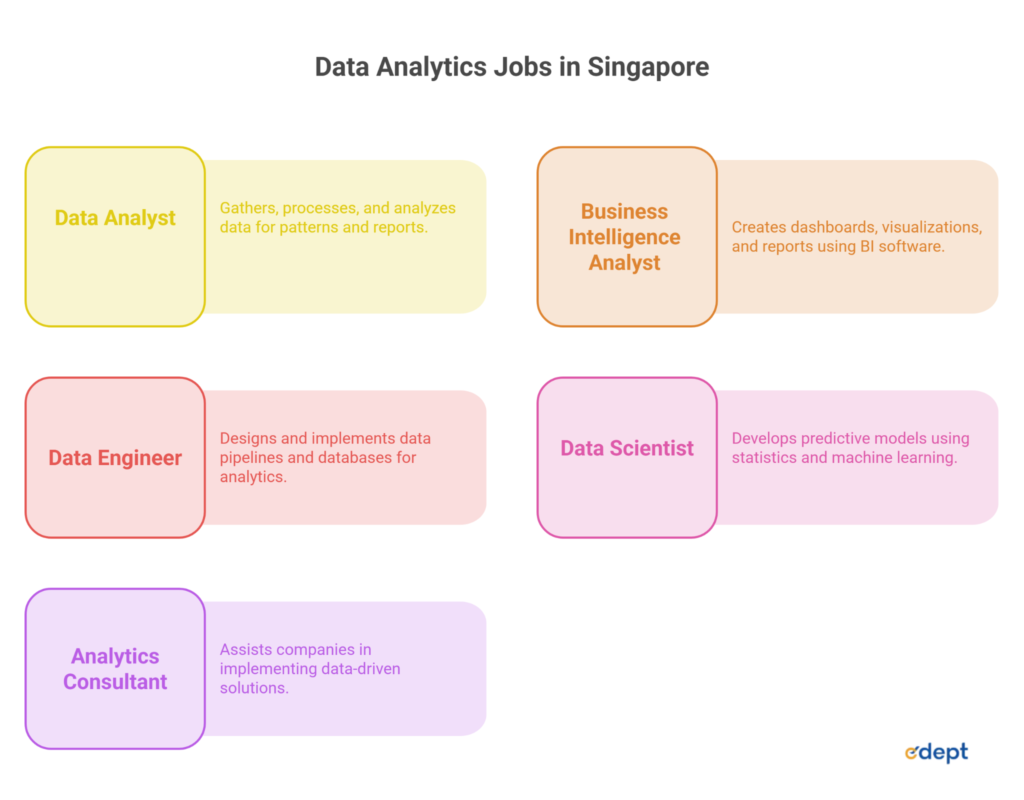
Data Analyst
A Data Analyst will gather, process, and analyze the data to recognize patterns and create reports. It is considered one of the most popular junior-level data analyst roles in Singapore.
Business Intelligence Analyst
Dashboards, Business Performance Visualization & Insightful Reporting are done by Business Intelligence (BI) Analysts with the help of Software like Power BI and Tableau.
Data Engineer
The Data Engineer designs and implements data pipelines and databases. They provide an organization with dependable, safe, and scalable data structures that enable analytics and artificial intelligence projects.
Data Scientist
Data Scientist develops predictive models using statistics, machine learning, and programming to uncover hidden patterns and solve business challenges. It’s one of the most rapidly growing jobs in the Singapore data analytics ecosystem.
Analytics Consultant
Analytics consultants assist companies in implementing data-driven solutions that optimize their business processes. Such professionals have been very sought after in many different companies, from consulting companies to multinationals and government agencies – thus, this is an extremely rewarding analytics job in Singapore.
Salary of Data Analytics Professionals in Singapore
Analytics Consultants assist businesses in implementing data-based strategies and improving their business operations using analytics. This skill is extremely in-demand by consulting firms, multinational companies, and even governments, thus making it an exciting career in analytics in Singapore that is likely to grow. Singapore is known for offering the most lucrative pay packages for data analysts in the region, as it is one of the best data analytics hubs in Singapore.
| Role | Entry-Level | Mid-Level | Senior-Level |
| Data Analyst | SGD 48,000-65,000 | SGD 70,000 – 95,000 | SGD 100,000–130,000+ |
| Business Intelligence Analyst | SGD 50,000–68,000 | SGD 75,000–100,000 | SGD 105,000–135,000+ |
| Data Engineer | SGD 60,000–80,000 | SGD 90,000–120,000 | SGD 130,000–170,000+ |
| Data Scientist | SGD 65,000–90,000 | SGD 100,000–140,000 | SGD 150,000–200,000+ |
| Analytics Consultant | SGD 55,000–75,000 | SGD 85,000–115,000 | SGD 120,000–160,000+ |
Entry-Level Salary
Fresh graduates entering data analytics jobs in Singapore typically earn between SGD 48,000 and SGD 70,000 annually, depending on their skills, employer, and qualifications.
Mid-Level Salary
Professionals with 3–5 years of experience can earn SGD 75,000–120,000 per year, particularly in finance, consulting, healthcare, and technology.
Senior-Level Salary
Experienced specialists and managers often earn SGD 120,000–200,000+ annually, especially in AI, data engineering, and leadership roles.
Comparison with Other Asian Countries
Compared with many Asian markets, Singapore generally offers higher salaries, stronger multinational exposure, and faster career growth, making it a preferred destination for professionals pursuing an analytics career in Singapore.
Skills Required for Data Analytics Jobs in Singapore
To succeed in the Singapore data analytics hub, professionals need a blend of technical expertise and business skills. Employers seek candidates who can analyze data, generate actionable insights, and communicate findings effectively across teams.
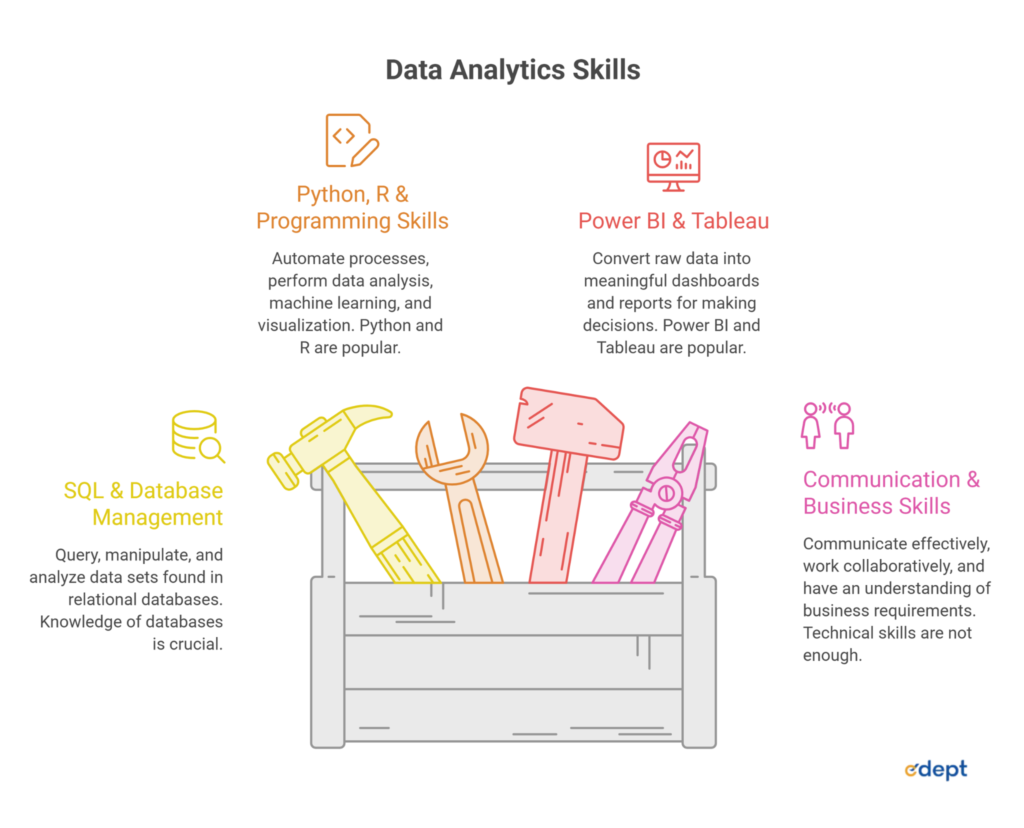
SQL & Database Management
This is one of the skills required in order to query, manipulate, and analyze data sets found in relational databases. Knowledge of databases is crucial for most data analytics positions in Singapore.
Python, R & Programming Skills
Python and R are two of the most popular programming languages for tasks such as process automation, data analysis, machine learning, and visualization.
Power BI & Tableau
Power BI and Tableau are some of the most popular visualization tools in Singapore. These enable analysts to convert raw data into meaningful dashboards and reports for making decisions.
Communication & Business Skills
Besides having technical skills, it is also important for you to be able to communicate effectively, work collaboratively, and have an understanding of the overall business requirements.
Why Skill-Based Learning Matters in Singapore’s Job Market
Singapore’s employers increasingly prioritize practical skills over academic qualifications alone. While a degree provides a strong foundation, hands-on experience and industry-relevant expertise play a crucial role in securing data analytics jobs in Singapore. Developing job-ready skills can significantly improve your chances of building a successful career in the Singapore data analytics hub.
Employers Prefer Practical Skills
The business world wants people who are able to handle actual problems by utilizing the data they have. Knowledge of tools like SQL, Python, Power BI, Tableau, and even cloud analytics is considered far more important than theoretical information on analytics.
Importance of Internships & Projects
Practical learning through internships and projects enables learners to apply classroom teachings in the actual world. Using actual data sets to build dashboards and handling actual case studies will enable you to build an impressive resume that will impress recruiters.
Industry Certifications Improve Employability
Professional certification from Microsoft, Google, AWS, Tableau, and any other respected professional provider of certifications proves that you have the skills needed and that you are committed to learning. This, when added to your practical experience, can help you have an advantage when seeking employment in data analytics in Singapore.
Visa & Work Opportunities in Singapore
Singapore offers a clear pathway for international students who wish to study analytics in Singapore and build a long-term career. Understanding the visa process and employment options can help students plan their education and transition smoothly into the workforce.
Student Pass Process
For international students studying in a full-time course at an approved educational institution, a Student Pass must be obtained prior to commencing their studies. The application process involves submitting the application online through an offer of admission and requires various documents like a valid passport, admission letter, proof of finances, and other documents as requested by the Immigration & Checkpoints Authority (ICA).
Work Rights for International Students
Those students who qualify as working students under the immigration rules and are pursuing their courses in approved institutions can engage in part-time jobs up to 16 hours weekly during the academic period without getting a work pass. During their holidays, they can work full-time and gain valuable experience for their career development.
Employability Pass for Analytical Professionals
Graduates who have secured employment with a Singapore-based company may qualify for an Employment Pass (EP). With the rapid growth of the Singapore data analytics hub, there are huge prospects for developing a successful career in Singapore within the domain of data analytics.
Challenges International Students May Face in Singapore
While the Singapore data analytics hub offers excellent education and career opportunities, international students should be prepared for a few challenges. Understanding these in advance can help you plan effectively and make the most of your study experience.
Competitive Job Market
Singapore is a hub for many skilled professionals across the globe. Therefore, competition in the job market is high. Students who have good technical skills, internships, industry certificates, and a good portfolio will find it easier to get jobs in data analytics in Singapore after graduating.
High Living Costs
The cost of living in Singapore is relatively high compared to other Asian nations. The cost of accommodation, food, transport, and other daily necessities can be expensive. Therefore, budgeting is an important aspect during your studies.
Employer Expectations for Skills & Experience
In Singapore, employers also prioritize experience along with formal education. Knowledge of SQL, Python, Power BI, Tableau, cloud computing platforms, and business communications skills, coupled with actual project work or internships, can help you increase your employability prospects. Students who regularly upgrade their skills and form professional connections will be able to make a mark in their analytics careers in Singapore.
Why Choose edept for Data Analytics Career Preparation
Success in the analytics hub of Singapore involves more than just gaining knowledge through studies. Potential employees need to have real experience, industry-oriented skills, and international exposure. The career-oriented courses offered at edept are intended to help learners acquire all the necessary qualities and knowledge to become successful professionals in the field of analytics.
Industry-Aligned Curriculum
The curriculum provided by edept is based on the latest trends and needs of the industry, such as Python Programming for Analytics, SQL & Databases, Data Visualization, Power BI, Tableau, Cloud Computing, Business Statistics, Machine Learning, and Business Analytics. It provides the knowledge needed to work in the global market of analytics.
Practical Analytics Training
Students gain practical experience through innovation projects, live industry assignments, internships, and project-based learning. This hands-on approach helps them build a strong portfolio and develop problem-solving skills that employers value.
Placement & Career Support
There is full career support at edept, which includes resume preparation, mock interviews, internships, industry mentorship, guest lectures, and collaboration with 300+ hiring partners. In addition, career counseling is provided to ensure that you can transition into an analytics career successfully.
Global Career-Oriented Programs
With a curriculum based on international standards, international project exposure, and a focus on skill development, edept helps you find success not only in Singapore but in any major technology hub of the world.
Step-by-Step Plan to Build a Data Analytics Career in Singapore
Building a successful career in the Singapore data analytics hub requires a structured approach that combines technical skills, practical experience, and professional networking. Following these steps can help you stand out in the competitive job market.
Step 1: Learn Core Analytics Skills
Build a solid foundation by acquiring knowledge in SQL, Python, Excel, statistics, and data visualization skills using tools like Power BI and Tableau. These skills will be useful in getting data analytics jobs in Singapore.
Step 2: Build Real Projects & Portfolio
Gain practical experience by working on various projects using business data and showcase them on your GitHub account or your own website. A good portfolio speaks volumes about your practical skills to recruiters.
Step 3: Gain Certifications
Acquire industry-recognized certifications through certification providers like Google, Microsoft, AWS, and Tableau. They add value to your resume.
Step 4: Apply for Universities or Jobs
Pick a good college or institute that fits your aspirations or directly apply for internships and entry-level data analytics positions if you have all the skills needed.
Step 5: Build Industry Network
Join technology conferences, university career fairs, and even LinkedIn networking sessions. Establishing professional relationships may lead you to success in data analytics careers in Singapore.
Future Scope of Data Analytics Careers in Singapore
The future of the Singapore data analytics hub looks exceptionally promising as businesses continue investing in artificial intelligence, cloud computing, and digital transformation. Between 2026 and 2030, analytics professionals are expected to play an even greater role in helping organizations make data-driven decisions and drive innovation.
AI & Big Data Expansion
Due to the growing adoption of artificial intelligence, machine learning, and Big Data technologies, there is an increasing requirement for people who can gather and make sense of large amounts of data. Every business operation is being infused with analytics for enhanced productivity and better customer experience.
Rising Demand for Analytics Professionals
Some of the industries like finance, healthcare, manufacturing, logistics, e-commerce, and cybersecurity are forecasted to be the main employers of skilled analysts. This will ensure job opportunities in data analytics in Singapore with good pay and promising careers.
Singapore’s Position as Asia’s Tech Hub
Thanks to continued investments by the government in innovations, state-of-the-art infrastructure, and the presence of many top global technology firms, Singapore is well poised to become one of the technology hubs in Asia. Future students who enroll in analytics in Singapore and hone their skills will have great careers in analytics in Singapore in the coming years.
Conclusion
Singapore has emerged as one of the most exciting places in Asia for young minds and professionals looking for lucrative careers in the field of analytics. With a dynamic digital economy, a supportive government, world-renowned educational institutions, and some of the best global technology firms present in the region, Singapore offers some of the best chances for analytics professionals. For those who wish to learn about analytics in Singapore or continue their career in the field, continuous education and practical experience would go a long way in making them more employable. Learning the correct set of business and technical skills could help one build an analytics career in Singapore.
Related Links:
| Artificial Intelligence vs Data Analytics | Skill-based vs Traditional Data Analytics Program |
| Complete Guide to Data Analytics Salary | Data Analytics Study Guide in Canada |